
Atlanta’s Wartime Newspapers
By Stephen Davis · Originally published April 2022 · pp. 6–9
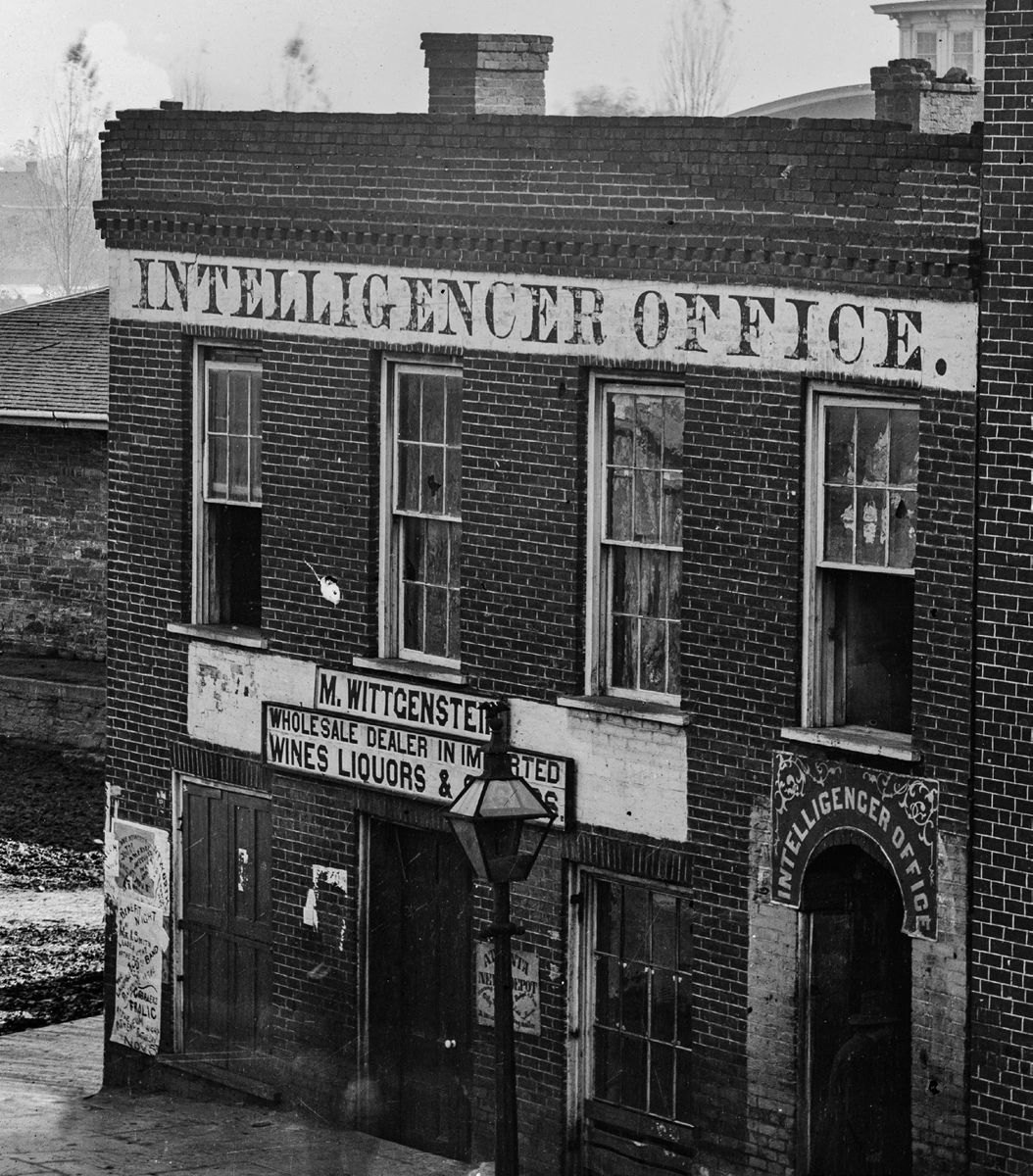
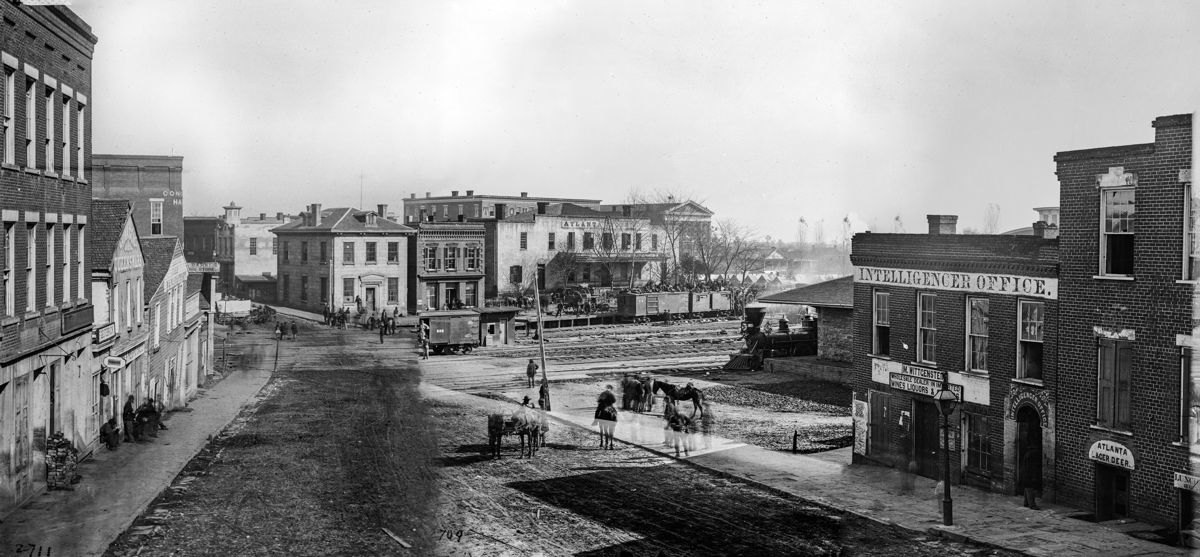
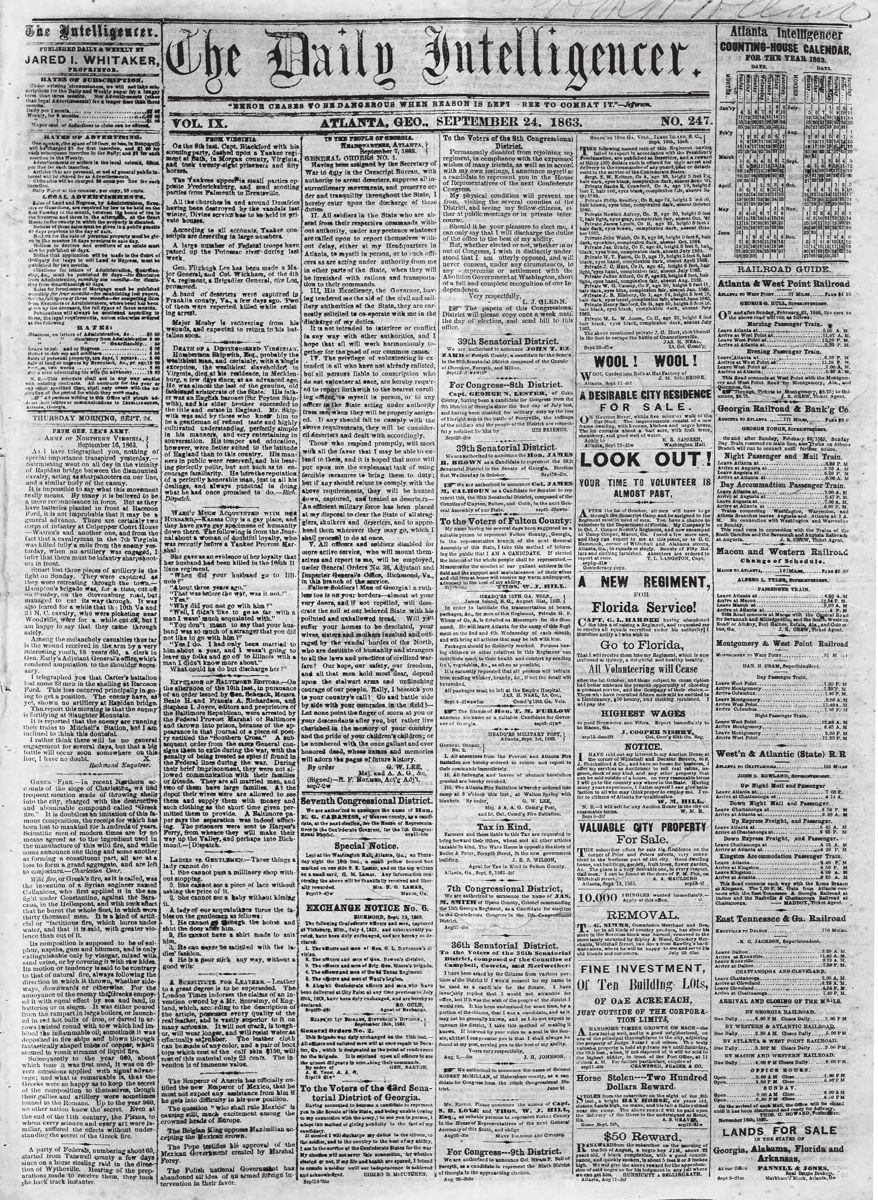
In Gone With the Wind, when fretful Atlantans learned that newspapers in the city were printing names of soldiers killed and wounded at Gettysburg, they flocked to the office of the Atlanta Examiner, a fictional daily. But the sign over the sidewalk could have read Atlanta Intelligencer. Wilbur G. Kurtz, historical advisor to Selznick for the film, insisted that the studio build a façade for the Examiner building that was virtually identical to that of the Daily Intelligencer.1 As famously photographed in the fall of 1864 by George N. Barnard, it was a two-story brick structure at the downtown nexus of Whitehall Street and the railroad. (And, yes, it did have a sidewalk bulletin board.) The structure proclaimed INTELLIGENCER OFFICE, which was on the second floor; to get there one walked up a flight of stairs from the sidewalk. The newspaper shared space with M. Wittgenstein’s saloon and wholesale liquor store on the ground floor.2 Barnard took the view from a second-story window across Whitehall, either at the Atlanta Cigar Manufactory or a building next to it painted with “China, Glass and Queensware” and “Auction & Negro Sales.” The latter was owned by Robert Crawford, Whitehall—a frequent advertiser in the Intelligencer.3 The site today is a few blocks from Atlanta’s Five
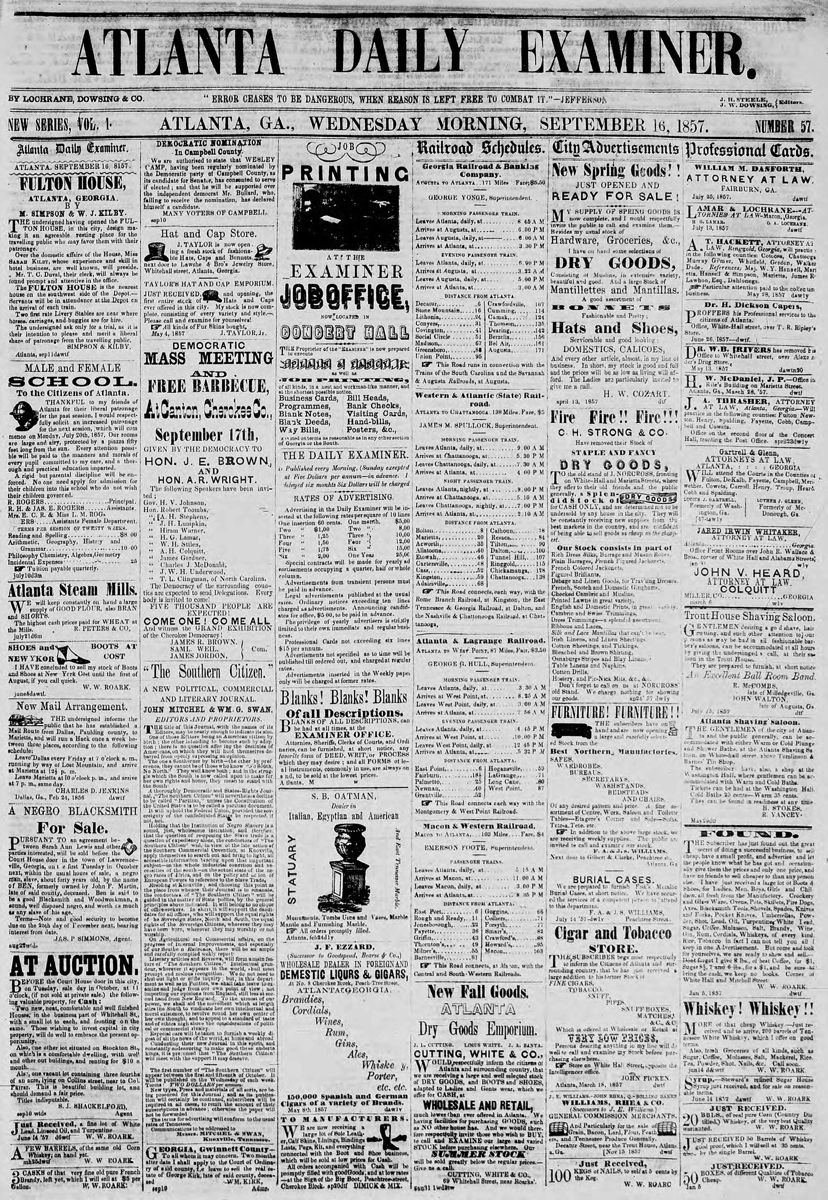
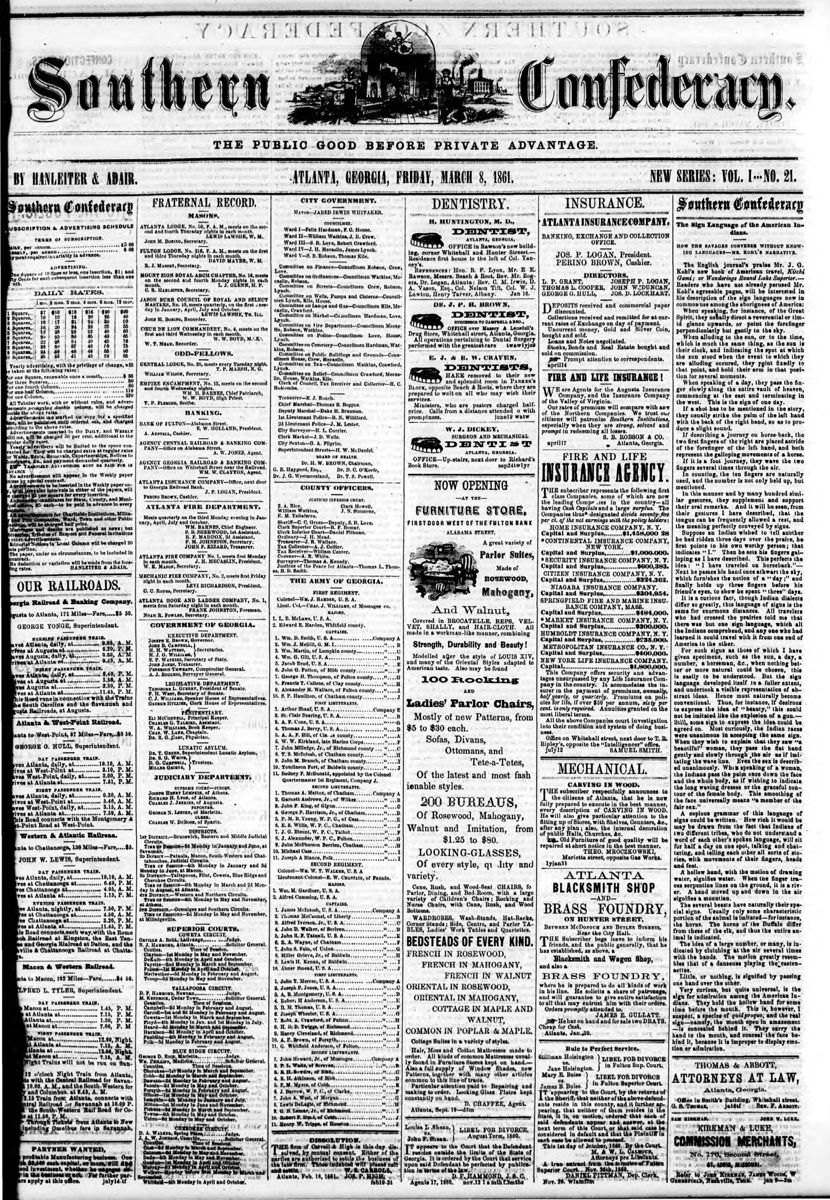
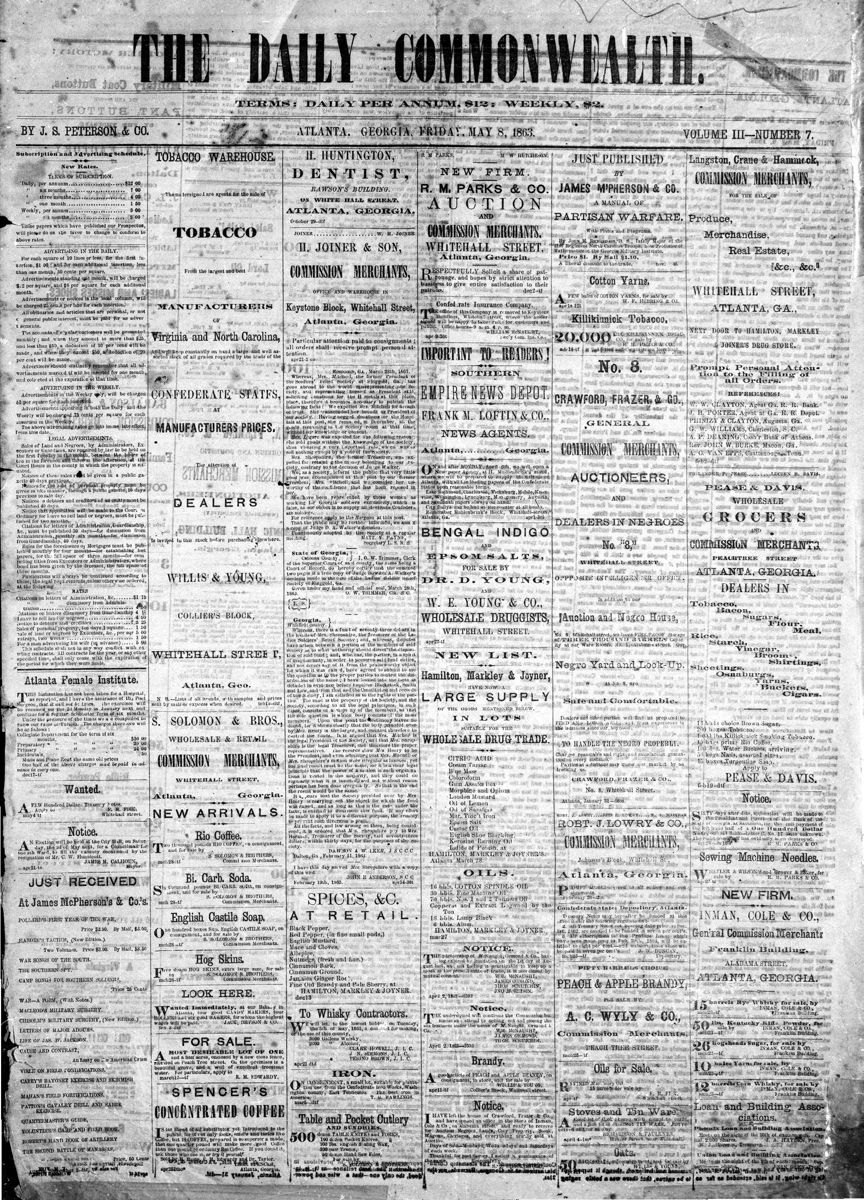
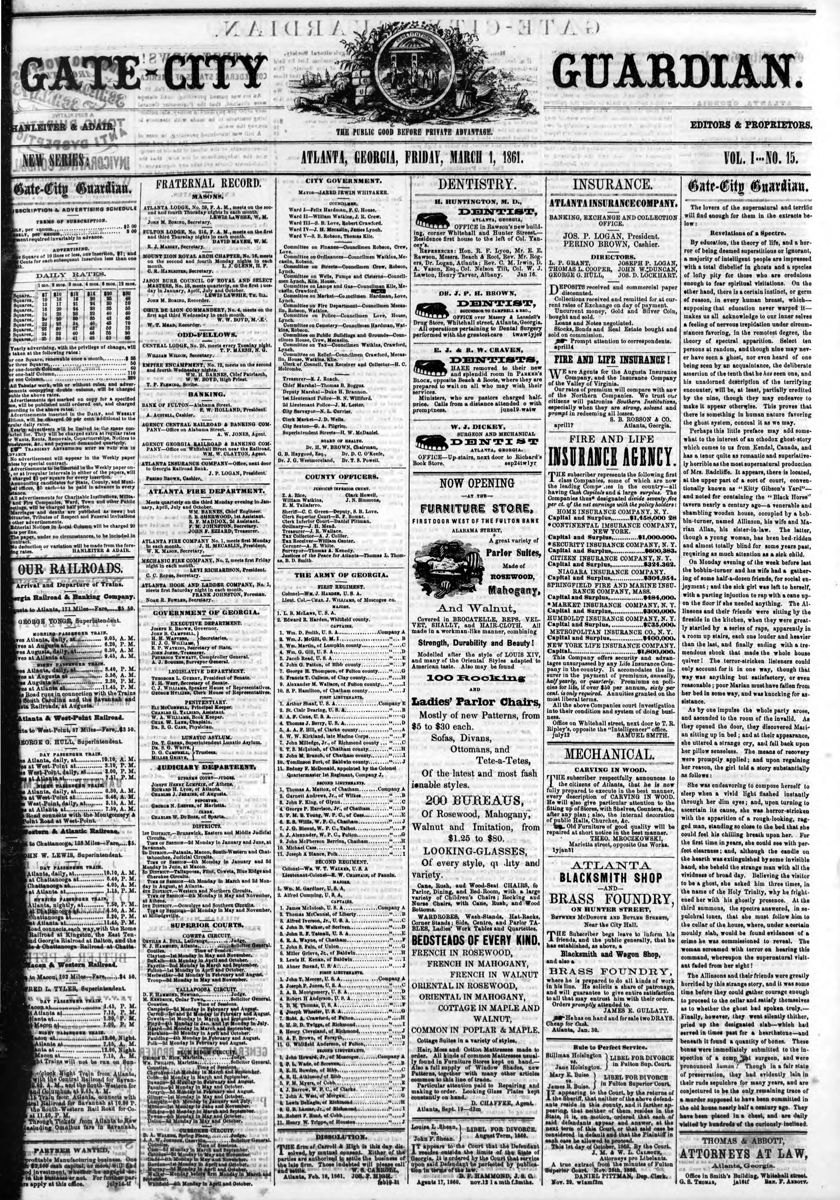
Points MARTA station. (By the way, the Examiner scene in the movie was shot in March 1939. It was here that Grandmother Tarleton learned of the twins’ deaths.) The Intelligencer, arguably the city’s leading wartime daily, had been founded in Madison, Georgia, in 1842 as the Southern Miscellany. Five years later it moved to Atlanta with its owner, Cornelius R. Hanleiter.4 In the spring of 1849 Hanleiter sold the paper to four Atlanta businessmen, who renamed it the Weekly Atlanta Intelligencer. The paper began putting out daily issues in 1854, and three years later it bought out the Daily Examiner, its chief rival at the time.5 Atlanta’s 1859 Directory stated that the paper’s offices were located downtown at the southwest corner of Alabama and Whitehall Streets.6 We don’t know when those offices moved to the site photographed by Barnard in 1864. At the time of the war, Atlantans had their choice of three daily newspapers. Cornelius Hanleiter, the ex-Southern Miscellany owner, founded a new daily, the National American in 1857. Three weeks after Georgia’s secession Hanleiter renamed it the GateCity Guardian—because of its extensive rail connections, Atlanta had already acquired a nickname. On March 4, 1861 (the day Abraham Lincoln took his oath in Washington) the Guardian was issued under a new title, the Southern Confederacy.7 Throughout the war, the Intelligencer and Confederacy sparred editorially and scrapped for subscribers and advertisers. Running a poor third was the Daily Commonwealth, which was issued in the evenings. The paper was sold by its owner, J.S. Peterson, in August 1863 to one M.W. Hutchinson, who intended to rename it the Gazette. It never got off the ground; the Commonwealth became the first of Atlanta’s dailies to fall during the war.8 The Southern Confederacy, owned by George W. Adair and J. Henly Smith, also didn’t make it. In July, 1864, with Yankees approaching Atlanta, the Intelligencer and Confederacy staff packed up their presses, type, paper and ink and moved to Macon, 80 miles to the south. The Intelligencer returned to Atlanta after the Yankees set out on their march to the sea; its first “extra” issue was put out on December 10. The Southern Confederacy, though, never returned. Its last issue, in Macon, came out in early February 1865.9 The Confederacy’s shrinking borders added to Atlantans’ journalistic smorgasbord. After the fall of Memphis in June 1862, the Daily Appeal moved first to Grenada, then to Jackson, then to Meridian, Mississippi. Finally, the “Moving Appeal” arrived in Atlanta, where its first relocated issue hit the streets on June 6, 1863.10 Confederate forces evacuated Knoxville on Sept. 1, 1863; two weeks later the Register resumed publication in Atlanta.11 Both refugee papers joined in the flight from the city in the summer of 1864. The Knoxville/Atlanta Register set up shop in Augusta, Georgia; its first issue appeared on August 29.12 The Memphis/ Grenada/ Jackson/ Meridian/ Atlanta Appeal moved out July 22 and reemerged in Montgomery.13 But the refugeeing papers left behind at least two staff members. Today, we would be without on-the-scene reporting of Sherman’s bombardment of Atlanta were it not for two brave individuals: Isaac Pilgrim and
John Dumble. Pilgrim, foreman for the Intelligencer, stayed in Atlanta, walked around, talked with people (not everyone had fled when Sherman’s shelling started), and observed the effects of the Federal’s artillery bombardment. Each afternoon, downtown at the Express office, he wrote a long news column and put it on the evening train to Macon. There it was received by the transplanted Intelligencer, and printed a couple of days later. For example, Pilgrim’s column of August 4 gave a virtual streetby-street description of property damage caused the Northern projectiles. John Dumble, editor of the Appeal, also stayed behind when his paper moved to Montgomery. He and Pilgrim got a small hand-press and each afternoon composed columns, set type, and each day produced frontback, single-sheet copies of the Memphis Appeal “Extra.” Copies of the Extra are rare today, but at the time, again put on the train to Macon and other Southern cities, the Appeal was reprinted widely, even in the New York Times. Thus we can read it today. To round out the story of Atlanta’s Confederate journalism is also to include reporters from other papers who stayed in the city, enduring Sherman’s bombardment and filing reports for printing in their papers. Such a star correspondent was Henry Watterson, who wrote for several Southern papers under such pennames as “Shadow” and “Grape.” Watterson’s Confederate patriotism was on full display when he turned to William
T. Sherman in his column for the Augusta Constitutionalist of August 28, 1864. “Of all the Yankee Generals he is the poorest, the vainest, the meanest,” Watterson wrote, “a paltry villain, a currish knave,” in a style that only Confederates could have appreciated. Indeed, to Watterson, Sherman was “an ill-begotten, ill-bred and destined caterpillar, clinging only to sloth and mildew, climbing no higher than the scum of a rank and putrid atmosphere.” Oh! That we could get away with that stuff now! Endnotes: 1.
Herb Bridges, The Filming of Gone with the Wind (Macon: Mercer University Press, 1984), 88-91; Steve Wilson, The Making of Gone With the Wind (Austin: University of Texas Press, n.d.),
154-57. Michael Rose, Atlanta: A Portrait of the Civil War (Charleston: Arcadia Publishing, 1999), 111. Keith F. Davis, George N. Barnard: Photographer of Sherman’s Campaign (Kansas City MO: Hallmark Cards, 1990), 86. Franklin M. Garrett, Atlanta and Environs: A Chronicle of Its People and Events, 2 vols. (Athens: University of Georgia Press, 1969 [1954]), vol. 1, 251. “C.R.H.” [Cornelius R. Hanleiter], “A History of Newspaper Enterprises in Atlanta,” Atlanta Southern Confederacy, July 14, 1861; Garrett, A & E, vol. 1, 279; Henry T. Malone, “Atlanta Journalism During the Confederacy,” Georgia Historical Quarterly, vol. 37, no. 3 (September 1953), 211. Williams’ Atlanta Directory, City Guide, and Business Mirror (Atlanta: M. Lynch, 1859), 28.
Malone, “Atlanta Journalism,” 211-12. Garrett, A & E, vol. 1, 573; “City Newspaper Changes,” Atlanta Daily Intelligencer, Aug. 12, 1863. Stephen Davis, What the Yankees Did to Us: Sherman’s Bombardment and Wrecking of Atlanta (Macon: Mercer University Press, 2012), 83; “Colonel Geo. W. Adair Is Paralyzed Today,” Atlanta Journal, Sept. 27, 1899; “J. Henly Smith Taken by Death,” Atlanta Constitution, Feb. 26, 1907. B. Kimball Baker, “The Memphis Appeal,” Civil War Times Illustrated, vol. 18, no. 4 (July 1979), 34-35. “Knoxville Register,” Atlanta Daily Intelligencer, Sept. 15, 1863. “The Atlanta Register,” Augusta Constitutionalist, Aug. 30, 1864. Ron Soodalter, “News on the Run:
Moving Appeal,’” America’s Civil War, vol. 32, no. 1 (March 2019), 17.
Publisher’s Note: All newspapers illustrated in this article are courtesy of the Georgia Historic Newspapers website at https://gahistoricnewspapers-files.galileo.usg.edu. This resource is invaluable to any researcher and is highly recommended. Stephen Davis of Cumming, Georgia, is author of seven books related to the Atlanta Campaign, including the Emerging Civil War
CivilWarNews.com paperbacks A Long and Bloody Task (2016) and All the Fighting They Want (2017). His two recent volumes on John Bell Hood (Mercer University Press, 2019, 2020) have won the Fletcher Pratt Award of the New York CWRT, the Richard Barksdale Harwell Award of the Atlanta CWRT, and the Douglas Southall Freeman Award of the Military Order of the Stars and Bars. His latest book, with Bill Hendrick, The Atlanta Daily Intelligencer Covers the Civil War, will be released this summer by the University of Tennessee Press.