
USCT soldier finally laid to rest
By Steve Reilly · Originally published September 2021 · pp. 6–7
Brad Quinlin, a noted Georgia Civil War historian, called me and related the sad story of a United States Colored Trooper killed in July 1864. Brad told how this soldier’s body was partly discovered along the south shoulder of the Chattahoochee River in Georgia, just north of Atlanta, and how the remains came into his possession. Fifty years ago, a man named William Stone found a skull that still had a Confederate Minié ball lodged in its left side, a US belt buckle, a breastplate, and four US uniform buttons. After Stone’s death in 2010, the skull of this fallen Union soldier eventually ended up with Brad. On June 27, 1864, General Sherman attacked the Confederate Army of Tennessee at the Battle of Kennesaw Mountain in three areas, same day, same time. The north assault was at Pigeon Hill, a clear Confederate victory. The middle assault was at Cheatham Hill, where the United States Army could not carry the Confederate works but dug in as close as 40 feet from the
Confederate line in some places. The Federals remained there until the Confederates retreated. The third Union assault on June 27 was the southern attack which was a Union success. General Schofield’s XXIII Corps pushed into General Johnston’s defenses, threatening the Confederate line of retreat. General Sherman ordered General Stoneman’s cavalry even further south to Sweetwater Creek, just above the Chattahoochee River, forcing General Johnston off Kennesaw
War Department General Orders Number 143, May 22, 1863. NARA.
Mountain on July 2, 1864, that same night General Sherman ordered General McPherson to disengage and to move south toward the Chattahoochee. This information puts the death of the USCT soldier between July 9, the date the Confederate army retreated across the Chattahoochee, and July 17, when the Union Army was fully across the river. After Brad Quinlin received the soldier’s skull, he contacted Dr. Richard Snow from Knoxville,
a forensic anthropologist. Dr. Snow examined the skull and reported that it belonged to a black man. At this point, the question is which USCT unit was at the Chattahoochee in July 1864? I contacted my friend, Elijah Washington, MD, a descendant of the 1st South Carolina Infantry and the founder of the Sons of Union Veterans of the Civil War Camp and USCT Museum, in Beaufort, S.C. He told me that on May 22, 1863, the War Department issued General Orders number 143, establishing the procedures to induct black men into the United States Colored Troops. He added that by the end of the Civil War, there were more soldiers in the USCT than all the Confederate forces From left to right Deacon Thomas Keitt, Mother Bernadette Keitt, Josh Darnell, Mother Emerita Walker, Josetta Walker, Richard Ransom, Brad Quinlin, Lamuriel Adams, and Darrell Saulsbe combined. Some put the number at 180,000 in the USCT and another 20,000 serving in the Union Navy. Dr.Washington noted there were black American soldiers killed on the assault of Kennesaw Mountain; their remains are buried in Marietta National Cemetery. He could not pinpoint which regiment would have had soldiers standing on the south shoulder of the Chattahoochee in early July 1864. So, the mystery goes on. In researching Marietta National Cemetery, Brad Quinlin found there are two hundred fifty-eight USCT soldiers buried there. Lee White, a genuinely knowledgeable western campaign historian, said to look at the 110th USCT, which was attached to the XVI Corps and assigned as pioneer detachments serving on the front lines. Major General James McPherson commanded the Army of the Tennessee in which and Brigadier General G. M. Dodge’s XVI Corps was serving. Brad has a list of twenty-one 110th USCT soldiers who were killed in action or died of illness during the Atlanta Campaign. He showed me a copy of the Sept. 9, 1863, General Order 323 from the War Department. The order authorized Union regiments to enlist black men into the regiment under the title “Under Cook.” These men were paid and allowed all duties, fighting when needed. The title Under Cook was listed below Privates on the Regiment’s Rolls.
General Orders, No. 323, War Department, each cook to have two under-cooks of African descent, 1863. William A. Gladstone African American Military Collection. Library of Congress.
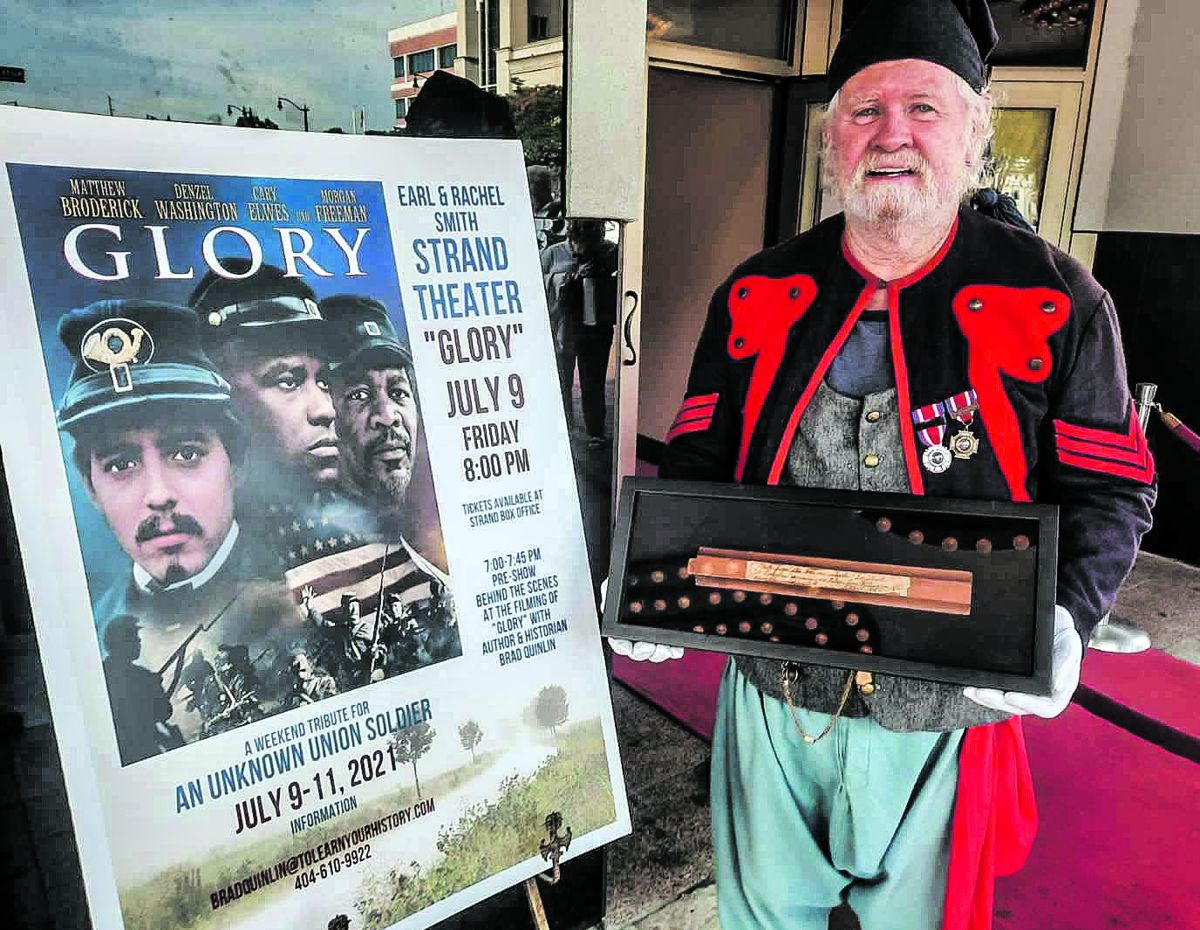
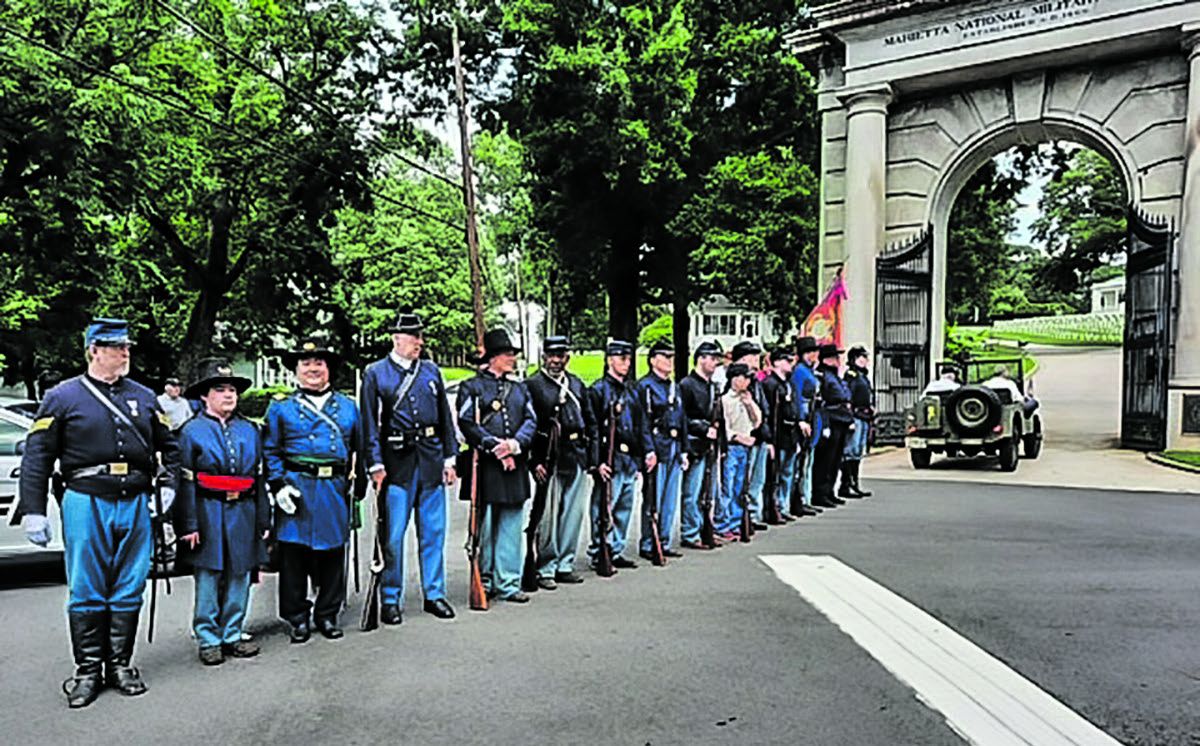
A Weekend of Tributes for an Unknown American Soldier The events started at the Old Zion Baptist Church and Heritage Museum; located in Marietta, Ga. Marietta is on the old railroad line connecting Chattanooga, Tenn., to Atlanta. It is the type of city that recalls the old South; when you walk across the city square; folks smile at you and say good morning. If Generals Sherman and Johnston could return, they would find the same roads that were there in 1864, and only a few have been widened for today’s traffic. The Old Zion Baptist Church was first organized in 1866 when the original members pulled out of the Marietta First Baptist Church, where they had once been slave members. In 1888, the present brick church was constructed. On July 9, 2021, many church members came together at the old Zion church and museum to reflect and learn and pray for this unknown American Hero. At 7 p.m., many filled the seats of the 1935 Old Strand Theater on the Marietta Square for a showing of the movie Glory. The 1989 American historical war drama depicts a short history of the 54th Massachusetts. Many attendees said they were there to reflect on the life and death of the black soldier, whose remains were discovered along the Chattahoochee River. Members of the Sons of Union Veterans displayed their civil war collections in the lobby before the program began. Before showing Glory, Brad Quinlin, who worked on the movie set as a background artist, spoke about the filming and locations used in the film. On July 11, approximately one hundred people joined together for a funeral tribute to the unknown Union soldier at the Zion Baptist Church. Many members of the Sons of Union Veterans from the Department of Georgia, South Carolina, and Tennessee joined with the congregation. Program coordinator Lamuriel Adams was seated only three feet away from the remains and uniform accoutrements recovered at the site. Now, we are all here, none of us knowing who he was, whether he was a slave or free man, when he enlisted? Pastor Eric M. Beckham, a hugely impressive young man who just joined the church, said, “He is not unknown. God knows who he is; God knows all of us.” The Sons of Union Veterans of the Civil War, a fraternal organization whose members are descendants of Union Soldiers, played an essential role in the funeral. Second Lt. J. Bryja and Sergeant of the Guard F. Purmort stood with the Guard of Honor as the service ended. Two members of the Union Sons carried the casket up the row, followed by all attendees, forming a processional walk exiting the church. They were joined by reenactors from the 21st Ohio, 123rd New York, and the 6th Kentucky. The Honor Guard fired three volleys outside the church, followed by Taps, played by Bill Miller. The casket was placed in the rear of a Vietnam-era army jeep. The honor guard and the congregation slowly walked to Marietta National Cemetery one-half mile away. Department of Georgia and South Carolina Commander of the Union Sons Michael Reither stated, “This is a historical event, it will probably be the last burial of a Union soldier in our lifetime. The SUVCW is dedicated to preserving the history and legacy of the veterans who fought to preserve the Union and we are proud to honor this American soldier with the respect and dignity he deserves.” The United States National Cemetery System does not conduct services on a Sunday, so the burial will be conducted at a later date. At this point, Brad Quinlin does not know who our unknown black American Civil War Soldier is. His best guess is one of four soldiers, Samuel Warren 52nd Illinois, David Taylor 63rd Illinois, Wyatt Fisher 10th Illinois, or Jobe Jackson of the 110th USCT Infantry. Brad hopes to conduct a detailed research at the National Archives in Washington, D.C. Keep following the Civil War News for any updates on this incredible story.
Steve Reilly served in the United States Marines 1967–1976. Retired from the New York State Police and long time member of Tilden Camp SUVCW and 69th New York Historical Association.