
Hero of the Battle of Tebbs Bend
By Professor Earnest Veritas · Originally published September 2021 · pp. 30–31
By Professor Earnest Veritas, Special Correspondent to the Civil War News
The seemingly arbitrary hand of History moves over events and people of note and with, it would seem, an uncaring manner, as it determines which events and people will be remembered or not. Examples are the Sultana disaster being overshadowed by the assassination of President Lincoln, the battle of Richmond, Ky., being forgotten because the Battle of Bull Run was on the same day, or the battle of Helena, Ark., being savagely fought on the 4th of July 1863.
Another example is the Battle of Tebbs Bend in central Kentucky. It was a battle of such unique circumstances that it could easily be considered the Thermopylae of the Civil War (see the dispatch below). Efforts to remedy this oversight have been successful and much-deserved light is being shed on this small battle that occurred on July 4, 1863.
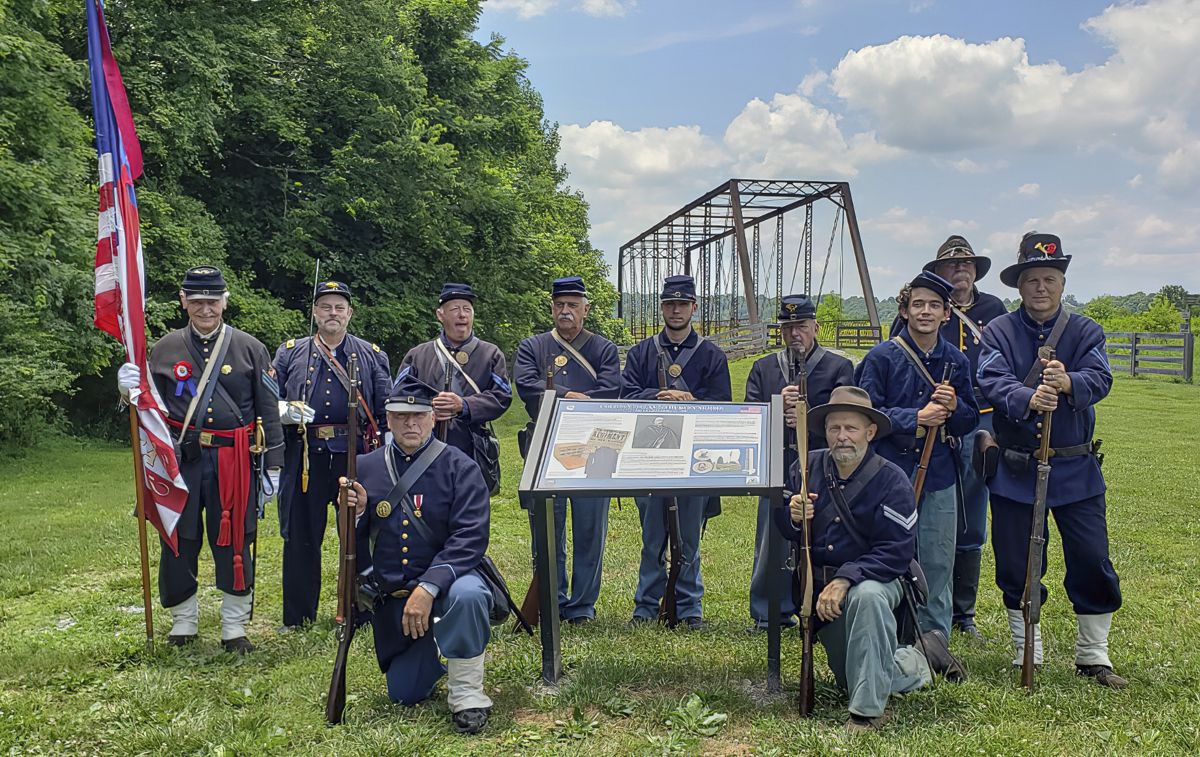
On Saturday, June 25, 2021, a crowd of approximately 50 people gathered at the park shelter of Tebbs Bend, Ky., to dedicate a new interpretive sign describing the unique Battle of Tebbs Bend and its hero, Colonel Orlando Hurley Moore of the 25th Michigan. Colonel Moore was a musician before he enlisted to fight in the war.
The 9th Michigan Infantry was present and served as an honor guard for the plaque and ceremony, then fired a 21-gun salute to end the ceremony.
The event was a culmination of years of hard work by the Tebbs Bend Battlefield Association to lift up the battle for recognition and to save a valuable piece of Kentucky Civil War history.
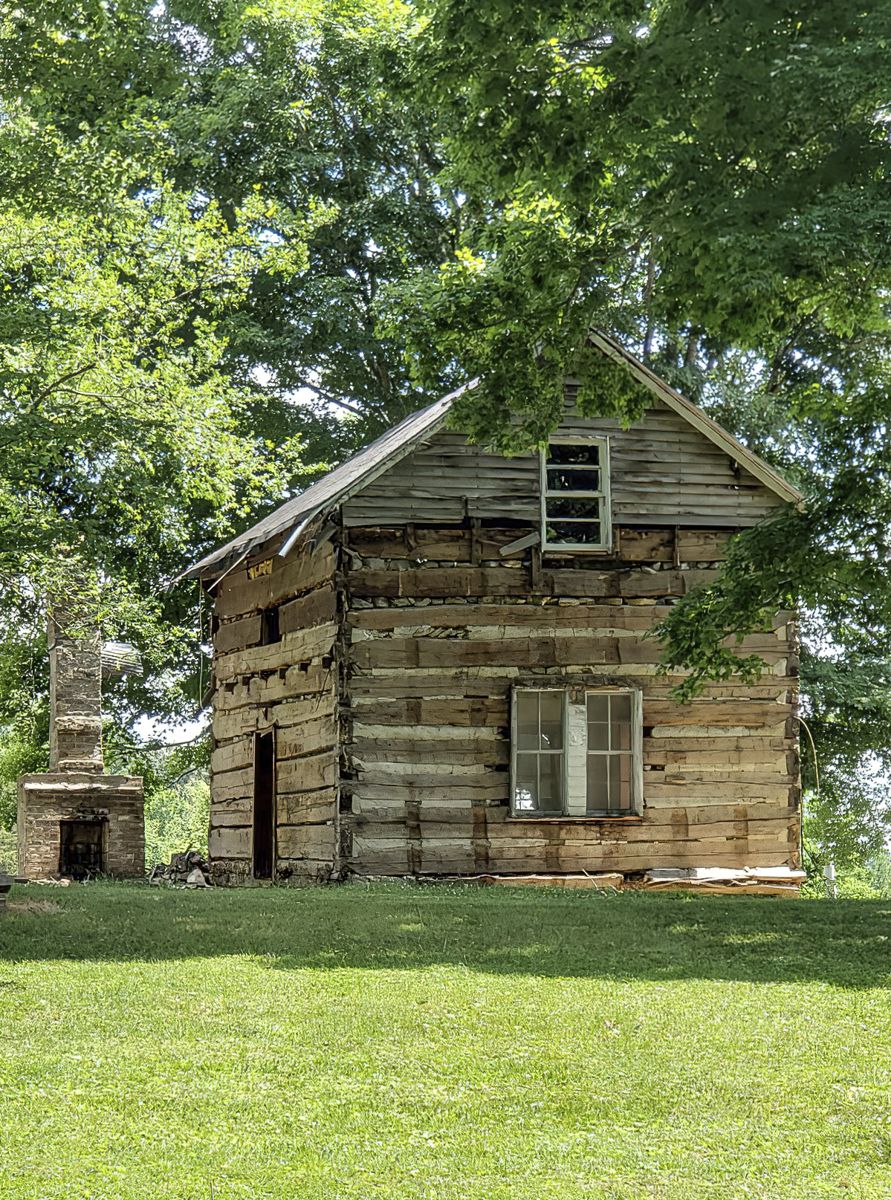
Efforts are now underway to raise funds to restore a log cabin used as the Federal hospital during the battle. To contribute, contact Betty J. Gorin at: [email protected] or contact the Tebbs Bend Battlefield Association at: Box 394 Campbellsville, KY 42719
The Battle of Tebbs Bend
(Dispatch was submitted to Professor Veritas by John Urschel)
A very good friend of mine likes to refer to the Battle of Tebbs Bend as the “Thermopylae of the Civil War.” While the numbers aren’t nearly as lopsided as the 300 against 7,000 at Thermopylae versus 200 against 2,500 at Tebbs Bend, the outcomes were different. At Tebbs Bend, the smaller force won.
In December 1862, CSA General John Hunt Morgan raided into Central Kentucky and burned a bridge over the Green River south of Campbellsville, Ky. During the summer of 1863 Federals, 60 men from the 8th Michigan and 79th New York were building a temporary replacement bridge. The 25th Michigan was the provost guard (military police) of Louisville, Ky., and their Colonel, Orlando Hurley Moore, of Schoolcraft, Mich., had run afoul of his commanding officer, Brigadier General Jeremiah Boyle, a Kentucky slaveowner. Moore was an abolitionist who had canceled the slave trade in Louisville and may have aided some slaves in crossing the Ohio River. Boyle was furious and devised a scheme to rid himself of Moore.
The Federals knew that Morgan was planning another raid into Kentucky and was building up his forces in central Tennessee. General Boyle sent Moore and half the 25th Michigan, about 200 men, to the burnt bridge in Taylor County, Ky., where they would be easy prey for Morgan. Lt. Col. Benjamin Orcutt and five companies of the 25th remained in Louisville, where the 25th’s Major DeWitt Fitch was appointed provost marshal.
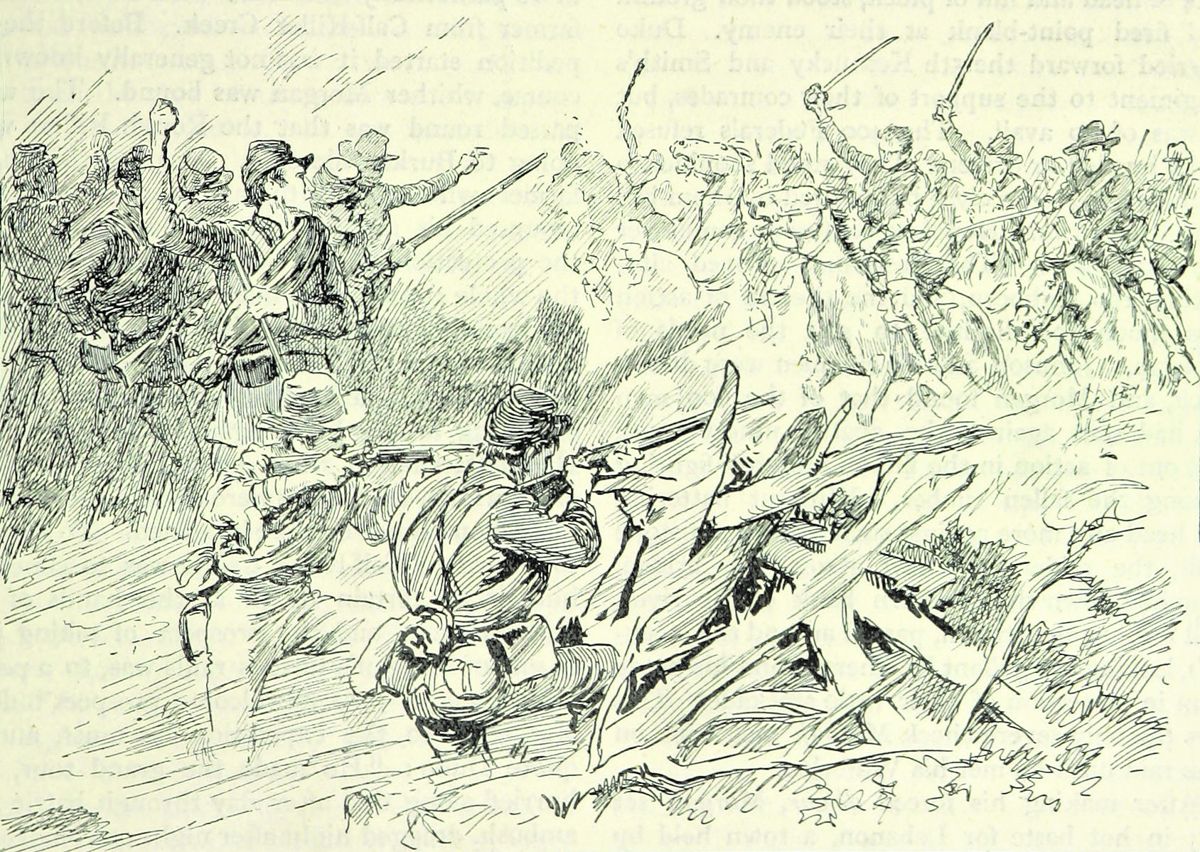
Moore was nobody’s fool and well understood the predicament he was in with Morgan potentially bearing down on him. As Morgan began his raid and headed toward Columbia, Ky., Moore surveyed his situation. He set his men to target practice and positioned his detachment on a narrow peninsula with steep sides where the road to the Green River Bridge ran down to the river. On this promontory, facing southward in front of a stand of woods, Moore constructed a defensive trench, with rifle pits 100 yards to the front and trees felled for breastworks and abatis.
The axes rang out from July 1 to 3. The Federal soldiers worked feverishly clearing fields of fire and constructing obstacles. Two trenches were dug to allow soldiers in the rifle pits to retreat to the main breastworks while under fire. Further, the rifle pits were constructed so that they would provide no protection from fire from the breastworks if they were occupied by the Rebels.
On the morning of July 4, 1863, one day after Lee’s defeat at Gettysburg and the same day Vicksburg surrendered, 200 of Moore’s men stood ready, having slept on the field while the rest of his command guarded the river fords. The rifle pits held 75 men. The remainder of four companies, about 100 men), manned the main line. Moore had also hidden 20 or so Company I Dutchmen, from Holland, Mich., in the woods behind the line. Moore advanced pickets to his front to act as skirmishers.
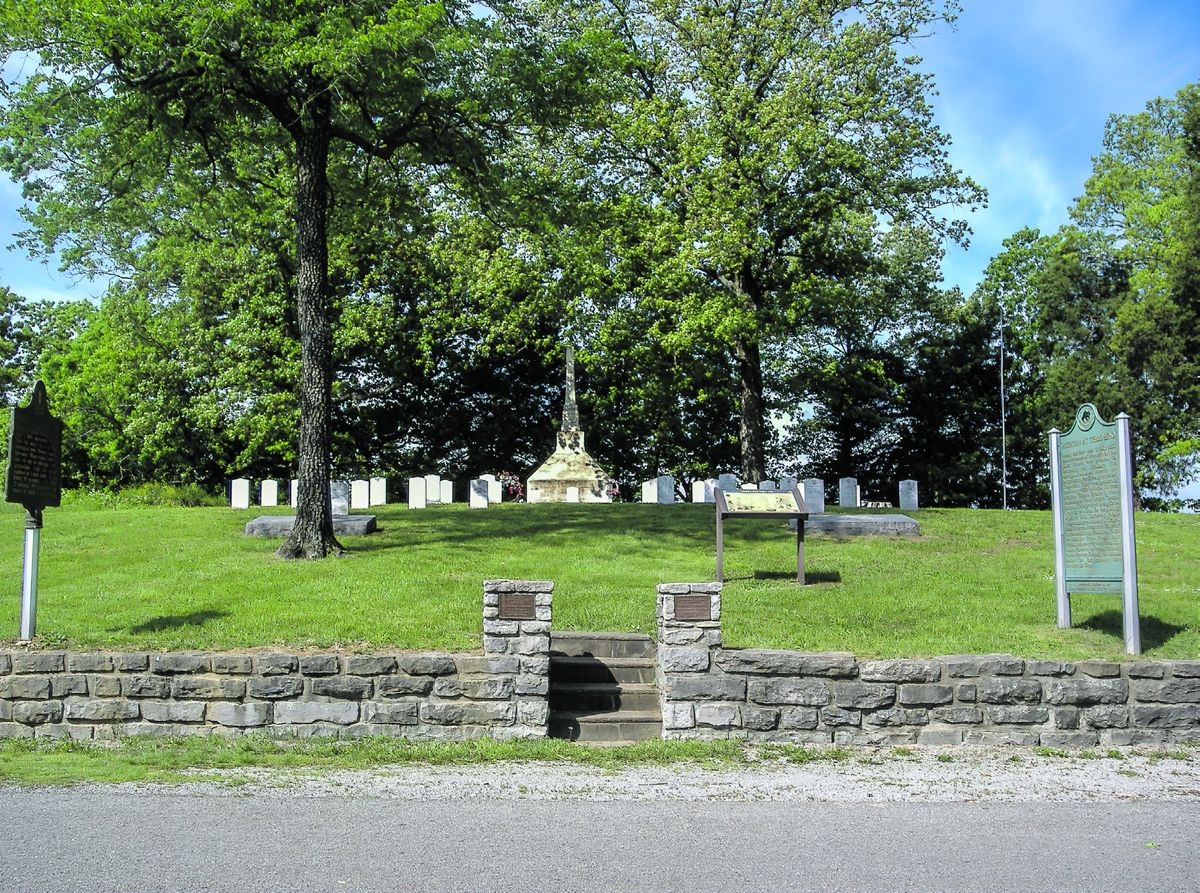
Colonel Moore had no cavalry, no artillery, and no reserves of any consequence. General Morgan, however, commanded an artillery battery of two 10-pounder Parrott rifles and two 12-pounder Napoleons. General Morgan’s force of 2,500 Confederate horsemen arrived on Moore’s front at 6:30 a.m. after defeating a Federal cavalry detachment at Columbia, Ky. When the pickets retreated, Morgan ordered one gun to commence firing on the rifle pits. Splinters flew and two men were wounded. The firing ceased and Morgan sent out a group of officers under a flag of truce to talk capitulation, since, in Morgan’s mind, resistance was futile. Colonel Moore supposedly stated, “This being the Fourth of July, I cannot entertain this proposition.”Rejected, the Confederate officers tried to persuade Colonel Moore of his foolishness, but he had a job to do and that was that. When they returned to Morgan, he commenced firing with his entire four-gun battery. Morgan’s usual tactics, which were almost always successful, were to fire a few artillery rounds, overstate the size of his force, and accept surrender. If not, he attacked and soon convinced his foes that surrender was a good idea. He most likely envisioned that a short fight would send the Michiganders running. In fact, five days later in Corydon, Ind., a force of 450 would fight Morgan briefly, then flee and finally surrender. Colonel Moore, however, wasn’t the surrendering type. He, as a U.S. Army lieutenant, had supposedly stood up to his commanding officer, Albert Sidney Johnston, in San Francisco when Johnston sought to ally California with the Confederacy. Moore was stubborn, opinionated, and had little patience for authority without competence. He had trained his group in the rifle pits as marksmen and taught his men to respond to bugle commands. Moore sat astride his horse, Lion, and watched as his marksmen silenced Morgan’s artillery. Morgan’s subordinates advised him that this position was easily bypassed by any number of nearby fords and as their objective was to raid through Kentucky, Indiana, and Ohio, and then ultimately join General Lee in Pennsylvania, these Yankees were just a nuisance. Plus, many of Morgan’s men were short on ammunition that had to be resupplied by capturing U.S. stockpiles. Morgan did not want a Federal force in his rear and he had no idea how close reinforcements that could organize and cause him grief might be. He decided to deal with the arrogant Michiganders blocking his path. Morgan’s first dismounted assault made short work of the rifle pits as the Michigan lads scurried back to the breastworks. Unfortunately, the rifle pits, as constructed, afforded no protection. The artillery remained useless since the field where they would have to deploy would expose the gunners to an even more devastating fire than before. Three and half hours of constant battle ensued with an unknown number of charges, with Morgan’s men regrouping and charging again and again. The Confederates even resorted to sending a desperate flanking maneuver under Col. David W. Chenault, down the steep embankment to the west and up it again to strike the main line of breastworks in the right flank. Moore, however, had anticipated that move and sent Company I from their position in a headlong charge into the flanking Rebels repelling them with heavy loss. Colonel Chenault was killed. Finally, Morgan realized that if hecontinued,his whole campaign would be in jeopardy. Sgt. Norris Merrill of Buchanan, Mich., had been convalescing when he was picked up by Confederate scouts and brought before General Morgan under penalty of death if he lied. Well, he lied to Morgan about troop strengths, nearby reinforcements, and cavalry units he had seen. Adding to this misinformation were the distinctive cavalry bugle calls Morgan heard from the Federal side. What he didn’t know is that Colonel Moore was doing the bugling. Morgan decided enough was enough and by 10:30 a.m. it was over. A truce was called and the wounded men were taken from the field. The terrain had been so narrow and fields of fire so well defined by Colonel Moore that General Morgan had two full regiments who were never engaged. An estimated 800 to 1,000 Rebels had taken part. Moore, still wary of Morgan discovering his real strength, demanded that his troops would bring the Confederate dead and wounded out from behind the U.S. lines. U.S. losses were 6 dead and 24 wounded with two succumbing to their wounds days later. Colonel Moore’s horse, Lion, had also been fatally shot. Morgan’s losses were reported by Col. Basil Duke, Morgan’s brother-in-law and second-in-command, as 36 dead and 45 wounded. Twenty officers were among the dead. Colonel Moore, who watched the dead and wounded being gathered after the battle estimated 50 dead and 200 wounded. Indiana artillerists arriving the next day estimated seeing over 60 bodies. One man reported burying 23 Rebels, another buried 28, and still another buried 40. Ten to twelve bodies were found in an eddy in the Green River. Thirty-two Southern soldiers were captured. The Confederates were buried in a trench next to the road and later movedtothebattlefieldcemetery. The Union dead were buried next to the Campbellsville Turnpike and later reburied in the Lebanon National Cemetery. The ratio of wounded to dead reported by Basil Duke as 5 to 4 (45 wounded 36 dead) can be found in no other battle, large or small. Even the Federal casualties were 4 wounded (24) for every 1 dead (6) or 4 to 1. A death toll of 36 in a Civil War battle should result in something near 144 wounded. It is equally hard to believe that a group of 200 soldiers who could pick off artillerists at a range of 200 yards couldn’t do more damage than 81 dead and wounded in a face-to-face 3 1/2 hour battle. Furthermore, if an attacking force of 800 to 1,000 loses only 23 men an hour, why were they not able to overrun the Federals? Historian E.B. Long wrote about Tebbs Bend, 108 years after the fact, in “The Civil War: Day by Day”. Buried within his 7 paragraphs for July 4th, 1863, he wrote: “John Hunt Morgan suffered a repulse on the Green River at Tebb’s Bend in his invasion of Kentucky, a momentary setback.” Morgan and Duke probably felt a little differently as they expected to hear of Moore’s promotion but it never came. Colonel Moore held brigade command for over a year yet never got his star. Duke had called Moore’s defensive position, “the best he had seen during the war.” He later referred to Moore “as humane as he was skilled and gallant.” Morgan reportedly sent a message back to Moore promoting him to Brigadier General. In Colonel Moore’s official report of the battle, he looped his “i” in Tibbs Bend forever changing the place name. The Tibbs family resided there until recently. The Confederates called it the Battle of the Green River Bridge. For the victory at Tebbs Bend, Colonel Moore and the 25th Michigan Volunteer Infantry received thanks from Generals Hartsuff and Burnside. From General Boyle, Moore received a court martial, but that is another story… The Tebbs Bend Battlefield lies on Tebbs Bend Rd. just west of Ky. 55, 6 miles south of Campbellsville, Ky. or 11.4 miles north of Columbia, Ky. There is a three mile loop battlefield driving trail. A CSA hospital with displays is located at the U.S. Army Corps of Engineers Visitors Center, east off Ky. 55. A former bridge toll house museum is located at the beginning of the tour on Tebbs Bend Road. The Atkinson Griffin House which was used as a Confederate Hospital during the battle is alsoon the Tebbs Bend Battlefield. For more information about the battlefield: Tebbs Bend Battlefield 327 Tebbs Bend Road Campbellsville, KY 42718 Phone numbers are: 270-789-3025 or 270-465-8726 Website: www.tebbsbend.org For further reading: Morgan is Coming by Betty J. Gorin. Harmony House Publishers, Louisville, Ky. John Urschel may be reached at: [email protected] Professor Veritas would like to express his appreciation to Betty J. Gorin and John Urschel for their significant contributions to this article. Simply put, always endeavor to tell the simple truth; simply. Professor E. Veritas