The Graphic War
Fantastical Surrender
By Salvatore Cilella · Originally published September 2021 · pp. 26–27
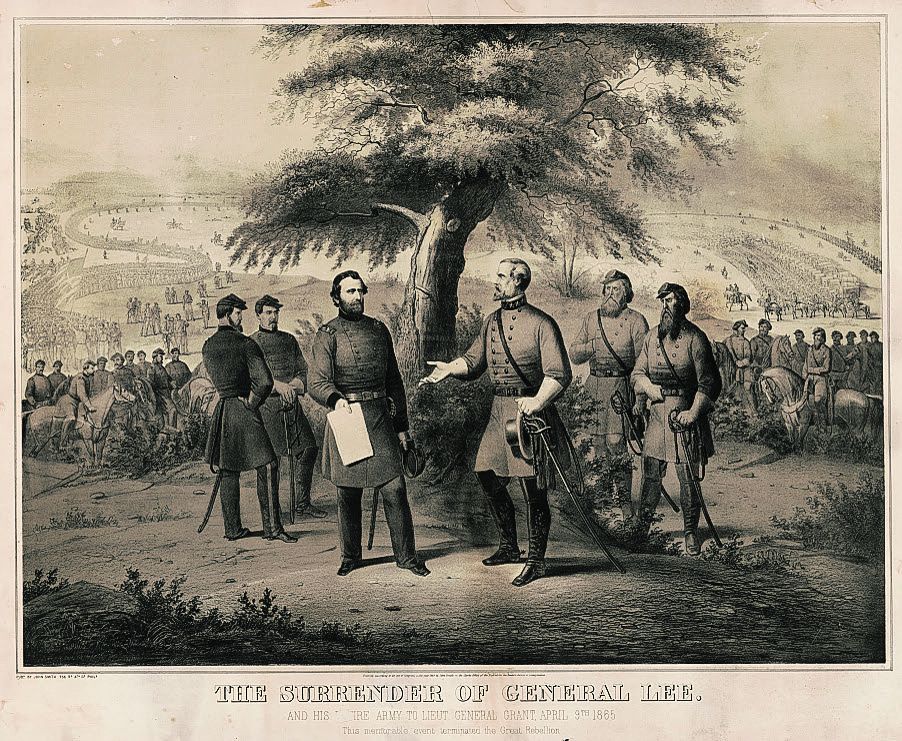
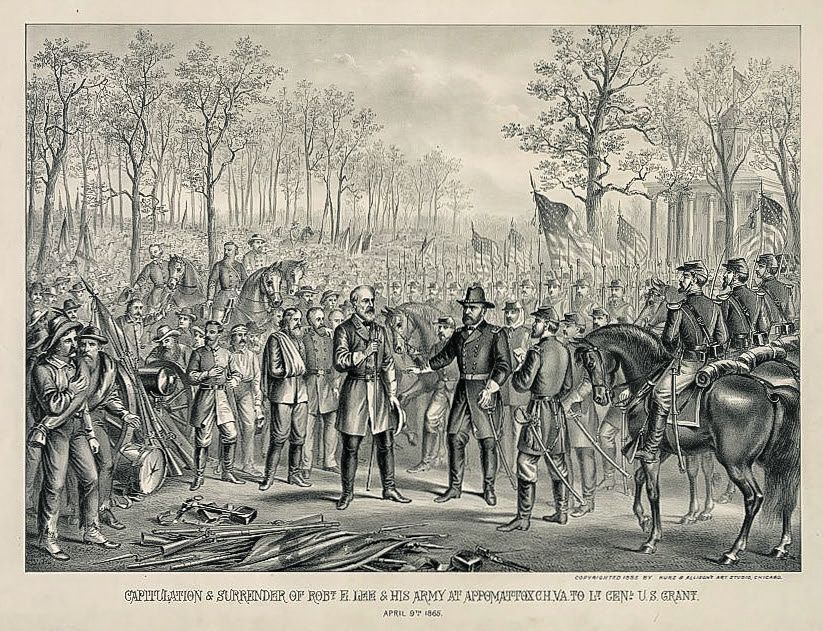
Fantastical Surrender The Graphic War highlights prints and printmakers from the Civil War discussing their meaning and the print maker or artist’s goals. There were no artists, lithographers, or engravers that April 9, 1865, at Lee’s Surrender. But that didn’t stop major Northern publishing/printhousesfromrendering a version of “what might have happened.” Unfortunately, they got it only half right. Most popular depictions of Lee and Grant at Appomattox were interior shots; they are the ones that come to mind. There is Lee in his fine pressed uniform sitting across from Ulysses S. Grant dressed in an enlisted man’s coat, muddy boots, and from his own account, recently suffering from an excruciating headache. They are seated across from each other at a ridiculously small table with a paper or two on it. Aides from both camps hover on all sides. After the April 7 Union victory at Sailor’s Creek, Grant proposed that the fighting end and Lee surrender. Lee held out for two more days before he finally accepted that his cause was hopeless and Grant held the upper hand. When the two finally agreed to talk, confusion began that ultimately led many printmakers and artists astray. Lee sent a message to Grant offering to meet. Grant gave one of his staff officers, Orville Babcock, his response. According to the National Park Service, “Babcock crossed into Confederate lines” and “found Lee resting in an apple orchard near the village…. From a distance, Babcock bore a resemblance to Grant, so as soon as news of the surrender started going around, many thought Babcock’s visit to Lee was the surrender meeting. This confusion led to one of the myths surrounding the surrender at Appomattox, and it caused quite a few soldiers to chop down apple trees in the orchard and cut them into souvenirs of the ‘surrender.’”1 Printmakers immediately conflated the actual indoor surrender meeting with this preliminary meeting to discuss a meeting between the two generals. John Smith was one of the earliest out of the gate (Fig. 1). In the same year according to some sources, 1868 by others, Smith produced a large folio lithograph entitled “The Surrender of General Lee/ And his entire army to Lieut. General Grant, April 9th 1865.” The two principles are standing in an open field under a central apple tree; Grant is handing Lee the surrender terms. In the background are the two armies, symmetrically placed behind their leaders. On the left and right are two unmounted staff officers from each camp. Not to be outdone, the team of Thomas Kelly, William C. Robertson, and Edward Valois, possibly also in 1865, rushed a nearly identical version of the fantasy surrender to public view (Fig. 2). In Kelly’s print, Lee and Grant have changed places; two mounted officers replaced the two on foot on the left and right of the principle negotiators. The apple tree remains central to the tableau. Again Grant is handing Lee the terms of surrender and the print is mis-labeled as Lee’s Surrender. Yet another publisher used the same scene. Artist Joseph Hoover also published an 1865 hand-colored lithograph published by A.L. Wiese. In “The Surrender of General Lee and His Entire Army to Lieut. General Grant April 9th, 1865.” Hoover and Wiese continued the myth with the subtitle: “This memorable event terminated the Great Rebellion.” Same scene, same message. A fourth variant (Fig. 3.) by the firm of P.S. Duval provided another version of Hoover’s fantasy surrender. Also entitled Lee’s surrender, here the principles are both on horseback with their staff. Lee rides and reads at the same time as Grant points the way to the future. Never to be outdone, the firm of Kurz and Allison, well known for their theatrical and “over-thetop” prints, cast Lee and Grant with a cast of thousands in their 1889 version of the surrender (Fig. 4). Facts were not an issue with the firm’s depiction of the historical event. The title margin reads: “Capitulation & Surrender of Robt. E. Lee & His Entire Army at Appomattox C.H., Va. to Lt. Gen. U.S. Grant, April 9, 1865.” The apple tree is gone, Lee and Grant are standing facing each other. No documents or papers are exchanged, but outlandishly, Lee is presenting Grant his sword. Grant noted in his autobiography that “the much talked of surrender of Lee’s sword and my handing it back” was the “purest romance,” Grant’s personal word for “fantasy.”2 According to Harold Holzer, et. al. the “atmosphere of the McClean parlor was too mundane.” The apple orchard was “a perfect excuse to dramatize” the moment. After all, “the war that had been fought on the field had to be surrendered in the field, in much the way the British had capitulated to George Washington.” Holzer suggests that “some Fig. 2. Two horsemen to the left and right of Lee and Grant. By Thomas Kelly, Wm. C. Robertson, Edward Valois. Ca. 1865. printmakers may actually have believed it because it offered a superior artistic setting for their panoramic prints.” Kurz and Allison’s late entry fits Holzer’s assertion that, “for years the majority of Appomattox prints portrayed Lee’s surrender to Grant in an outdoor setting.”3 Printmakers may have heard that Lee and Grant did meet outdoors the next day, April 10, 1865. The two leaders did not meet to negotiate the surrender however, that had been done indoors the day before. In their second meeting, Grant urged Lee to consider advising “the rest of the Confederate forces to lay down their arms.”Lee demurred, stating he had to confer with Jefferson Davis as he did not have the authority to do so. During the half hour meeting they spoke of operational and organizational details relative to the surrender.4 Thanks to printmakers’ misinformation, we are confronted today with a myriad of fantasy depictions of one of the most historically important moments in American history. Endnotes: 1. https://www.nps.gov/apco/learn/historyculture/the-surrender-meeting.htm 2. Grant, Memoirs, 2: p. 490, p. 494. 3. Harold Holzer, Gabor Boritt, Mark E. Neely Jr. The Confederate Image: Prints of the Lost Cause, Chapel Hill: University of North Carolina Press, 1987, pp. 74-75. Lithographer James Queen also produced an 1866 print showing the two at the apple tree, Lee reading a document and Grant pointing off into the distance. 4. William Marvel, A Place Called Appomattox: Community at the Crossroads of History. Chapel Hill, University of North Carolina Press, 2000, pp. 249-250.
After 43 years in the museum field, Salvatore Cilella devotes his time collecting American prints and maps and writing. His last professional position was President and CEO of the Atlanta History Center. His most recent books are Upton’s Regulars: A History of the 121st New York Volunteers in the Civil War (U. Press Kansas, 2009). His two-volume Correspondence of Major General Emory Upton, (U. of Tennessee Press, 2017), received the 2017–2018 American Civil War Museum’s Founders Award for outstanding editing of primary source materials. His latest book “Till Death Do Us Part,” an edit of Upton’s letters to his wife 1868–70, was published in 2020 by the Oklahoma University Press.
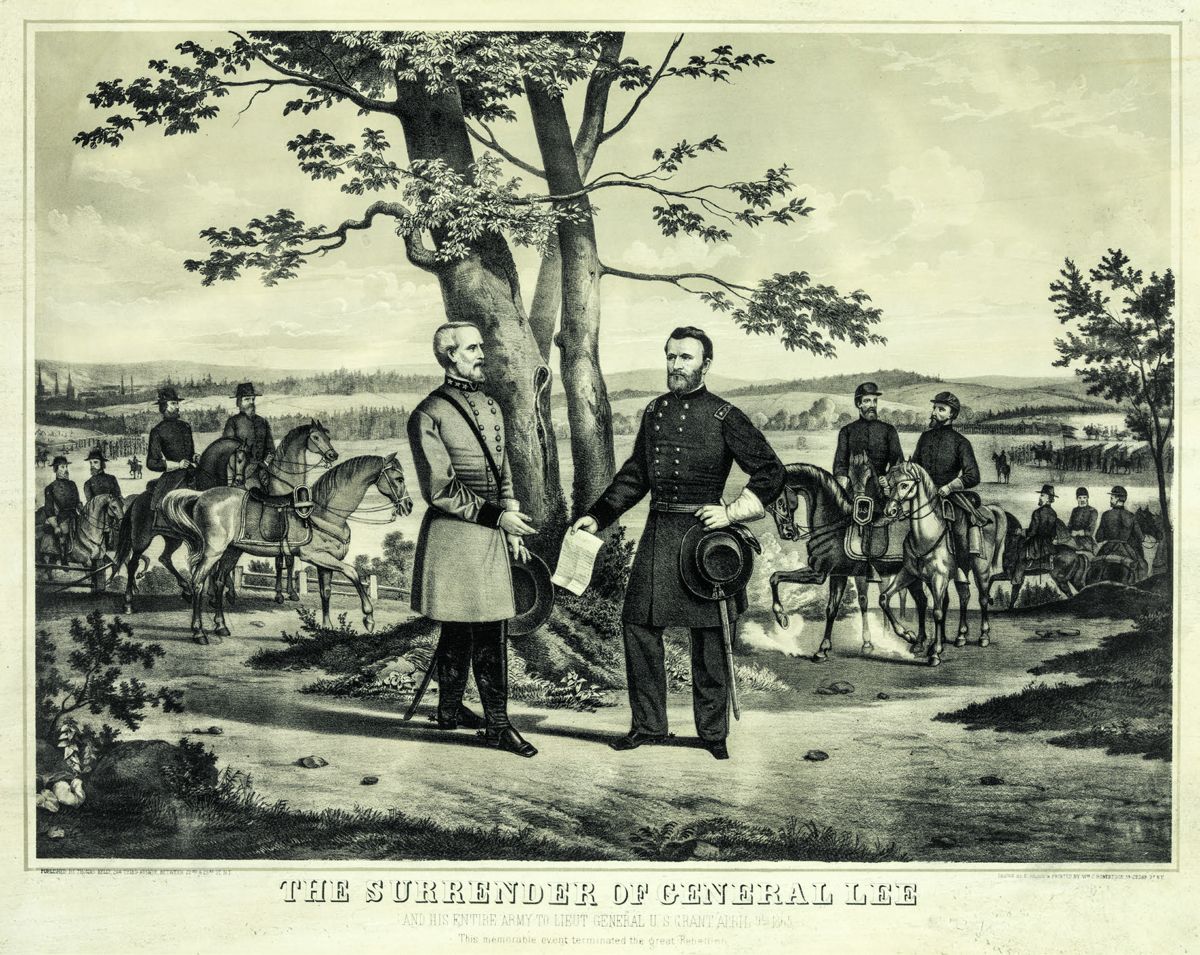
Fig. 3.Duval litho.
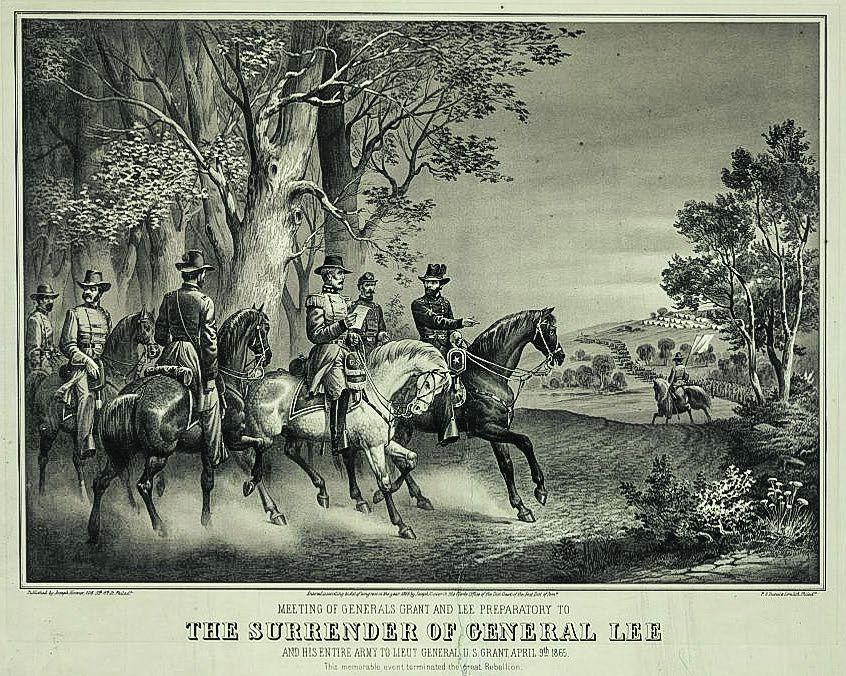
Fig. 4. Kurz and Allison, 1890.