
Through The Lens
Crook’s Devils
By Stephanie Hagiwara · Originally published September 2021 · p. 18
Crook’s Devils “Fighting battles is like courting girls. Those who make most pretension and are boldest usually win. So go ahead, give good hearty yells …[But] don’t expose yourself to show bravery; we know you are all brave.”– U.S. Col. Rutherford B. Hayes, 23rd Ohio In August 1864, U.S. Gen. Ulysses S. Grant appointed 33-year-old cavalry officer Gen. Philip H. Sheridan commander of the reorganized Army of the Shenandoah Valley, Va., with the orders to “put himself south of the enemy and follow him to death.” Initially, Sheridan was cautious. He was unsure about the size of C.S. Gen. Jubal Early’s Army of the Valley and wanted to avoid the political consequences of a defeat. On September 14, Grant went to Charleston, Va. to nudge Sheridan into action. Under a large oak tree, Sheridan did the talking. He shared with Grant the intelligence that C.S. Gen. Kershaw’s Division and C.S. Col. Wilfred Emory Cutshaw’s Artillery Battalion were returning to Richmond, Va., then presented his attack plan to Grant with the assurance that he could
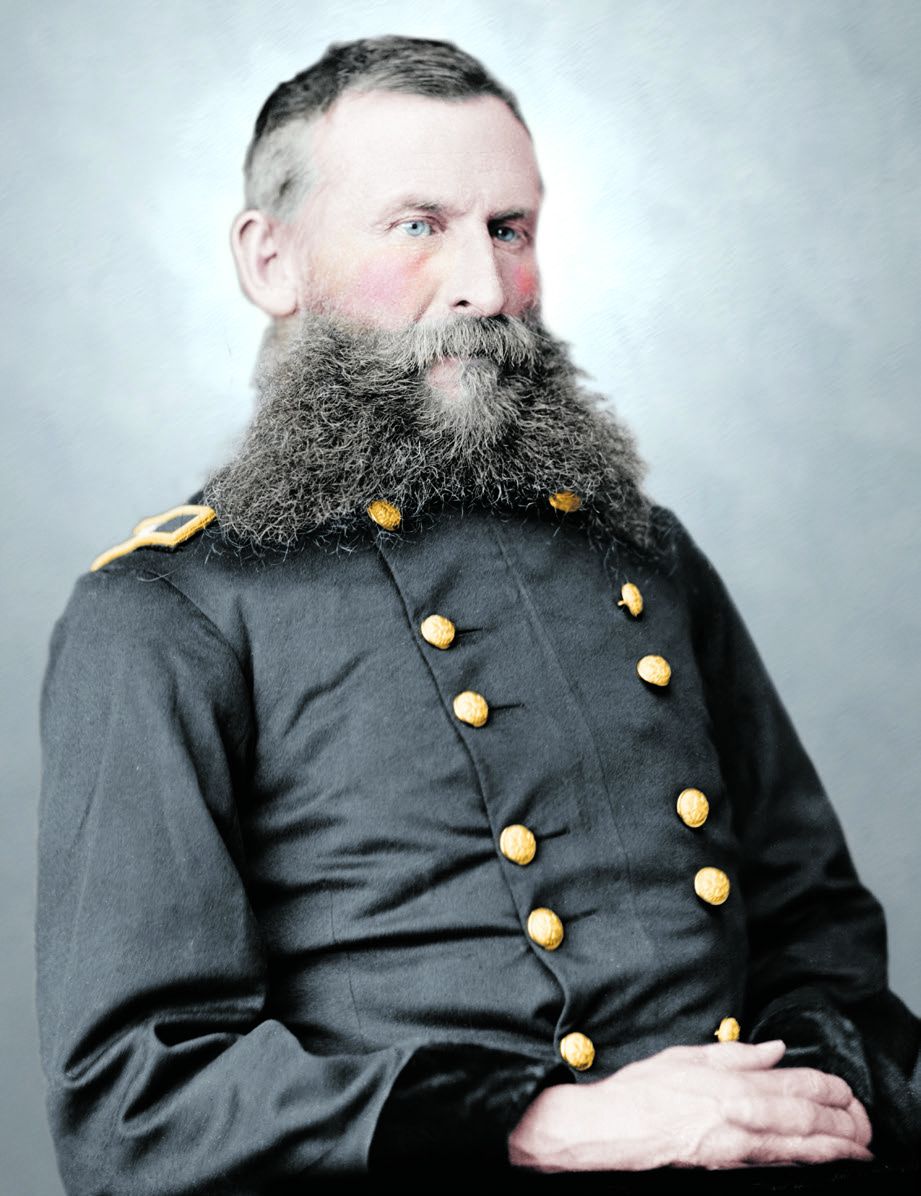
“whip them.” Grant’s response was to ask if he could move by Tuesday, four days hence. “Oh yes, Sheridan replied, “could be off before daylight on Monday.” In the briefest order he gave during the War, Grant said, “Go in.” Early thought Sheridan “possessed an excessive caution which amounted to timidity.” He split his army, taking his infantry to Martinsburg, Va., to investigate a rumor the Federals were destroying the railroad. On Sept. 18, Early learned of Grant’s visit with Sheridan. Both sides knew, “When that old cuss [Grant] is around there’s sure to be a big fight on hand.” On Monday, Sept. 19, Sheridan ordered his 20,000 men to funnel through the Berryville Canyon, which took longer than he expected. The Third Battle of Winchester began before 6 a.m. as the Confederates attacked Federals emerging from the gorge. By 1 p.m. Sheridan needed to send in his reserves, the forces of Gen. George Crook’s VIII Corps. Instead of just protecting the extreme right of the XIX Corps, Crook decided his fresh troops would aggressively fight C.S. John B. Gordon’s Division on Early’s left on the north side of Winchester.
Among Crook’s troops was future president Rutherford B. Hayes, commanding the 1st Brigade, 2nd Kanawha Division. Volunteering at the start of the war with his Literary Society friends, 38-years old Hayes was soon promoted to major in the 23rd Ohio. He would develop a close relationship with 18-yearold William McKinley, another future president, who was also serving in the 23rd Ohio. According to McKinley, Hayes “was the most beloved officer in the regiment from the beginning to the end of the war. He was ever looking after the care and well-being of the thousand young men who came from different parts of the state, strangers to him, with no military experience, and no experience in taking care of themselves.” “Hayes took desperate chances in battle”, McKinley said, years later. “He seemed like one inspired. His quiet nature at once changed. He permitted nothing to stand in his way, and he often recklessly exposed himself.” In 1864, news of his exploits resulted in his candidacy for the U.S. House of Representatives. Hayes could have missed fighting the battle to campaign but thought, “An officer fit for duty who at this crisis would abandon his post to electioneer for a seat
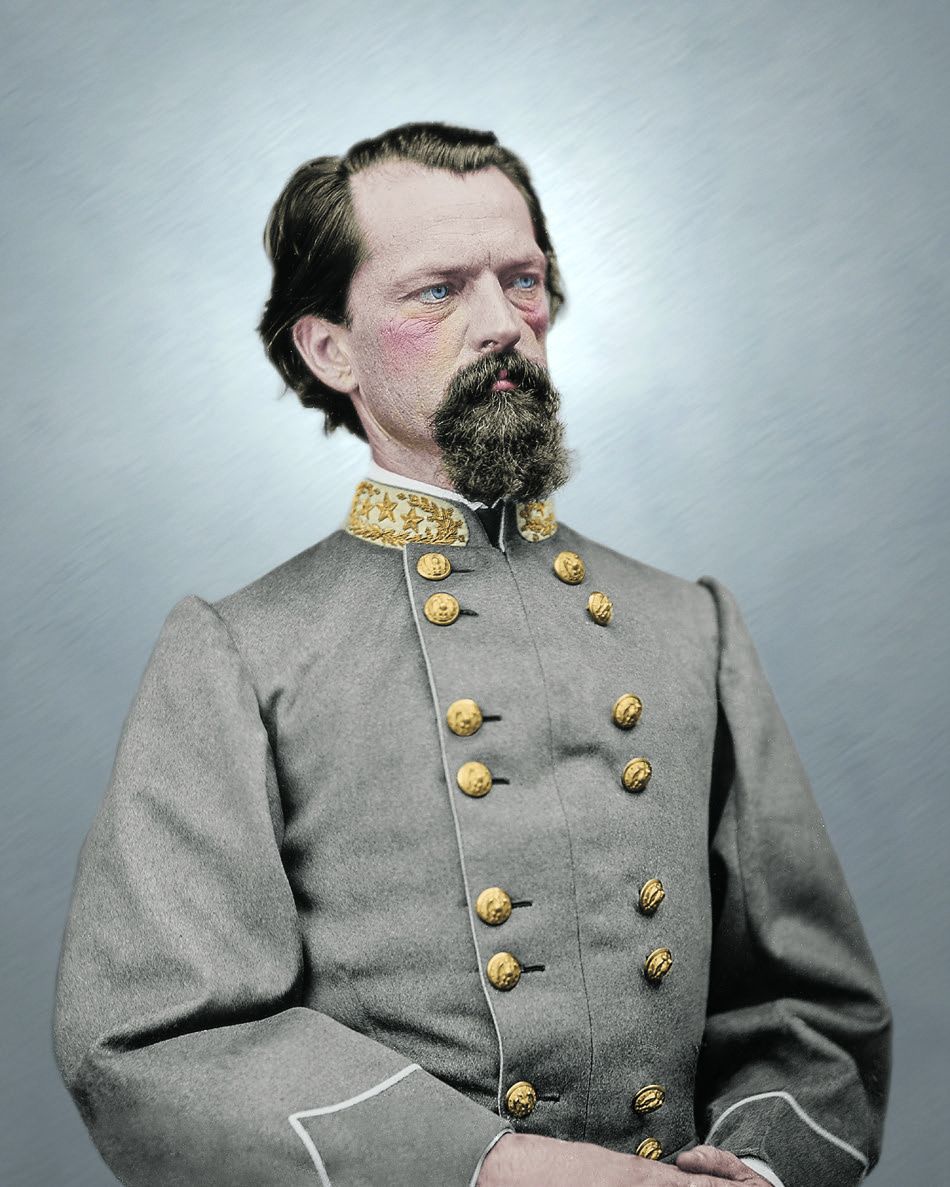
Gen. George Crook. Colorization © 2021 Gen. John B. Gordon. Colorization © 2015 civilwarincolor.com, courtesy civilwarincolor. civilwarincolor.com, courtesy civilwarincolor. com/cwn. Library of Congress. com/cwn. National Archives.
in Congress ought to be scalped. You may feel perfectly clear I shall do no such thing.” To get into position, Crook’s men marched six miles through the ravine and the rear of the battlefield. Hayes’s Brigade was selected to find the enemy’s left, “strike and carry it at all hazards.”The men moved at the double-quick across an open field under “galling fire,” burst through a thicket only to discover Red Bull Run, “a deep creek with high banks, boggy, and perhaps twenty-five yards wide. … Of course the line stopped. To stop was death. To go on was probably the same,” wrote Hayes. Hayes instantly made his decision, “spurring his horse into the morass called out in voice clearly heard above the hellish sound of battle ‘Come on boys’”, recalled Capt. Russell Hastings. “… Hayes’ horse sticking in the mud, off he got, floundering along with his boys, who with cartridge boxes thrown upon their shoulders, wade and plunge and drag themselves along. … and Hayes, first across, reaching the brink led the charge up the steep bank.” Coming out of Red Bull Run, the soaking wet Federals swarmed after him, “all regiments mixed up – all order gone. [There was] no chance of ever reforming, but pell-mell, over the obstructions, went the crowd.” Crook’s other division, with some of the XIX and VI Corps arrived. “For thirty minutes the battle that ensued was perfectly terrific,” recalled one participant, “but then the forces in our front gave way, and in an instant we were over their works, and after them with yells and shouts of victory.” Cavalry would drive Early’s army out of Winchester, leaving it in Union control for the rest of the War. The battle was the bloodiest to date in the Shenandoah Valley. Hayes would write to his wife, “I certainly never enjoyed anything more that [sic] the last three hours … The sum of it is, … Crook’s skill and his men turned the Rebel left making victory possible, and the cavalry saved it when it was in danger of being lost.” Several years later, Hastings said, he met one of the rebel generals who had commanded that day, the exemplary John B. Gordon, who pointed to a scar on his cheek and said, “I
Gen. Rutherford B. Hayes. Colorization © 2021 civilwarincolor.com, courtesy c i v i l w a r i n c o l o r. c o m / c w n . Public Domain. am indebted to Hayes’s boys for this beauty spot. When we first saw Hayes and his men coming over the hills, we rather laughed the movement to scorn, knowing of this morass on our left, but when in you came, plunging into the morass as though it were mere pastime, we began to wonder of what metal such men were made. One of my staff officers remarked, ‘they must be devils …’ After that charge my men always spoke of your corps as ‘Crook’s devils.’” Sources: •
•
•
Perry, James. Touched With Fire, Five Presidents and the Civil War Battles That Made Them: Public Affairs, 2009 Wert, Jeffry D. From Winchester to Cedar Creek: The Shenandoah Campaign of 1864: South Mountain Press, 1987 Williams, Charles Richard. (Ed.) The Diary and letters of Rutherford B. Hayes, Vol. II: Ohio State Archaeological and Historical Society, 1922
Stephanie Hagiwara is the editor for Civil War in Color.com and Civil War in 3D.com. She also writes a weekly column for History in Full Color.com that covers stories of photographs of historical interest from the 1850’s to the present. Her articles can be found on Facebook, Tumblr and Pinterest.