
The Unfinished Fight
Coggins Point Raid, September 1864
By Craig L. Barry · Originally published September 2021 · pp. 8–9
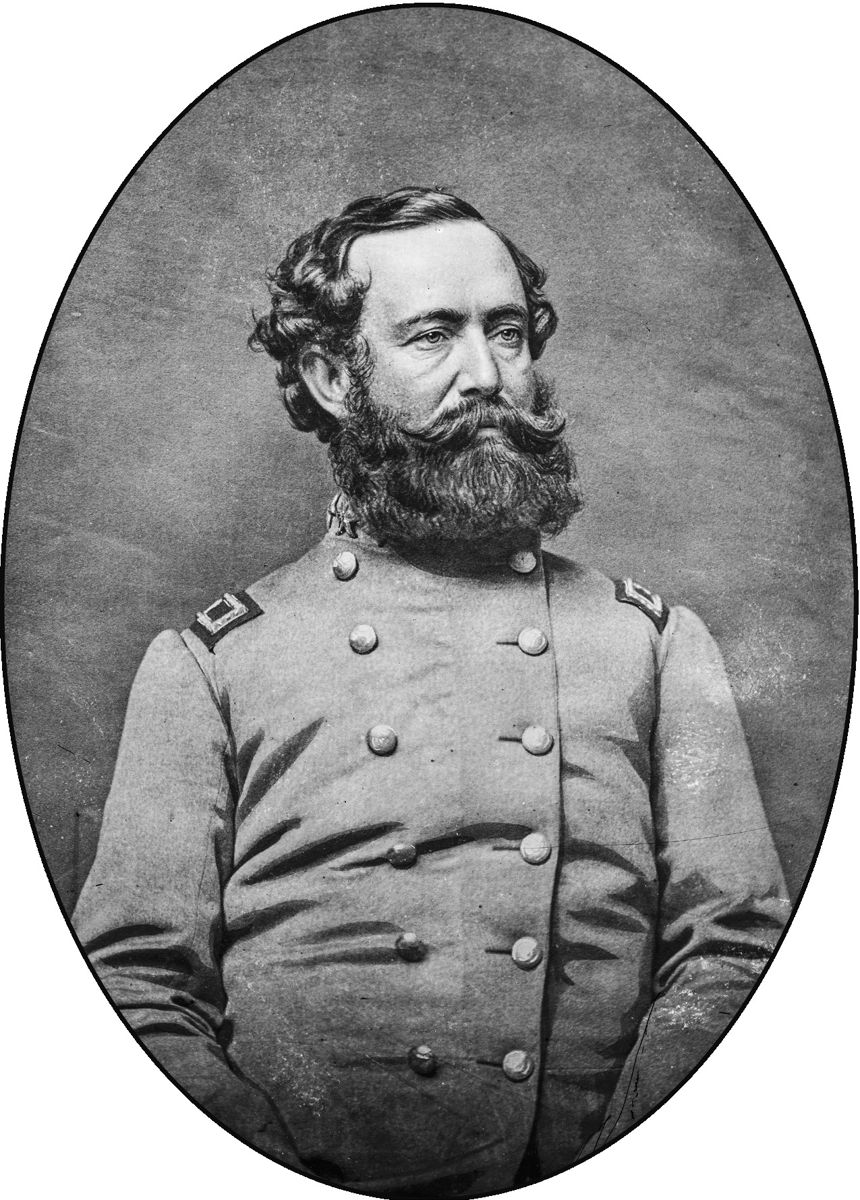
General Wade Hampton’s successful Great Beefsteak Raid at Coggins Point was a unique and interesting footnote to the Petersburg/Richmond campaign of 1864. Of the beef provided by the raid, Tracy J. Power noted in Lee’s Miserables: Life in the Army of Northern Virginia, “Thay ware [sic] the best beeves I ever saw, and it is opinion of all who saw them that thay will average five or six hundred pounds.” This interesting large-scale cattle raid by Hampton merits further discussion. In mid-September 1864, a stalemate in Virginia existed around Richmond and Petersburg. In the trench warfare characterizing that campaign, the lull between the Second Battle of Reams Station in late August and The Battle of Chaffin’s Farm in late September was interrupted by a bold maneuver by Confederate cavalry led by General Wade Hampton. After the untimely death of ANV Cavalry Corps commander J.E.B. Stuart at Yellow Tavern in May 1864, Major General Wade Hampton was ultimately given command of the Army of Northern Virginia Cavalry Corps, though his selection was by no means without controversy. Hampton was chosen over General Robert E. Lee’s nephew, Fitzhugh Lee, in something of an upset to the logical progression to higher command. In making his decision, Robert E. Lee gave a less than stunning endorsement of the new commander: “General Hampton, I think, deserves it from both his services and gallantry; Of General Fitz. Lee I do not wish to speak so positively, but I do not know of any other officer in the cavalry who has done better service. I should admire both more if they were more rigid in their discipline, but I know how difficult it is to maintain rigid discipline in our armies and therefore make allowances.” This reflected a mollified view from General Lee’s opinion as expressed five months earlier (March 1864) and given in response to complaints from General Hampton of personality clashes with General J.E.B. Stuart, for which Robert E. Lee had little patience. It was recorded anecdotally that Robert E. Lee directly replied to Wade Hampton’s complaints with less than his normal diplomacy: “I would not care if you went back to South Carolina with your whole division.” The choice of words is interesting, and Wade Hampton was deeply offended. Mary Chesnutt makes mention of it in her diary, where she also noted that Wade Hampton found Robert E. Lee’s tone in delivering the statement, “immensely mortifying.” However, a short time later, after the victory at Trevillian Station in June 1864, Wade Hampton noted a change in tone mentioning that, “He (Robert E. Lee) is now very civil to me.”Whether that was out of necessity or a change of heart, the two soon conjured up a plan reminiscent of the kind of bold endeavor conducted in the past with such aplomb by General J.E.B. Stuart when he commanded the ANV Cavalry. In early September, Hampton received a detailed report from Sergeant George Shadburn, a scout who had penetrated well behind Union lines. His information suggested that the supplies at the rear of the Union army were lightly guarded by one hundred soldiers and largely unarmed civilians, a fact that is difficult to believe but none-the-less proved true. Those supplies included a substantial herd of cattle estimated at 3,000, grazing at Coggins Point along the James River. Fresh beef provided a welcome relief from the steady Confederate diet of salted meats. The Union Army of the Potomac had cattle drivers directed by the Quartermaster’s Department.These men followed behind the army with a herd of
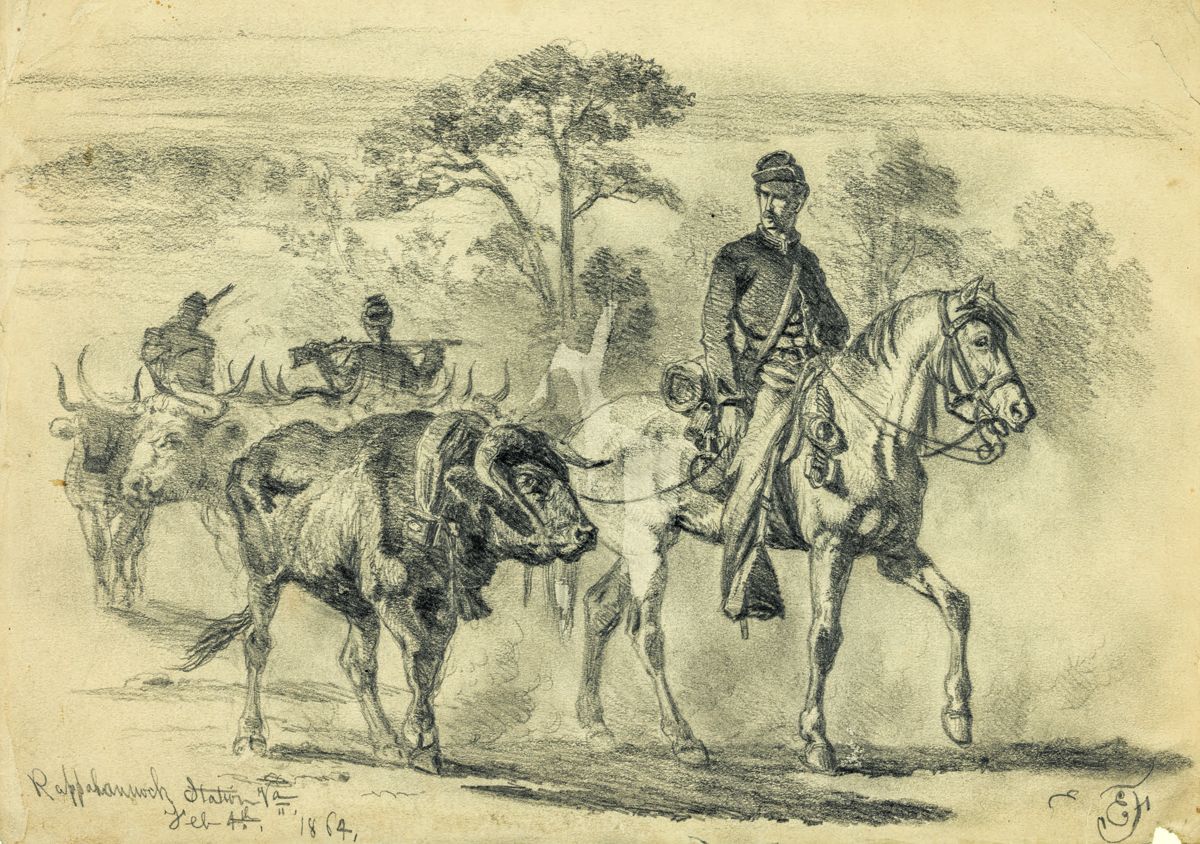
cattle. Whenever the infantry stopped for the evening, a number of cattle were slaughtered and issued that night or early the next morning so that soldiers could prepare the meat for use that day. Most soldiers enjoyed their fresh beef ration broiled on a stick over an open campfire. Since the army consumed about 100 head of cattle per day, this size herd represented a 30-day supply of fresh beef. The cattle were of an unspecified breed and reportedly came from midwestern stockyards. In a report from Lt. Col. A.B. Warfield, Q.M.C. of the Federal Quartermasters Department, dated September 1864: “All provisions are purchased by contract, proposals to furnish them having been invited by public advertisement. The salt meats and fresh beef for the army are brought from the north. About one hundred head of cattle are used per day; and they arrive in lots of some five hundred at a time. Those came from Chicago, and nearly all that are used are from Illinois.” One question then is what sort(s) of cattle were these? What breeds of beef cattle originating from Illinois were used by the Union army? Well, depending on how this is interpreted, it could mean almost any breed of beef cattle known to the time period. The fact is virtually all beef sold to the Federal government“on the hoof”came through the Chicago stockyards and was transported by rail from there to the army before being driven to the front. Therefore, in a manner of speaking, all beef “came from Illinois” regardless of the origin of the particular breed or variety. This herd was most likely one of the smaller “shorthorn” beef varieties, common throughout the mid-west and Illinois. Texas Longhorn steers are quite a bit larger and the much larger breeds such as Herefords, Charolais, and Limousines, were not commonly found in the mid-west until years after the Civil War. The description of the captured cattle as“weighing between five hundred and six hundred pounds,” while not scientific, does support the notion that this herd was more likely to have been the smaller shorthorn breeds most common to both Illinois and the mid-western plains. However, another account estimates the size of the cattle captured at Coggins Point as “…up to 1,500 lbs (and) all are western cattle and recently arrived to Grant’s army.” Who knows? This is a huge difference in estimated size of course, but in the final analysis this made little difference to the hungry men who were getting fresh beef. The alternate meat ration (when available) was salt pork or salt beef, the latter Library of Congress. derisively labeled “salt horse” by the soldiers. It was hard to work with the salt beef ration as it needed considerable soaking before it could be cooked or eaten. Even then, it was still often spoiled or infested with worms from improper curing or packing and gave off a less than appetizing odor. Fresh beef was beyond doubt the preferred meat ration of the Civil War soldier, followed closely by fresh hog. Robert E. Lee had some initial reservations about the plan for the Coggins Point raid. There was an element of risk the Confederates could ill afford to take under the circumstances. Lee had no doubt that the cavalry could capture the herd along with any incidental supplies, but he expressed a valid concern about the speed with which the expedition could return to Confederate lines“embarrassed with cattle and wagons.” As a result, General Lee planned a diversionary attack for the same day and went forward with the plan. One matter of tactical importance was that the cavalry raid was kept completely confidential as though Lee and Hampton were somehow reminded of Stonewall Jackson’s famous method for success. This proved to be the key as apparently neither Wade Hampton nor Robert E. Lee shared the details with their subordinates and the target of the attack was indeed a true surprise for all involved. Whatever the reason for secrecy the result was that at dawn the morning of September 16, 1864, Rooney Lee’s Division and Rosser’s Brigade shocked the Federal cavalry encamped at Sycamore Church about two miles from the herd. Such was the complete surprise that by 8 a.m., after a brief but stalwart initial resistance, the rout of the halfdressed Union soldiers was finished and the supplies and prisoners were on their way back. Rosser sent a special detachment to round up the cattle and drive them immediately to Petersburg. The cavalry covered over one hundred miles in 72 hours, returned with 304 prisoners, 11 wagon loads of supplies, and two million pounds of beef. The cattle stretched out in a line seven miles long. Federal pursuit was quashed near Ebenezer Church and, upon re-crossing the aptly named Blackwater River; the Confederates burned the bridge behind them. General Ulysses S. Grant wired George Meade to send additional troops in pursuit, but Meade demurred. Ever cautious, he replied, “Hampton’s force is so superior to ours, there is no time… it is futile.” And so, the ANV Cavalry Corps with Wade Hampton at their head led the herd through the streets of Petersburg on their way to the Commissary Department. The Confederates were happily “eating Hampton steaks” for weeks afterwards. During this time one soldier wrote a letter home about his welcome meal of:“…sweet potatoes, Irish potatoes, biscuits with butter…and last but not least some very nice beefsteak which was intended for the boys over the way but which through the instrumentality of a gentleman named Hampton of whom you have doubtlessly heard was transferred to this side of the lines, much to our satisfaction.” The supply of beef might have lasted longer, but the Confederates lacked the extra hay or grain to feed such a large herd. Shortly afterwards General Grant purportedly treated Meade and some of his other commanders to some “beefless” dinners at headquarters to reinforce his dissatisfaction with the embarrassing outcome of Wade Hampton’s Great Beefsteak Raid at Coggins Point. On the other side, Robert
E. Lee praised his cavalry’s “energy and courage.” The Richmond press was delighted with the audacious turn of events. That Hampton had made his way unobserved such a distance from Confederate lines, and then made it back with a large herd of what are acknowledged to be slow and plodding creatures was eerily reminiscent of the earlier heroic exploits of the much-lamented cavalier J.E.B. Stuart. The Richmond Examiner (stretching things a bit) called Hampton’s Raid “One of the boldest and most brilliant things of the war.” As might be expected, the Washington Herald was embarrassed and aghast, noting “…the rebels have succeeded in this bold maneuver and have actually taken from beneath our very noses sufficient beef to supply their army for weeks.”
Craig
L.
Barry was born in and
Masters degrees from
Craig served
The
Charlottesville, Va. He holds his BA the University of North Carolina (Charlotte).
Watchdog Civil War Quarterly as
Associate Editor and Editor from
2003–2017. The Watchdog published books and columns on 19th-century material from and donated publications preservation.
to all funds battlefield
He is the author of several books including The Civil War Musket: A Handbook for Historical Accuracy
(2006, 2011), The Unfinished Fight: Essays on
Confederate
Material
Culture Vol. I and II (2012, 2013). He has also published four books in the Suppliers to the Confederacy series on English Arms & Accoutrements, Quartermaster stores and other European imports.