
A Presentation Louisiana Flag
By Shannon Pritchard · Originally published September 2021 · pp. 32–33
By Shannon Pritchard
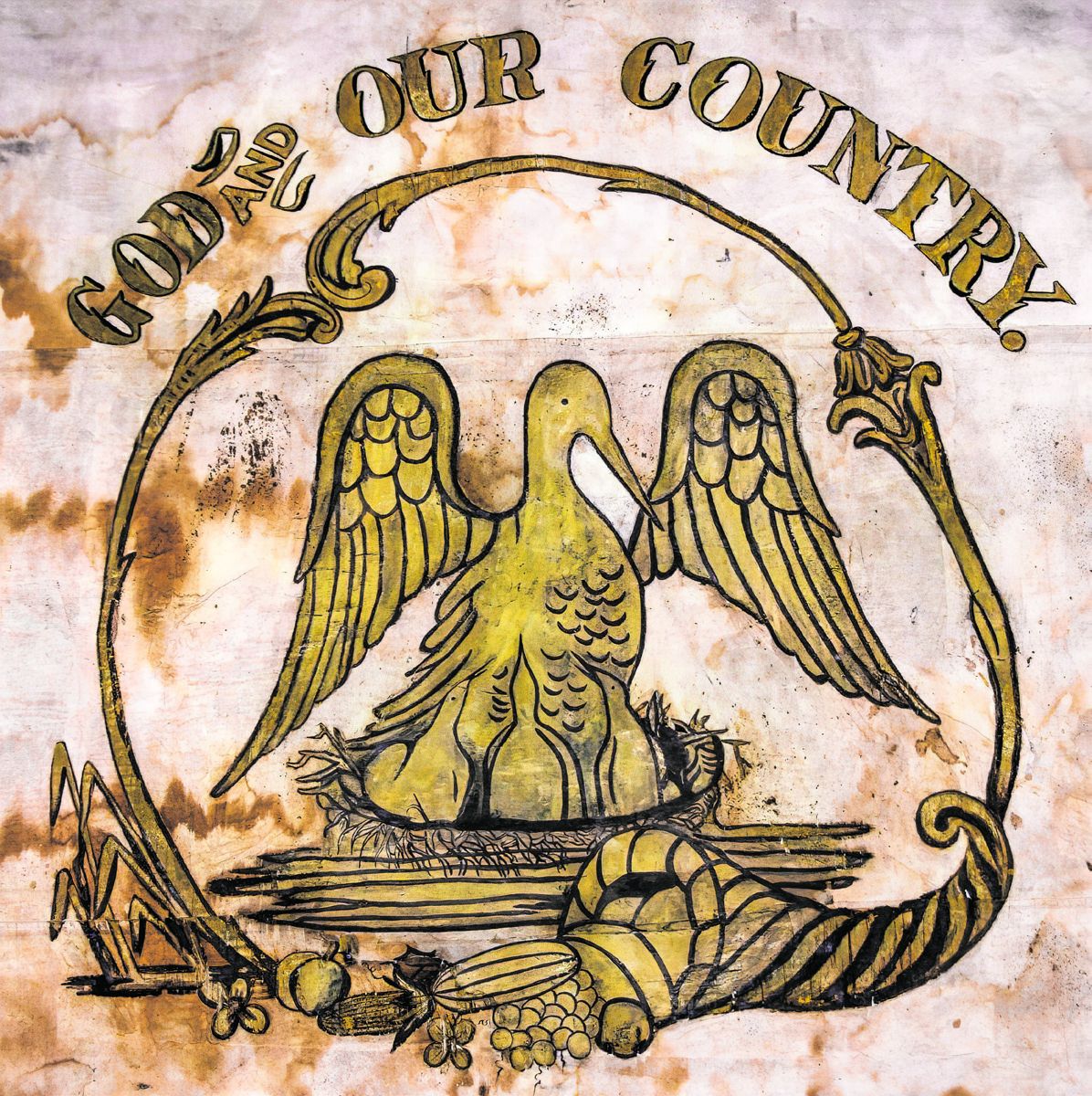
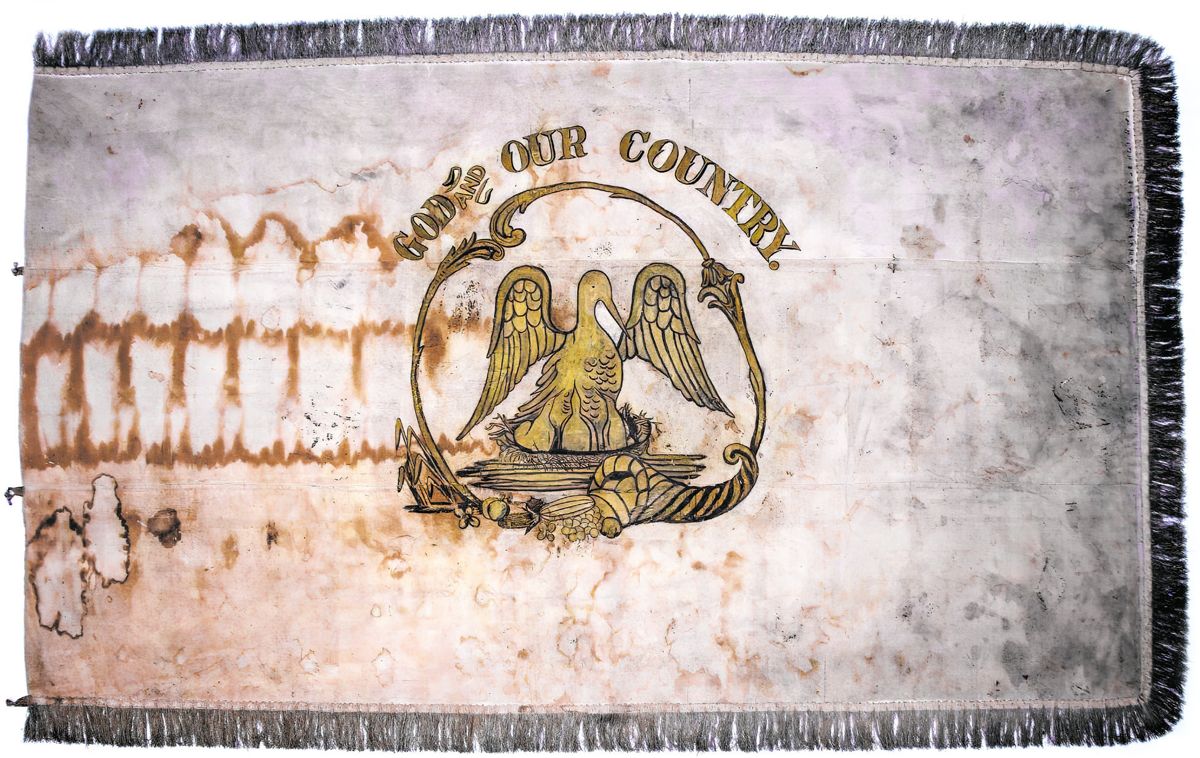
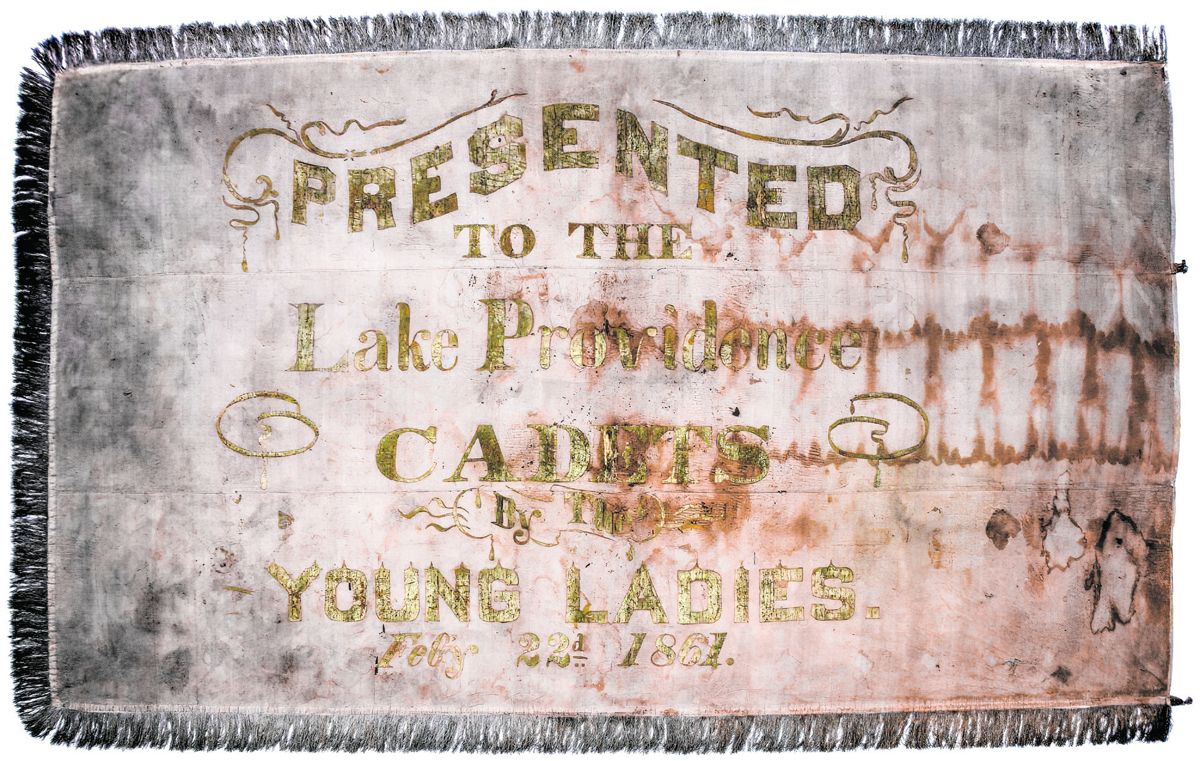
This beautiful work of art has an extraordinary amount of known history associated with it. The flag is large, measuring 75.75 inches by 115.75 inches. The flag’s history is recorded on the flag itself. The obverse side bears the Louisiana State Seal, a nesting Pelican feeding her young from the blood of her own breast. The seal is surrounded by an outline border of vines, at the base of which is a cornucopia, a cannon barrel, and sprouting sugar plants, the whole beautifully executed in gold and outlined in brown to give it depth. Roman stylized letters 3 3/8 inch high display the motto, “God And Our Country.” The artwork, on a field of pure white, portrayed the wealth, the might, and the staple that surrounded their homes and families, and proclaimed their allegiance to the God of their fathers and the country of their birth, at that time the sovereign state of Louisiana. Nearly every company and regiment that marched off to the War was presented a flag by the ladies of the town or county where the unit was raised or by the ladies of the town they were defending. These presentations followed a regular form, the men would be drawn up in formation and one lady would make a presentation speech. The speech would generally exhort the men to defend the South and Southern womanhood’s honor to their dying breath, all couched in flowery prose. Though many bearing the Pelican of Louisiana were presented in those heady days of 1861, only four are known to survive because they were almost always made of silk; often taken from the wedding dress of a prominent officer’s wife. Of the four survivors, three are institutionalized, making this the only known original flag bearing the Louisiana State Seal in private hands.* Another rarity is the record on the flag’s reverse that records who the flag was presented to, who presented it, and when; a remarkable record indeed!The reverse field is made of pink silk, no doubt as a reminder of the fair ladies that presented it. “Presented To The Lake Providence Cadets By the Young Ladies. Feb.’y 22d .. 1861.” This too is artistically executed in the most beautiful style. The June 16, 1861, edition of the New Orleans Times Picayune makes note that of the 104 rank and file, nearly all are single men. Thus arises the question of the chicken or the egg? Did all those singles join because the ladies loved the company, or did the ladies love the company because all those single men joined? Alas, the intricacies of love and war. The Lake Providence Cadets would become Company C, 4th Louisiana Infantry. After organization on May 25, 1861, the 4th received orders to serve on the Mississippi Gulf Coast. Through the summer, the companies were divided between camps at Pascagoula, Biloxi, Pass Christian, Mississippi City, and Ship Island. After the evacuation of Ship Island in September, the regiment moved to Franklin and Brashear City to protect the lower Atchafalaya River and Bayou Teche. In February 1862, the
Camp Fayetteville, York county, Va., September 9, 1861. Messrs. Editors: The First Regiment of North Carolina Volunteers being formed for dress parade this afternoon, Mr. John W. Baker, Jr., in the name and on behalf of the ladies of Fayetteville, presented to them a very handsome Confederate flag, and accompanied the presentation with the following remarks: “Officers and Ladies of the First Regiment North Carolina Volunteers: It is with mingled feelings of pride and pleasure that I find myself addressing a North Carolina regiment upon the soil of Virginia—the home of Washington—and that, too, near the battle-field of Yorktown, where in the days of the Revolution the clarion voice of the Father of his Country was heard, leading our noble sires to glory, to victory and renown. Aye, it was on this spot, in the days that tried men’s souls, that the smoke of battle might have been seen ascending from the valley and the hill top; it was here that Cornwallis, the pet of the lion King of Great Britain, surrendered his sword to the leader of that little Spartan band who were then in mortal strife for their homes, their firesides and for liberty, that inestimable boon which they have given us as an inheritance, and which we so highly prize, that anathema would be pronounced upon any degenerate son who would essay to name its equivalent. Is it not, my friends, a remarkable coincidence that you are here to-day, in this boasted age of progress in civil and religious liberty, near the same spot, prompted by the same motives and actuated by the same feelings that animated the breasts of your noble ancestors, in making red with blood the field of Yorktown and consecrating it to liberty, and as it was their mission then so it is yours to-day to lay bleaching upon the plains of Virginia the bones of the invader who is seeking to rob you of your birthright, to subjugate, devastate, lay waste and utterly destroy, aye, everything that is near and dear to the heart of an American freeman. Continue, my friends, to meet them as you have begun upon the threshold; meet them, as I know you will do, like men; let their blood be upon their own hands; let their graves be in Virginia. As to how you have acquitted yourselves as soldiers thus far, I must be permitted to say that you have discharged your every duty with a conscientious regard for the welfare of your country, which will ever endear you to every true Southron. With characteristic patience and cheerfulness you have submitted to the many hardships and inconveniences which must ever be attendant upon the tented field; and you have yielded implicit confidence and obedience to the orders of your superior officers, which is the first duty of soldiers, and by so doing you have gained the applause of our entire army as being one of the best disciplined, best officered regiments now in the tented field; and your many friends at home feel that while you have a Magruder, a Hill, a Lee, a Lane, et als of the same stamp to lead you, that they have nothing to fear. The results of the battle of Bethel have spoken, and do speak for themselves; it was then that all the resources of your minds were called into requisition, and there was naught that you would not have cheerfully sacrificed to attain the ends of your superior officers, and give success and eclat to the Confederate arms. And I trust I may be pardoned for mentioning the fact that I but echo the public sentiment when I say, that nobler men, more accomplished gentlemen, and purer patriots, were never known to draw a sword or shoulder a musket in defence of any country. And permit me in behalf of the ladies of the town of Fayetteville, whom I have the honor to represent on this occasion, to offer you their profoundest gratitude for the protection that you have thus far given to our homes and our liberties; they thank you for your patriotic courage, your heroic gallantry and your noble daring, exhibited upon the battle field of Bethel; they congratulate you, whose glorious privilege it was to participate in that ever to be remembered struggle; and they desire to assure you that Bethel Church will ever stand as a monument to the unflinching courage and bravery of the twin sister States of Virginia and North Carolina; and that it will be the pride and boast of your children in all time to come to say that on the memorable 10th of June, 1861, my father was at Bethel. Need I tell you that the struggle in which you are engaged is one of gigantic importance, and that the single issue presented to you is literally ‘liberty or death;’ need I remind you that in this contest the God of battles has already given you unmistakable evidence that He is with you—‘and if He be for you who can be against you.’ Need I say to you that at dewy morn and sultry eve the prayers of loved ones at home are offered up to the throne on high to guide, protect and defend each and every one of you, and if it be His will, when you have accomplished your mission here, that you may return in safety to the bosoms of your families and friends, whose hearthstones have been made desolate by the footfall of the invader—homes in the sunny South, where the best feelings of our nature have been wont to cluster. And as an earnest that you have the approving smiles, tender sympathies and undying confidence of those noble Spartan women that you have left behind, they present to you this beautiful regimental flag, upon which you will find inscribed (by authority of the Old North State) the word ‘Bethel,’ the talismanic influence of which simple word must ever inspire you with renewed vigor and courage; and they desire that you never cease to strike while Southern soil is polluted by the footprints of the invader; and, if needs be, that the ample folds of this flag may float gaily o’er the dome of the Federal Capitol.” The standard-bearer was then ordered to advance and receive the flag, the regiment being at a ‘present arms,’ and the Adjutant, on behalf of the officers and soldiers, officially responded as follows: Camp Fayetteville, September 9, 1861. “The officers of the First North Carolina and men Regiment, Volunteers, gratefully acknowledge the kind remembrance in which the ladies of Fayetteville have held them. No proof was needed to any Southern soldier that Southern women possess as well the zeal and patriotism which prompted such a gift, as the taste and skill which its workmanship displays. It is much, however, in alleviation of the necessary hardships of the service, far the greatest of which is the separation from our homes, and the fair spirits which minister there, to know that we are not forgotten, but that the pure and lovely women, whom it is our greatest glory to protect, are mindful of us in our absence. Something, perhaps, the regiment has done; more, if the opportunity occurs, it will gladly do, to justify, if possible, the estimation which this gift evinces. The fair donors may rest assured that the regiment will return with the flag to North Carolina, if the regiment itself returns. Charles C. Lee, Colonel, For the First Regiment.”
~
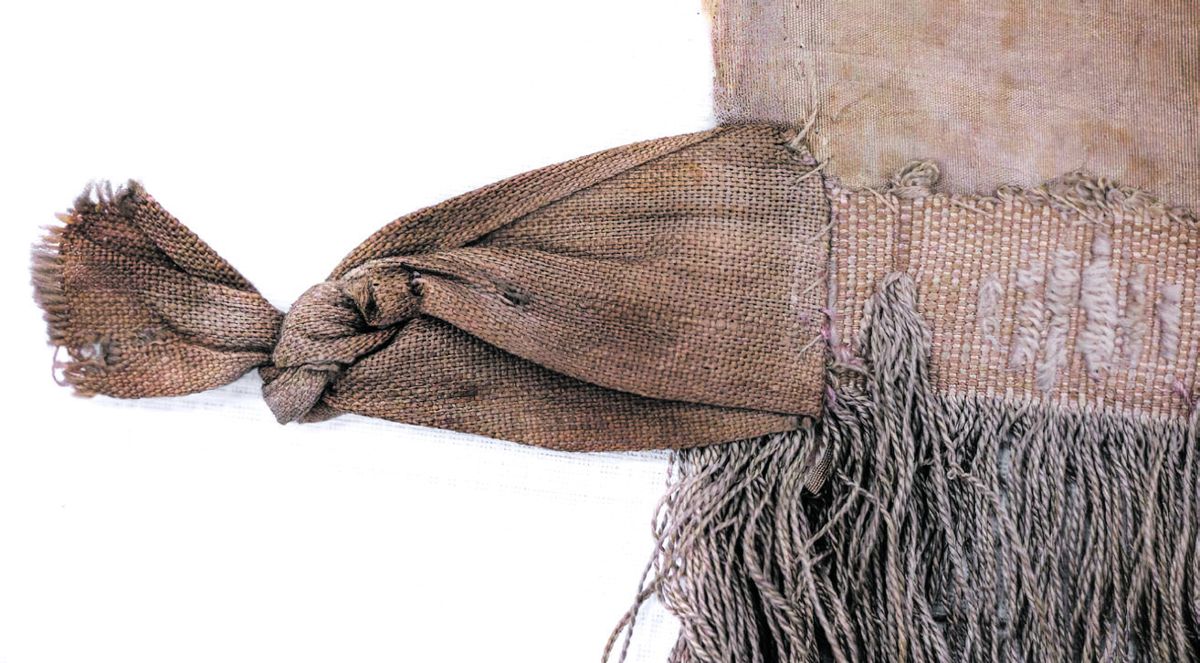
The flag was attached to the staff by four ties sewn to the hoist.
*According to Vexollogist, researcher, and author Howard Madaus, only four flags bearing the Louisiana State Seal are known to survive, and the other three are institutionalized. Shannon Pritchard has authored numerous articles relating to the authentication, care and conservation of Confederate antiques, including several cover articles and is the author of the definitive work on Confederate collectibles, the widely acclaimed Collecting the Confederacy, Artifacts and Antiques from the War Between the States, and is co-author of Confederate Faces in Color.