
The Unfinished Fight
U.S. Model 1842
By Craig L. Barry · Originally published October 2021 · pp. 8–9
The U.S. Model 1842 holds an odd, but interesting, place in history. It was the last .69 caliber smoothbore musket made by Federal armories while simultaneously being the first fully parts interchangeable musket and the first with a regulation percussion lock. It was not produced in “great numbers,” as is often stated, yet the M1842 was not rare either. Total production from the Harper’s Ferry and Springfield Armories was 272,565 spread out over twelve years. As a frame of reference, the Springfield Armory itself produced nearly that number of U.S. Model 1861 rifle-muskets in eighteen months. Private contractors also produced a few thousand U.S. 1842s, including A.H. Waters and B. Flagg in Millbury, Mass. These were distinct mostly for their brass instead of polished iron barrel bands. After A.H. Waters went out of business, Flagg entered into a partnership with William Glaze of Columbia, S.C. The machinery was relocated in 1851 to the Palmetto Armory in Columbia. Most of the Palmetto Armory’s output went to the South Carolina state militia. There were only 6,020 M1842 muskets produced on that contract; none were made there after 1853. It is currently believed that a number of the Palmetto Armory 1842s were assembled from surplus and condemned parts obtained from A.H. Waters. The U.S. 1842 was stored in Federal Arsenals throughout the South prior to the Civil War. An article in the Richmond Enquirer dated October 11, 1861 states (in part):
muskets, saved unimpaired from the Harper Ferry conflagration.” A Mexican War veteran volunteering for the Confederacy received the same U.S. 1842 musket he carried in Mexico during the mid-1840s, recognizing it from his own calligraphy carved in the stock years earlier. The article apparently does not go into detail, but by virtue of “making the newspaper” the soldier must have been very pleased by the reunion. The continued use of buck and ball rounds is one reason why the so-called “obsolete” smoothbore muskets were still seeing service on both sides when Robert E. Lee surrendered at Appomattox Courthouse in April 1865. A good source on the extent of smoothbore musket usage during the Civil War is The Bloody Crucible of Courage by Brent Nosworthy. The author reviewed ammunition requisitions from the last years of the conflict and found that an unexpectedly large number of orders for .69 caliber buck and ball cartridges were being filled right up until the war’s end. If the armies were armed almost totally with .58 caliber rifle-muskets as has often been stated, what use would the .69 caliber buck and ball rounds have been and what purpose would the soldiers have for them? Obviously, buck and ball cartridges were being issued because a number of smoothbore muskets were still in the ranks. What did the officers at the time think about the effectiveness of the “new” rifle-muskets in the field? Opinions seem to vary, but after approximately two years in the field studying the effectiveness of both “rifled” and “smoothbore” muskets in battle, one officer reported back: “…(Even) with all the defects in the new (rifled) arms, caused by the great curves of their trajectories, an army can not now do without them; it would be placed in a position of inferiority to its adversary (at longer ranges). It would be equally in error to fall into the other extreme, and discard entirely smoothbore arms from our army, a result towards which we have been tending for several years past. The report concludes by saying, “Battles must be fought and won, as in times past; decisive victories cannot be gained by firing at long ranges; at short ranges the (smoothbore musket with) the buck and ball cartridge is certainly more effective. It is a grave error to adopt for an army rifled (muskets) to the entire exclusion of smoothbore arms.”
Craig
L.
Barry was born in
Charlottesville, Va. He holds his BA and
Masters degrees from
Craig served
The the University of North Carolina (Charlotte).
Watchdog Civil War Quarterly as
Associate Editor and Editor from
2003–2017. The Watchdog published books and columns on 19th-century material and donated all funds from publications preservation.
to battlefield
He is the author of several books including The Civil War Musket: A Handbook for Historical Accuracy
(2006, 2011), The Unfinished Fight: Essays on
Confederate
Material
Culture Vol. I and II (2012, 2013). He has also published four books in the Suppliers to the Confederacy series
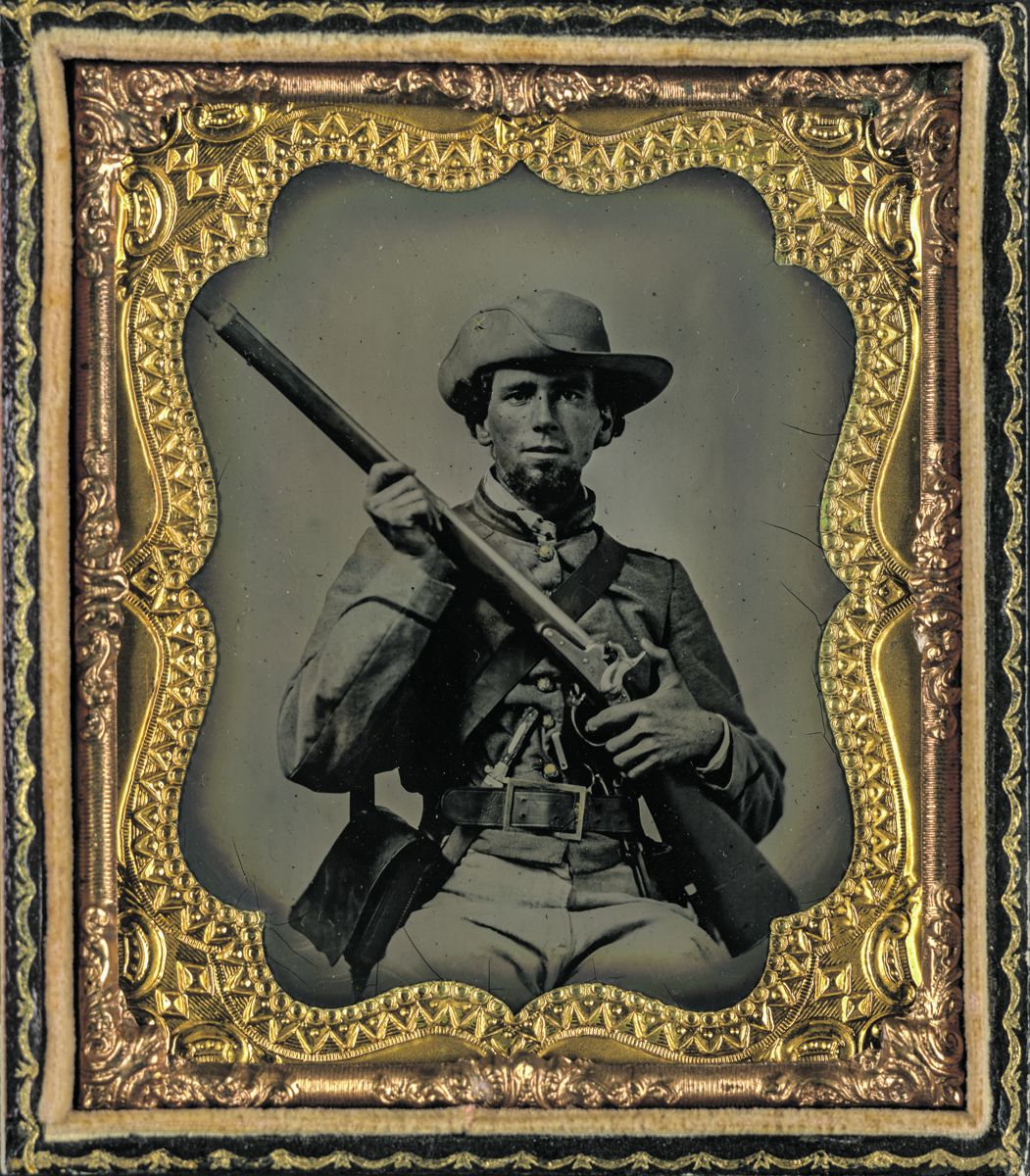
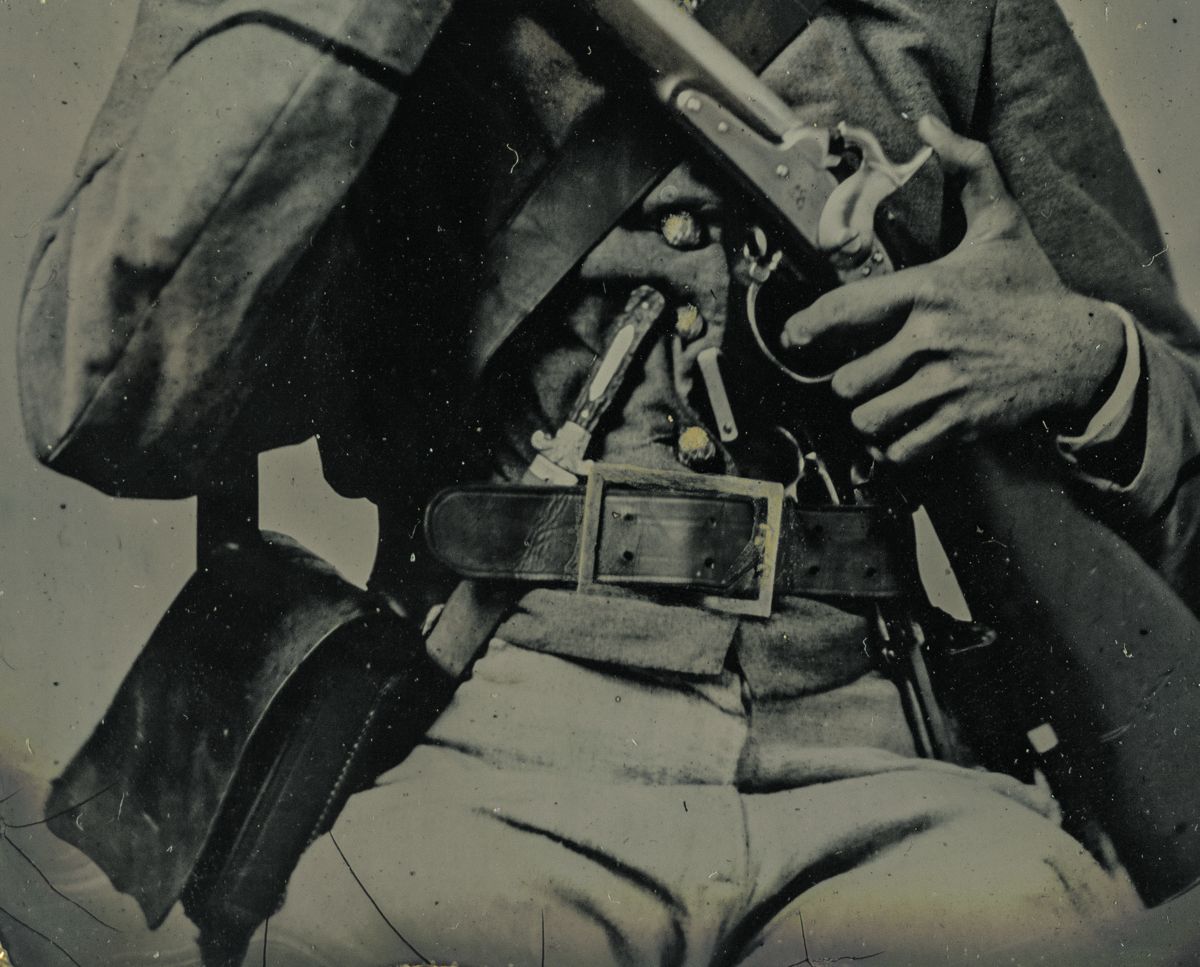
Right: Alldredge is decked out in this fine 1862 photograph posed with Model 1842 smoothbore musket, Colt Model 1851 Navy revolver, Sheffield bowie knife, Confederate wishbone buckle on waist belt with percussion cap box and cartridge box. Below: U.S. Model 1842 .69 caliber smoothbore musket by Harpers Ferry. The U.S. M1842 holds the distinction of being the first percussion infantry musket adopted for general issue by the U.S. Ordnance Department and the last general issue smoothbore long arms. It was essentially a percussion redesign of the earlier U.S. Model 1835/40 flintlock musket, which was based on the French Model 1822. It was also an early attempt at achieving parts interchangeability at the U.S. armories.
on English Arms & Accoutrements, Quartermaster stores