
The Graphic War
America in 1857
By Salvatore Cilella · Originally published October 2021 · pp. 26–27
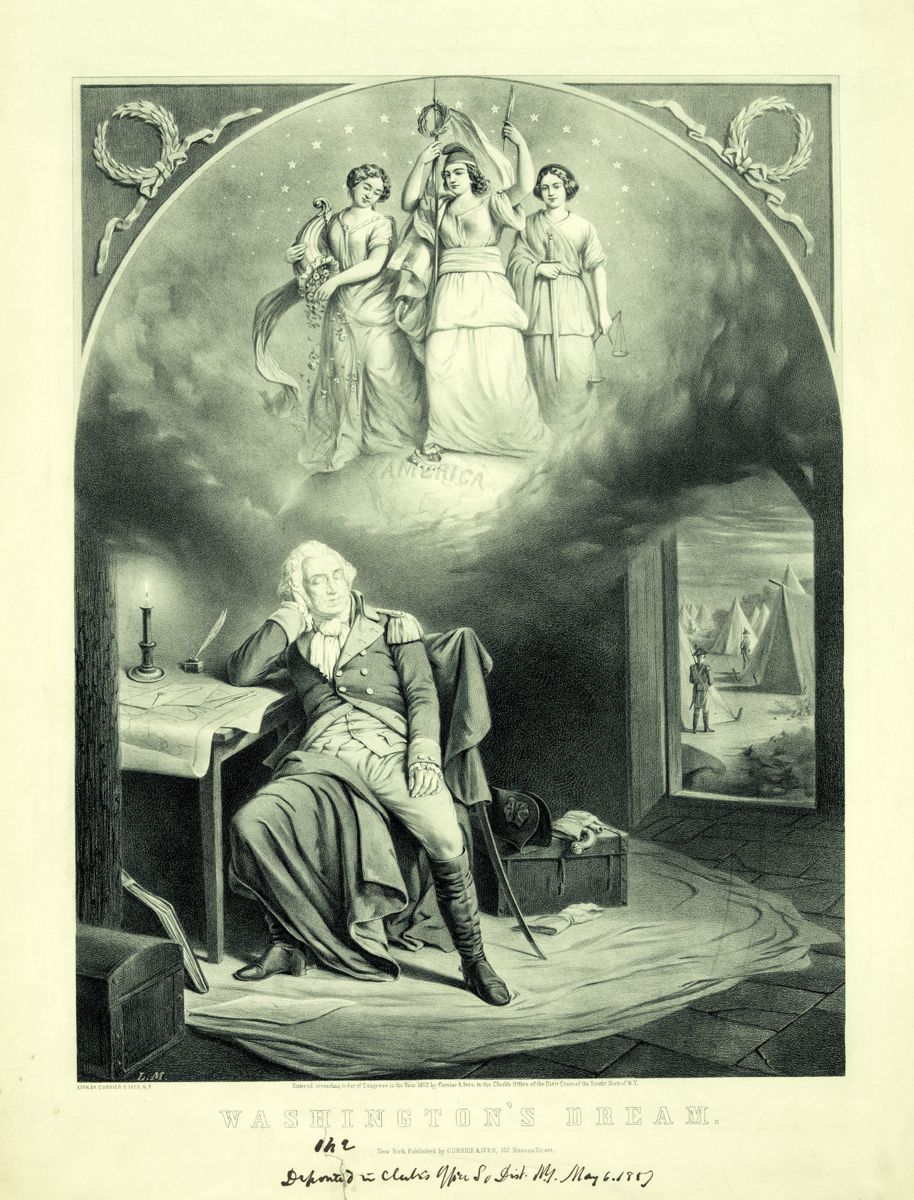
The Graphic War highlights prints and printmakers from the Civil War discussing their meaning and the print maker or artist’s goals. The decade of the 1850’s in America was one of tension and anxiety. It seemed that the American people were hopelessly deadlocked on the concept of their “original sin,” slavery. Its existence and/or its expansion were the themes of the day as the nation appeared to be on a headlong collision between those who supported the “peculiar institution,” and those who vehemently opposed it. Proponents on both sides possessed subtle variations of solutions. Details such as those that appeared in the 1820 Missouri Compromise, one new free state, Maine; one slave, Missouri, were modified with the
Compromise of 1850. With the new formula, California was to be admitted free; territories taken in the Mexican War were added with no designation; the slave trade (not slavery) was outlawed in the District of Columbia, and the Fugitive Slave law was strengthened. The Kansas-Nebraska Act of 1854 killed the Missouri Compromise altogether by allowing residents of territories applying for statehood a voice in whether the state should be free or slave. The proponents of “popular sovereignty” vigorously pursued by Senator Stephen Douglas were convinced that the intensity of the debate would cool tempers on both sides. It was not to be; pro and anti-slavery advocates poured into Kansas. The concept, instead inflamed tempers leading to “Bleeding Kansas;” the caning of Senator Sumner on the senate floor by South Carolina Senator
Preston Brooks in 1856; John Brown’s Pottawatomie massacre that same year; and the demise of the Whig Party in 1854. Further infuriating abolitionists, in 1857, the Supreme Court handed down the Dred Scott decision pronouncing slaves and all blacks inferior and not Americans. Presiding over the last four years of the decade was the politically weak President James Buchanan. He had parlayed himself into the White House playing northern Democrats against their southern counterparts. Almost forgotten in the country’s headlong plunge toward war was the panic of 1857, overshadowed by John Brown’s raid on Harper’s Ferry and the Lincoln-Douglas debates. With Lincoln’s election in the new Republican Party, the die for war was cast.1 It is no wonder print makers and cultural leaders turned to symbols of apparent stability and tradition. In 1857, although the country took a momentary breath, it was headed on a path toward dissolution. Currier and Ives decided to bring the image of Washington to the fore in a modest attempt to instill some modicum of patriotism and the idea of one nation. In their portrait of Washington,
Currier depicted him as a hero dedicated to gaining American independence from British rule. The print’s appeal was obviously to our forefathers. With his battle plans spread on the table and his sword beside him, Washington is portrayed as a leader fighting for freedom. An army encampment is visible through a door in the background. In his dream, Washington’s desire to establish an independent nation is embodied by three allegorical figures of women dressed in flowing garb. Triumphantly positioned on a globe labeled “America,” the three symbolize (from left to right) prosperity with her cornucopia; liberty with her sword, and justice with her scale. The artist Louis Maurer, as we have highlighted in past columns, a native of Biebrach Germany, was an immigrant who arrived in America in 1851, thereby embarking on a remarkable career. He was a renaissance man, trained in anatomy, lithography, and mechanical drawing. He learned cabinet making from his father. At war’s outbreak Maurer became a shooting instructor in Palisades Park,2 and worked as one during the War. He earned his artistic reputation employed with Currier and Ives specializing in trotting horses; a series called The Life of a Fireman; and Indian and Western scenes. Currier authority, Harry Peters credited him with immortalizing the American trotter.3 The Western scenes he drew came after two extensive trips to the frontier. Although he had already established his art credentials, it was not until Maurer turned 50 that he began the formal study of art, enrolling in the Gotham Art School and The National Academy of Design. At 80 he joined the Eastman School of Music, learning how to play the flute. He had his first solo exhibition at age 99 in New York City, and lived another year passing away during July 1932. At his 100th birthday party, he played the flute.4 He lived to see the country torn apart by war and then reborn as he witnessed his artworld also changing. As he told one listener, he was “puzzled” by the new modern art. The old principles of good art were the best, he said.
Endnotes: •
•
•
•
For an excellent view of the year of 1857 and its place in the decade of the 1850s see Kenneth Stampp, America in 1857: A Nation on the Brink. Oxford; Oxford University Press, 1990. “Louis Maurer, 100, Oldest Artist, Dies,” New York Times, July 20, 1932. Peters, Harry, (1942). Currier & Ives, Printmakers to the American People. Garden City, NY: Doubleday. New York Times, July 20, 1932.
After 43 years in the museum field, Salvatore Cilella devotes his time collecting American prints and maps and writing. His last professional position was President and CEO of the Atlanta History Center. His most recent books are Upton’s Regulars: A History of the 121st New York Volunteers in the Civil War (U. Press Kansas, 2009). His two-volume Correspondence of Major General Emory Upton, (U. of Tennessee Press, 2017), received the 2017–2018 American Civil War Museum’s Founders Award for outstanding editing of primary source materials. His latest book “Till Death Do Us Part,” an edit of Upton’s letters to his wife 1868-70, was published in 2020 by the Oklahoma University Press.