
Through The Lens
A Series of Unfortunate Events
By Stephanie Hagiwara · Originally published October 2021 · pp. 18–19
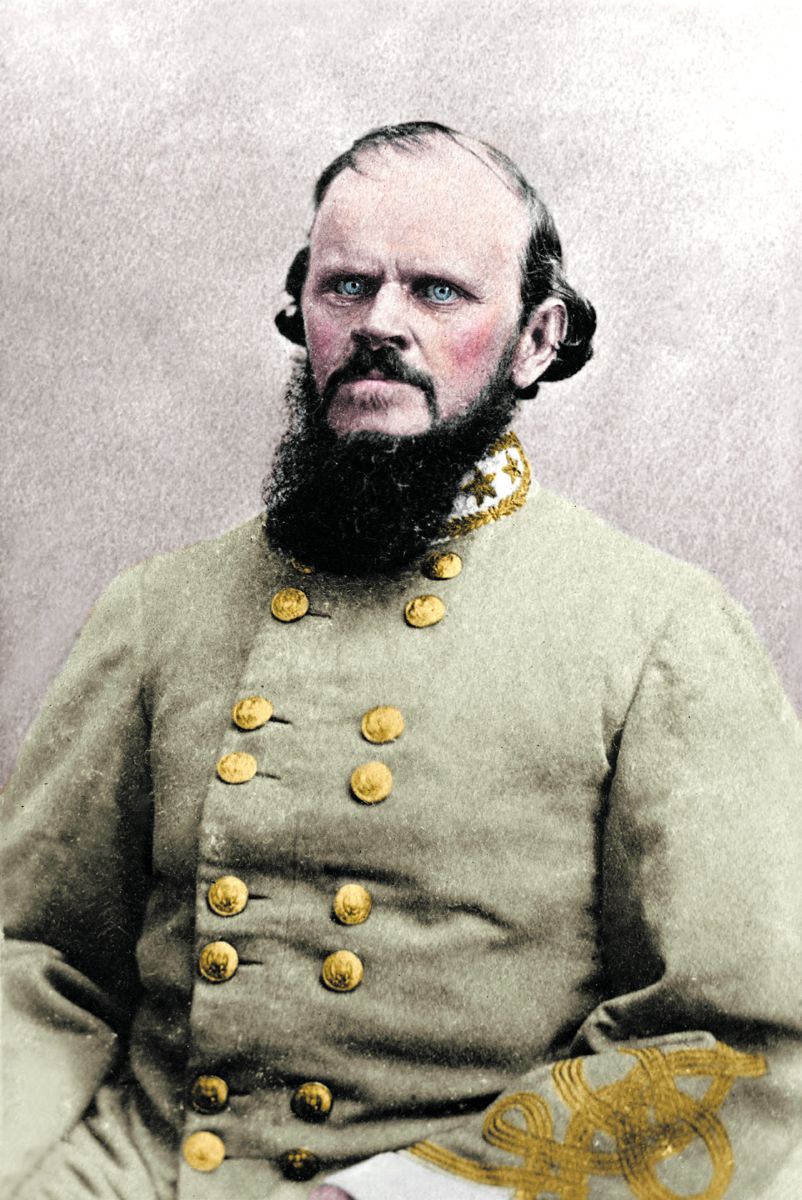
“News was brought in that there was a small camp without pickets. And it seemed to me precisely one of those pieces of carelessness on the part of the enemy that ought to be taken advantage of.” – U.S. Col. Charles P. Stone After the July 21, 1861, Battle of First Manassas, Va., U.S. Gen. Irvin McDowell was replaced by Gen. George B. McClellan. McClellan boosted the morale of his expanding army with endless drills as the bands played. To the public, the army appeared ready to fight. As the months passed, McClellan resisted the growing pressure to do so. Both sides created outposts on the Potomac. The lines were separated about 30 miles apart. Leesburg, Va., the western most Southern outpost, was important militarily due to its junction of roads and river crossings. C.S. Col. Nathan “Shanks” Evans and his 7th Brigade, some 2,800 men, were ordered to watch the enemy and “to make a desperate stand, falling back only in the face of an overwhelming enemy.” West Point graduate Evans was known as “very argumentative,” both a hard fighter and drinker. On October 16, minor skirmishing near Harper’s Ferry, W.Va., convinced Evans that the Federal’s superior force was coming to overwhelm his troops and pulled back eight miles to Carter’s Mill. Days later, Gen. P.G.T. Beauregard, his superior officer, ordered Evans to return at least one regiment to Leesburg. Evans moved the entire brigade back to his original defensive line. In the meantime, Evans’s departure was reported to U.S. Gen. Charles P. Stone, then passed on to McClellan. McClellan speculated that Evans’s withdrawal was due to other Federal movements and action from the east might force Evans to abandon Leesburg. McClellan ordered Gen. George McCall to reconnoiter towards Dranesville, Va., map the area, and then return to Langley, Va., the next day. McCall requested and received additional time to finish the mapping. He also ordered Stone to make a “slight demonstration” along the Potomac. McClellan mentioned McCall’s reconnaissance to Stone but not the mapping delay. Stone occupied the area around Poolesville, Md. The scouting party crossed the Potomac at a narrow point near Harrison Island, two miles long, half a mile wide, piece of flat land 500 yards from the Maryland shore and 150 yards from the Virginia side where “The point of landing was a bluff, fully one hundred feet high and too steep to climb up straight, covered with trees, rocks, and bushes. A narrow sheep-path wound around to the top. Up this little path all of the men had to go in single file, and the rifled gun when brought over later had to be dismounted and dragged up by hand.” After flushing out some rebel pickets during his “slight demonstration,” Stone ordered Harvard educated lawyer Col. Charles Devins, 15th Mass. Inf., to investigate for further signs of Confederate activity. Devins selected Capt. Chase Philbrick, a 38-year-old stonecutter, to lead the night mission. Three quarters of a mile from the river, the group of about 20 men spotted a row of maple trees. Light from the moon shining through the trees, gave the illusion of tents. Philbrick believed he was seeing a deserted Confederate camp but did not investigate the lack of men or campfires. The October 21, 1861, Battle of Ball’s Bluff was conceived as a raiding party. Stone ordered five companies of Col. Charles Devens to attack the enemy camp at first light. Two companies of Col. William Lee’s 20th Mass. with two 12-pdr. mountain howitzers would go to the Maryland side of the Potomac opposite Ball’s Bluff to aid if needed. To divert attention, a feint was ordered at Edwards’s Ferry, using the 3rd NY Cavalry and two companies of the 1st Minn. Col. Edward D. Baker, who was also serving as the seated U.S. Senator from Oregon, was ordered to march to Conrad’s a.k.a. White’s Ferry. Using three boats, it took about four hours for Devens’s men to cross the rain swollen Potomac. He soon discovered that the reported tents were trees. His scouts reported that all was quiet in nearby Leesburg. Devens sent word to Stone that he would remain in position until reinforced. As he waited, the Union feint was activated; when Capt. William Duff’s 18th Miss. company skirmished with the 15th Mass., both sides were alerted to the other’s presence. Baker went to see Stone, who briefed him on the situation and the availability of boats. He was not to advance unless the enemy’s force was inferior to his own. In writing, Stone put him in overall command of what he thought was a reconnaissance mission and gave Baker the discretion to cross more troops or to withdraw those already there. By the time Baker arrived at Harrison Island, the 20th Mass. with their howitzers were on the bluff. Instead of going into the field to evaluate the situation, Baker spent the next three or four hours expediting the men crossing the river with the few boats. He didn’t reach the skirmishing until after 2 p.m. West Pointer Col. Milton Cogswell, 42nd NY, was appalled by the chaos that greeted him when he reached the Potomac. Worse, the Federals were positioned in an open field with heavy woods on both sides, facing hills with their backs to a steep bluff above a bottlenecked river crossing. Cogswell informed Baker that his line was defective and could easily be overrun by the enemy. Baker ignored Cogswell’s suggestions and ordered him to “take charge of the artillery,” squandering the opportunity to drive forward. During the argument, C.S. Col.
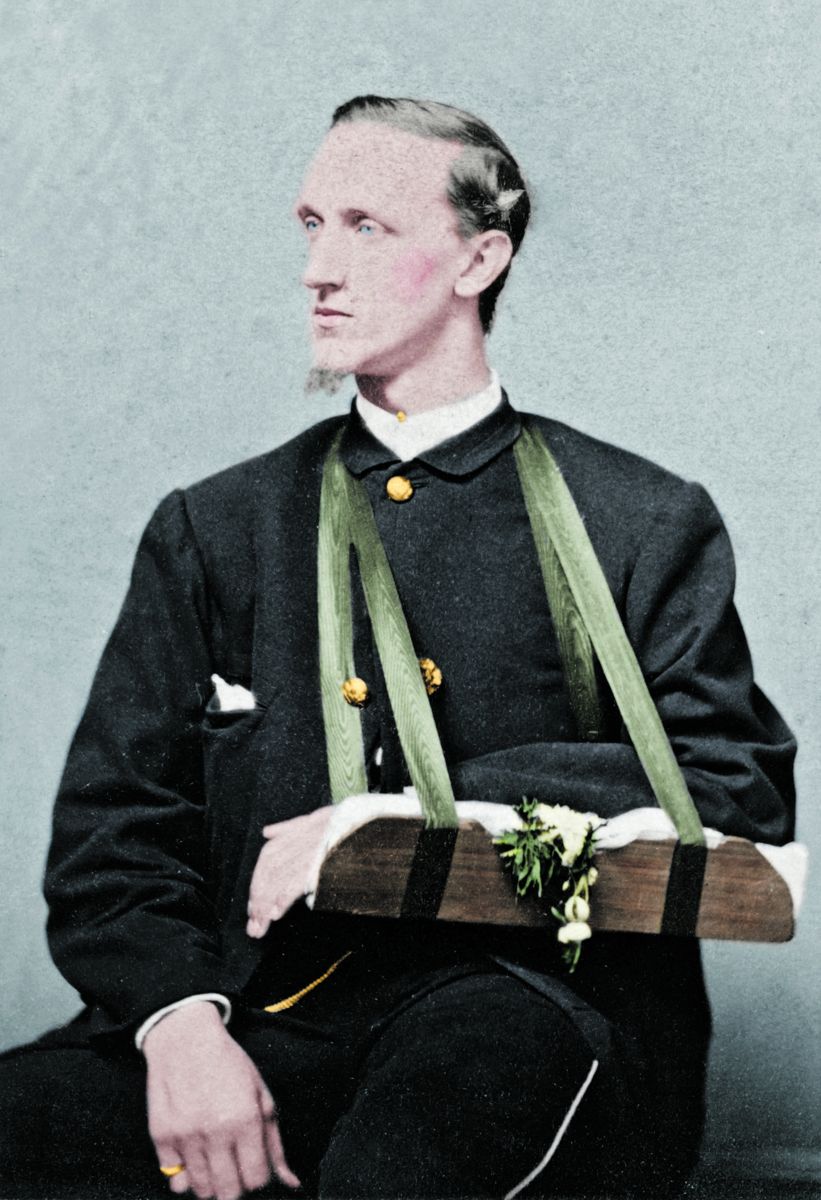
Eppa Hunton, 8th Va., repositioned his line. In the process, one quarter of the 8th Virginia under Lt. Col. Tebbs’s fell all the back way to Leesburg. Evans previously told a messenger, “Tell Hunton to hold his ground till every d___ man falls.” Now Evans sent in the 18th and 17th Miss. “… The bullets flew about very thick, and I saw many of my men fall all about me… Col. Baker came down near me and cheered on the men … he was shot. He got up again and then fell, struck by eight balls,” recounted Capt. Caspar Crowninshield, 20th Mass. Without a designated a replacement, the Federal force fell in disarray. Under fire, Capt. William F. Bartlett, 20th Mass. led his men down the bluff. “The water was full of human beings, struggling with each other and the water, the surface of which looked like a pond when it rains, from the withering volleys that the enemy were pouring down from the top of the bank.” Bartlett encouraged those who could swim to do so. The others he led upriver where they found a skiff that could hold five men. Using a rotation system, he was able to save eighty men and three officers from being taken prisoners. The battle cost the Federals 223 soldiers’ lives, 226 wounded, and another 553 taken prisoner. The northern public’s outcry resulted in a Congressional Joint Committee on the Conduct of the War that would cause conflict between the politicians and generals. After a good night’s sleep, Bartlett woke to discover he was the highest-ranking officer in camp. Taking a page from McClellan’s playbook, the future general “… thought it best to have a dress parade as usual, both to let the men see that everything was not broken up, and to cheer them with the music. It had a very good effect.”
Morgan III, James A. A Little Short of Boats: The Battles of Ball’s Bluff & Edwards Ferry, October 21–22, 1861: Savas Beatie, 2011 Gottfried, Bradley M. Maps of First Bull Run: An Atlas of the First Bull Run (Manassas) Campaign, including the Battle of Ball’s Bluff, June – October 1861: Savas Beatie, 2009 Francis William Palfrey. Memoir of William Francis Bartlett: Houghton, Mifflin and Company, 1878 Bruce, George Anson. The twentieth regiment of Massachusetts volunteer infantry, 1861–1865: Houghton, Mifflin and company, 1906
Stephanie Hagiwara is the editor for Civil War in Color.com and Civil War in 3D.com. She also writes a weekly column for History in Full Color.com that covers stories of photographs of historical interest from the 1850’s to the present. Her articles can be found on Facebook and Pinterest.