
The Unfinished Fight
Birmingham versus London Enfields
By Craig L. Barry · Originally published November 2021 · pp. 8–9
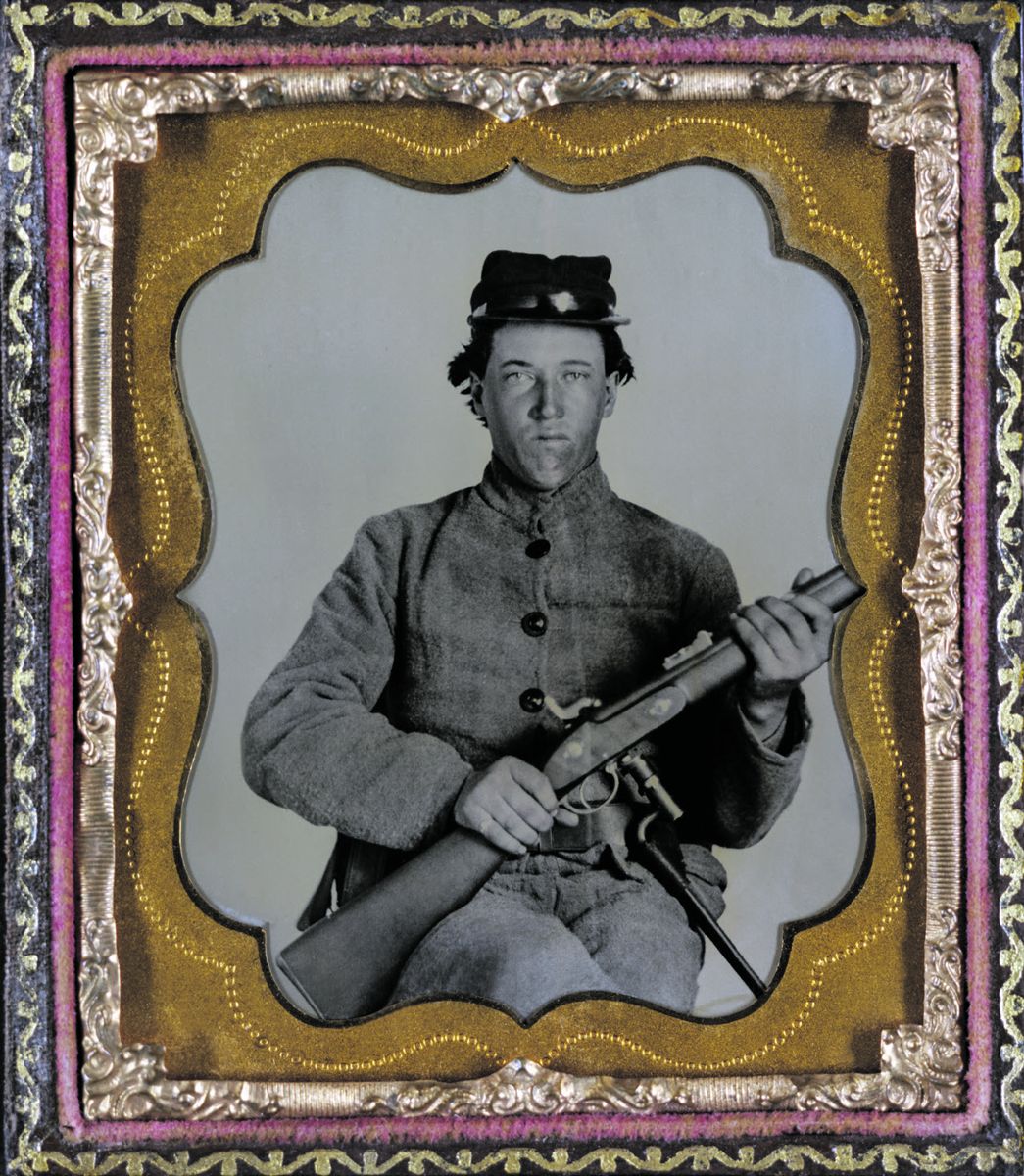
“Captain Joe Lee orders us to load and fire at will upon these batteries. Our Enfields crack, keen and sharp.” – Samuel Watkins, 1st Tenn., Company H The P53 Enfields referenced by Sam Watkins in his memoirs Company Aytch were commonly used by both U.S. and C.S. soldiers during the Civil War. A question on one of the internet forums inquired about which city in England produced the greatest numbers of commercially made P53 Enfields exported to the Southern states during the Civil War. In terms of overall statistics, as far as they are known, the conclusion was that over the course of the entire Civil War, the ratio was about 50/50 in terms of London vs Birmingham going to the South.
Especially early in the conflict, many P53 Enfields exported to the Confederate States were London made. Union purchases early in the war were more heavily tilted toward Birmingham commercial gunmakers. Later, in September 1863, the Union abruptly cancelled their existing contracts with the Birmingham Small Arms Trade “when the manufactories at Springfield and elsewhere in the United States were found sufficient to supply their wants.” Therefore, after September 1863, the Confederacy was the only American customer for the Birmingham Small Arms Trade and total exports began to fall off rather dramatically. Why were the London gunmakers primarily supplying the Confederacy early in the war? U.S. Consul F.H. Morse noted in his correspondence back to Washington, D.C., that the Commission Houses of Sinclair, Hamilton and S. Isaac,
Campbell & Co. had entered contracts that tied up the capacity of many London gunmakers for the Confederates by mid-1861 with orders for all they could produce for months to come. In other words, the Commission Houses representing Confederate interests immediately contracted for all available P53 Enfields from the largest commercial gunmakers before Federal buyers could do so. For their services, Commission Houses like S. Isaac, Campbell & Co., and Sinclair, Hamilton typically charged a two to three percent commission on each rifle. So, if that was the case, did the Confederacy only receive Enfields made by London commercial gunmakers and none went to the Union? Things are seldom that cut and dried. There were also very early U.S. Government contracts with the London Armoury Company that date from May 1861, as well as a separate contract with the
Commonwealth of Massachusetts that preceded any commercial sales from London Armoury to the Confederacy. London Armoury also had contracts for their interchangeable parts P53 Enfields with the British War Department. The commercial gunmakers in London & Birmingham sold arms to whomever it was legal to sell to, as long as they could pay for them.
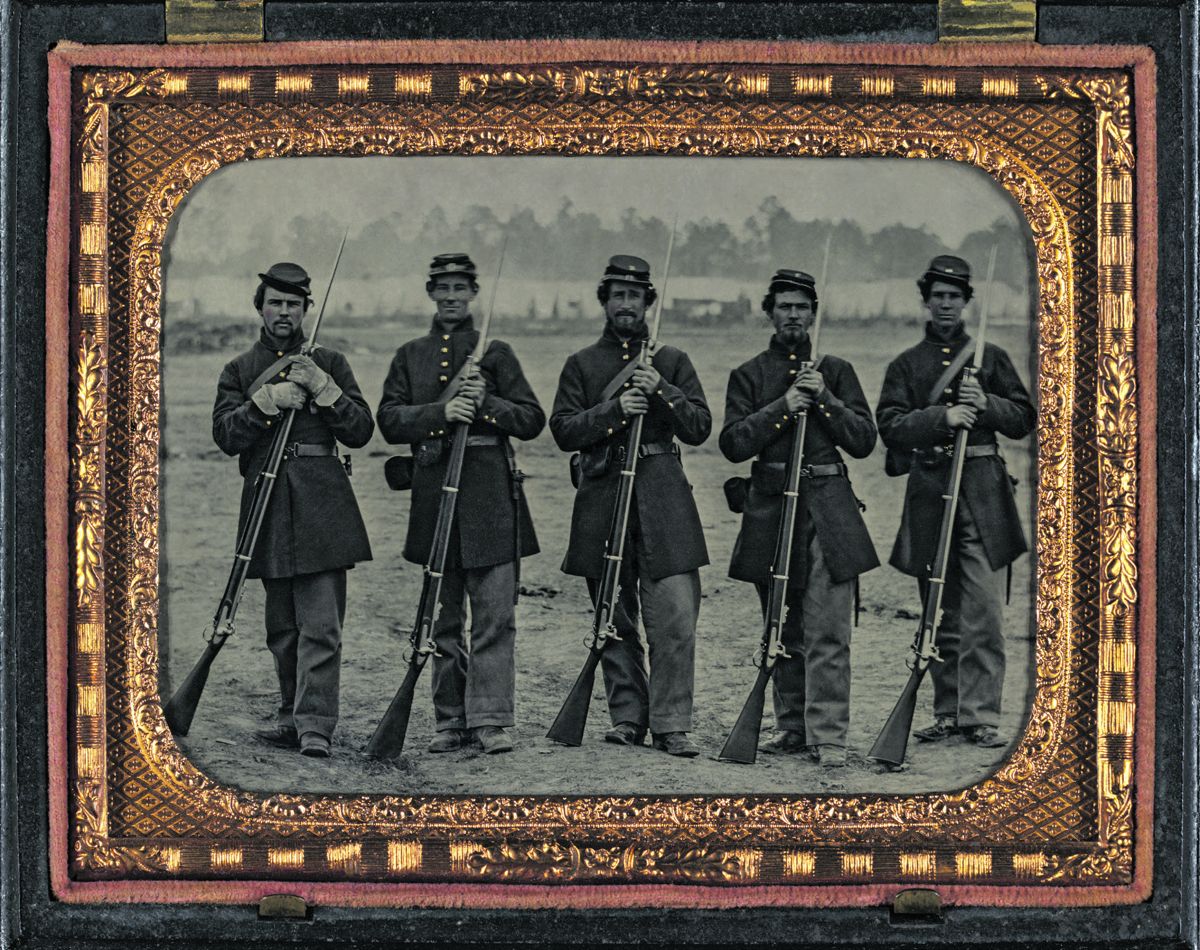
A great example was the firm of J.E. Barnett & Sons. Barnett was a London gunmaker well known as a large supplier the Confederacy. In fact, the first shipment of 3,500 P53 Enfields to run the blockade was aboard the steamship Bermuda and landed in Savannah, Ga., September 18, 1861. It included a number of P53 Enfields from Barnett. However, like London Armoury Company, Barnett did not only sell to the Five soldiers in Union uniforms of the 6th Regiment Massachusetts Volunteer Militia outfitted with P53 Enfield muskets, and Enfield leather accoutrements, in front of encampment. Liljenquist Family Collection of Civil War
Confederacy. It is worth noting that at least one Confederate contract with J.E. Barnett & Sons fell into Union hands when the C.S. Government did not pay in a timely manner as U.S. Consul F.H. Morse reported to the Secretary of War on November 6, 1861: “I have the satisfaction of informing you that one of the gun manufacturers here who had a contract with the rebels running to March (1862) has had a difficulty with them, broken the contract, and will hereafter send his guns, Enfield rifles, to New York on his own account. His name is Barnett and his rifles stand very well here.” Hence, neither the U.S. nor C.S. solely did business with only Birmingham or London commercial gunmakers. There is also a question about which city produced more P53 Enfields for export to America during the Civil War? To be certain, both cities had a large and vibrant commercial gun trade however, one city had a decidedly larger number of exports to America. As far as total numbers produced by London vs Birmingham, if you trust the statistics reported at the time by John D. Goodman, the Chairman of the
Birmingham Small Arms Trade, in The Resources, Products and Industrial History of Birmingham and the Midlands (Samuel Timmins, ed. 1866) p. 418, the following table is insightful: Number of Rifles Supplied to America During the War of 1861–1865 Birmingham…743,303 London…344,802 Total 1,078,205 There are also other tables that show production year by year, but in terms of the total P53 Enfields exported during the Civil Warera, Birmingham gunmakers outproduced their London counterparts by a rate of nearly 2 to 1. The largest numbers from Birmingham were exported in 1862 (388,264), despite a slight fall-off in January that year due to a brief embargo as a result of the Trent Affair. The next largest year in terms of production was 1863 (210,078). By the end 1864, when the C.S. Government and individual Confederate States were their only American customers, exports dipped to 42,242. Did all P53 Enfields used in the Civil War come from either London or Birmingham? Not at all. There were also large numbers P53 Enfields produced in Belgium (Liege), but some were also exported from Germany and France. There were even small numbers of P53 Enfields manufactured in America, but that is a topic for another day.
Craig
L.
Barry was born in
Charlottesville, Va. He holds his BA and
Masters degrees from
Craig served
The the University of North Carolina (Charlotte).
Watchdog Civil War Quarterly as
Associate Editor and Editor from
2003–2017. The Watchdog published books and columns on 19th-century material from and donated publications to all funds battlefield preservation. He is the author of several books including The Civil War Musket: A Handbook for Historical
Accuracy (2006, 2011), The Unfinished Fight: Essays on Confederate Material Culture Vol. I and II (2012, 2013). He has also published four books in the Suppliers to the Confederacy series on English Arms & Accoutrements, Quartermaster stores
European imports.
and other