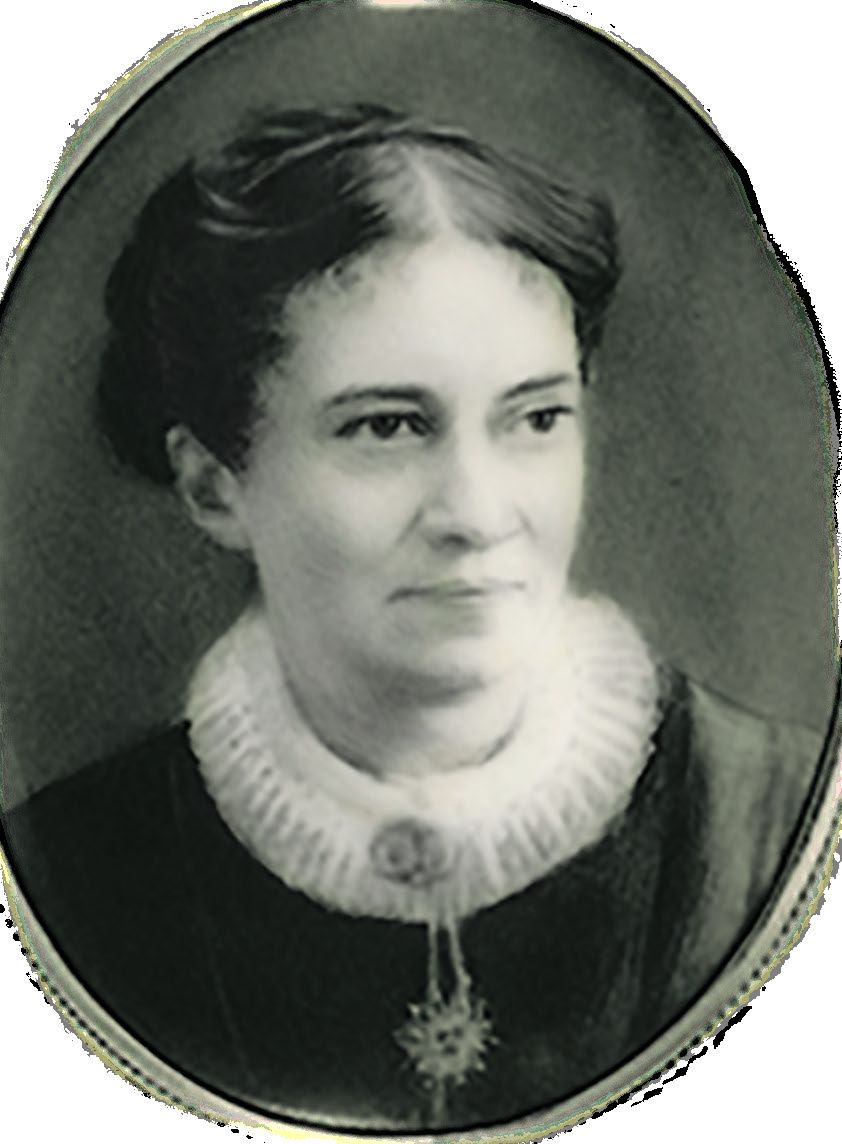
Who was Cornelia Phillips Spencer? (Part 2)
By Joan Wenner, J.D. · Originally published May 2021 · p. 21
“There is as yet too much to be forgotten—too much to be forgiven.” – Cornelia Phillips Spencer of North Carolina
Continuing from Part 1, from the April 2021 Civil War News, excerpt of Cornelia’s writings from “THE LAST NINETY DAYS OF THE WAR IN NORTH CAROLINA,” published in 1868 with her detailed glimpse of the Civil War in western North Carolina: “General Stoneman’s detour into Virginia had completely mystified the people of North Carolina. They breathed for relief as he passed over the border, and congratulated themselves that the dreaded raid, which for weeks had been anticipated, was at an end. The troops which had been posted by General Beauregard at Salisbury, for its protection, were moved off and to the railroad bridge across the Yadkin, and the town was left with little or no defense. If Stoneman had marched toWilkesboro, he would probably have been repulsed with disaster, for a large body of infantry, with artillery and cavalry were concentrated there; but when Salisbury was attacked, on the morning of the twelfth of April, the whole effective force did not exceed five hundred men, including two batteries on their way to join Johnston at Raleigh. Of these five hundred two units were “galvanized” Irish, recruited from among Federal prisoners—besides artisans in the government employ from the state’s Junior reserves, and a number of citizens who volunteered in defense of their homes. In the absence of General B. Johnson [Bradley Tyler Johnson], the commandant of the post, General Gardner [William Montgomery Gardner] took command, and disposed his handful of men at various locations on the road to Mocksville, so as to man and support the batteries, there being nowhere more than one hundred and fifty at that point. The attack began at daylight. By eight o’clock the batteries were flanked. The artillery-men fought bravely, but were soon overwhelmed and compelled to leave their guns in the hands of the enemy. A few of the “galvanized” Irish fought but the majority went over in a body to the Federals soon after the fight commenced, leaving the artillery without support, and betraying theweaknessoftheConfederates. A desultory fight was kept up till the suburbs of the town were reached, all order and subordination were lost, the Confederates scattering through the town and to the woods beyond. Several of thewounded,andoneortwowere killed in the town. The loss of the Federals is unknown, but several were buried on the field and a number of Confederates were taken prisoners, some citizens, negroes, etc. By nine o’clock the place was in quiet possession of the enemy, who galloped in with drawn swords and full of strange oaths. Many of the citizens, negroes, and children, were at open doors and on the side-walks gazing for the first time at the Federal uniform. In the desultory running fight that was kept on the streets, one of the Irish recruits before mentioned, fighting bravely, was shot through the lungs but he continued to fire as he retreated till he fell on the piazza of Mrs. M.E. Ramsay. Though the balls fell thick about him, and she was with little children, she went out to him and managed to get him inside the house where she nursed and stimulated him the rest of the day, till she could get a physician to have him removed to the hospital. He said to her, “They have killed me, but I die a brave man; I fought the enemy while I could stand.” She supposed of course that his wound was mortal, but a fortnight later, to her astonishment, he returned to her with thanks for her kindness.” Sources: docsouth.unc.edu, Encyclopedia of UNCG History, (+ photos), and Dictionary of North Carolina Biography. Joan Wenner, J.D. is a longtime Civil War history writer with a law degree and regular contributor to CWN. A native New Yorker, she presently resides in coastal North Carolina. Comments are welcomed at her email [email protected].