
Through The Lens
Starving the Federals: The Camden Expedition – Part II
By Stephanie Hagiwara · Originally published May 2021 · pp. 18–19
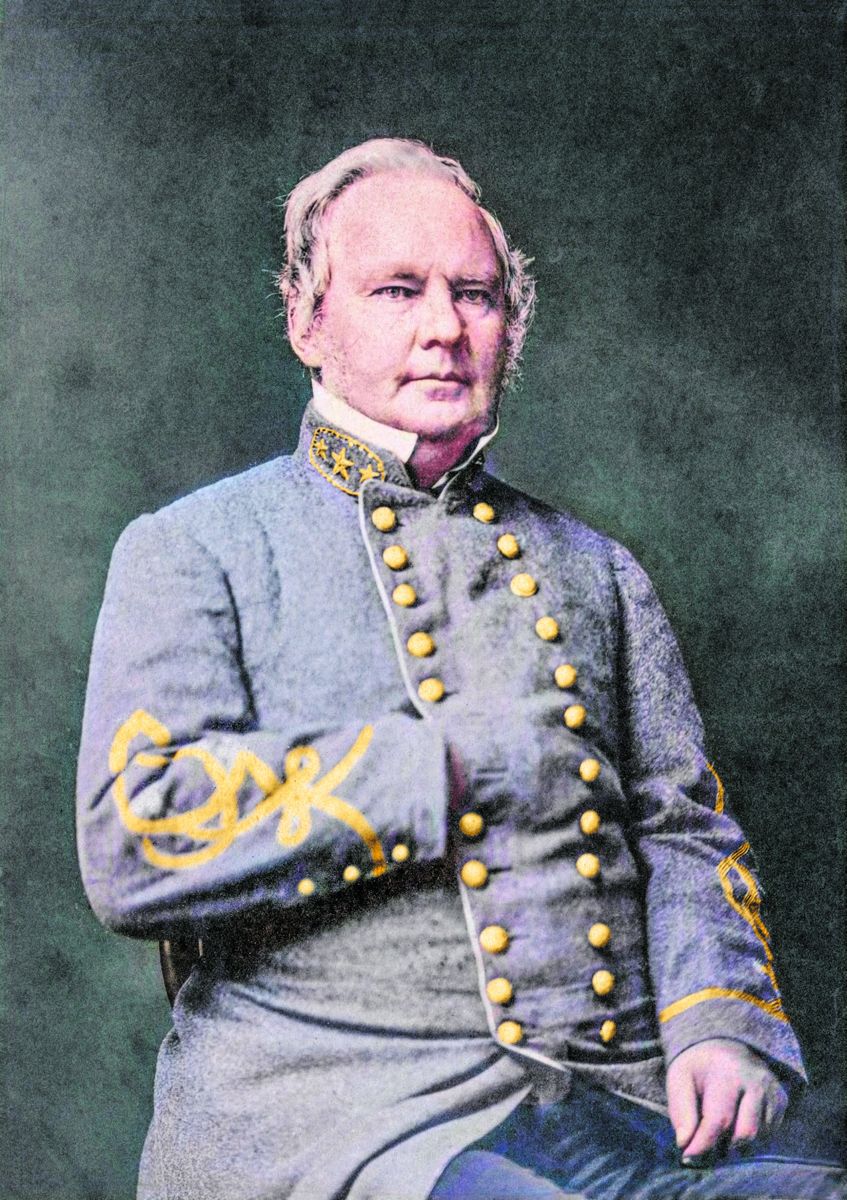
“Pvt. Dickson Wallace … was the first man to the artillery, and mounting astride one of the guns gave a whoop, which was followed by such a succession of whoops from his comrades as made the woods reverberate for miles around.” – C.S. Col. Tandy Walker, 2nd Indian Brigade On March 23, 1864, U.S. Gen. Frederick Steele launched the Camden Expedition from Little Rock, Ark. By April 3, a lack of provisions compelled Steele to divert from Shreveport, La., to Camden, Ark. First, he had to lure out the Confederate troops stationed in the heavily fortified town by heading towards the Confederate capital of Washington.
The April 10-13, Battle of Prairie D’Ane, Ark. took place over a 30-mile square, open prairie surrounded by dense pine forest and cypress swamp. The Prairie was a well-known crossroad. To the west lay the town of Washington, to the east lay Camden and to the South lay the Red River and Shreveport. Maj. Gen. Sterling Price’s cavalry was harassing the Federals. Price, Cmdr. of the Dept. of Arkansas, had served as the governor of Missouri and led the Missouri Militia at the Battle of Wilson’s Creek, Mo. Price was amiable, known for hard drinking and, according to Jefferson Davis, “the vainest man I ever met.” Price planned to not only vanquish Steele but use reinforcements to gain Missouri for the Confederacy. Price had to keep Steele on the Prairie until reinforcements arrived and he could spring his trap on the road to Washington. It was Steele’s 12,000 men vs. Price’s 7,000 cavalry. At Gum Grove, a copse of trees on a ridge above the prairie center, C.S. Capt. Harris, 4th Mo. Field Battery and C.S. Capt. Richard A. Collins, Mo. Battery, whose company’s mascot was Collins’s pet black bear, “Postlewait,” positioned their guns. The Confederates threw up dirt and timber breastworks as they awaited the action. Steele had planned for cavalry to lead his forces onto the prairie. After one look at Gum Grove, the Federals knew infantry was needed to clear it out before moving forward and rearranged their troops. Capt. Martin Voegele, 9th Wis. Battery, Capt. Thomas Vaughn, 3rd Ill. and Lt. Charles Peetz, 2nd Mo. Light batteries were positioned on the right. The open prairie allowed the Federals, in parade formation, to spread their line across an impressive two mile front. At 5 p.m., the afternoon’s skirmishing turned into an artillery combat. Twilight turned the duel into a fireworks show. U.S. Gen Fredrick Salomon ordered the infantry to advance. Between the smoke and dusk conditions, the Confederates could not see their foe’s approach. The Federals rapidly swarmed Gum Grove, capturing the position. The Confederates repositioned a mile back. Both sides continued the fireworks until midnight. During the next three days of skirmishing, Price would fall back, leading the enemy towards his ambush. Steele, having pushed the Confederates off the prairie to avoid observation, was now able to make his dash to Camden. There, Steele’s plan to use U.S. Navy gunboats to resupply via the Ouachita River was denied. Adm. David Porter was using the fleet to support Gen. Nathaniel Banks’s Red River Campaign. The April 18, Battle of Poison Springs, Ark. was a Confederate ambush on Steele’s men returning from gathering foodstuff. The Confederates outnumbered the Federals, 3,500 Confederates vs.
1,200 Federals. C.S. Gen. John Marmaduke’s cavalry blocked the road ahead amidst the dense woods on either side. C.S. Gen. Samuel Maxey’s men would attack from a ridge that meandered in the southern field. Amongst Maxey’s men was Col. Tandy Walker’s Brigade of Choctaw Indians, “mounted on ponies, dressed in all sorts of clothing, including buckskin with feathers in hats.” U.S. Col. James Williams, 1st Kansas, moved his 198 wagons close together, positioned the 500 men of 1st Kansas (colored) in front, his 200 cavalry at the flanks, 375 men of the 18th Iowa at the rear and the Iowan’s two howitzers and two guns of the 2nd Ind. oriented to the South. Maxey’s men attacked the Federal flanks and met galling fire from the guns and staggered back. Still the assault continued. The 1st Kansas had routed the 29th Texas at Honey Springs. Okla., less than a year earlier. The Texans’ shots were returned by Kansas fire. Overwhelmed and running out of ammunition, Williams ordered a retreat to Camden,abandoningthewagons. In swoopedWalker’s 2nd Indian Brigade, replacing war whoops with the “Rebel Yell.” Fearing the Federal numbers in Camden, the Confederates did not follow the retreating men, but the violence continued. The wounded and captured Kansans were bayoneted. Some of the Choctaws took scalps. The survivors staggered back to Camden. On April 20, the long-awaited Union supply wagons arrived from the Pine Bluff, Ark. quartermaster. Along with foodstuff and coffee, “the good old mail” was delivered. “… Little could the writers of those letters imagine, how eagerly the envelopes were torn open, or how dear and precious the words of love and hope, from home, seemed to us, there in the enemy’s country.” Steele assigned Lt. Col. Francis Drake, 36th Iowa, with 2,000 men and four guns, to protect the 211 supply wagons on their return journey. Tagging along in the rear were 75 wagons of sutlers, refugees, and about 300 runaway slaves. Learning of the train, C.S. Gen. James Fagan came up with an attack plan. With hard riding, the cavalry could get ahead of the train and stop it. The train’s length would spread the defenders thin. Success would come from attacking at various points. At dawn on April 25, the Battle of Marks Mills, Ark., started as 4,000 Confederate cavalry ambushed the train after it struggled out of the swamp. C.S. generals
Portrait Gallery. Portrait Gallery.
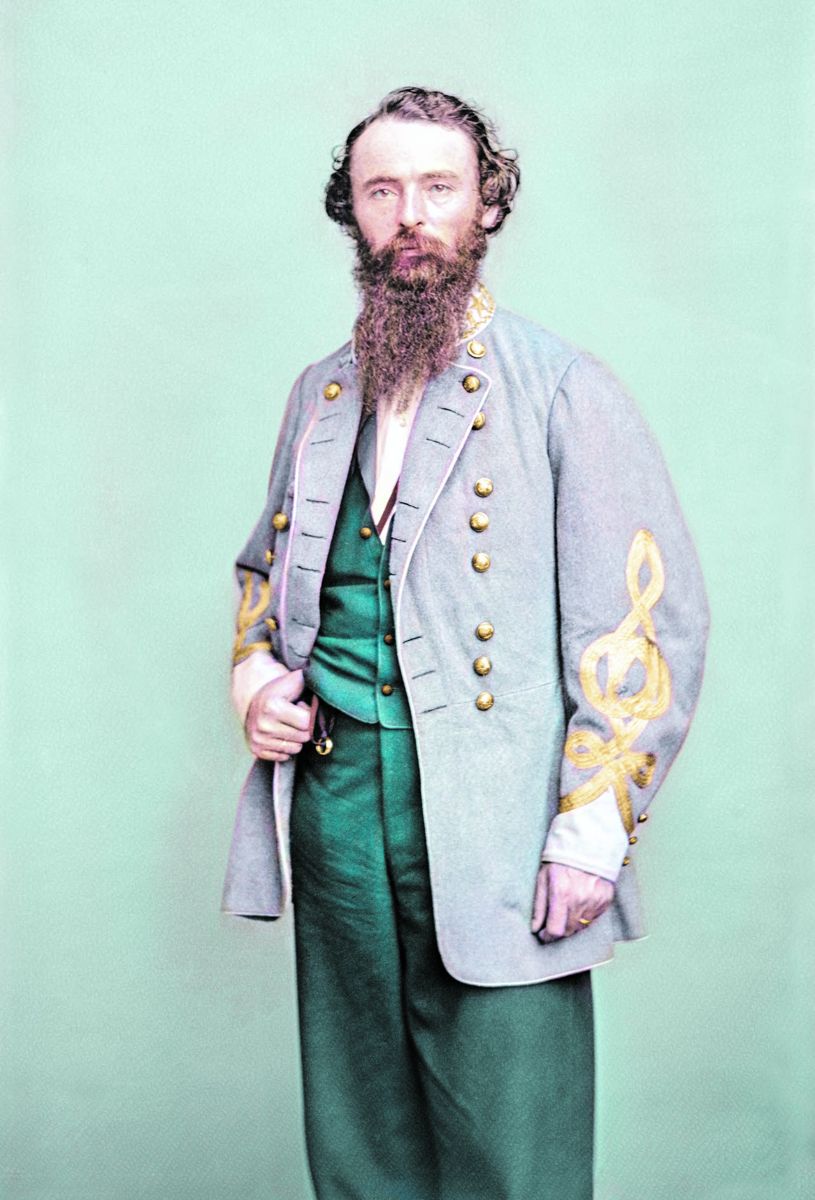
Joseph Shelby attacked at the head as William “Old Tige” Cabell attacked the flank of the wagon train. U.S. Lt. Charles Peetz’s, 2nd Mo. Light Artillery, 10pdr. Rifles, fired back. After 1 ½ hours of bloody fighting Cabell’s assault began to falter. C.S. Gen. Thomas Dockery’s men arrived. They charged to shore up the line, crashing into the Federal wagons. Drake ordered the infantry to attack and was shot in the leg. The line faltered. As he passed out from blood loss, the Federal resistance began to disintegrate. The U.S. 1st Iowa, going home on furlough, arrived at the scene. One of its pickets helped end the battle with his wit. Captured prisoner, Lt. Silas R. Nugen, announced that he was from “the advance of General Steele’s army.” After five hours of hard fighting, the Confederates called off their assault, allowing some Federals, including the 1st Iowa, to escape. The Rebels were left to inventory their captured bounty which included a paymaster with Union greenbacks.
Sources: •
•
•
•
Forsyth, Michael J. The Camden Expedition of 1864 and the Opportunity Lost by the Confederacy to Change the Civil War. McFarland & Company, Inc., 2015. Sperry, A. F. History of the 33d Iowa Infantry Volunteer Regiment 1863–1866. Mills & Company, 1866. Johnson, Ludwell H. Red River Campaign: Politics and Cotton in the Civil War. Kent State University Press, 1993. Official Records,. Series I, Vol. 34, p. 849
Stephanie Hagiwara is the editor for Civil War in Color.com and Civil War in 3D.com. She also writes a column for History in Full Color. com that covers stories of photographs of historical interest from the 1850’s to the present. Her articles can be found on Facebook, Tumblr and Pinterest.