
Salem Church Battlefield & The Lesson For Preservation
By Terry Rensel · Originally published May 2021 · p. 25
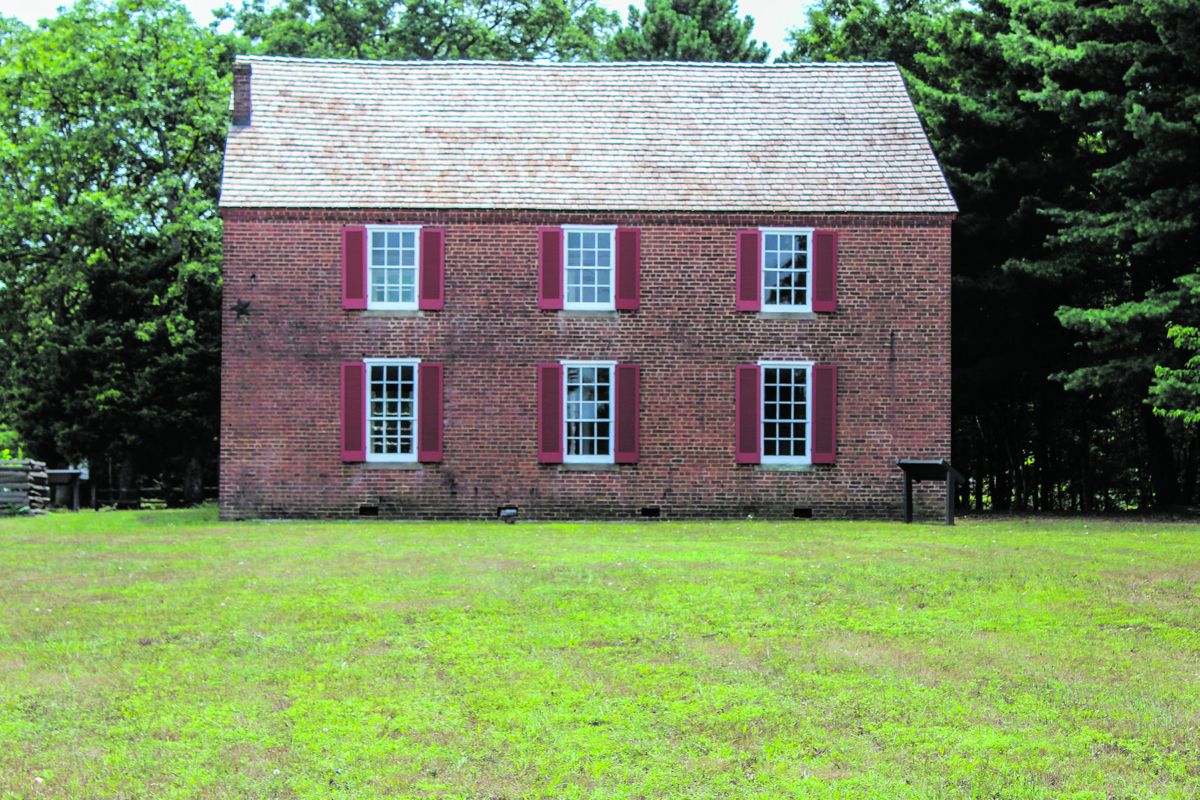
Salem Church still stands on the crest of high ground, but the scene around the historic meeting house has changed significantly since 1863 when Civil War soldiers battled in the church yard. At that time, open high ground surrounded the solitary building standing near the Orange Plank Road allowing for effective artillery use and room for infantry movements. The Battle of Salem Church occurred on May 3, 1863, as part of the Chancellorsville Campaign. While Union General Joseph Hooker and the majority of the Army of the Potomac crouched around the Chancellor clearing and tried to hold on to their trenches in the dense woods, Union General John Sedgwick’s VI Corps was supposed to be creating a diversion and coming down the Orange Plank Road on to the Confederate rear. As day dawned on May 3, General Robert E. Lee’s available Confederate forces were already divided into three parts. Jackson’s Corps fought to reunite with Anderson and McLaws’s Divisions while General Jubal Early’s Division warily watched the town of Fredericksburg and Sedgwick’s Yankees. In the morning, Sedgwick’s men launched successful attacks at Marye’s Heights, Lee’s Hill, and Fall Hill, driving Early’s soldiers into retreat and temporarily opening the road toward Chancellorsville. Approximately ten miles and two Confederate divisions lay between Sedgwick and Hooker. Aware of the threat to his rear, Lee sent Lafayette McLaws’s Division and William Mahone’s Brigade to aid Cadmus Wilcox’s Brigade in delaying Sedgwick; their battle unfolded in the rolling landscape around Salem Church. On May 4, 1863, the Confederates launched uncoordinated attacks against Sedgwick’s troops that were repulsed, but did force the Union units to face three directions near Salem Church with the Rappahannock River to their rear. Confederates started pushing Sedgwick north toward the river, preparing to seal the VI Corps off from the rest of the Union army. Meanwhile, with Sedgwick pinned in place, the rest of the Confederate force around Chancellorsville focused on driving Hooker and his six infantry corps toward the river. The “divide and conquer” strategy had not played out well for Federal commanders this time, because Lee pulled off a brilliant tactical move. The Battles of Second Fredericksburg and Salem Church resulted in approximately 6,900 casualties (totaled for both sides), and many received medical aid within the four walls of the traditional place of worship. Perhaps in its own way, the fight at Salem Church offers a depiction of the armies and their commanders at that time in Virginia. Lee’s audacity was on display as he divided his army again to meet the threat, and once again Hooker’s plans fell to pieces at another point in the Chancellorsville Campaign. Despite its tactical importance and the eight Medals of
Honor given for bravery in this fight, only a very small piece of the Salem Church battlefield has been preserved. The open fields have disappeared under road expansion, parking lots, and shopping complexes. Just the historic church, a little ground between Salem Church and a modern house of worship, and a patch of land holding two Union monuments are preserved by the National Park Service. Salem Church and its “lost battlefield” is an example in Fredericksburg of the need for battlefield preservation. Of course, similar stories resonate throughout the American landscape and the preservation community is aware of such instances. There are some among the founding preservation partners of the Central Virginia Battlefields Trust who point to the preservation loss at Salem Church as the inspiration for forming a nonprofit battlefield preservation group with a local, grassroots focus. Part of the preservation loss at Salem Church includes the difficulties facing the National Park Service for funding and perspective on preservation from the early and mid-20th Century when it focused on saving narrow strips of land where highly dramatic action took place. In the 1970’s, with Congressional approval of boundary change, Fredericksburg-Spotsylvania National Battlefield was allowed to preserve six acres at Salem Church. Later, as development started ramping up on the ridges between Fredericksburg and Salem Church, additional acreage was offered for preservation, but lost due to funding difficulties. Today, the land still rises toward Salem Church, but the actual battlefield has disappeared.
Driving along the widened highway or sitting in traffic near Salem Church, I’m a little saddened by the lost battlefield, but it also reminds me of the importance of preservation. Perhaps the losses of battlefields like Salem Church serve as a lesson and a wake-up call to the preservation community. Just a few years after the lack of funds situation at Salem Church, Central Virginia Battlefields Trust was formed to assist in future moments of opportunity. As I look through the CVBT files and hear stories from longtime board members, I’m reminded that while development threatens many historic sites there has been a record of success around Fredericksburg, Chancellorsville, The Wilderness, and Spotsylvania Court House in approaching developers and seeking solutions to save land. Raising awareness for historic preservation and helping the local community appreciate the historic greenspace and resources in their town is a big part of finding solutions that benefit all. Salem Church interests me as a battle that took place, the preservation that occurred, and the lost preservation opportunity. Through a series of circumstances and no particular fault, Salem Church battlefield did not get a “happy ending” in the preservation saga, but the historic structure and enough land remains to serve as a reminder of the importance of all preservation entities finding ways to work together to save places where history happened. Terry Rensel serves as the Executive Director at Central Virginia Battlefields Trust. CVBT saves battleground to preserve the memory and meaning, sacrifices and stories of the men who fought at Fredericksburg, Chancellorsville, The Wilderness, and Spotsylvania Court House. Learn more: www.cvbt.org.
Veterans at Salem Church, about 1900. On the gable end, one entrance was for men, the other for women. Salem Church was a Baptist church built in 1844. It was a brick construction 2 ½ stories tall. It was located on a low ridge along the Orange Turnpike about 4 miles west of Fredericksburg. Courtesy NPS.