
The Graphic War
Libby Prison “From the Inside.”
By Salvatore Cilella · Originally published May 2021 · pp. 26–27
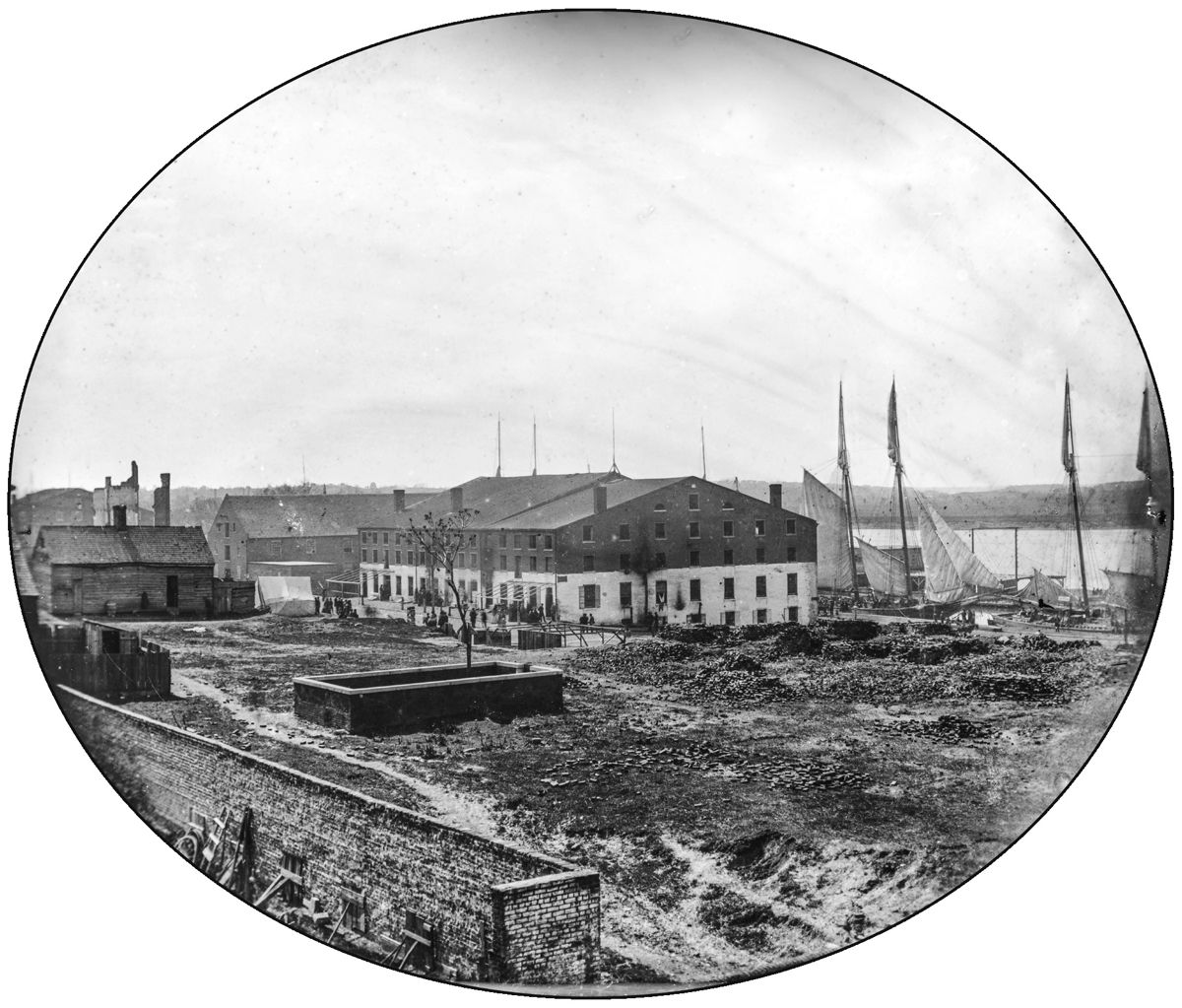
The Graphic War highlights prints and printmakers from the Civil War discussing their meaning and the print maker or artist’s goals.
One of the more unusual Civil War prints is Major Otto Boetticher’s view of Libby Prison from the inside, especially its dimensions. Most 19th century prints were either small, medium, or large folio, and they were rarely oblong. This panoramic scene inside the infamous prison measures 10 ½ high and nearly 21 inches wide. The title margin reads “Libby Prison, /Union prisoners at Richmond, Va. / from nature by Act. Major Otto Boetticher; lith. of Sarony, Major & Knapp, 449 Broadway, N.Y.” We have written about Otto Boetticher before when we detailed his important lithograph “Sherman before Savannah.” Libby prison was not his first depiction of imprisoned Union soldiers. Boetticher was also responsible for the iconic Union soldiers playing baseball in the Confederate prisoner of war camp at Salisbury, N.C. He was also documenting his first-hand experience as a resident of both camps. Boetticher joined the 68th New York Volunteers as a captain in Company G during August 1861. He fell into enemy hands the next spring, probably near Manassas, and was first imprisoned in Libby and then moved to Salisbury.1 In September he was exchanged and went on to participate in the battles of Chancellorsville and Gettysburg. Discharged in 1864, the following year he was awarded the brevet rank of Lieutenant Colonel.
Boetticher; lith. of Sarony, Major & Knapp, 449 Broadway, N.Y. Library of Congress.
This print, like the Salisbury depiction, was published sometime in 1863 by Goupil and Cie, famous European art dealers and connoisseurs. Goupil established a New York office in 1848. The firm of Sarony, Major, and Knapp printed Boetticher’s work. Both firms were well known for their artistic renderings that included, in Goupil’s case, reproducing Vincent Van Gogh’s artistry. A copy of this print in the library of Congress identifies Brigadier General August (von) Willich, at the right, reading in bed. It is not a part of the print but a hand written notation in pencil below the title margin. Willich, Prussian born, settled in Ohio in 1853, and when war came he formed the 9th Ohio Infantry and later led the 32nd Indiana through most of the western battles. He was captured at the Battle of Stones River. He was a soldier’s soldier and his men loved him as they were drilled in German. One historian calls him “one of the premier officers and disciplinarians in the service.”2 He had a remarkable career,evenreturning to Europe to join in the FrancoPrussian war. He was rejected for
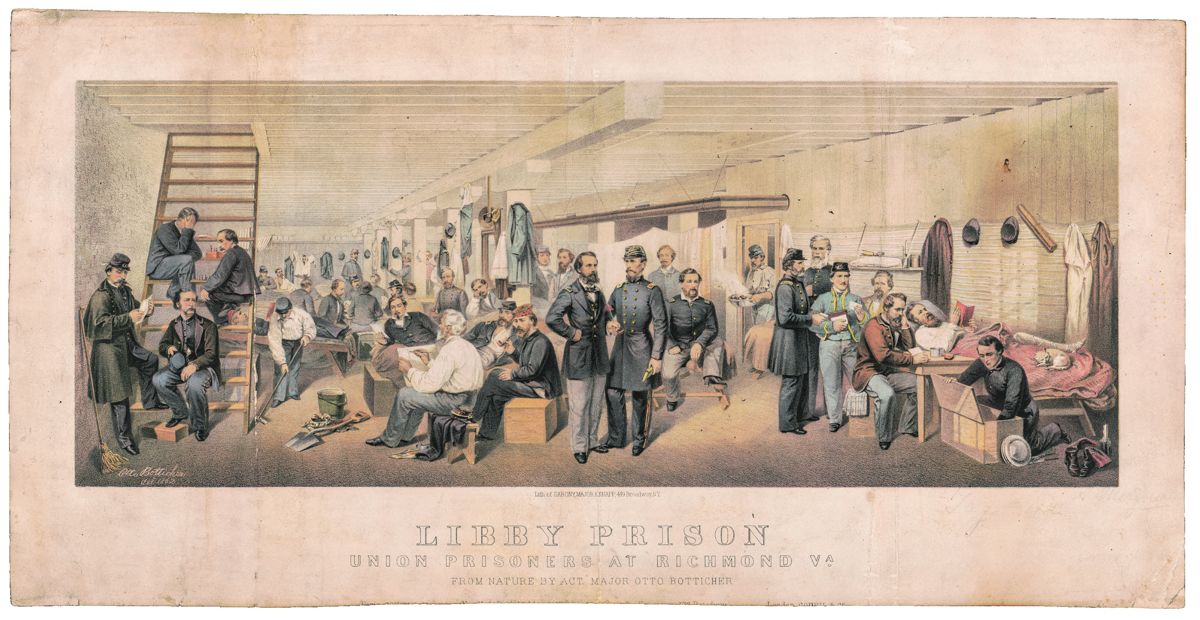
his communist leanings. Unfortunately no other inmates are identified. However, a copy of this print in the possession of Chicago’s Abraham Lincoln Bookshop has two handwritten names above the two central officers in the view. They are “Col. F. W. Swift” and “Gen. Wilkins.” Frederick Williams Swift was one of the officers brevetted as Major General or Brigadier for services rendered during the war but not appointed to full rank. He was awarded the Medal of Honor “for having gallantly seized the colors and rallied the regiment after three color bearers had been shot.”3 “General Wilkins” is William Duncan Wilkins, (1826– 1882) who fought in the Mexican War and participated in Civil War campaigns in Maryland and
Virginia until he was captured and imprisoned at Libby. The highest rank Wilkins achieved was brevet lieutenant colonel in March 1865, well after he had resigned his commission August 29, 1863.4 For generations artists used a common technique to identify themselves with their particular work of art beyond merely signing the piece. Including themselves in the scene was a way of saying “I was there and I recorded this for posterity.” Look closely at the distinguished grayhaired, bearded man sitting on a stool just to the left of Swift and Wilkins. The seated individual is drawing. Could this be a self-portrait of Boetticher at work? Endnotes: 1. Union Prisoners at Salisbury. https://americanhistor y.si.edu/collections/search/object/ nmah_326070. Also see entry from the Reynolda House Museum of American Art, https:// www.reynoldahouse.org/ collections/object/unionprisoners-at-salisbury-nc. 2. Ezra Warner, Generals in Blue: Lives of the Union Commanders, Baton Rouge, LSU Press, 1964, pp. 565-566. 3. Ibid., 581 and 593. Quote is from Francis B. Heitman, Historical Register and Dictionary of the United States Army, Washington, 1903, I, p. 941. 4. William D. Wilkins Paper, Library of Congress, https://www.loc.gov/item/ mm85061935/. Heitman, I, p. 1,037. See also NYTimes, “The Rebel Prisons. Names of Union Officers in Libby Prison,” September 21, 1864. After 43 years in the museum field, Salvatore Cilella devotes his time collecting American prints and maps and writing. His last professional position was President and CEO of the Atlanta History Center. His most recent books are Upton’s Regulars: A History of the 121st New York Volunteers in the Civil War (U. Press Kansas, 2009). His two-volume Correspondence of Major General Emory Upton, (U. of Tennessee Press, 2017), received the 2017–2018 American Civil War Museum’s Founders Award for outstanding editing of primary source materials. His latest book “Till Death Do Us Part,” an edit of Upton’s letters to his wife 1868–70, was published last year by the Oklahoma University Press.