
Black Powder, White Smoke
Instructing the “Stupids”
By Joe Bilby · Originally published May 2021 · pp. 6–7
In the early months of the Civil War the basics of military life were often difficult to grasp for many volunteers, a situation that caused a Springfield, Mass., newspaper to complain that: “Some stupids down near Boston have been loading the United States rifle muskets with cartridges made of heavy paper, and finding that they do not work well, complain of the rifles as in fault.” Of course, the paper did not name the contractor who created the oversized rounds in the first place.
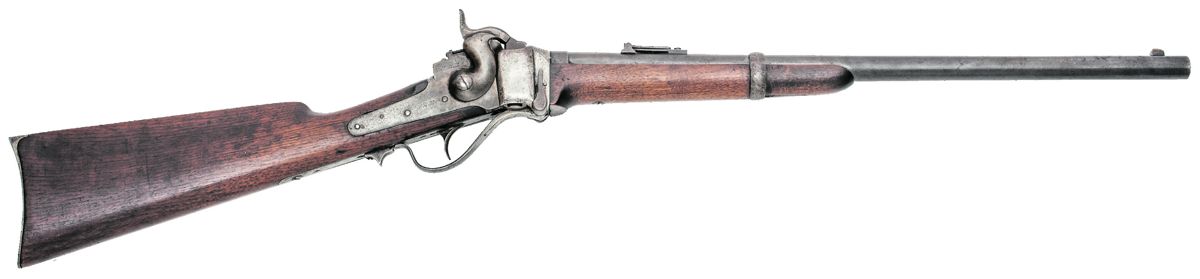
Sharps .52 caliber carbine. Manufactured in 1863.
Spencer .56-.56 caliber seven shot repeater carbine.
Apparently the “stupids” had been loading their rifle muskets in the same manner they had used with smoothbore muskets as militiamen in the past, pouring powder down the muzzle and then ramming down the rest of the cartridge, including the paper casing, unaware that with the rifle musket, the cartridge paper was supposed to be disposed of before inserting the Minié ball in the gun’s muzzle. The newspaper went on to further lecture the “stupids” that “no paper should be used in loading these arms. First the powder is poured in from the cartridge, and then the ball is dropped on top, and will go home of itself, but a gentle tap of the ramrod is useful to fill the cavity of the ball with powder, and leave no opportunity for the gas generated by the explosion to escape but behind the ball.” Apparently there were “stupids” on the other side as well, since a Richmond newspaper copied the article as an advisory to Virginians.
Confederate Colonel John Mosby, who became infamous for his sudden raids against advanced Union positions, when first encountering the Henry in battle called it “that damned Yankee rifle that can be loaded on Sunday and fired all week.” Since then that phrase became associated with the Henry rifle. Source: http://www.henryrepeating.com/history.cfm. Henry .44 caliber repeating rifle. Photo Courtesy of Poulin’s Antiques & Auctions.
“With regard to the best weapon for dismounted men it, is hard to decide. I have seen several different carbines, all good in their way. The Spencer carbine was latterly in very general use, superseding Sharp’s. There was but little to choose between them. I have fired as many rounds in the course of twenty minutes out of Sharp’s as out of Spencer’s. The latter fires seven rounds pretty rapidly, but it takes some time to reload. The Henry rifle, or sixteenshooter, is a magnificent weapon, quickly loaded, and firing as quick as a Colt’s revolver. It is also very accurate.” Source: Whittaker, Frederick. Volunteer Cavalry: The Lessons of the Decade. United States: author, 1871.
The Stupids Evolve By mid-July 1864, after two and a half months of desperate fighting, the Confederate Army of Tennessee had been pushed from northern Georgia to the outskirts of Atlanta by Major General William T. Sherman’s Union forces. In a risky attempt to break the developing siege of the city, Confederate Lieutenant General John B. Hood withdrew men from Atlanta’s defensive lines and launched a series of assaults on Sherman’s enveloping army. Hood’s July 20 attack at Peach Tree Creek failed, but two days later his gambit seemed on the verge of success, as the Rebels broke through Yankee lines and, in the process, killed Major General James B. McPherson. When victorious Confederates surged into the Federal rear, however, they encountered stiffening resistance from Union units, including the 66th Illinois Infantry, a regiment with a large number of Henry .44 caliber repeating rifles in its ranks. Private Prosper Bowe of the 66th recalled that: “We startedour[Henry]sixteen-shooters to work. The first column in front of us nearly all fell at the first two or three volleys.” The “sixteen shooters” helped win the day, driving the Confederates from the field. The Rebel retreat proved timely for the rapid-firing Yankees, however, since they had begun to run out of ammunition. General Hood ultimately failed in his attempt to lift the siege of Atlanta, arguably at least partially due to the “sixteen shooters.”The city was doomed, and with it, ultimately, the Confederacy. On September 19, 1864, at Winchester, Va., Union Major General Philip Sheridan launched his campaign to drive Confederate General Jubal Early out of the Shenandoah Valley. As Sheridan’s army advanced, Brigadier General Cullen A. Battle’s Alabama Brigade counterattacked and, exploiting a gap between two corps, precipitated a retreat all along the VI Corps front. The First New Jersey Brigade’s fighting withdrawal held off the Rebels and then the Jerseymen were relieved by the 37th Massachusetts Infantry, a regiment recently rearmed with seven-shot Spencer repeating rifles, and the Bay State boys let loose a blizzard of bullets, slowing the Confederate advance. This,
coupled with confusion caused by the death of Confederate Major General Robert Rodes and a flank attack conducted by Brigadier General Emory Upton, stopped the Rebels in their tracks. The Massachusetts men, like their Illinois brothers in arms to the west, ran low on ammunition. They took to ground under a heavy fire of Confederate musketry until soldiers from the 2nd Rhode Island Infantry filled their pockets with Spencer .56-.56 caliber cartridges and ran the ammo up to the 37th. The Yankees went on to win the day, and Colonel Elisha Hunt Rhodes of the 2nd was so impressed that he carried a Spencer carbine as his personal arm for the rest of the war. If 1863 was the year of the rifle-musket, when the major armies of North and South were finally completely armed with the standard “modern” infantry weapon of the day, 1864 could be called the year of the repeating rifle, as increasing numbers of Spencer, and to a more limited extent Henry, repeaters drew notice in the field. These revolutionary breech loading arms fired self-contained copper rim fire cartridges, with primer, powder, and bullet all in one sturdy waterproof package. The South did not have the industrial capacity to make its own repeaters or ammunition for them, and, although captured Spencers and Henrys began to appear in Rebel ranks as the year wore on, Confederate combat use of captured repeating rifles, unlike rifle-muskets or even Sharps carbines, was dependent on a supply of captured cartridges.
Joseph G. Bilby received his BA and MA degrees in history from Seton Hall University and served as a lieutenant in the 1st Infantry Division in 1966–1967. He is Assistant Curator of the New Jersey National Guard and Militia Museum, a freelance writer and historical consultant and author or editor of 21 books and over 400 articles on N.J. and military history and firearms. He was also publications editor for the N.J. Civil War 150 Committee and edited the award winning New Jersey Goes to War. His latest book, New Jersey: A Military History, was published by Westholme Publishing in 2017. He has received an award for contributions to Monmouth County (N.J.) history and an Award of Merit from the N.J. Historical Commission for contributions to the state’s military history. Email at [email protected].