
A New Initiative at Gettysburg: Rehabilitating Culp’s Hill
By Sue Boardman and Ben Hansford · Originally published May 2021 · pp. 1–5
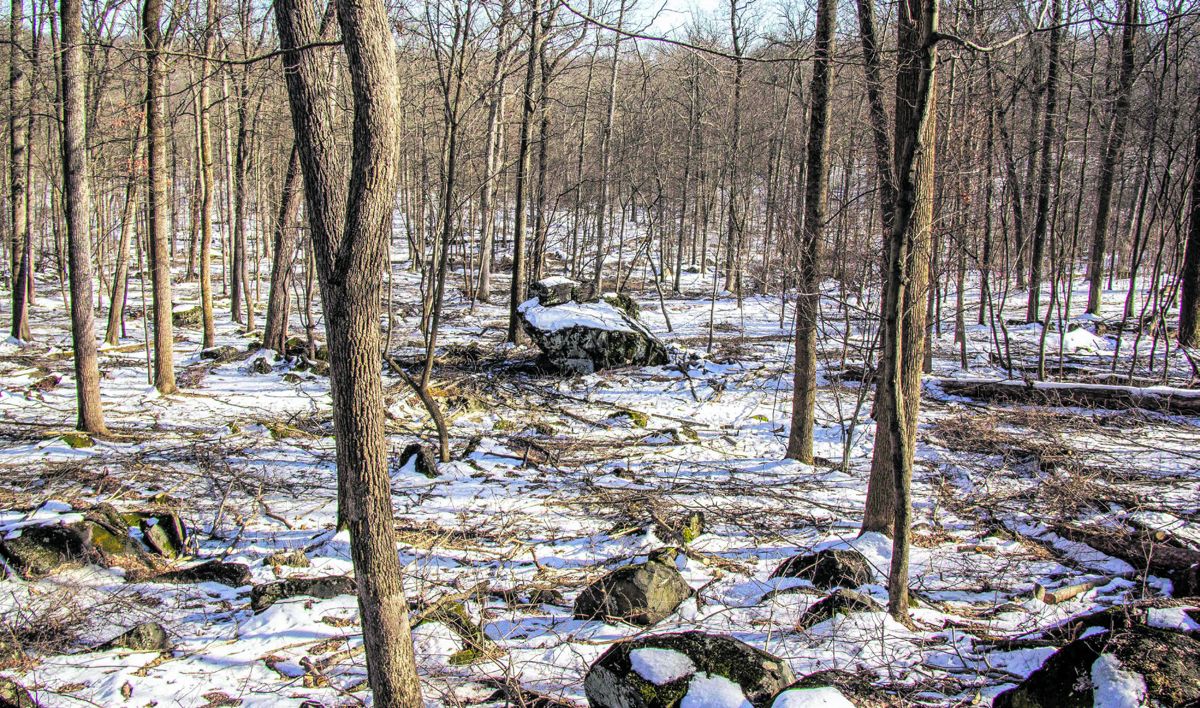
The Gettysburg battlefield is one of the most studied, photographed, written about, and visited Civil War sites. Yet portions of that field and its accompanying stories often go unnoticed, in part because the terrain has become obscured by vegetation and its viewscapes lost. The Gettysburg Foundation and Gettysburg National Military Park are changing that with a major rehabilitation of Culp’s Hill.
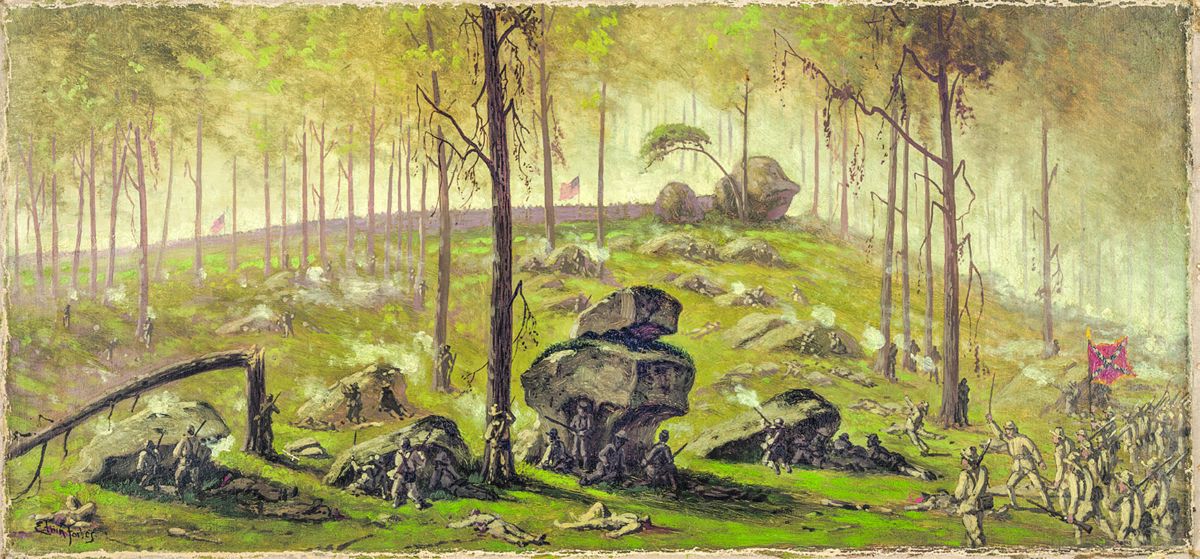
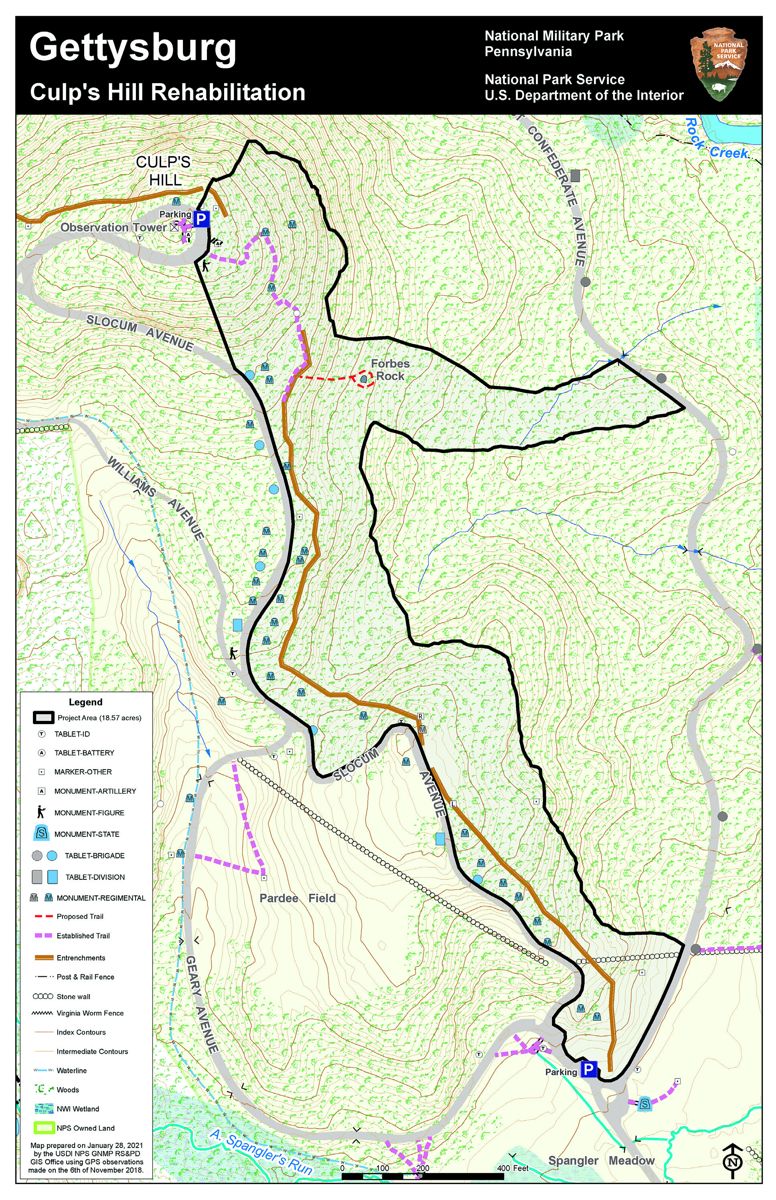
The Gettysburg Foundation and Gettysburg National Military Park are partnering to rehabilitate Culp’s Hill. This comprehensive project includes landscape improvements and enhanced educational resources, both of which will help visitors better understand events that took place here. We are grateful to Charles ‘Cliff’ Bream, III and Julie St. John, whose lead philanthropic support is making this transformation a reality. The thinning of 18 acres of woodlot will have the greatest impact on site interpretation here. Since farmers owned most woodlots in Gettysburg before the battle, grazing animals kept woods clear of undergrowth. As such, Confederate assaults up Culp’s Hill would have been relatively unencumbered by vegetation. Edwin Forbes’ famous painting depicts this landscape. Prior to rehabilitation, visitors parked along Slocum Avenue looking east had a difficult time imagining Confederates charging up the hill, given the overgrown vegetation. Visitors were unable to comfortably walk through this area and understand how intense combat took place here. Since woodlot treatment began in February 2021, visitors can now visualize the unique fighting that took place on Culp’s Hill. Gettysburg National Military Park identified a key part of the Culp’s Hill battlefield to receive this treatment, the 18 acres on the east side of Slocum Avenue from Spangler’s Spring to the summit. Work included removal of brush and select trees that were five inches or less in diameter. The initial thinning is only the beginning of the Culp’s Hill woodlot management program. Without proper treatment, this woodlot will return to its previous form within a few years. The Gettysburg Foundation is building an endowment to fund the maintenance of this project in perpetuity so that future generations can enjoy it. The rehabilitation will also expose and highlight historic earthworks from Spangler’s Spring to the summit. Earthworks played a major role in the Union’s defense of the right end of their battle line. These earthworks were rebuilt by veterans at the end of the 19th century and have since been overgrown by vegetation and shrubs. Only the most astute visitors could spot them through the overgrowth. Work to remove vegetation from the historic earthworks began in March 2021. These structures, which played a major role in the Culp’s Hill battle action, are now being exposed. The cleared earthworks, situated near the edge of the thinned woodlot, provide visitors with a more historically accurate view, unimaginable just a few months ago. Another rehabilitation component is creating a trail between the summit parking area and Forbes Rock. Adventurous visitors previously utilized an informal social trail to access Forbes Rock, but social trails are not maintained and cause erosion and damage to historic landscapes. The new formalized trail will provide proper natural and cultural landscape techniques that apply visitor safety concepts and will drastically cut down localized erosion. The new trail will provide visitors the opportunity to walk in the footsteps of soldiers and appreciate the viewshed from Forbes Rock, where the elevational change of Culp’s Hill can be fully appreciated. An American Conservation Experience (ACE) crew will complete both removal of vegetation from historic breastworks and trail construction. ACE is a non-profit organization that provides service opportunities for youth of all backgrounds, allowing them to improve public lands and gain valuable experience.
Importance of Culp’s Hill Culp’s Hill anchored the Union right flank during much of the battle. The outcome of the fighting here was critical to the Union Army’s success at Gettysburg. One of the first three landmarks preserved by local citizens and veterans, in the early post-war years, Culp’s Hill was once one of the most frequently visited places on the field. It bore testimony to the fierce and prolonged fighting that occurred here during two July days. John Bachelder, in his 1873 tour book, Gettysburg: What to See and How to See It, wrote, “There is probably no place on the Gettysburg battlefield which presents such a strong attraction as Culp’s Hill. It is natural that the visitor should wish to see some tangible evidence of the battle. Many portions of the field have since been cultivated, and little remains to distinguish them from other and contiguous ground. But here there is no mistaking the fact that some great and unusual event has occurred.” Bachelder was referring to the shattered trees and remnants of earthworks attesting to the hard fighting here. On the evening of July 2, the Union XII Corps, which occupied the hill most of the day and had built substantial earthworks along their line, was ordered to assist Union troops on the left flank. Confederate General James Longstreet’s troops were attempting to turn the Union line on that end of the field with some success. Despite heavy skirmishing in front of their lines, most of the XII Corps left Culp’s Hill by dusk. A small brigade, less than 1,400 New Yorkers, commanded by General George Greene, remained to cover the entire hill. Soon after, an attack by nearly 4,500 Confederates of General Edward “Allegheny” Johnson’s
Veterans walking the Union lines between upper and lower Culp’s Hill during the 1913 reunion at Gettysburg. Sue Boardman Collection.
Division ensued. As the men in gray charged up the steep, boulder-strewn slopes, they ran headlong into the formidable earthworks protecting the small Union brigade. Intense fighting lasted for several hours in near total darkness. A New York soldier described it for a Syracuse newspaper by saying, “The Rebels advanced, and a perfect storm of lead was poured into them, mowing them down like grass; but the rascals stood their ground well and returned fire….Our men, however, were protected by their breastworks, and consequently suffered comparatively little.” The tenacity of Greene’s men, the advantages of the terrain and the protective breastworks allowed Greene’s brigade to retain control of much of the hill, although Confederates under General George Steuart occupied the former Union breastworks on lower Culp’s Hill for several hours. Around midnight, the rest of the XII Corps began returning to their former positions but found some occupied by Steuart’s Confederates. After establishing a new Union line from Greene’s right flank toward Spangler’s
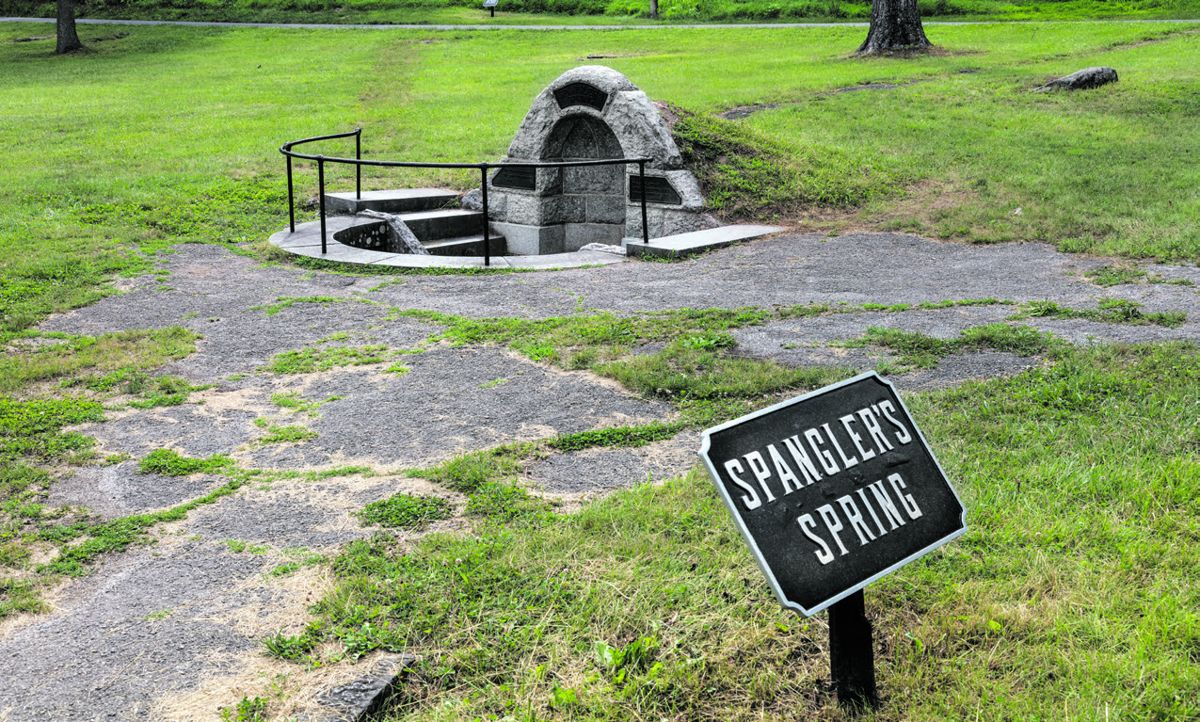
The 149th New York Infantry, 3rd Brigade, 2nd Division, XII Corps monument near Culp’s Hill. swale (now Pardee Field) and along Spangler’s Lane, they settled in for a few hours of rest before daylight. With additional reinforcements in place, both Union and Confederate commanders determined to reengage in the early morning of July 3. Union artillery fire about 5 a.m. was followed immediately by repeated attacks from Confederate infantry. General Alpheus Williams, a Union XII Corps division commander, said of the fierce fighting, “The whole line of woods was ablaze with continuous volleys, especially on Geary’s front, against which they hurled their columns with a most persistent determination to get possession of the portion of the line held by Greene…” A Union soldier was quoted in Memoirs of the 149th New York, “The appearance of the men as they worked in the trenches with their clothes ragged and dirty, their faces black from smoke, sweat and burnt powder, their lips cracked and bleeding from saltpeter in the cartridges bitten by them, and while loading and firing for dear life, resembled more inhabitants of the bottomless pit than quiet peaceful citizens of the United States of America. The people at home would not have recognized their friends, and a father would have been perplexed to know his son.” Fighting stretched from the top of Culp’s Hill to the bottom, across Spangler’s meadow, swale, and spring. Union Lieutenant Colonel William F. Fox stated, “It was a remarkable fight. For seven hours the unremitting roar of the rifles continued along the front of the XII Corps, varied at times by the heavier crashes where come a fresh regiment relieving another opened with a full volley. As fast as the regiments expended their ammunition, they were relieved, went to the rear, cleaned their rifles, refilled their cartridge boxes, and then resumed their place in line with loud cheers. It was the longest continuous fight of any made at Gettysburg…” Despite repeated attempts to break the Union lines during those seven hours of sustained fighting, Confederate forces lost their foothold on lower Culp’s Hill and failed to dislodge their opponents at any other point along the Union earthworks. By late morning it became clear the fight on the right was a Union victory. During following decades, veterans returned to Gettysburg, walked the fields and raised monuments to help future generations understand what occurred during the battle. Culp’s Hill was visited often, not only by the veterans who had fought to save or capture it, but also by those who desired to see evidence of the battle. As the veterans aged, the field seemed to age with them, losing some of its strength and ability to bear witness. Visitors’ attention was drawn to the fields of Pickett’s Charge, the heights of Little Round Top and the jumbled boulders of Devil’s Den. By the early 20th century, the official tour route offered Culp’s Hill as an option rather than a must-see part of the story. Even the extensive rehabilitation of the battlefield, envisioned in Gettysburg National Military Park’s 1999 General Management Plan, struggled to find the resources to bring Culp’s Hill in line with the rest of the restored landscape. Licensed Battlefield Guide Sue Boardman remarked, “Culp’s Hill is every bit as important and as exciting as Little Round Top, but the story is very hard to tell given the condition of the terrain. Natural intrusions have claimed much of the visual evidence of the great battles on the Union right, resulting in Culp’s Hill becoming one of the least-visited areas on the battlefield. Confusing placement of monuments, loss of viewsheds, and lack of access to specific points of interest have made interpretation difficult.” A new National Park Service initiative, in partnership with the Gettysburg Foundation, is underway and the project is changing the interpretive value of Culp’s Hill.
Culp’s Hill Rehabilitation Project
Spangler’s Spring.
The ACE crew plans to complete both tasks by the end of June. The final element to complete the project is the addition of interpretive wayfinding signs. While the National Park Service is careful not to clutter historic and hallowed grounds with signage, it has detected a need for more interpretation at Culp’s Hill. These signs will give visitors a better understanding of the fighting on Culp’s Hill, provide information about the cleared breastworks, and call attention to the new trail. This project encompasses more than just changes on the battlefield. The Gettysburg Foundation and Gettysburg National Military Park are committed to expanding the educational resources associated with Culp’s Hill. For example, the Foundation and Gettysburg National Military Park are creating a Culp’s Hill Walking Guide that will be available for visitors. This guide will help visitors navigate Culp’s Hill and share stories beyond the information on the wayfinding signs. The Gettysburg Foundation has acquired a Culp’s Hill diorama that will be temporarily displayed in the Gettysburg National Military Park Museum & Visitor Center. This diorama will provide visitors an overview of the Culp’s
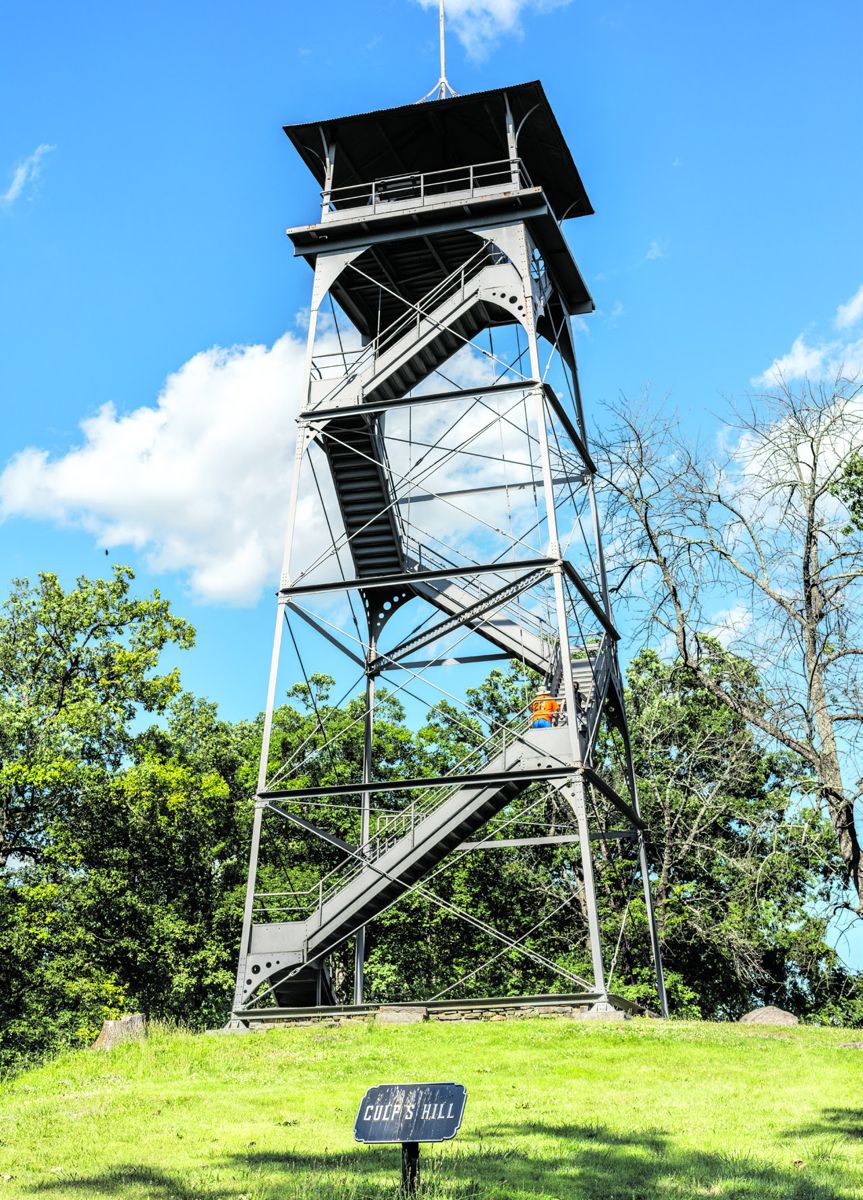
Hill fighting to help familiarize them in preparation for their tour of this battlefield area. Finally, both the Gettysburg Foundation and Gettysburg National Military Park are creating digital content on the Culp’s Hill project to share on their websites and social media channels. The digital content includes on-site live streams with park rangers and Licensed Battlefield Guides, time-lapse videos of woodlot thinning, and highlights of Culp’s Hill artifacts from the archive.
The Power of Partnership The Gettysburg Foundation is a non-profit philanthropic, educational organization operating in partnership with the National Park Service to preserve Gettysburg National Military Park and Eisenhower National Historic Site, and to educate the public about their significance. The Foundation has a 31-year history of land and monument preservation, educational programming, battlefield rehabilitation, and artifact acquisition. The Foundation raised the money for, built, owns, and operates the 139,000 square-foot Gettysburg National Military Park Museum & Visitor Center. The public-private partnership between the Foundation and the National Park Service has become a national model, combining the interpretive expertise and preservation resources of the National Park Service with valuable public outreach capabilities and private financial support of the Gettysburg Foundation. The National Park Service is responsible for stewarding many of our country’s natural, historic, and cultural treasures and resources. This stewardship requires funding that is not always available from the federal government. Gettysburg National Military Park identified woodlot maintenance at Culp’s Hill as a potential project; this vision is being realized thanks to private funding from Cliff Bream, Julie St. John, and the Gettysburg Foundation’s commitment to fund continued maintenance.
Support the Project The Gettysburg Foundation is building a Culp’s Hill endowment to make certain the 18acre woodlot and trail are properly maintained forever. You can contribute to this endowment at GettysburgFoundation.org/Culps or by texting CULPS to 41444. Your help will ensure our future generations can enjoy the same experience we are providing current generations. If preserving Gettysburg’s landscapes and lessons is important to you, consider becoming a Gettysburg Foundation member. Through volunteer and fundraising efforts, our Friends of Gettysburg help the National Park Service continue their mission of acquiring and preserving battlefield lands and artifacts, improving the visitor experience, and educating the public. In addition to donating to the Culp’s Hill endowment, we invite you to visit Gettysburg National Military Park to experience the rehabilitation project in person. Before heading onto the battlefield, be sure to visit the Gettysburg National Military Park Museum & Visitor Center. We recommend setting the framework for your visit by seeing the film presentation of A New Birth of Freedom, experiencing the one-of-a-kind Battle of Gettysburg Cyclorama, and exploring the 12-gallery Gettysburg Museum of the American Civil War. Reserving a car tour with a Licensed Battlefield Guide allows you to personalize your tour; request adding Culp’s Hill to the battlefield sites you want to see and stories you wish to hear. Repeat visitors will enjoy taking another look at the Culp’s Hill artifacts on display in the museum prior to experiencing the rehabilitated landscape and hiking to Forbes Rock. When you visit Culp’s Hill, keep in mind that the newly opened and more accessible area is hallowed ground and a vital resource the National Park Service works to preserve and protect. Please take care when walking the ground and avoid walking on or over the historic breastworks that have been uncovered. Help us further protect the landscape by staying on established trails. The rehabilitation of Culp’s Hill will make the stories above, and many more like these, accessible to future generations. The Gettysburg Foundation is honored to partner with Gettysburg National Military Park on this transformation. Contributing writers:Gettysburg Foundation’s Leadership Program Director Emeritus, Sue Boardman and Gettysburg Foundation’s Associate Director of Philanthropy, Ben Hansford.