
The Source
The Lincoln Archives Digital Project
By Michael K. Shaffer · Originally published March 2021 · p. 18
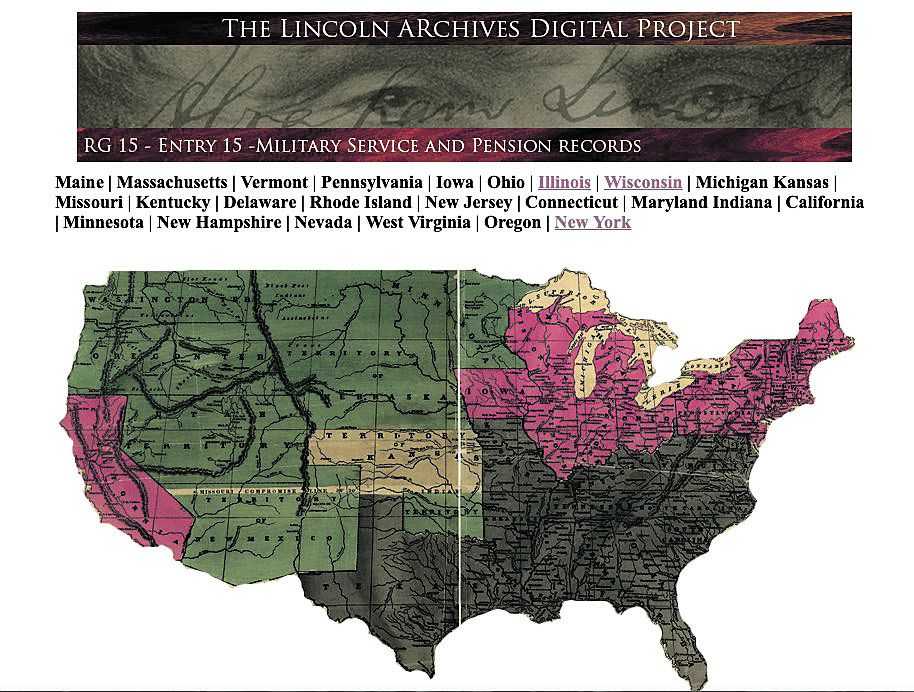
The Lincoln Archives Digital Project Readers will recall the introduction, last month, of the Lincoln Archives Digital Project. (lincolnarchives.org/) This month, an overview of the various sections and a look into specific categories. Over 20 years of scanning and digitization represent the current offerings; the work will continue well into the future, so bookmark the site and check back for updates. One can also follow the Project on Facebook and Twitter. The ’Site Map’ (see image of partial records) provides an excellent starting point for obtaining an overview of the various record groups from the National Archives section, which will eventually contain thousands of digitized documents. After reviewing the various records, researchers may opt to use the search function to mine those digitized thus far. One might not expect to locate regimental information in a Lincoln project, but some exist currently—Illinois and
New York—from RG 15: Military Service and Pension Records. (See map image) For example, the 104th Illinois Infantry data includes a detailed account of the unit’s service during the war. The overview of the 104th follows; see the balance at lincolnarchives. org/cgi-bin/lincoln?a=d&d=&sf=&d=Drg94-519-ill-inf-104. “This Regiment was organized at Ottawa, in August 1862, and was composed almost entirely of La Salle county men. Before being uniformed or armed, they received orders to report at Louisville, Ky., where they remained for some time, and in the reorganization of General Buell’s Army were assigned to General Dumont’s Division. When General Buell commenced his march in pursuit of General Bragg, they were on the left of the army, going first to Frankfort, Ky., where they remained until October 26, then marching to Bowling Green, Glasgow, Thompkinsville, and on December 1, reached Hartsville, Tenn., on the Cumberland River. The brigade was commanded by Colonel Scott, of the Nineteenth Illinois, until they reached Hartsville, when Colonel A.B. Moore, of the One Hundred and Fourth Illinois, was assigned to command. Lieutenant Colonel Hapeman commanding the Regiment.” Periodically check the Lincoln Archives Digital Project (lincolnarchives.org/)foraddedcontent. In the interim, continued good luck in researching the American Civil War! Michael K. Shaffer is a Civil War historian, author, lecturer, and instructor, who remains a member of the Society of Civil War Historians, Historians of the Civil War Western Theater, and the Georgia Association of Historians. Readers may contact him at [email protected] or request speaking engagements via his website civilwarhistorian.net. Follow Michael on Facebook www. facebook.com/michael.k.shaffer, and Twitter @michaelkshaffer.
Site Map Screen