
Black Powder, White Smoke
Smoothbores at Gettysburg
By Joe Bilby · Originally published March 2021 · pp. 10–11
By the midpoint of the Civil War, the Army of Northern Virginia and the Army of the Potomac were mostly armed with rifled weapons.The Confederates largely shouldered imported British Enfields, captured Springfields, and some Richmond manufactured rifle muskets crafted on the Harper’s Ferry manufacturing equipment seized at the War’s onset. The Yankees were armed with Springfield rifle muskets and contract made duplicates, plus a scattering of imported guns, including Enfields and Austrian rifles. At the conflict’s outset, both sides had carried more obsolete smoothbore muskets.These were either Model 1842s or earlier flintlocks altered to percussion ignition, but by 1863 most soldiers had traded them for rifled arms of some sort. So, when both armies clashed at Gettysburg in what some have called, “America’s Greatest Battle,” for the most part, the regiments armed with the old-fashioned firearms were those who, for some reason, preferred the older technology. Among those, most notably, were the New York regiments of the Irish Brigade and the soldiers of the 12th New Jersey Infantry, who clung to their smoothbores well into the following year. Although most volunteer units wanted rifled arms, not only because they were perceived as more effective in combat, there was also the idea of status, with more effective units supposedly receiving the more modern weapons. Not everyone agreed, of course, and General Meagher of the Irish Brigade said he preferred smoothbores for his men because he thought most of the brigade’s fighting “would be at very close quarters.” Many officers were in agreement with Meagher’s belief that most combat would be at short range. Colonel George Willard of the 125th New York Infantry, a well-known proponent of the smoothbore, flatly stated that “under certain circumstances, the arms formerly employed [smoothbores] were more effective than the new ones, particularly when at close quarters.” There was disagreement, of course, and William O’Grady of the 88th New
York Infantry, one of Meagher’s regiments, recalled after the war that “sometimes our short-range weapons were a disadvantage.” A few years ago, I decided to get familiar with the care and feeding of smoothbore muskets.
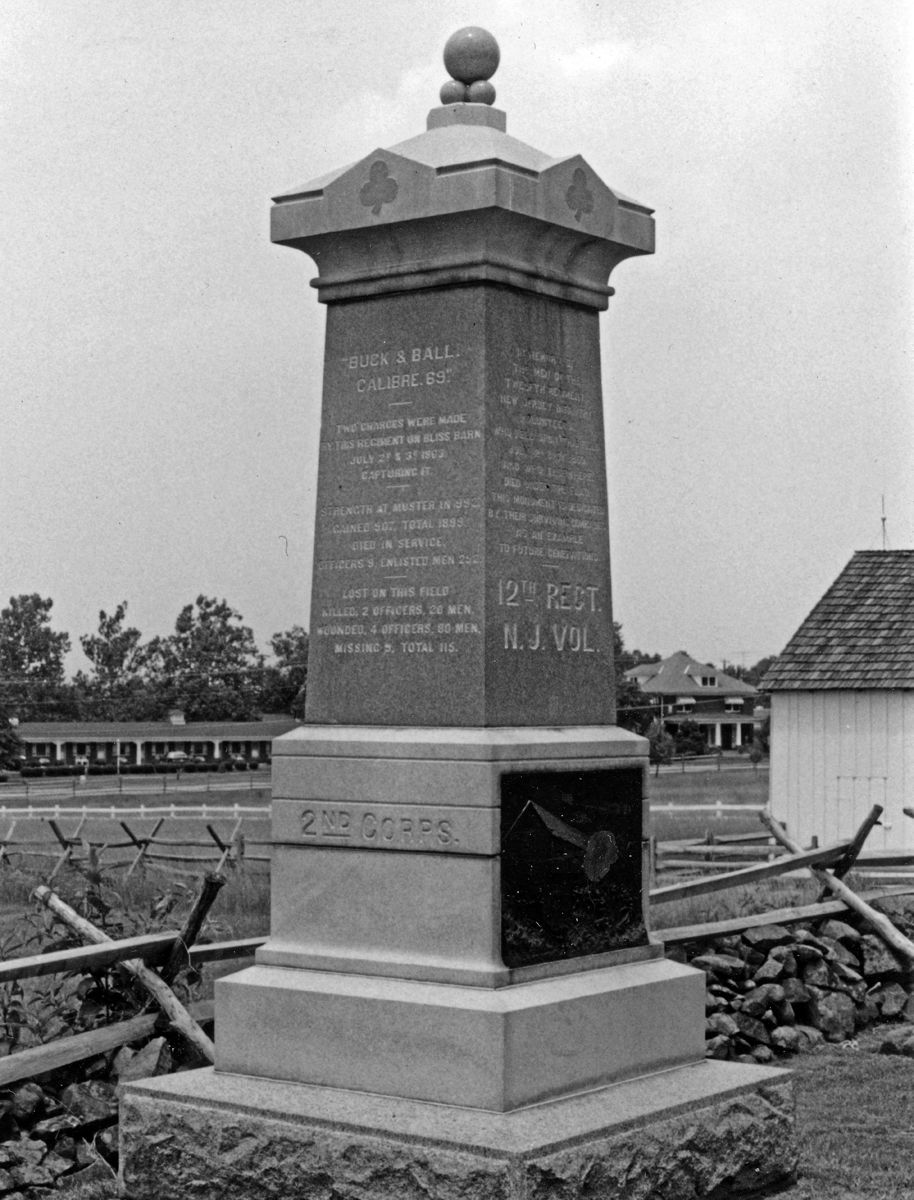
The “buck and ball” round was the standard smoothbore load during the war. I had a local cartridge maker fabricate some buck and ball cartridges in the original manner, paper enclosed and containing powder, a .650 caliber From the front of the monument: In memory of the men of the Twelfth Regiment New Jersey Infantry Volunteers who fell upon this field July 2d & 3d 1863, and who elsewhere died under the flag. This monument is dedicated by their surviving comrades as an example to future generations.12th Regt. N.J. Vol. On another side reads: “Buck & Ball Calibre .69.” Two charges were made by this regiment on Bliss Barn July 2d & 3d 1863 capturing it. Strength at muster in 992 Gained 907, total 1899 Died in service, officers 9, enlisted men 252. Lost on this field Killed 2 officers, 20 men Wounded, 4 officers, 80 men. Missing 9, Total 115.
ball and three .31 caliber buckshot. The powder charge was slightly less than the original. In the first test four shooters fired at six cans of seltzer water suspended from four target frames at fifty yards. Two shots each cleared the targets. Two shooters next fired five rounds each at two police silhouette targets, scoring eighteen hits on one target and thirteen on the other. A series of shots at 100 yards achieved random hits with the balls on the backstop, but most buckshot hit the ground at around seventy-five yards. On July 2 at Gettysburg, the Irish Brigade held its own in close range fighting in the Wheatfield area, but the ultimate triumph of smoothbore arms came the following day on Cemetery Ridge. July 3 opened without major combat, but an afternoon artillery duel preceded the disastrous Confederate infantry assault known forever afterward as “Pickett’s Charge” after Major General George Pickett, who commanded one of the three divisions. The attack hit the II Corps portion of the Union line, held in part by the 12th New Jersey Infantry on the right flank. The Jerseymen, armed with smoothbore muskets, had been instructed by a senior officer to begin firing at the enemy when the Rebel line hit the road down the hill, about 200 yards away, but had torn apart cartridges, added multiple buckshot to their muskets, reserved their fire and laid low behind a stone wall until the enemy was within fifty yards and then rose and delivered a devastating volley into the Twenty-sixth North Carolina regiment, shattering that unit and capturing its battle flag. The flag was sent as a trophy to Trenton, where it remained until returned to North Carolina in the early twentieth century. It is currently at the American Civil War Museum in Richmond. Over several days of heavy fighting, the regiment lost twenty-three men killed, eighty-three wounded and nine missing. The Jerseymen returned to Gettysburg on June 30, 1886 to dedicate the first monument to a regiment from their state at the battlefield. It was a tall column topped with a large round ball and three smaller ones and inscribed “Buck & Ball Calibre .69?” Joseph G. Bilby received his BA and MA degrees in history from Seton Hall University and served as a lieutenant in the 1st Infantry Division in 1966–1967. He is Assistant Curator of the New Jersey National Guard and Militia Museum, a freelance writer and historical consultant and author or editor of 21 books and over 400 articles on N.J. and military history and firearms. He was also publications editor for the N.J. Civil War 150 Committee and edited the award winning
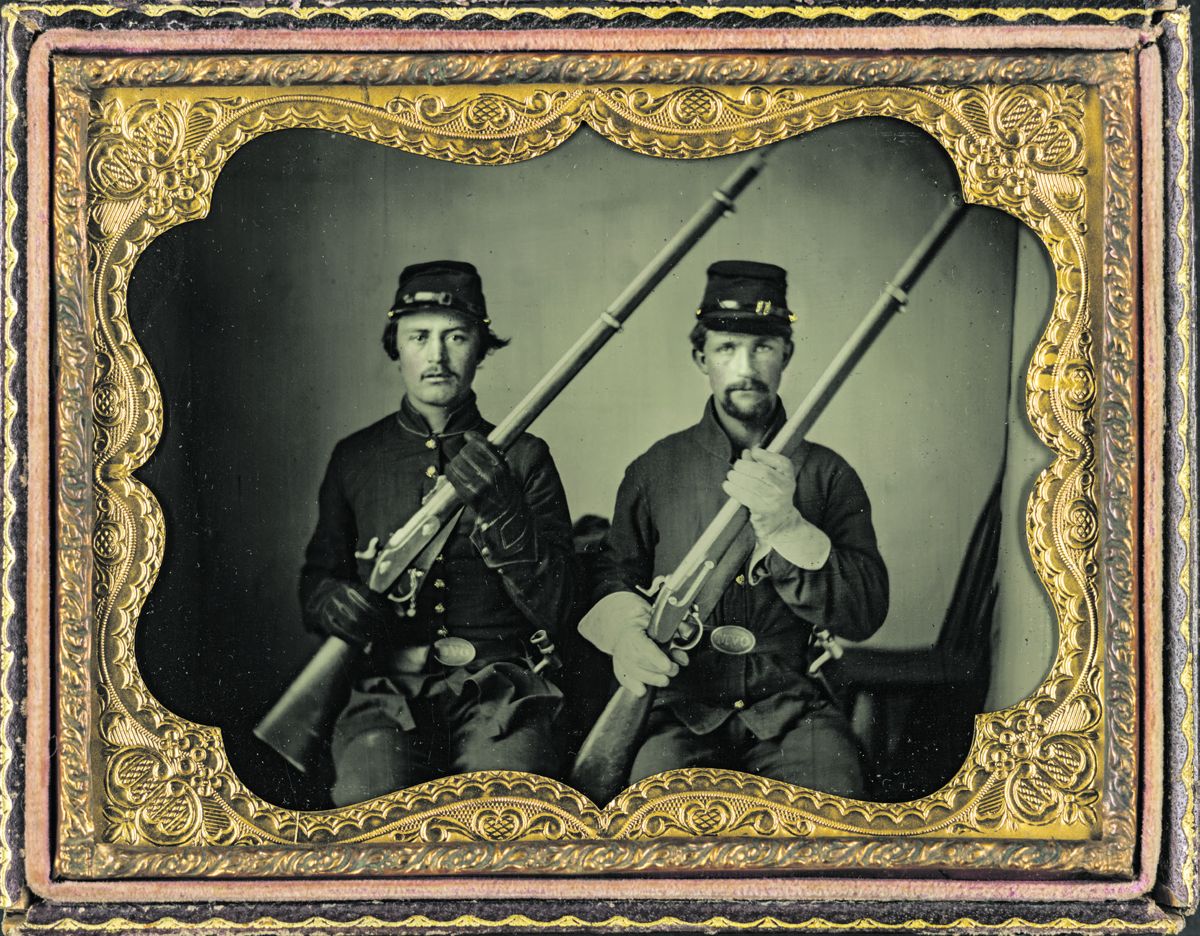
Two Ohio Volunteer Militia Men posed in uniform holding a Pattern 1853 Enfield rifle musket (left) and Model 1842 smoothbore musket. Both wear “OVM” belt plates and both pose holding their muskets with black and white gauntlets which infantryman rarely would ever have in the field. The soldiers are identified as Wesley Scott and L. P. Nash. Wesley P. Scott enlisted late war at Camp Chase, Ohio, May 2, 1864 into Company F, 157th Ohio. There are several Nashs that also entered service at same time but none with matching initials. Wesley was mustered in as a 38 year old corporal and would serve his hundred days guarding prisoners and return home. Note with photo reads: “Right hand, L.P. Nash, left hand, Wesly Scott. One with whiskers Nash.” Liljenquist Family Collection of Civil War Photographs (Library of Congress).
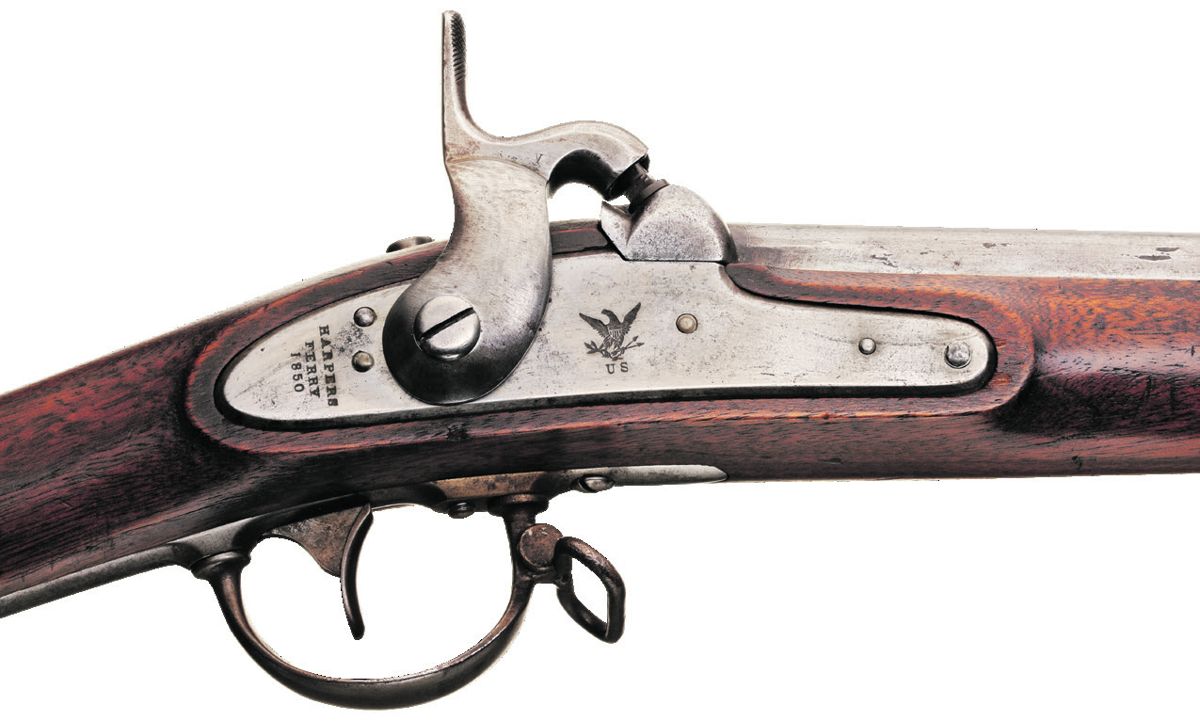
U.S. Model 1842 Musket by Harpers Ferry. .69 caliber, 42 inch barrel. The U.S. M1842 holds the distinction of being the first percussion infantry musket adopted for general issue by the US Ordnance Department and the last general issue smoothbore long arms. It was essentially a percussion redesign of the earlier U.S. Model 1835/40 flintlock musket, which was based on the French Model 1822. It was also an early attempt at achieving parts interchangeability at the U.S. armories. During the production life of the guns at from 1844–1855 Harpers Ferry manufactured around 103,000 guns and Springfield produced around 172,000. Arston Grant Collection.
New Jersey Goes to War. His latest book, New Jersey: A Military History, was published by Westholme Publishing in 2017. He has received an award for contributions to Monmouth County (N.J.) history and an Award of Merit from the N.J. Historical Commission for contributions to the state’s military history. Email at [email protected].