The Graphic War
Lee and Jackson as Fund Raisers
By Salvatore Cilella · Originally published March 2021 · pp. 22–23
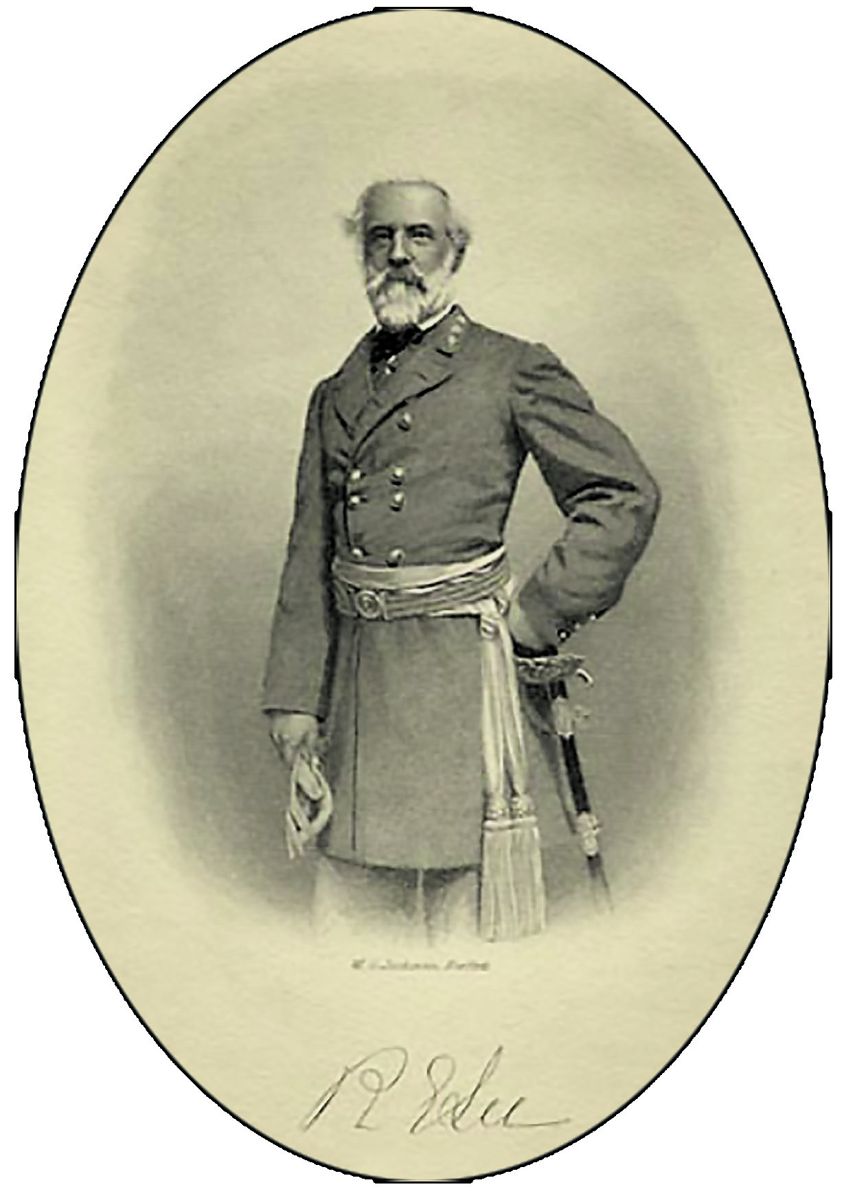
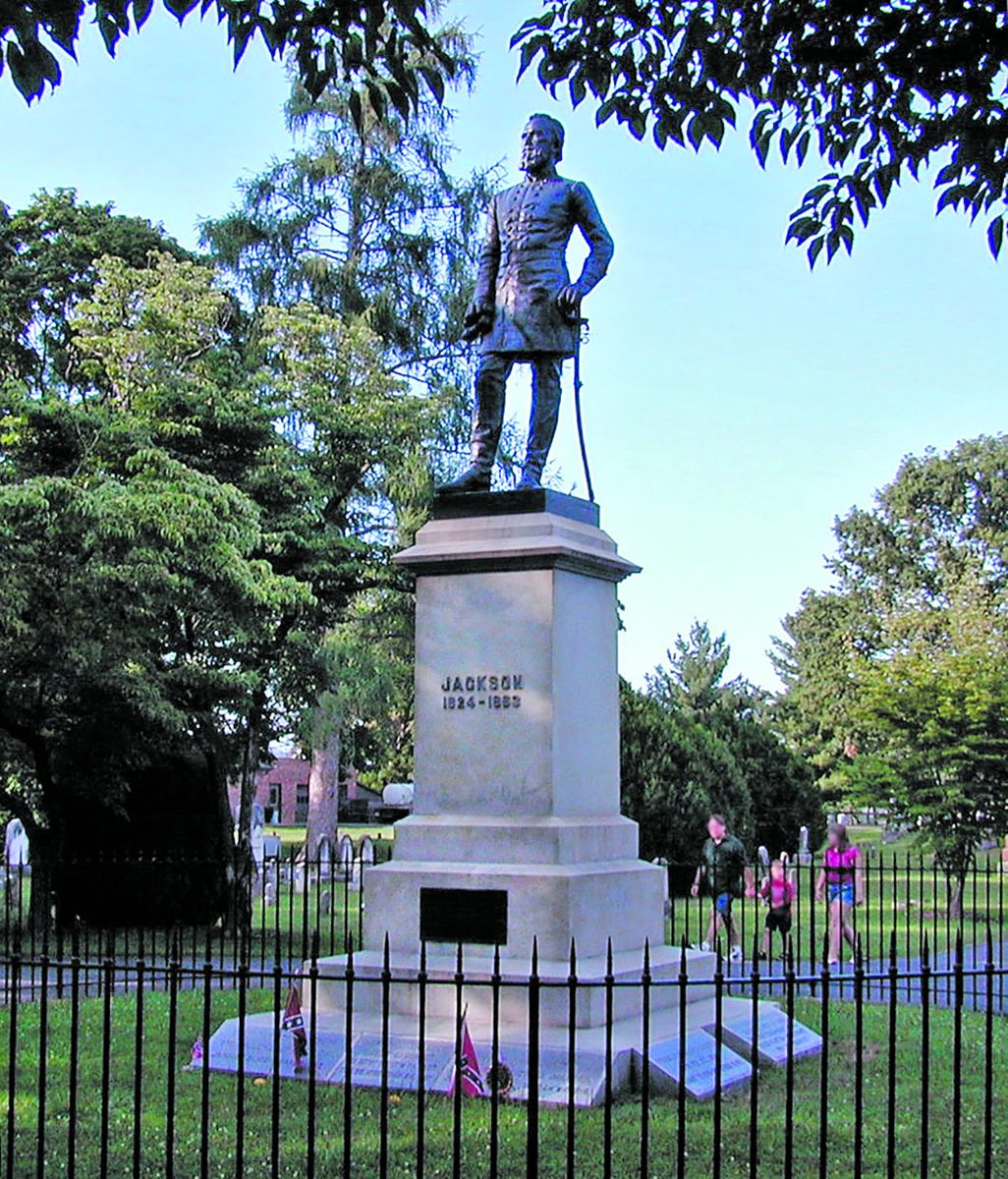
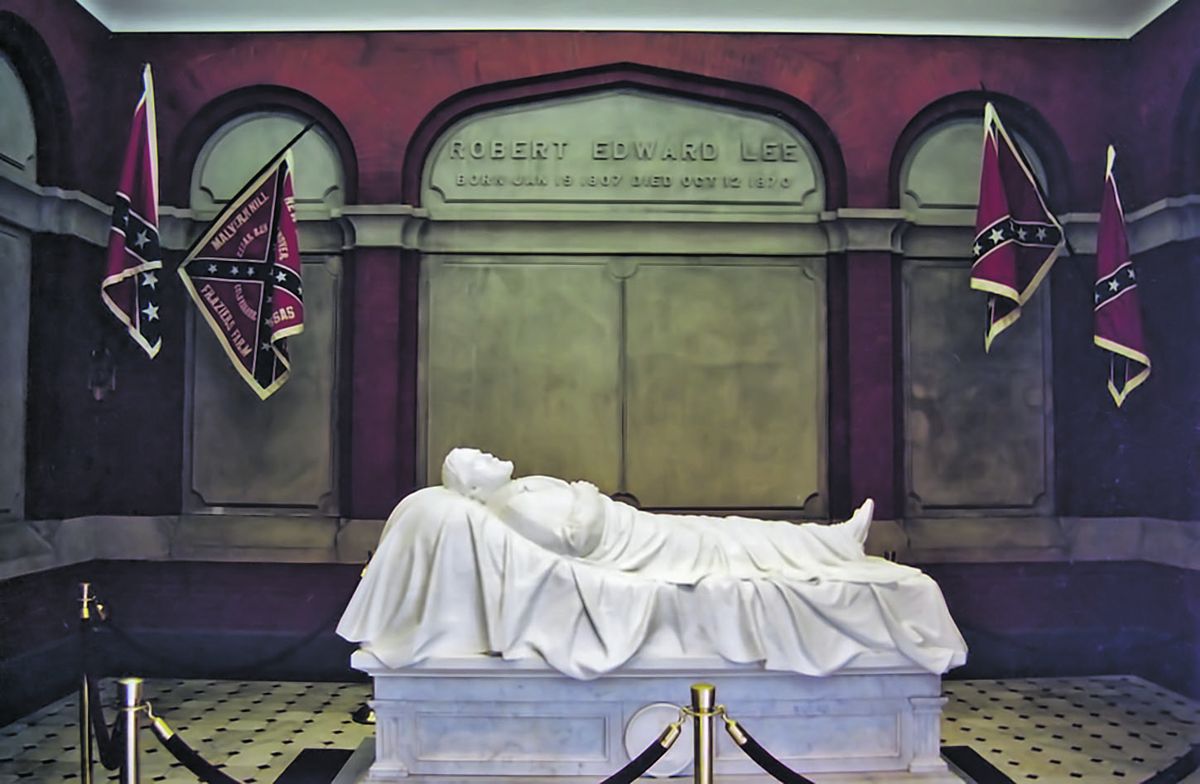
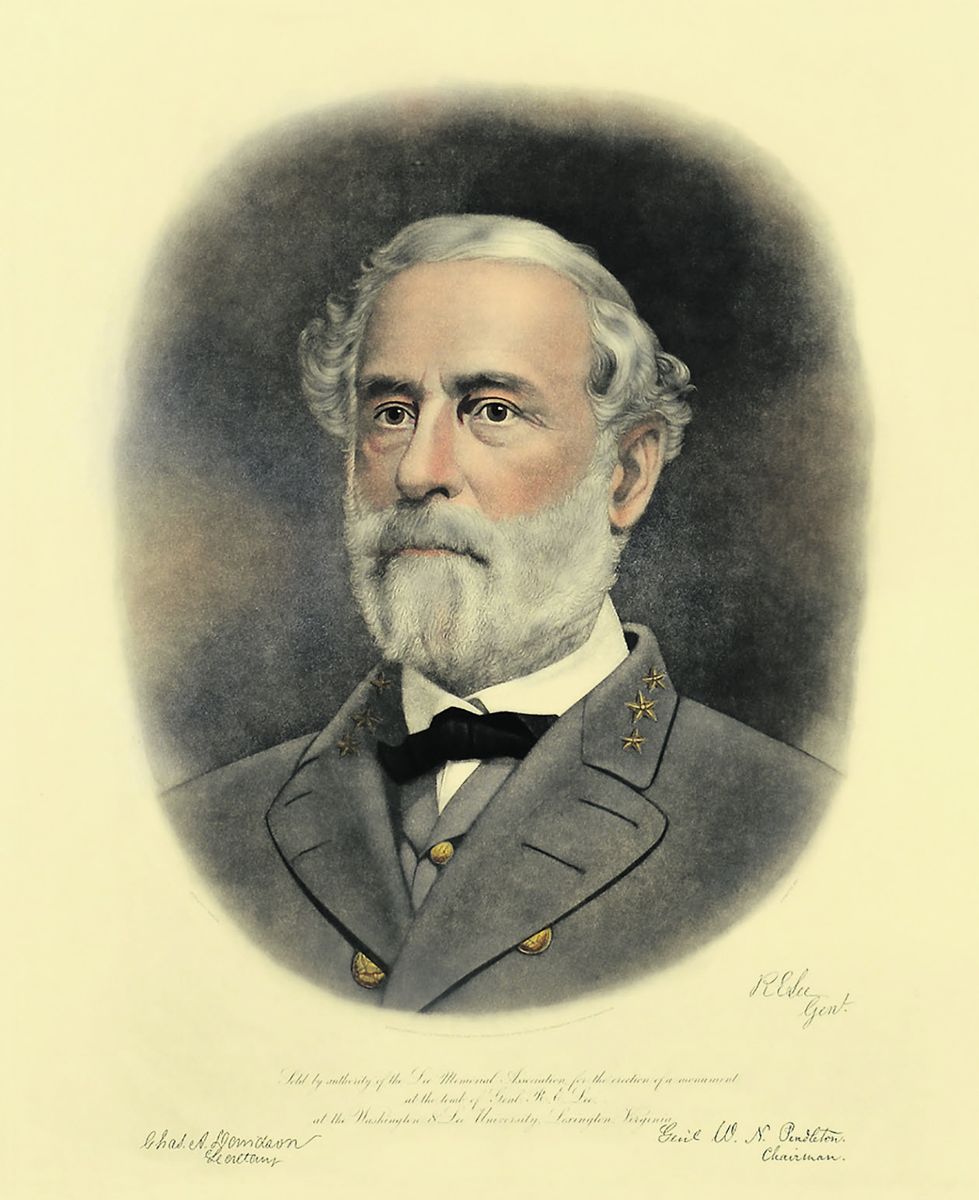
Lee and Jackson as Fund Raisers The Graphic War highlights prints and printmakers from the Civil War discussing their meaning and the print maker or artist’s goals. Soon after the war, northern printmakers, in the hunt for new customers,quickly began producing prints with southern themes. During reconstruction, while northern troops occupied the former confederacy and southern veterans and families began coalescing around the “lost cause” myth, northern printmakers produced likenesses of Robert E. Lee, Stonewall Jackson, Joseph E. Johnston, and other “confederate heroes.” The major print centers of Boston, Philadelphia, and of course, New York City, began an assembly line of lost cause images. A few years earlier, such a monumental marketing effort would have seemed inconceivable. Even Jefferson Davis, not exactly a superstar even among Southerners, was the subject of several portrait prints. “The printmaker’s cause after 1865 was profit, no patriotism.”1 Beyond the decorative nature of the prints, Southerners longed for reminders of their heroes. Jackson and Lee fit the bill. It was only a matter of five years before they were posthumously enjoined to raise funds for a worthy cause in their memory. Jackson died in 1863 and Lee, 1870. The latter had been President of Washington College at Lexington, Va., and Jackson lived much of his life in Lexington. What became known as the Lee Chapel at Washington College had been built in 1867– 68 at Lee’s request. Upon his death and burial in the Chapel, Lee’s admirers’ immediately began promoting the idea of creating a memorial and sculpture of a recumbent Lee where the altar would have been located. Taking up the cause was a mutual colleague, the Reverend/General William Nelson Pendleton, who also called Lexington home. He was intimately connected to both families and projects. A graduate of West Point (1830), he finished in the class behind Lee and Joe Johnston; and two behind Jefferson Davis. His roommate was John Magruder. But the army life was not for him. In 1833, he accepted a professorship in a Pennsylvania Episcopal College. Five years later Pendleton was ordained an Episcopal Priest, eventually ending up in Lexington, Va., in 1853 as the church’s rector. When war came, his West Point credentials and limited military experience earned him an artillery command. Half way through the war, he became Lee’s Chief of Artillery. A more incompetent leader would be hard to find. Disliked by officers and enlisted men, he was ultimately relegated “to bureaucratic roles.”2 After the war, he and his wife fell on hard times, even though he maintained his position in society as an Episcopalian rector. One observer characterized Pendleton as always “hard up.” Compounding matters, Pendleton took up the rantings of Jubal Early and his “lost cause” narrative and, at one point, accused James Longstreet for the rebel defeat at Gettysburg. Both narratives fit Pendleton’s undying devotion to Robert E. Lee as he dedicated himself to preserving Lee’s “sacred memory.” Upon Lee’s death, Pendleton and others in Lexington began planning a suitable tribute to their fallen leader. At Lee’s funeral, when he was interred in the chapel floor, it was resolved by “a large number of ex-Confederate soldiers assembled… to take steps to erect a monument” to Lee.3 At that meeting, the principles agreed to form the Lee Memorial Association and raise money, despite the hard times in the south, for a monument. The assembled dignitaries elected Pendleton as the association’s chairman. They overloaded the association’s officer corps with luminaries from each Confederate state including Jubal Early, P.G.T. Beauregard, WadeHampton,JosephJohnston, D.H. Hill, John Gordon, John Hood, and John C. Breckenridge as the association’s president. Pendleton took it upon himself to make the memorial happen, seeing it as his personal duty to preserve Lee’s memory. The first step was to choose a sculptor. The committee left it up to Lee’s widow. Mary Custis Lee selected a Virginian, Edward Valentine, to design and sculpt the recumbent Lee; the next year after the model, and its price, $15,000, were accepted, Valentine began work. Pendleton, “at Valentine’s request,” spent “two hours in [Valentine’s] studio with General Lee’s uniform coat on, that the artist might get the details of his military bust with life-like truth and effect.”4 His second step was fund raising. In that, he was successful. With some effort, nearly every former Confederate state donated money. Some northern donors, and a patron from Glasgow, Scotland, also participated. The committee decided that a print, showing the regal likeness of Lee, would entice donations. “A considerable sum was realized from a steel engraving of Gen. Lee published by Bostwick & Co., of Cincinnati.”5 The engraving was executed by artist Adam B. Walter, a lifelong resident of Philadelphia, after a photograph from life and published in 1870 by the Bradley company. Very little is known of Walter. He was born in 1870 and died in Philadelphia in 1873, just after completing these three engravings. A pupil of another well-known American engraver, Thomas B. Welch, a native of Charleston, S.C., Walter worked with him until 1848. Walter is best known for his mezzotint work. For the Lee project he produced an oval vignette with facsimile signatures of Lee, Pendleton, and Charles A. Davidson, Association Secretary. The additional imprint read: “Sold by authority of the Lee Memorial Association for the erection of a monument at the tomb of Genl. R. E. Lee at the Washington & Lee University, Lexington, Virginia.” Pendleton also received hate mail. One letter, dripping in sarcasm, dated May 7, 1864, purportedly from Cemetery Hill, Gettysburg, included a small contribution “to commemorate the virtues of that truly good and loyal man, Robert E. Lee.” In return, the writer asked for a small contribution to commemorate “that good and great man, John Brown, of Ossawatamie, of blessed memory,” and his “noble efforts in the cause of human freedom.”The letter instructed the recipient to send his money to B.F. Butler in Arlington Heights, Va. It was signed “Thaddeus Stevens.”6 In conjunction with the commemorative print,Pendletontook to the road to raise funds. He spoke on Lee in Memphis at two small churches and the congregation had a “collection taken up” for the monument. He moved on to Augusta and Savannah at the end of 1870. “This tour realized three thousand five hundred dollars, to which” another supporter “added a check for five hundred dollars for the church and one thousand for the monument.”7 During the same period, the Virginia Military Institute, between 1869 and 1871, raised funds for a memorial to Stonewall Jackson. That effort was led by a former governor of Virginia, John Lechter, and Pendleton was also involved. Walter and Bradley collaborated in 1871, producing a similar engraving honoring Jackson. As with the Lee portrait, the print was used to supplement a lecture tour to raise the necessary funds. Jackson’s, Lechter’s, and S. Bassett French’s facsimile signatures appeared with the legend: “Sold by authority of the Jackson Monument Association for the purpose of creating a Monument to the memory of Genl. Thomas J. Jackson, at the Virginia Military Institute Lexington, Va.” The principles were not as successful as the Lee memorial fund raisers and the Jackson memorial did not come to fruition until 1896. In 1872,Walter produced a similar mezzotint engraving of Joseph Eggleston Johnston after a photo from life which was published by W.W. Bostwick, Cincinnati, and printed by Bradley & Co. There is a copy in the Brown University Library, as part of the Anne S.K. Brown Military Collection, Brown Digital Repository. It was not used for fund raising. Endnotes: 1. Mark Neely, Harold Holzer and Gabor S. Boritt, The Confederate Image: Prints of the Lost Cause. Chapel Hill: University of North Carolina Press, 1987, 100. Hereafter Holzer, Image. 2. Robert K. Krick, “A Stupid Old Useless Fool.” Civil War Times, June, 2008. 3. W. Allan. “Historical Sketch of the Lee Memorial Association,” 3. In Ceremonies Connected with the Inauguration of the Mausoleum and the Unveiling of the Recumbent Figure of General Robert E. Lee, at Washington and Lee University, Lexington, Va., June 28, 1883. Oration of John H. Daniel, LL.D., Lynchburg, J. P. Bell, & Co., Printers, 1883. Hereafter Allan, Sketch. 4. Susan E. Lee, Memoirs of William Nelson Pendleton, D. D.,” Harrisonburg, VA., Sprinkle Publications, 1991. 456. Hereafter, Pendleton, Memoirs. 5. Allan, Sketch, 7. 6. Pendleton, Memoirs, 457-458. 7. Pendleton, Memoirs, 458-459.
After 43 years in the museum field, Salvatore Cilella devotes his time collecting American prints and maps and writing. His last professional position was President and CEO of the Atlanta History Center. His most recent books are Upton’s Regulars: A History of the 121st New York Volunteers in the Civil War (U. Press Kansas, 2009). His two-volume Correspondence of Major General Emory Upton, (U. of Tennessee Press, 2017), received the 2017–2018 American Civil War
Museum’s Founders Award for outstanding editing of primary source materials. His latest book “Till Death Do Us Part,” an edit of Upton’s letters to his wife 1868-70, was published in 2020 by the Oklahoma University Press.
![Thomas J. Jackson. [Stonewall Jackson]. A.B. Walter, engraver.](/article-images/cwn-2021-march/cwn-2021-march-lee-and-jackson-as-fund-raisers-03.jpg)