Inspection, ARMS!
Bacon Navy Revolvers – A Potential Success Scuttled by Smith & Wesson
By Tim Prince · Originally published March 2021 · pp. 24–26
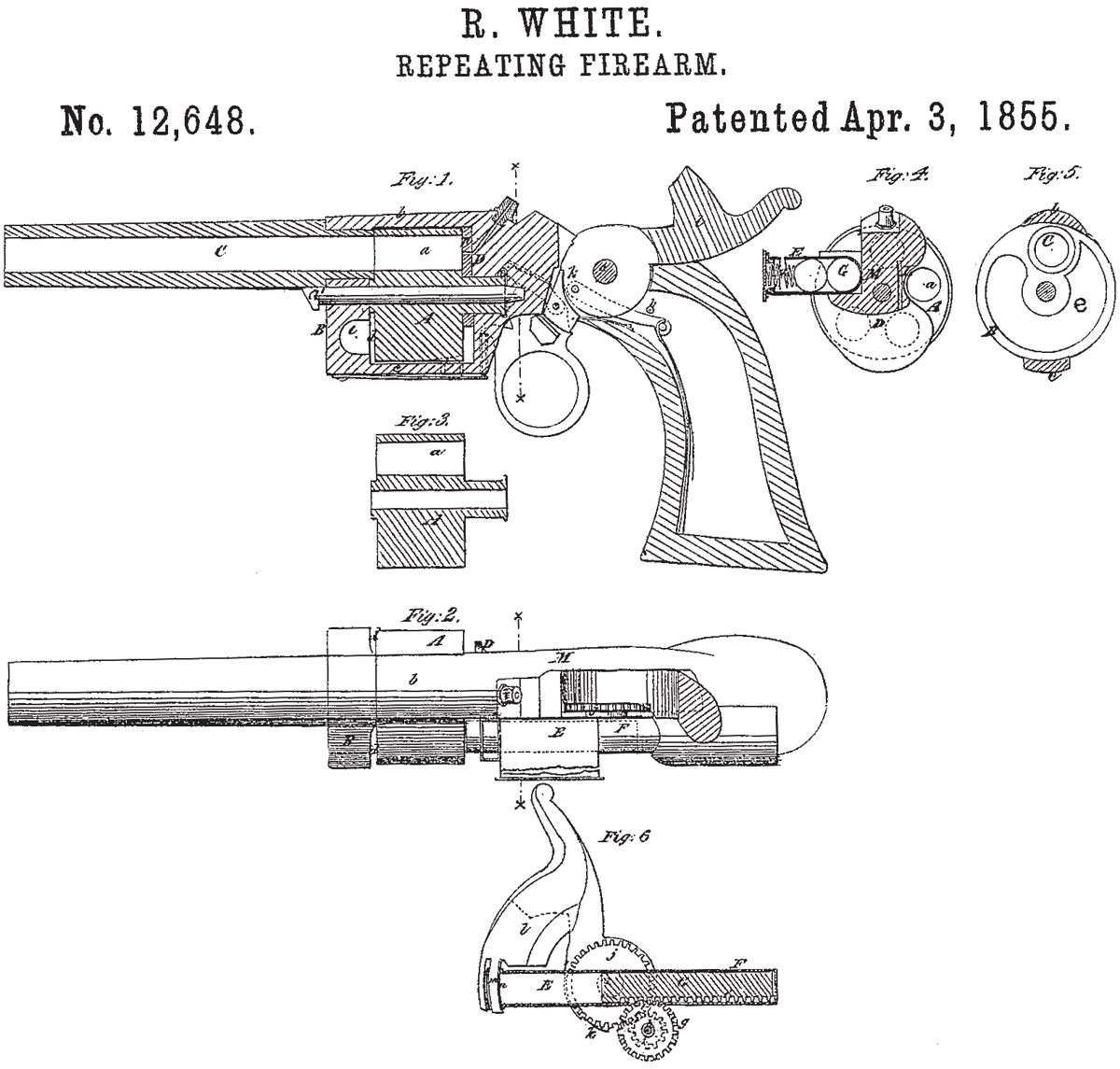
Bacon Navy Revolvers – A Potential Success Scuttled by Smith & Wesson The story of the various gun companies that were established and run by Thomas K. Bacon is rather interesting and a tale that has yet to be fully told in detail. From most accounts Bacon was a machinist, who seems to have had his first brush with firearms manufacturing in 1840, when he purchased some property in Grafton, Mass., from gun maker Ethan Allen. Two years later, both Allen and Bacon relocated to Norwich, Conn., and it appears that the nearly simultaneous migration was not coincidental. By 1846, Allen factory records show that Bacon was operating as a parts supplier, producing “cones and triggerguards.” Bacon’s work as a “jobber” for Allen probably came to an end when Allen relocated his company to Worcester, Mass., in 1847. As a result, it appears that Bacon went into the firearms production business on his own, forming Bacon & Company in Norwich, which he ran until 1857. The firearms produced by this early Bacon company were primarily inexpensive single-shot percussion arms such as pocket, bar hammer, ring trigger, and under hammer pistols as well as some pepperboxes. In 1857, after an unsuccessful attempt to raise the necessary capital to expand his business into the fairly new, and very lucrative percussion revolver business, Bacon & Company went out of business. Bacon spent the next year working as the plant superintendent for the Manhattan Firearms Company, also located in Norwich, but was very soon operating his own business again. The newly formed Bacon Manufacturing Company was established in Norwich in 1858, and Bacon was into the business of producing revolvers. His product line included pocket percussion revolvers based upon the Colt 1849 “pocket” model that were offered under the Bacon moniker, under various trade names, and with custom retailer markings. In addition to the traditional percussion revolvers, Bacon introduced a line of self-contained cartridge revolvers in .22, .25, .32, and even .38 rimfire. The majority of these revolvers were manufactured in violation of the Rollin White patent (#12,648) for the bored-through cylinder, held by Smith & Wesson. As a result, Smith & Wesson successfully sued Bacon, resulting in a monetary damages award, as well as requiring all subsequent Bacon revolvers (as well as those unsold and remaining in inventory) that utilized the bored through cylinders to be marked with Rollin White and Smith & Wesson patent information, and with royalties paid to Smith & Wesson for each revolver of that pattern subsequently sold. In 1863, the chief shareholder of the Bacon Manufacturing Company became displeased with Thomas Bacon’s performance with the company and forced him out of the business. With Bacon gone, the company continued in business through 1868, but with lackluster sales and minimal success. In 1868 the firm was subsequently reorganized and reestablished as the Hopkins & Allen Company, a firm that remained in business through the second decade of the 1900s. Thomas Bacon was not to be defeated. By 1864 he had started his third firearms company in Norwich, Conn., the Bacon Arms Company. His triumph was short lived however, as he sold the assets of his new business in December 1865. This might have been a financial move due to the sudden changes in the firearms market brought on by the end of the Civil War. With their lucrative government contracts cancelled, the large American arms makers turned to the civilian market, and would certainly have been able to out-produceandout-promoteany smaller maker. The sudden flood of cheap surplus military arms on the market certainly would not have helped the market share for a small, start-up firearms company either. The result was that Bacon’s final company became little more than a footnote in firearms history. Thomas Bacon worked at various jobs in the gun business for the next few years but died in 1873, without ever achieving the level of success his designs probably warranted. Bacon’s “Navy” sized .38 rimfire revolver was certainly ahead of its time and one of the first American cartridge revolvers to be chambered in a potentially “man-stopping” caliber. His removable triggerguard pocket .32 rimfire revolver was also innovative, if somewhat short lived due to the Smith & Wesson lawsuit. Bacon also developed one of the first American cartridge revolvers to use a “swing out” cylinder, a truly innovative concept that was again stopped in its tracks by the Smith & Wesson suit. This feature was available in a pocket variation as well as the 2nd Model of his Navy revolver. Had Bacon been able to produce the Navy revolver with the swing out cylinder in sufficient quantities to attract the attention of the Ordnance Department, the history of self-contained cartridge United States military revolvers would probably be quite different. It is worth noting that the U.S. Ordnance Department agreed that the potential to use White’s bored through cylinder patent to make more advanced cartridge revolvers during the Civil War had been a lost opportunity. In 1869 White’s original patent expired and he applied for a seven year extension. The Patent Office denied the request, and in 1870, White lobbied Congress for relief. In response Congress passed a bill for relief that would allow White to receive his patent extension. However, the newly elected president, Ulysses S. Grant, the overall commanding general of Union forces during the Civil War, vetoed the proposition. His decision was based in part by the suggestion of his Chief of Ordnance, Alexander Dyer. Dyer noted that the White’s constant suits and legal wrangling during the Civil War to prevent other manufacturers from taking advantage of the patent’s technological improvement had created an “inconvenience and embarrassment” for the Union during the trying times. He additionally noted that such an extension would “operate prejudicially to its (the Ordnance Department’s) interests by compelling it (the Ordnance Department) to pay to parties already well paid a large royalty for altering existing revolvers to use metallic cartridges.” Dyer also knew the extension would increase the cost of any new cartridge revolver the government might look to adopt in the near future. Thomas Bacon’s historically important and extremely scarce Bacon Manufacturing Company Navy Revolvers were made in two distinct variations with some sub-variants. Based upon available information, less than 1,000 of all types of these .38 caliber rimfire revolvers were produced. The number of minor enginering and manufacturing differences found in a revolver produced in relatively small quantities suggests that Bacon was never fully satisfied with the design and may have been making improvements, not only to try to evade the Smith & Wesson held White patent, but in an attempt to secure Ordnance Department contracts. The features common to all the Bacon Navy Model Revolvers were that they were single-action, solid frame designs with a sheathed spur trigger. The guns had a six-shot cylinder chambered for the .38 rimfire cartridge. The revolvers had octagonal barrels that were nominally 7 ½ inches in length, although some minor variations in length have been noted. The rudimentary sights included a dovetailed front sight blade and a sighting groove in the topstrap as a rear sight. The guns were all finished
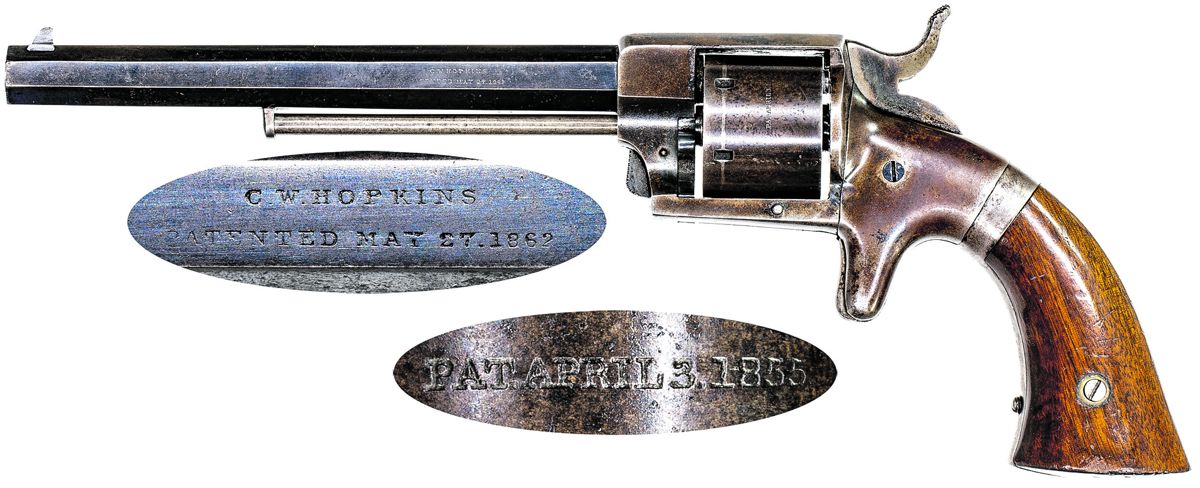
Right: Standard Bacon Navy barrel marking for both the 1st and 2nd Model revolvers.
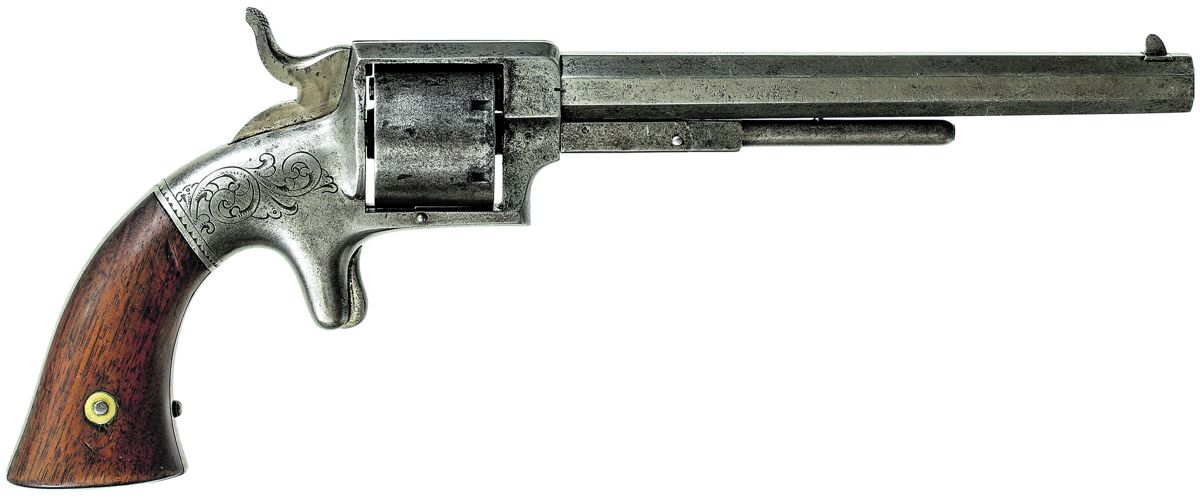
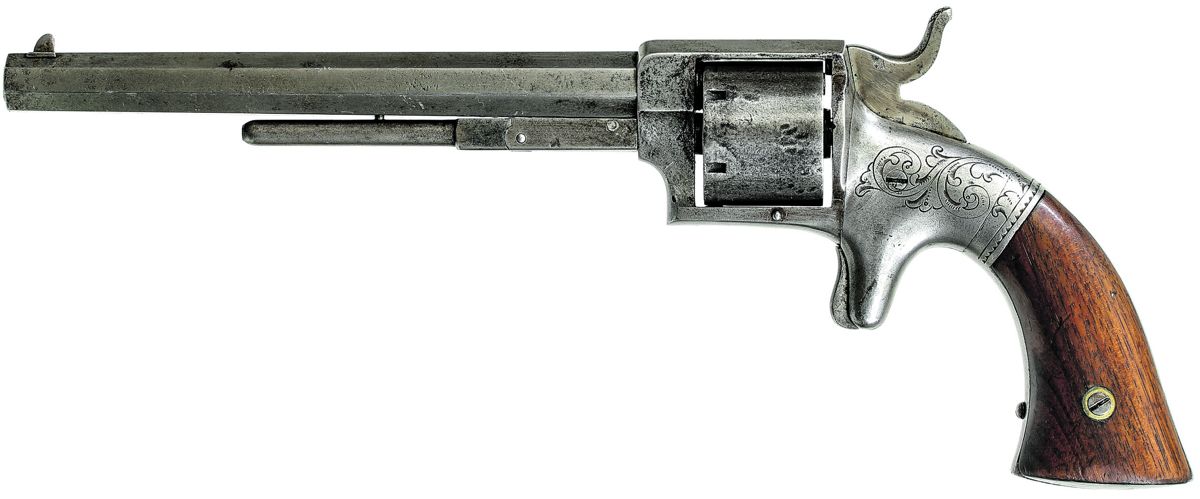
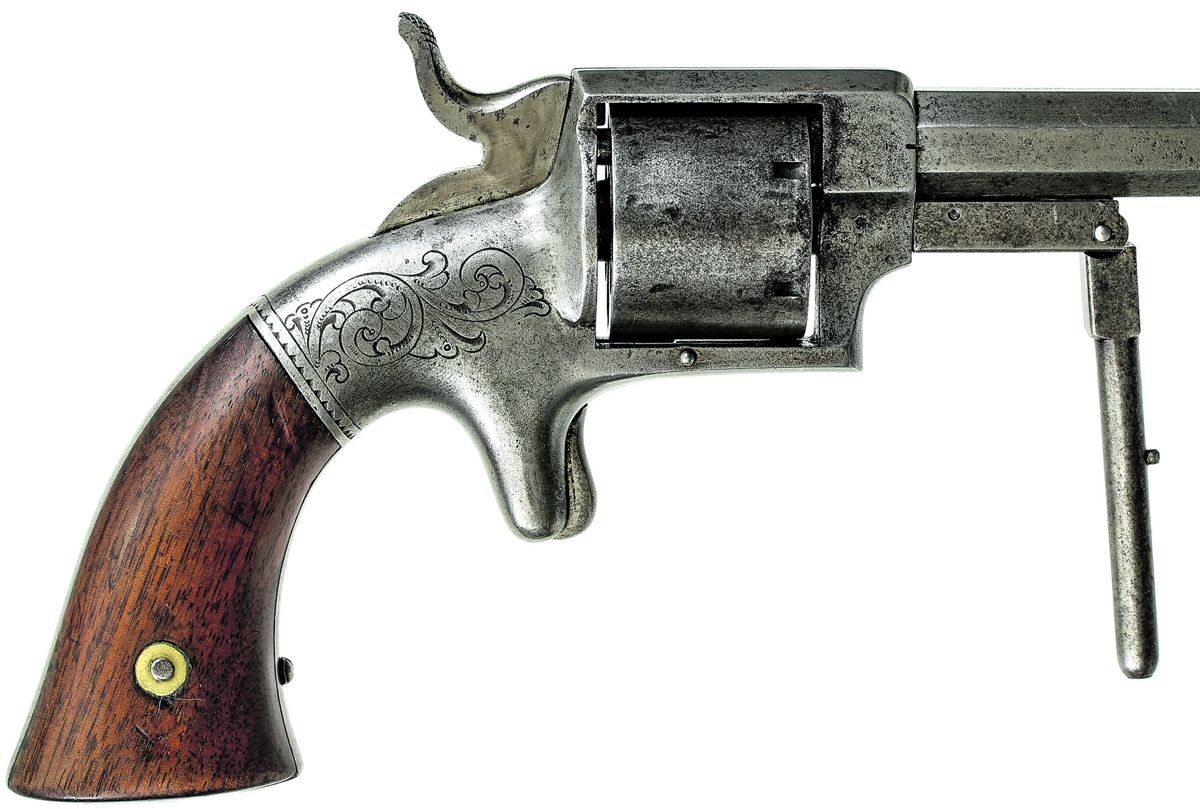
Obverse view of a Bacon 1st Model, 1st Type, Navy revolver #304 with a hinged combination cylinder arbor pin and cartridge ejector. When the pin is pivoted down at its center it can be removed, allowing the cylinder to be removed from the frame. The 1st Type of the Bacon 1st Model is the most common version, with about 400 produced. Two additional variations of this model were made with small changes in the cylinder retention system both of which were produced in very small quantities. All photos by Tim Prince. Bacon 1st Model, 1st Type Navy, revolver with the cylinder arbor pin lowered, allowing it to be removed from the revolver to release the cylinder.
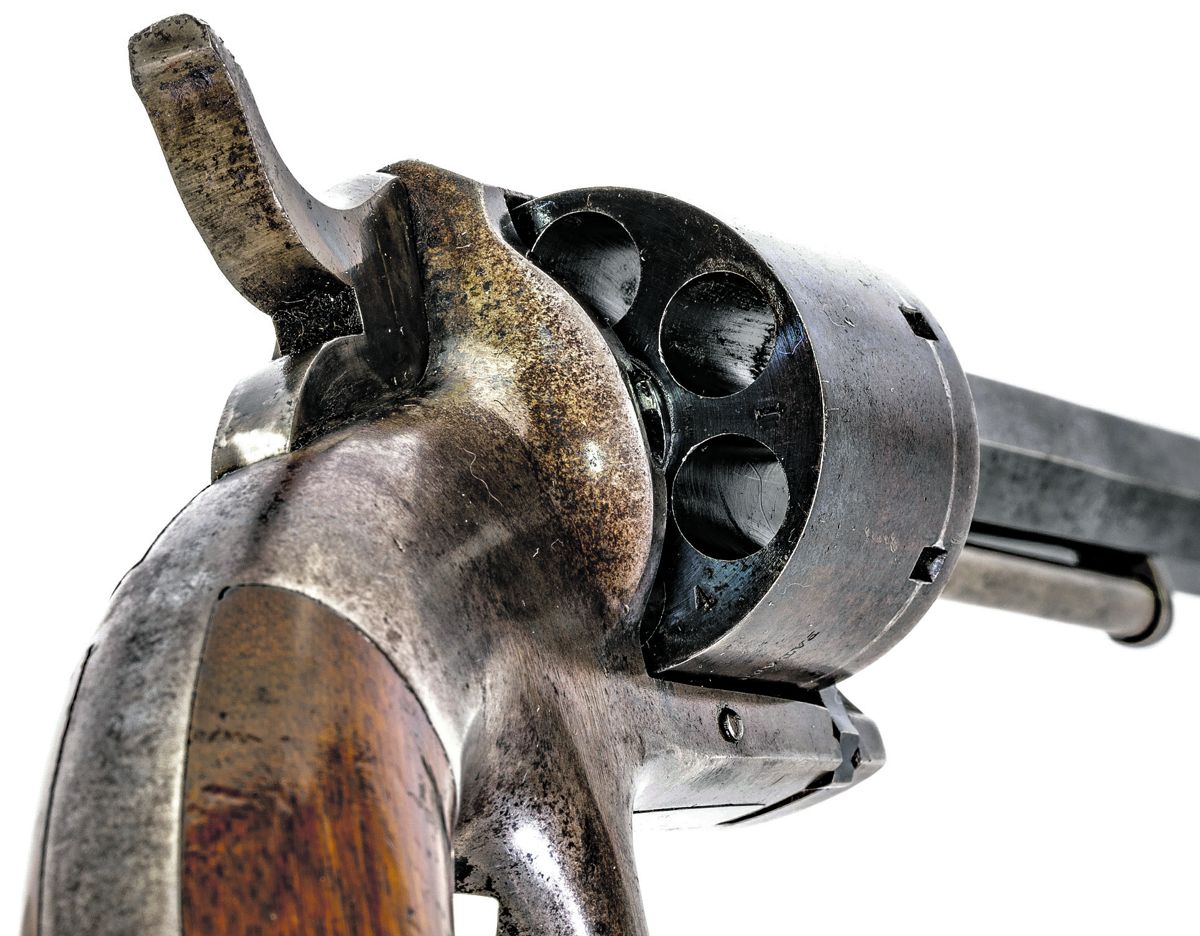
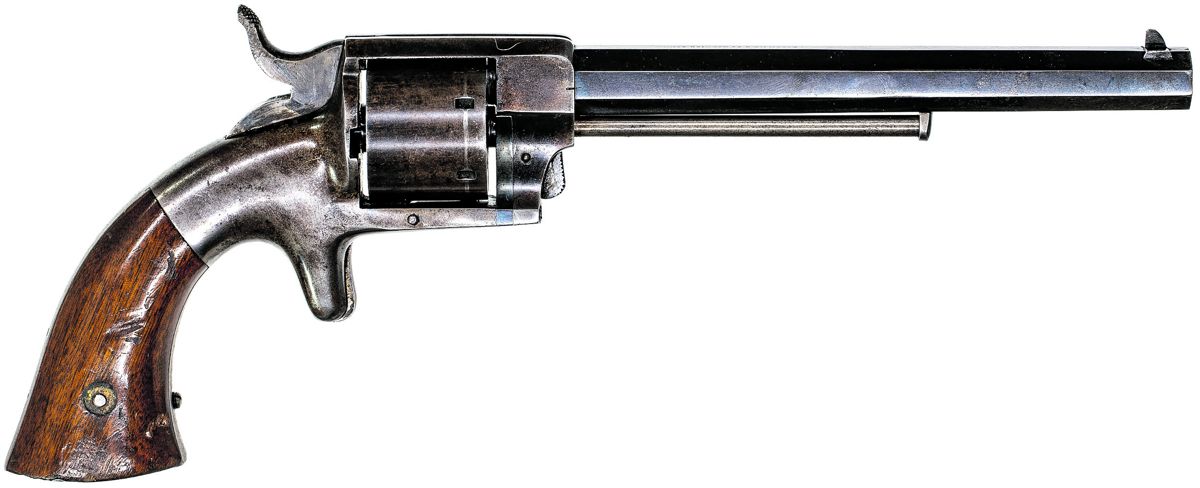
Bacon 2nd Model Navy revolver #41 with swing-out cylinder. Depressing the catch at the lower front edge of the frame released the cylinder to partially tilt out of the frame to the right, exposing about a third of the cylinder for loading and unloading. Only about 325 of this version are estimated to have been produced.
with blued barrels and frames, color casehardened hammers, and had two-piece walnut grips that were typically varnished. Many early production guns were decorated with simple, loose foliate scroll engraving on the frame behind the cylinder. Markings were sparse, with only a simple barrel mark reading BACON MF’G CO. NORWICH. CONN. Serial numbers on most major components appear on all models. All 1st Model variants had to have their cylinders removed from the frame to load and unload the revolver, for the most part, variations found in these 1st Model revolvers relate to the process of securing the cylinder to the frame and how the cylinder was removed from the frame. Some early examples relied upon a push button release; one early variation had a knurled plate attached to the cylinder’s rear that may have been an attempt to circumvent the Rollin White patent for the bored through cylinder. The 2nd Model Bacon Navy revolvers introduced the innovative swing-out cylinder design to large frame cartridge revolvers. This feature had been patented by Charles W. Hopkins on May 27, 1862 (Patent #35,419), and was a concept ahead of its time, but only practical in conjunction with the bored-through cylinder. Interestingly, Hopkins would be part of the group that would force Bacon out of his own company, and would be a principle in the reorganization and establishment of Hopkins & Allen after Bacon was gone. The 2nd Model guns have the additional two-line marking on the left side of the barrel that reads C.W. HOPKINS / PATENTED MAY 27, 1862, referring to Hopkins swing-out cylinder patent. It is generally estimated that only about 600 1st Model Bacon Navy revolvers were produced in all the variations, with only about 325 2nd Model guns manufactured. All these revolvers were produced between about 1860 and 1863 as the loss of the Smith & Wesson lawsuit in 1862 sounded the death knell for the design.Those guns that were produced and sold, or were inventory unsold, after Smith & Wesson and Rollin White won their suit against Bacon were additionally marked on the cylinder with the White patent date of April 3, 1855. The Bacon Navy revolver will forever be an example of “what might have been” in terms of Civil War period revolvers. Had White and Smith & Wesson been willing to license White’s patent to other makers, or had they tried to work in conjunction with other Left: 2nd Model Bacon Navy revolver with cylinder “swung out” for loading or unloading.
companies, it is quite possible that U.S. military would have adopted a self-contained cartridge revolver for general issue during the course of the War. Such a technological advance might have had a significant impact on the Union cavalry’s effectiveness, and might have even helped bring theWar to a more rapid conclusion. Tim Prince is a full-time dealer in fine & collectible military arms from the Colonial Period through WWII. He operates College Hill Arsenal, a web-based antique arms retail site. A long time collector & researcher, Tim has been a contributing author to two major book projects about Civil War era arms including The English Connection and a new book on southern retailer marked and Confederate used shotguns. Tim is also a featured Arms & Militaria appraiser on the PBS Series Antiques Roadshow.