
A Yankee Who Cheated Death
By Joseph F. Wilson · Originally published March 2021 · pp. 15–21
A Yankee Who Cheated Death by Joseph F. Wilson For many soldiers, a single musket ball crashing into their body would have caused extensive damage. A shot to the chest or abdomen surely meant death, while a bone crushing blow to the extremities often meant the loss of the limb. Soldiers suffering from a gunshot to the torso received little attention. Medical personnel often simply made them comfortable till death came. Surgeons then turned to amputating shattered appendages as these soldiers were more likely to survive. A heap of amputated arms and legs piled high outside the nearest window testified to their efforts. Private Tobias Yoder wasn’t like most soldiers. Hailing from the coal country of central Pennsylvania, young Tobias grew into a strong barrel-chested specimen. The well-muscled young man defeated all wrestling challengers in Somerset County. Tobias enlisted in the 39th Pennsylvania Volunteer Infantry in May 1861. Also known as the 10th Pennsylvania Reserves, the regiment was part of the famed Pennsylvania Reserve Corps. At the time of his enlistment, he was already 33 years old, but Yoder’s patriotism was as rock solid as his physique. Long before joining Lincoln’s Army, Yoder had several brushes with death in Somerset, Penn. While working in a coal mine, a cave-in buried him under an avalanche of earth and rocks. In a display of incredible strength, and a survival instinct to match, Tobias dug his way out with his bare hands. His trusty dog, who accompanied him in the mine, wasn’t so lucky. On another occasion, a rail yard hand car ran over Yoder, breaking six ribs. Working for a living proved mighty dangerous for the Pennsylvania Mennonite. Cheating death became a habit for the ruggedYoder. The danger grew tenfold as the new recruit marched with the Army of the Potomac to exchange musket fire with Robert E. Lee’s storied Army of Northern Virginia. If good luck followed Tobias, he’d need it now more than ever. Yoder’s baptism under fire came at the December 1861 Battle of Dranesville, a small engagement relative to the fighting that awaited. Not until June the following year in the Seven Days’ Battles would he feel the real sting of battle. First at Beaver Dam, next at Gaines’ Mill, and on June 30, 1862, Tobias took part in the bloody Battle of Glendale. At Glendale, his good fortune ran out. Or so it seemed. Under an intense attack, the 39th Penn. stood in line of battle until they exhausted all their ammunition. Pulling back into the cover of some woods, the boys cleaned their muskets and replenished the ammo. A ball had already torn Yoder’s coat while another ripped off his kepi buckle. So far, so good. On returning to the firing line, the Pennsylvanians walked straight into an ambush as the Confederates unleashed a hail of bullets from both flanks. Caught in a vicious crossfire, many fell to the ground shrieking in agony. Among those hit was Tobias Yoder. Tobias wasn’t shot just once. A total of seven musket balls penetrated his stout frame. With the Army of the Potomac moving in great haste for the protection of the James River, Yoder was left for dead. Tobias lay on the battlefield bleeding from the mouth and several bullet holes. At first, the Confederates left in possession of the field only searched for wounded soldiers wearing the gray or butternut uniform. Sometime later, a Confederate wagon stopped and Yoder was roughly thrown in. Tobias was now a severely wounded prisoner of war. For the next 40 days Yoder found new homes in Libby Prison and Belle Isle in Richmond, Va. Doctors there determined his wounds were fatal, and they refused to help. Yoder didn’t want their help anyway. He found some tobacco and plugged up the several holes in his body. This remedy not favored by the medical community; it may have been an odd treatment, but it worked. The bleeding stopped. Because of the severity of his wounds, the Confederates released the bullet riddled Yank after a month and a half. Union officials sent him to a hospital in Chester, Penn., where doctors gave him 48 hours to live. Yoder paid them no mind and simply went home. Much to the surprise of the doctors, he recovered nicely. Doctors agreed most men would’ve accepted death. Not Tobias! Other doctors, fascinated by the case, wanted to take a look at the medical miracle. Seven bullets struck Yoder. Two musket balls passed through his lungs. Another two balls went through his body. One broke a shoulder blade. And two more balls entered on his side with one stuck under the hip bone and the other resting close to the spine. These two he carried for the rest of his life. Amazingly, all seven missed any major arteries. Tobias had a gum rubber blanket thrown over his shoulder and tied at the waist. If not for the blanket softening the impact of the two balls lodged in his body, they likely would’ve passed right through. Not only did he survive the barrage of musket balls, but the spirited Private Yoder also decided he wasn’t done with soldiering. With the scars covering his body and two chunks of lead residing within, Tobias wanted to stand in line of battle once again before the hostile Confederate muskets. Less than a year since being pummeled with lead,Yoder traveled to Washington, where his 10th Pennsylvania Reserves were encamped during the spring of 1863. Private Yoder sought to rejoin the regiment and reported for duty. Like the doctors in Chester, the regimental doctors scoffed and told him to go home. Instead, Yoder attached himself to the regiment, and in late June marched with the regiment to fight at Gettysburg. Being so close to home, Yoder took the Rebel invasion personally. Tobias Yoder arrived on the battlefield on July 2, 1863 with a compliment of sixty-two musket balls. Forty rounds were in his cartridge box, another 20 in his haversack, and the last two were embedded in his body. Tobias and the 10th Penn. Reserves rushed to support Colonel Joshua Chamberlain on the left of Little Round Top. Arriving at the conclusion of the fight, the 10th piled up rocks, and took up a position in the saddle between the two hills. Yoder’s name is proudly displayed on the regiment’s brass tablet on the Pennsylvania monument at Gettysburg. At the conclusion of the Gettysburg campaign, doctors convinced Yoder to serve out the rest of his term in the Veteran Reserve Corps, formerly called the Invalid Corps. Yoder reluctantly went along. When Tobias mustered out of the Veteran Reserves in May 1864, he decided he still wasn’t finished fighting. The patriotic Tobias Yoder looked to reenlist. Doctors once again told him to go home. Only after jumping up and clicking his heels in a display of fitness did the doctors relent. Yoder joined the 187th Pennsylvania Regiment with the rank of Sergeant. Few men in all of history possessed his physical durability combined with a fierce determination to serve their country. Combat for the 187th came quickly. Grant took heavy casualties at Wilderness, Spotsylvania, and Cold Harbor. Washington sent more men to join Grant, including the 187th Pennsylvania. The regiment joined the Army of the Potomac as they side stepped Lee and moved on to Petersburg. On June 18, 1864, the regiment took part in the massive assault on the Rebel lines. Yoder was back in the fight. The regiment suffered heavy casualties in a charge eliciting praise from brigade commander,GeneralJoshua Chamberlain. Sergeant Yoder came away unscathed.
Plaque on the Pennsylvania Memorial, Gettysburg National Military Park. Tobias D. Yoder’s name is pointed out with the arrow.
The regiment held the line at Petersburg until August when it saw more fighting at the Weldon Railroad. In late September, the 187th were assigned to Camp Cadwalader in Philadelphia where they performed escort and garrison duty until the end of the war. Perhaps Tobias Yoder might have felt more pride while in Philadelphia than in all his service thus far in the war. In April 1865, orders received in camp directed the 187th to escort the body of the assassinated President Abraham Lincoln from the train station to Independence Hall to lie in state. A more exciting order
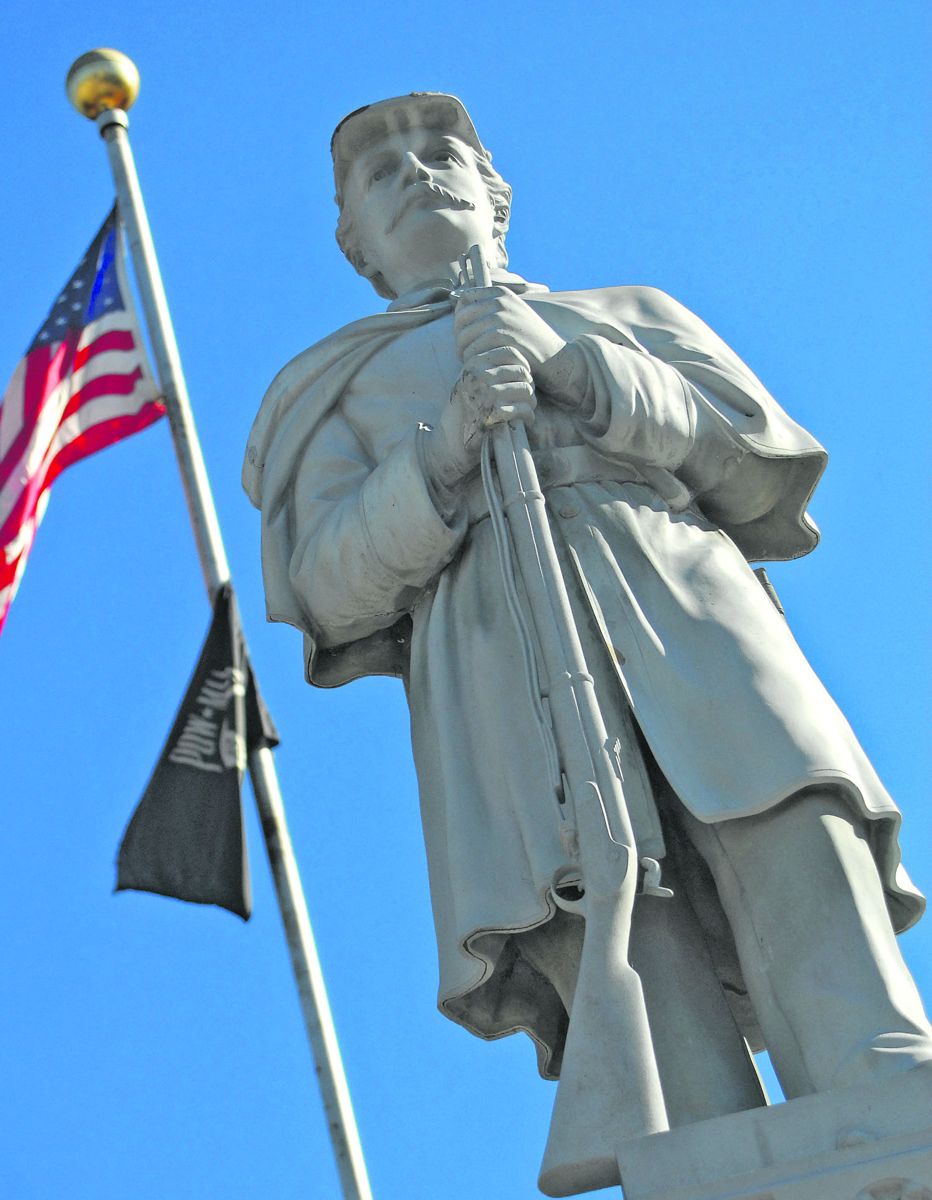
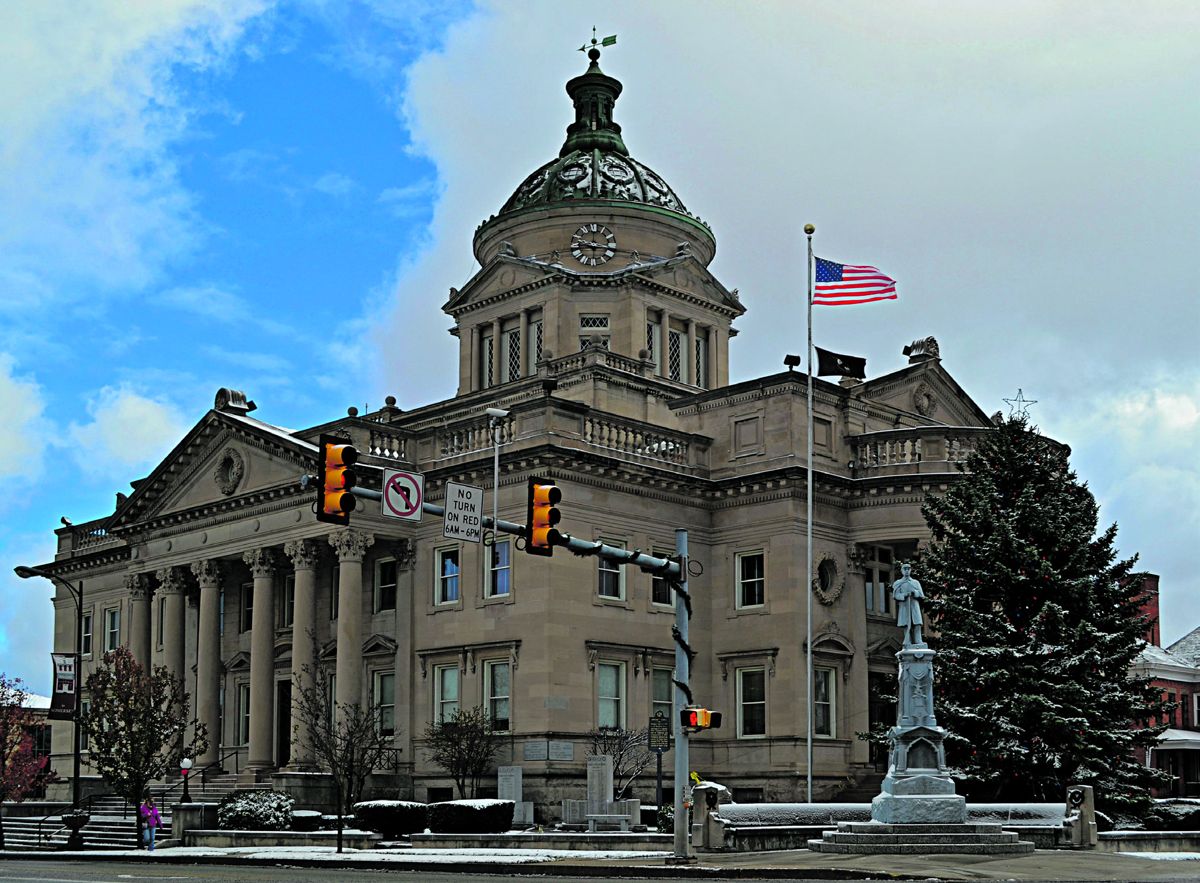
came down giving the regiment the privilege of serving as honor guard to stand watch all day over the President’s body. This duty was much envied by many other regiments. For Tobias Yoder, Lincoln was the man for whom he carried two lead balls in his body along with several bullet holes. At the conclusion of the funeral, the 187th regiment, along with the 1st Philadelphia City Troop, escorted the President’s remains back to the train depot to continue its journey to Springfield, Illinois. Sergeant Tobias Yoder mustered out with the regiment on August 3, 1865. His eventful service in Civil War came to an end. Tobias should have been laid to rest on June 30, 1862, in the Glendale National Cemetery along with all the other Union soldiers who gave the last full measure of devotion in the fighting around Glendale. But Tobias simply refused to die. Yoder went back to his wife and two kids in Somerset after the war and had nine more children. Seven musket balls apparently didn’t hamper the virility of the robust and shot up Tobias. For his sacrifice, he collected a pension of eight dollars a month, the typical allowance for a wounded soldier. No distinction was made between a single musket ball that found its mark or the seven that struck Yoder. Family lore states that the image of Tobias Yoder was used when erecting a monument at the county seat to honor the Somerset County soldiers. One glance at the monument leaves no question that it’s more than just family folklore. Standing tall atop the pedestal is indeed a granite likeness of the irrepressible Sergeant Tobias Yoder. A fitting tribute to the patriot and medical marvel from Somerset County, Penn.
Editor’s Note: Confederate Gen. John B. Gordon’s multiple wounds at Sharpsburg deserve a mention here: I had gone but a short distance when I was shot down by a fifth ball, which struck me squarely in the face, and passed out, barely missing the jugular vein. I fell forward and lay unconscious with my face in my cap; and it would seem that I might have been smothered by the blood running into my cap from this last wound but for the act of some Yankee, who, as if to save my life, had at a previous hour during the battle, shot a hole through the cap, which let the blood out. Reminiscences of the Civil War, by John Brown Gordon, New York, Charles Scribner’s Sons, 1904, p. 90.
Somerset County Courthouse.
Joseph F. Wilson is a member of the General Meade Society and the writer and producer of the new documentary film, “Civil War Prisons – An American Tragedy.” He also offers lectures on various Civil War topics. Contact info: [email protected] or 856 627-5401.