
Whiskey—The Drink of Choice of the Common Civil War Soldier
By Tom Elmore · Originally published June 2021 · pp. 30–33
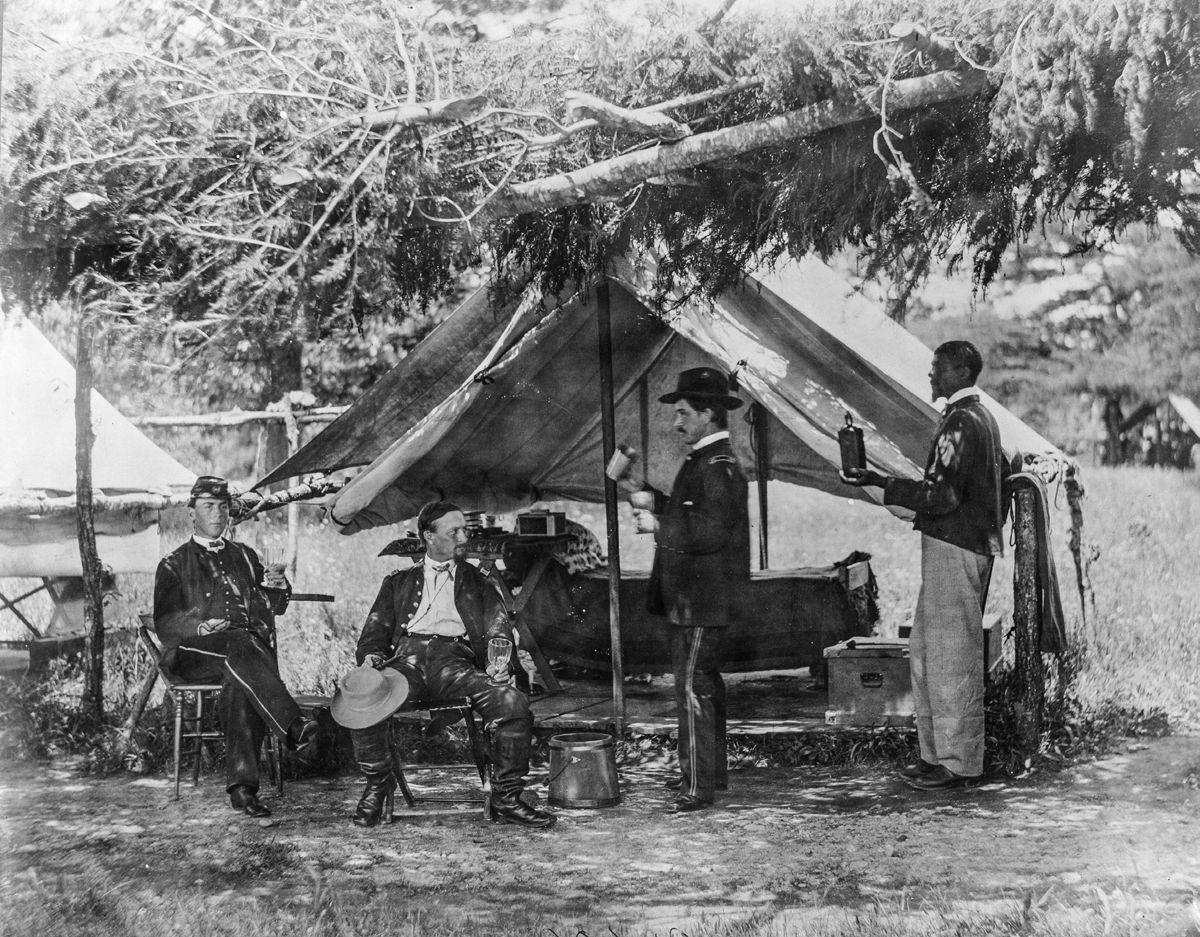
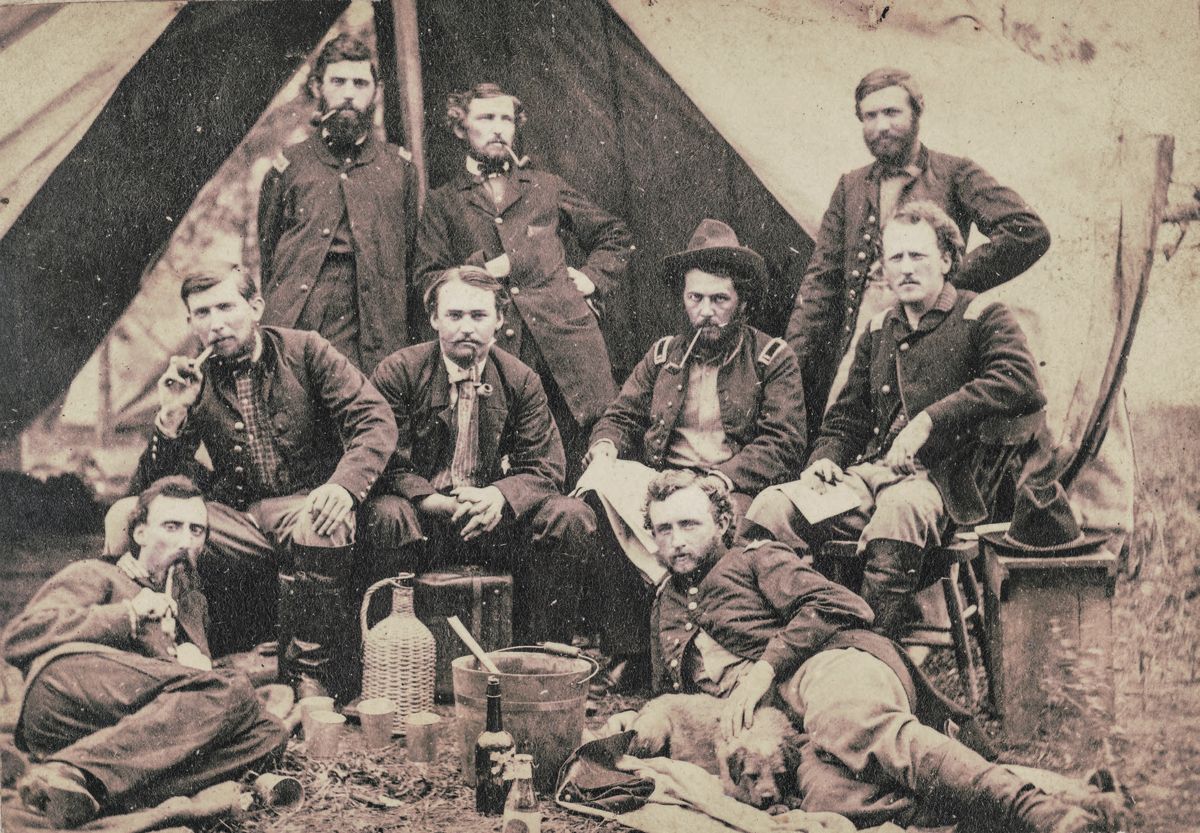
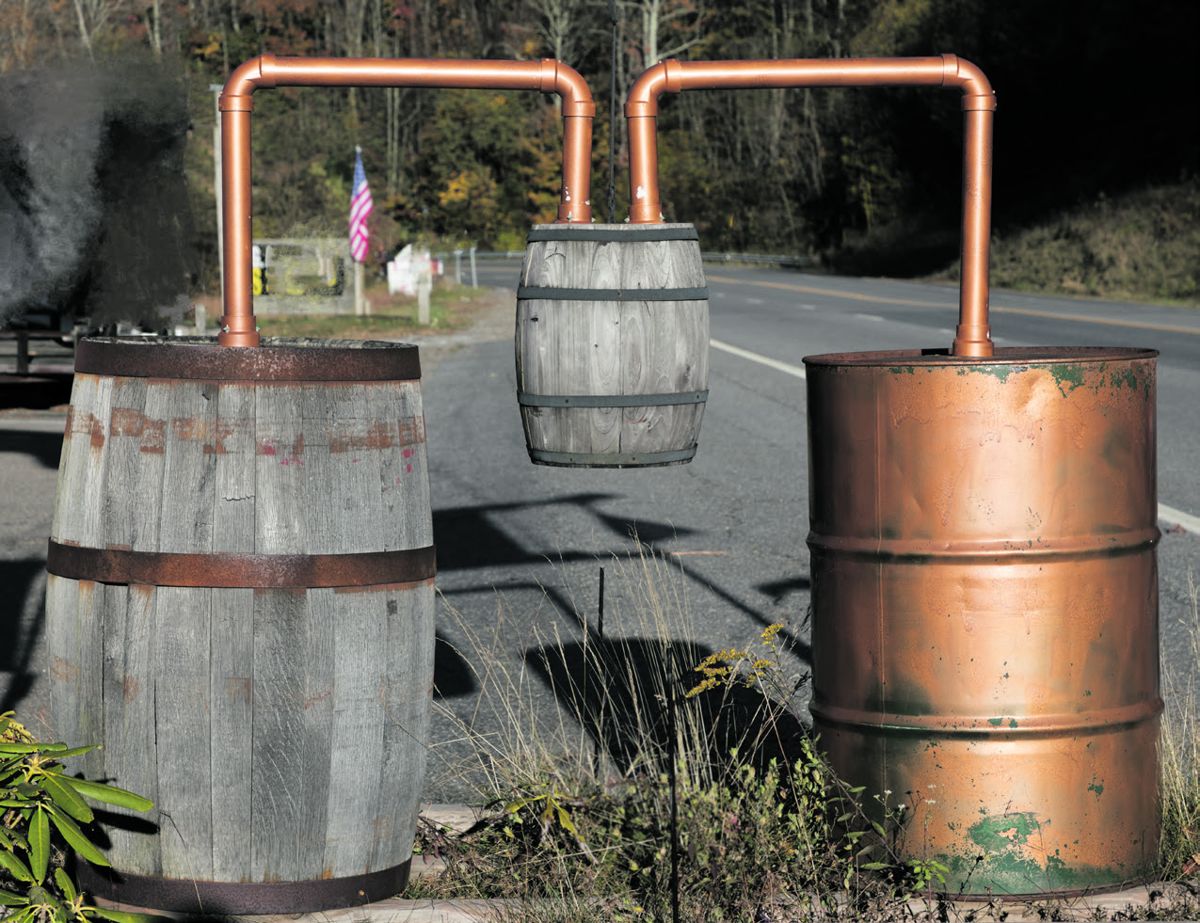
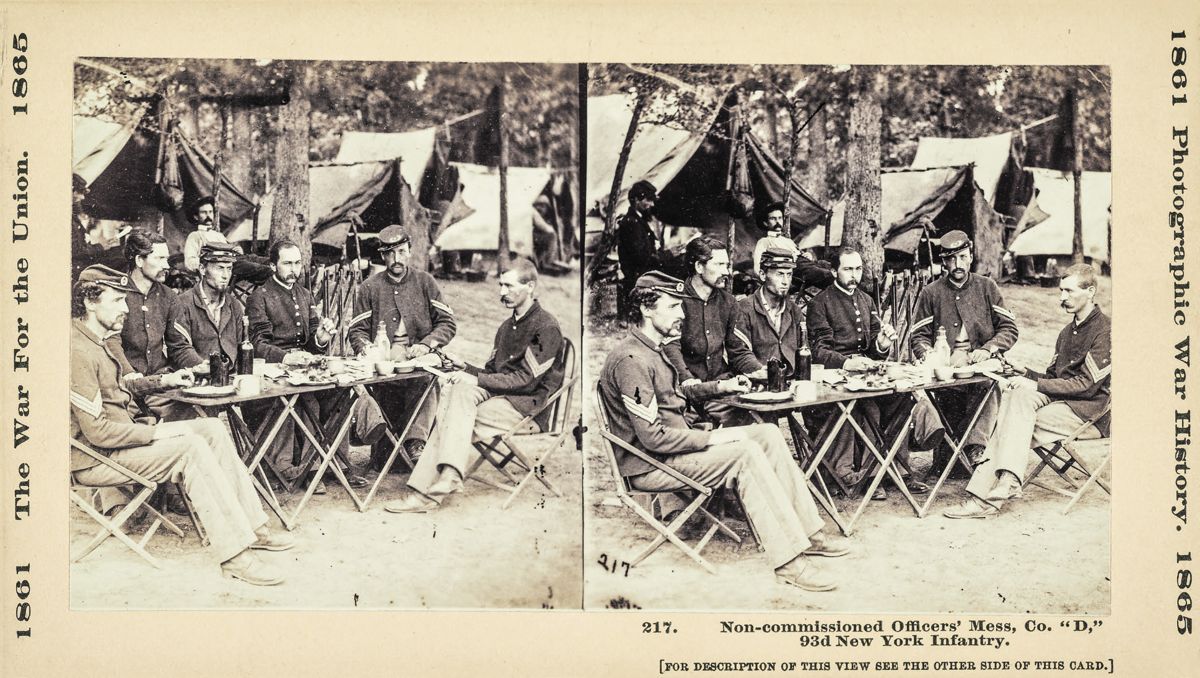
Whiskey—The Drink of Choice of the Common Civil War Soldier by Tom Elmore Since the dawn of time soldiers have spent many an hour off-duty consuming strong drink. The American Civil War was no exception. The potential dangers of alcohol were not lost on the generals. U.S. Maj. Gen. George McClellan called “the degrading vice of drunkenness” the biggest obstacle to the war effort and believed that eradicating it would be the equivalent of adding 50,000 troops to the Union Army. Likewise, Confederate Gen. Braxton Bragg felt the South “lost more valuable lives at the hands of whiskey sellers than the [musket] balls of our enemies.” Making a difficult situation worse for Union generals was that army regulations allowed soldiers to drink while on duty as long as they did not get drunk. Many a soldier took advantage of this loophole to keep themselves warm on picket duty during long, cold nights. Despite the dim view some officers had towards consuming alcoholic beverages, many realized that it could be used as both a carrot and a stick by offering soldiers whiskey as an incentive or taking it away as punishment. The Confederacy enacted a prohibition law in 1862. Officially, its purpose was to ensure growing grain for food and not liquor, though in reality it was aimed at recycling the copper stills into military supplies. That same year, Abraham Lincoln introduced an excise tax on whiskey to help fund the Union war effort. Rank often played a part in beverage choices. Officers tended to drink brandies and wines, while whiskey was the preferred choice of common soldiers. Whiskey became the most popular liquor in the United States after the American Revolution and was sometimes used in lieu of currency. Furthermore, whiskey was easy to transport and was not seriously impacted by weather or time. For the high number of troops of Irish or Scot-Irish ancestry, whiskey was part of their culture. Whiskey was also used for medicinal purposes and there were numerous occasions where whiskey was probably safer for a soldier to drink than the local water. Whiskey is a distillate made from the cereal grains corn, wheat, rye, or barley. The grains are soaked in water until fermented into a mash. The mash is boiled in a copper or copper-lined vat.The copper removes impurities and makes the beverage drinkable. The steam rising from the boiling mash is trapped in the cooker’s cover and diverted into another tank for cooling. This clear liquid is then put into wooden barrels for aging where whiskey gets it brown color and added flavor. What kind of whiskey Civil War soldiers drank is a difficult question to answer. There were over a half dozen types of whiskey soldiers might have access to. Making this question even harder is that when reading first-hand soldier accounts, they generally only say “whiskey” without providing any more details. Union troops probably drank more whiskey than their Rebel counterparts, in part due to the Confederacy’s prohibition act which resulted in gigantic spikes in the prices of liquor throughout the South where “cheap” whiskey went from 25¢ a gallon to $25. This had an unintended impact on the South’s war effort; blockade runners started carrying more liquor and fewer guns as the former was far more profitable. Union soldiers also had fewer problems obtaining whiskey. Though army regulations prohibited selling whiskey to enlisted men, they found ingenious ways to obtain the liquor. Care packages from home were a common ploy, but eventually officers caught on to what was happening and started inspecting the packages. This in turn led to whiskey being placed in unlikely packaging, such as milk cans. Soldiers would sometimes disguise themselves as officers and buy whiskey directly from the sutlers, who probably did not care who was actually buying. There are even tales of soldiers hiding it in their rifle barrels. The following list, arranged alphabetically, shows the major whiskey types available in America in the mid-1800s. Also included are easy to find equivalents of Civil War era whiskies, many of them made by companies that were in business in the 1860s for those who are interested in a unique “taste” of the war.
American Blended Whiskey One of the oldest styles of whiskey produced in the United States, American blended whiskey was probably first made in western Pennsylvania prior to the American Revolution. George Washington made some at Mt. Vernon. American blended whiskey, by modern law, must be distilled at less than 95% alcohol by volume or 190 proof.The fermented mash must be less than 51% of any one type of grain, making it the only whiskey made in America whose primary grain is not dictated by law. In the early days, rye was the base with corn added. The whiskey must be stored for a period of at least two years in new, charred oak containers. Afterwards, it must be stored in oak containers (newly charred is not required) and bottled at no less than 40% alcohol by volume (80 proof ). During the War American blended whiskey was popular with troops from the northeastern part of the United States. Afterwards, it remained a favorite in the western portion of the country throughout much of the late 19th century. Eventually its popularity waned as consumption of rye and bourbon whiskies grew. Though it was founded after the Civil War, Kessler’s Whiskey is one of the few brands of traditional American blended whiskey that dates from the 19th century sold nationwide. The most popular brand in America today, Seagram’s Seven Crown, was first made in the 1930s.
![Camp punishments—too fond of whisky [sic]—scene in the Army of the Mississippi. Harper’s Weekly, June 28, 1862, p.](/article-images/cwn-2021-june/cwn-2021-june-whiskeythe-drink-of-choice-of-the-common-02.jpg)
Bourbon Whiskey Bourbon is the most popular whiskey produced in the United States. In recent years, it has also developed a global following. Kentucky whiskey distillers chose corn over rye because it was easier to cultivate, and it gave Kentucky’s whiskies a unique flavor different from Pennsylvania’s rye-based whiskies. The drink was named after Bourbon County, Ky., and was first made in the late 18th century, but that version was not the same that is enjoyed today. Some say that the first man to make what we would today recognize as bourbon was a Welsh distiller, 412.
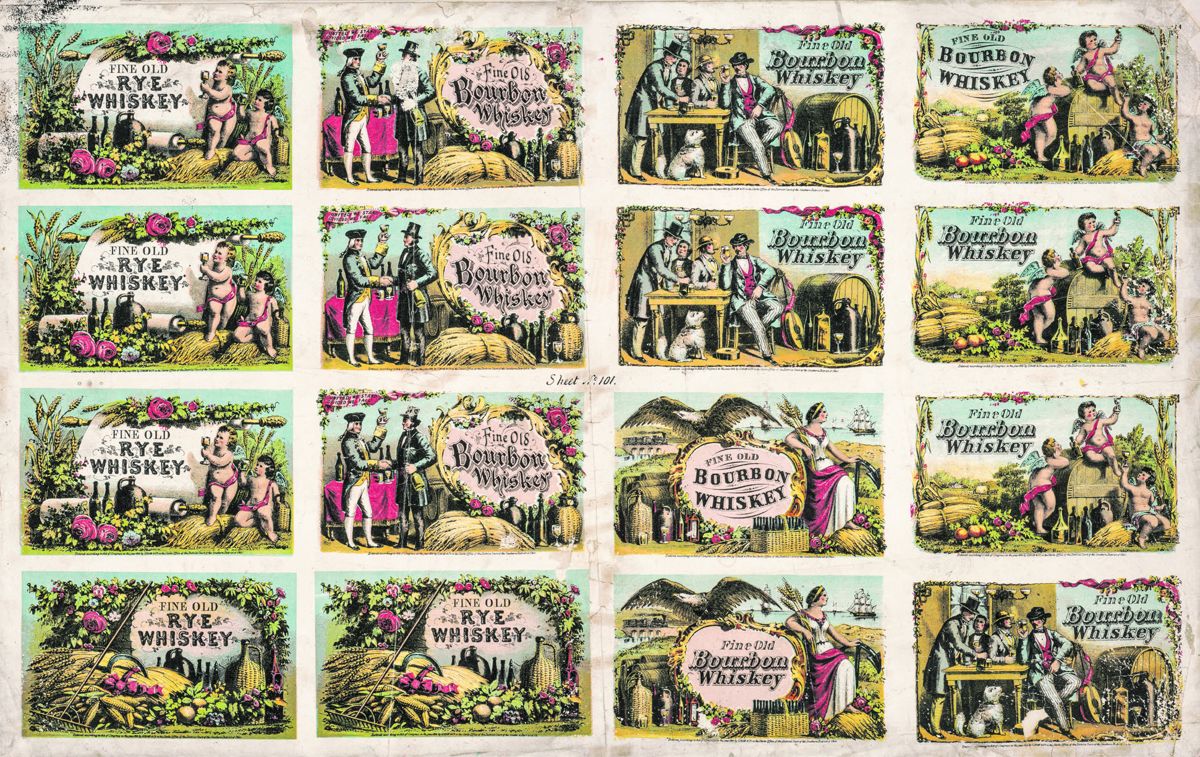
Evan Williams (1755–1810) in the 1780s. Others say a Baptist preacher turned distiller, Elijah Craig (1738–1808), deserves the honor. Both claims have been disputed by historians. A more plausible candidate for the first distiller of modern bourbon whiskey is Scotsman, James Crow (1789–1856), a physician and chemist who experimented with his formula before the debut of his Old Crow whiskey in 1835, but the evidence is only circumstantial. Bourbon must be made in the United States, though it does not have to be made in Kentucky. The mash must be at least 51% corn and has to be anywhere from 80 proof to 160 proof. It also must be aged in new charred oak barrels. As an aside, many 19th century laws regulating alcohol production in the United States are still enforced.
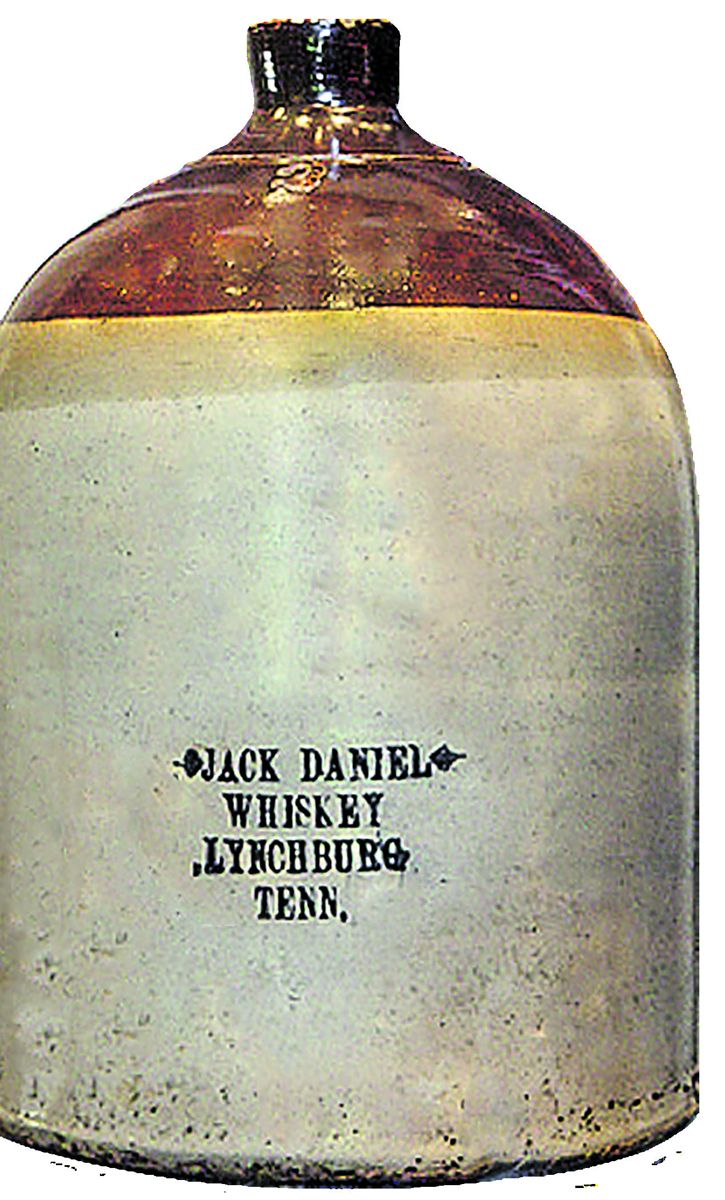
Jack Daniels, founded by Jasper Newton “Jack” Daniel, is produced in Lynchburg, Tenn. It is basically bourbon with one extra step. The liquid goes through a charcoal filter as it is poured into the barrel. This style of whiskey did not exist during the war, though a variation of it was popular prior to the 1850s. Not surprisingly, bourbon was very popular in the south and west prior to the War. Many a Union soldier marching through Kentucky got his first taste of the liquor and after the war demand for bourbon grew; in the process, its appeal and popularity changed from a regional to a national favorite. The war was hard on the bourbon whiskey industry since many distilleries were in combat zones. Even worse, one objective of Gen. Bragg’s 1862 Kentucky invasion was to confiscate copper stills to be recycled into war materiel. Old Crow was a favorite of generals U.S. Grant and Jubal Early. That recipe was changed in the 1980s and no longer tastes like it did during the War. Buffalo Trace dates to 1773 and can be found in select liquor stores. Jim Beam was founded in 1795 by Jacob Beam, who is credited with giving bourbon whiskey its name. The current master distiller is the sixth direct descendant of Jacob Beam to hold the position, and the 225 year old family recipe is still used today.
One of the fathers of the Canadian whiskey industry was an American, Hiram Walker (1816–1899) who began distilling whiskey in Detroit in 1854. Five years later he moved his operations a short distance south to Windsor, Ontario, where Walker would have to deal with less government regulation and lower business costs. The brand’s low price and high quality ensured success. Another key to the whiskey’s success was Walker’s decision to call it Club Whiskey, giving it a more elegant appeal. Jealous American distillers successfully petitioned Congress to pass a law that forced Walker and other foreign distillers to state the country of origin on the bottle hoping it would hurt Canadian whiskey sales; however, the renamed Canadian Club Whiskey sounded even more posh, further increasing sales. Canadian whiskey is a blend using corn as its base and rye for flavoring. It must be 80 proof and, unlike other whiskies, it can contain flavoring and does not have to be aged in oak, though it must be aged in wooden barrels. As a rule, Canadian whiskies are lighter and smoother than other whiskies. The Civil War was good to Walker. As the value of the U.S. dollar dropped, smuggling Canadian whiskies into America became popular and profitable.
Allegedly, Walker himself loaded ferries with as many jugs of his whiskey as they could carry across the Detroit River and made a fortune. There were even farfetched tales of him building a pipeline from his distillery, under the river and into Detroit. It is probable that troops from Michigan and surrounding areas carried a lot of Walker’s whiskey with them. Hiram Walker’s original Canadian Club is still popular today.
Irish Whiskey On the eve of the Civil War, Irish whiskey was the most popular in America and the world. The mass exodus from the Emerald
Island due to the Great Potato Famine was undoubtedly a factor in its popularity; however, it was also among the cheapest whiskeys at the time. It was the preferred drink of Irishmen whose communities could be found in the river and sea ports across the United States. About 150,000 Irishmen fought for the North while an estimated 20,000 to 45,000 fought for the South. Irish whiskey can be blended or single malt. It is distilled three times and has to be aged at least three years though some today are aged three to four longer. The popularity of Irish whiskey has grown in recent years with distillers creating new varieties. There are several brands of Irish whiskey that predate the Library of Congress.
Civil War. Bushmills’ dates to 1608 and is one of the oldest distilleries in the world. The biggest brand in America today is Jameson, founded in 1780. Ironically, John Jameson was born in Scotland.
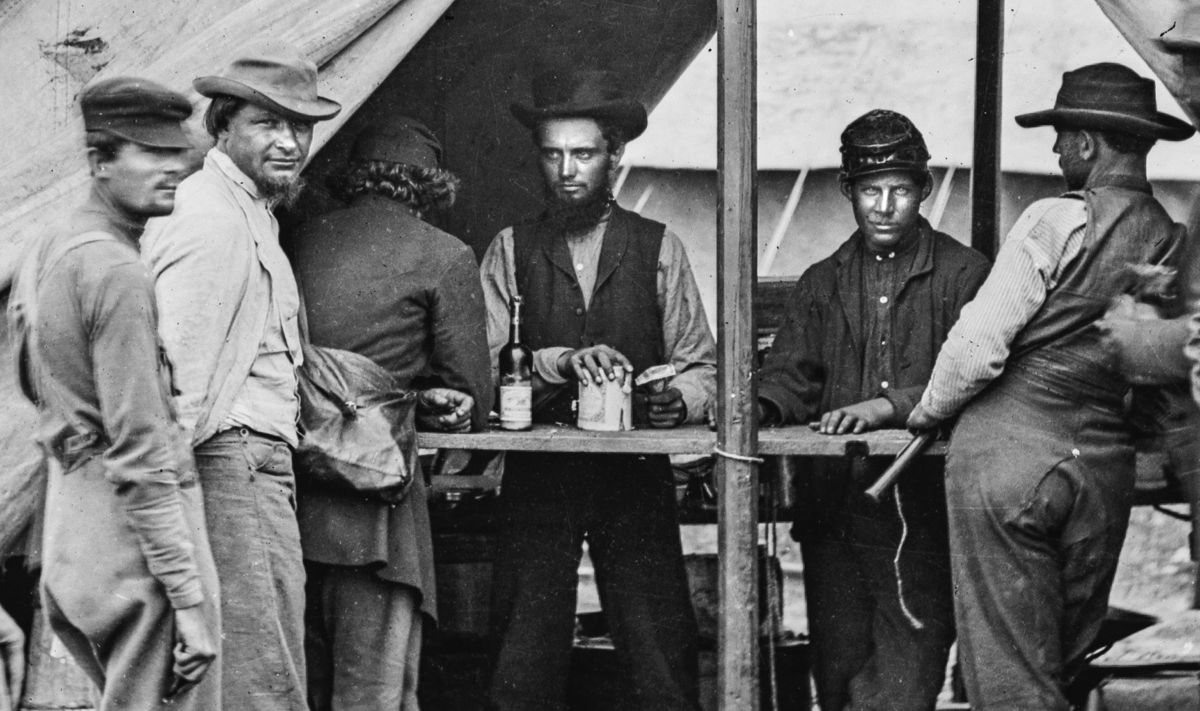
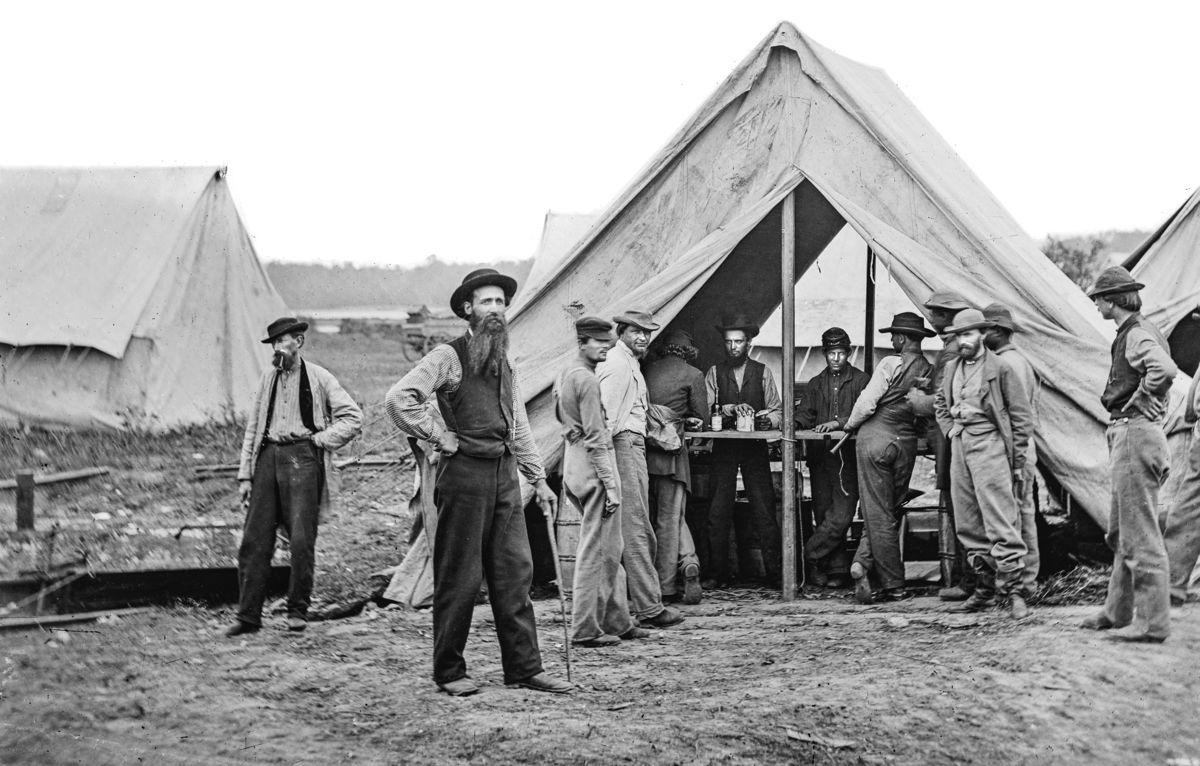
Moonshine Whiskey When soldiers were in camp for extended periods, clandestine stills appeared. The origins of moonshine go back to Scotland in the 1700s. “Moonshine” whiskey was so named because those who made it did so under the light of the moon or “moonshine,” a nighttime version of “sunshine.” In America, the traditional heart of moonshine country has been the Appalachian Mountains. Historically, production goes up when economic times are hard. A corn farmer could make up to ten times more money by selling “liquid corn” than selling it as solid food. Contrary to popular perception, moonshine itself is not illegal. It is only becomes illegal when the producer does not secure the proper permits and pay the taxes and fees required to legally operate a still. Moonshine is clear, unaged whiskey. Traditionally, it is made from a corn mash, though barley and rye are sometimes used. Since the 20th century, sugar has been used in its production. A typical still can produce 1,000 gallons a week. Drinking unregulated moonshine is risky since the use of metals other than copper in the stills can make the beverage toxic. Another factor is that revenue agents often find dead animals in illegal stills. Safe, legal moonshine can be commonly found in spirits shops today.
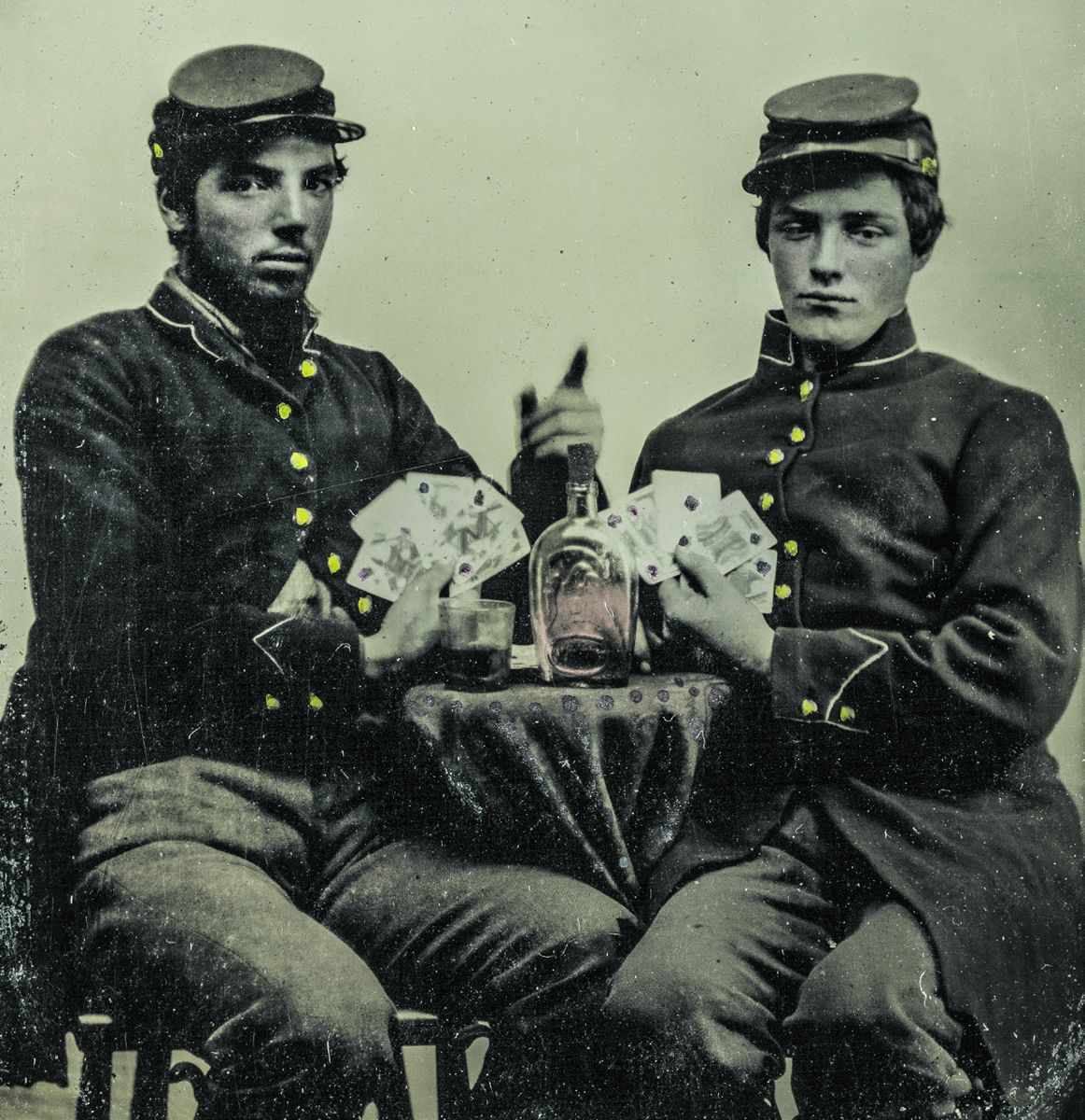
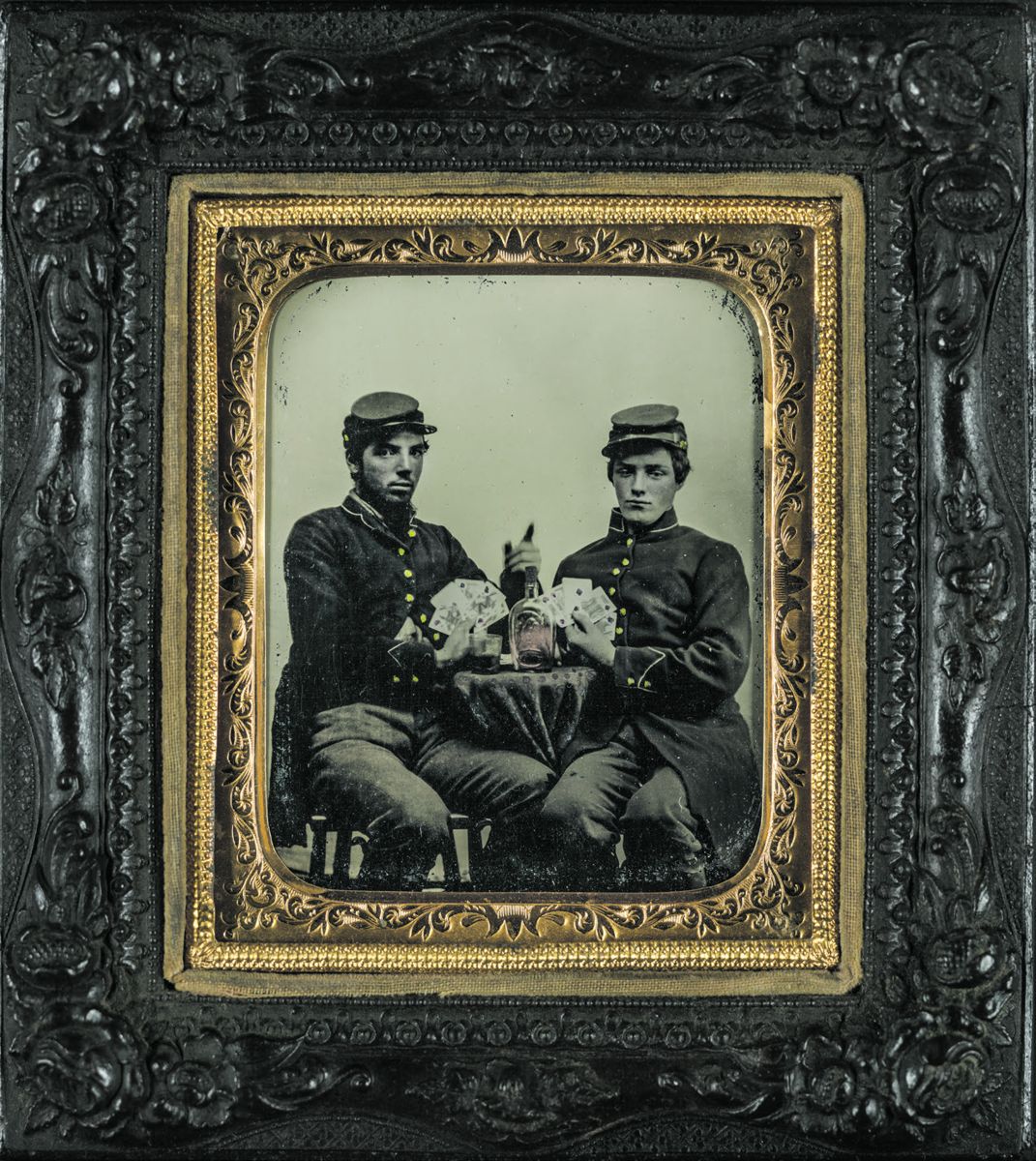
Rye Whiskey Rye whiskey is one of the oldest whiskies produced in America. Early Pennsylvania settlers found Two Union soldiers drinking whiskey and playing cards. The bottle is a double eagle whiskey flask with shield made in Pittsburgh, Penn. Liljenquist Family Collection of Civil War Photographs (Library of Congress). that rye grew better in the new world than other European grains and consequently, surplus rye was turned into whiskey. In 1810 Henry Overholt, nee Oberholzer, (1739–1813) built a rye whiskey distillery in West Overton, Penn. The company has remained in business ever since and even sold medicinal whiskey during prohibition. The firm is often called “a foundation stone of American whiskey.” Rye whiskey is made from a mash that is at least 51% rye. The remaining 49% is usually corn and malted barley. It can be no higher than 125 proof and must be aged in new charred oak barrels for at least two years. Prior to the Civil War, rye whiskey was very popular in the eastern part of the country, especially Pennsylvania and Maryland. General Grant was a fan of Old Overholt. Unlike bourbon whiskey producers, Old Overholt, and other rye whiskey distillers, had little to fear during the Civil War as very few, if any, found themselves in harm’s way. After the War Old Overholt grew in popularity, especially in the far West where legendary gunslingers Doc Holiday and Johnny Ringo drank it. Prohibition and World War II led to a major decline in the popularity of rye whiskey, though President John. F. Kennedy enjoyed it. By the 1960s, Old Overholt is the only rye whiskey brand readily available nationally today. Rye whiskey has made a small comeback in recent years, but, it is still, at best, a niche market.
Scotch Whisky
Scotch whisky (The Scots do not use the “e” in their whisky) is the most popular style of whiskey in the world. In 2017 more Scotch was consumed than American, Irish, or Canadian whiskies combined. In the 1860s, scotch was not big in America, thanks in part to its high price; consequently, its consumption was primarily limited to the wealthy and elite. By law, “scotch” must be made in Scotland. The mash is made from malted barley, wheat, or rye or combinations thereof. Sometimes the grains are dried over a peat fire before being used in the mash to give the scotch a distinct flavor. The liquor is distilled at least twice, though some are distilled three times. After distillation, scotch is aged for at least three years in oak barrels, though premium scotches are aged for longer periods. Scotch is broken down into two categories:
Single Malt Scotch is made at one distillery using only water and malted barley. This style of scotch is believed to have been the most popular in America, especially among Southern aristocrats, on the eve of the Civil War. The Glenlivet distillery was opened in 1824 and has remained in business continuously, except for World War II. Their twelve year old single-malt may have been the most popular brand of scotch in American prior to the War.
Blended Scotch Whisky makes up 90% of modern scotch production. It must contain at least two single grain scotches from two different distilleries. Blends contain both malt whisky and grain whisky. Premium blends can contain dozens of different scotches. There are numerous blended Scottish distilleries that claim to have been founded prior to 1860. Less inexpensive brands are probably closer to what a soldier would have drunk. DISCLAIMER: The following information is provided for educational and informational purposes only. Do not try any of this at home or anywhere else!
Sutler Whiskey Sutler Whiskey, sometimes called Frontier Whiskey, was a cheap knock-off sold by unscrupulous sutlers and saloons. Though sutlers also sold useful and practical items, often at inflated prices, whiskey was their biggest money maker. Sutlers would buy real whiskey and then “stretch” or “cut” it by diluting it with water or adding ingredients like:
140 proof grain alcohol Tea for coloring Burnt sugar Ether Peppers Almonds The results often created concoctions that were not only toxic, but also highly flammable. Some even resorted to making whiskey from scratch using dangerous and deadly ingredients. One 1861 recipe is as follows: Take oil of vitriol [sulfuric acid] one quart, strychnine one gallon, and spirits of turpentine twenty-four gallons. Mix with rain water, and allow it to settle for three days, and then it will be ready for use. This article adds greatly to the combativeness of the drinker, and can be given with advantage to qualmish [sic] militia men who can’t exactly make up their minds to go to war; but who boast loud of an intention of doing so. After the war ended, thousands of soldiers came home with wounds, both visible and hidden, that they self-medicated with alcohol. This was in addition to those who had a drinking problem they incurred or was made worse during the war. The spike in alcoholism would play a part in the rise of the Temperance Movement in the late 19th-early 20th century. In essence the Civil War helped create a new war between the “wets” and the “drys” culminating in the 18th Amendment in 1920. Tom Elmore has a B.A. in History and Political Science from the University of South Carolina. He has written four books dealing with South Carolina during the Civil War. In addition, he has also written dozens of articles for national, regional, and local publications. He has lectured and participated in historical symposiums throughout the Southern Atlantic States. He has also been a book reviewer for two national publications, including Civil War News. He lives in Columbia, S.C., with his wife Krys and their Chihuahua Sassy.