
Through The Lens
Thinking Bayonets: Camden Expedition Part III
By Stephanie Hagiwara · Originally published June 2021 · pp. 18–19
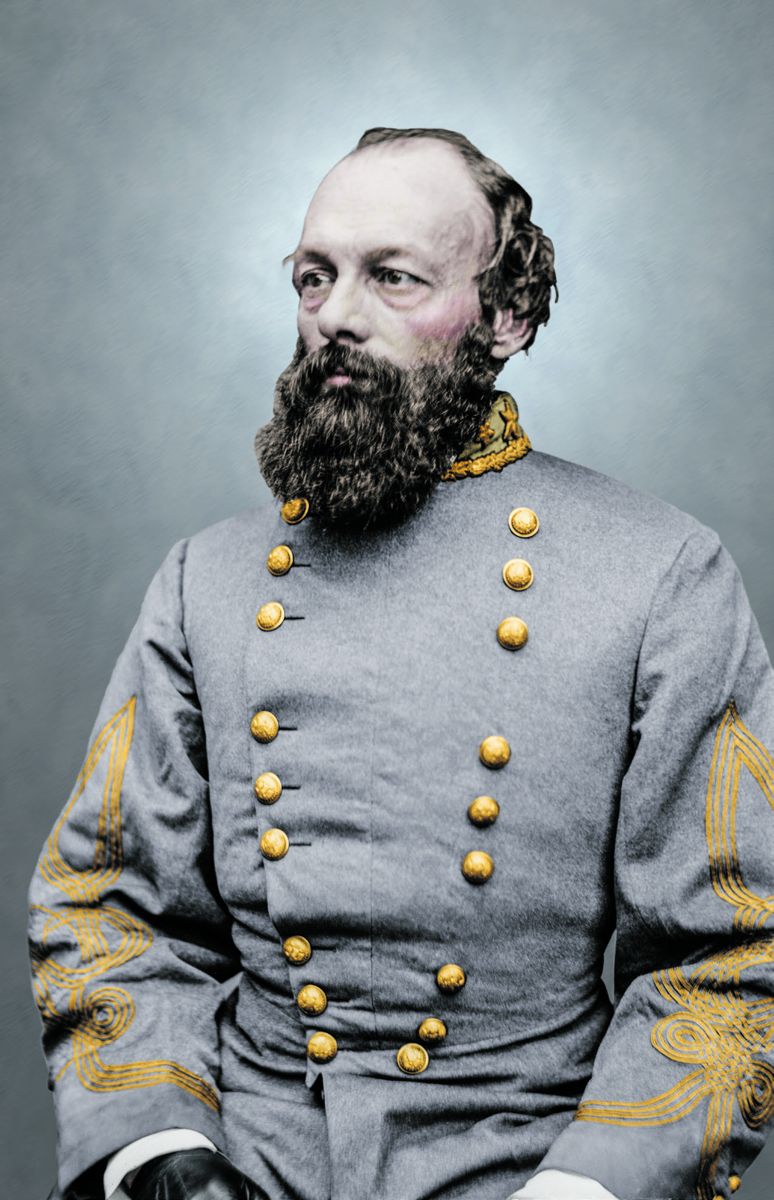
Thinking Bayonets Camden Expedition Part III “I cannot conceive what ‘political and military points of view’ are to be obtained for the Confederacy by abandoning the certain destruction of an army of 30,000 men backed by a huge fleet, to chase after a force of 10,000 in full retreat with over one hundred miles the [head] start.” – C.S. Gen. Richard Taylor On April 25, 1864, notified that his men lost the Battle of Marks Mill, Ark., U.S. Gen. Fredrick Steele realized the Camden Expedition was doomed. During separatebattles,theConfederates had captured two of his supply trains. The area surrounding Camden, Ark., was unable to feed his men, horses, and mules. Without a rapid retreat to his starting point, Little Rock,
Ark., his men faced starvation or capture. Steele had been ordered to Shreveport, La., by Gen. Ulysses S. Grant, newly promoted to command all Union troops. Federal forces were to advance up the Red River to Shreveport, La., before moving on into Texas. Adm. David Porter’s flotilla of gunboats was to provide firepower. Gen. Nathaniel Banks would lead 20,000 soldiers, along with an additional 15,000 men from Gen. William Sherman to combat Confederate land forces. Steele’s Expedition was meant to distract the Confederates, and then join Banks at Shreveport. Before diverting from his orders, Steele called a council of war with his generals, Fredrick C. Saloman, Eugene A. Carr, John M. Thayer, and Samuel A. Rice. Steele had received dispatches that Banks had withdrawn to Grand Ecore, La. Furthermore, according to Confederate prisoners, C.S. Gen. Edmund Kirby Smith, Comander of the Trans-Mississippi Department, was coming with reinforcements. Since the Federals lacked supplies, the ability to reliably communicate with Banks, and were “threatened by so large a force of the enemy,”it was agreed to abandon joining Banks and retreat. On April 26, after 9 p.m. taps, Carr’s cavalry started over a pontoon bridge crossing the Ouachita River. Thayer’s and Rice’s Divisions followed with Salomon’s Division acting as rear guard. The 40th Ill. were left to protect Capt. Junius Wheeler’s engineers quietly disassembling the pontoon bridge. Slipping away from Camden, the Federals fell into march formation without alerting the Confederates. At Shreveport, Smith had been getting updates on the progress of both Banks’s and Steele’s Expeditions. The Confederate military strategy to defend hundreds of miles of territory with comparatively few troops was to disperse them where they were needed most. This strategy pitted generals Richard Taylor vs. Sterling Price as to who would receive reinforcements. Gen. Taylor, son of former Pres. Zachary Taylor and a military historian, may have been “deeply versed in the annals of war,” but he was impatient and would harangue Smith about attacking Union forces. Banks had been “beaten” and Porter’s fleet “had barely enough water to float upon.” Taylor wanted “to strike vigorously to capture or destroy both.”This action would drive the Federals from Louisiana and have the added benefit of aiding the
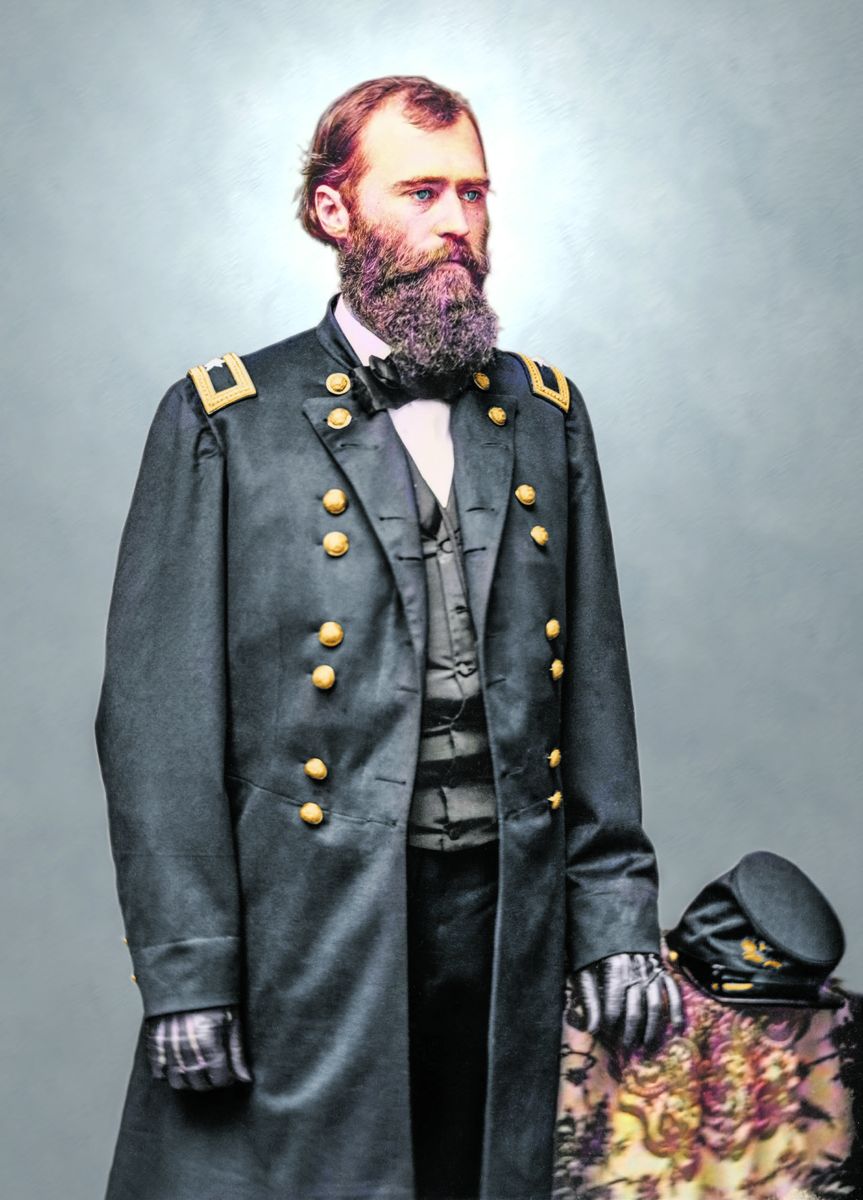
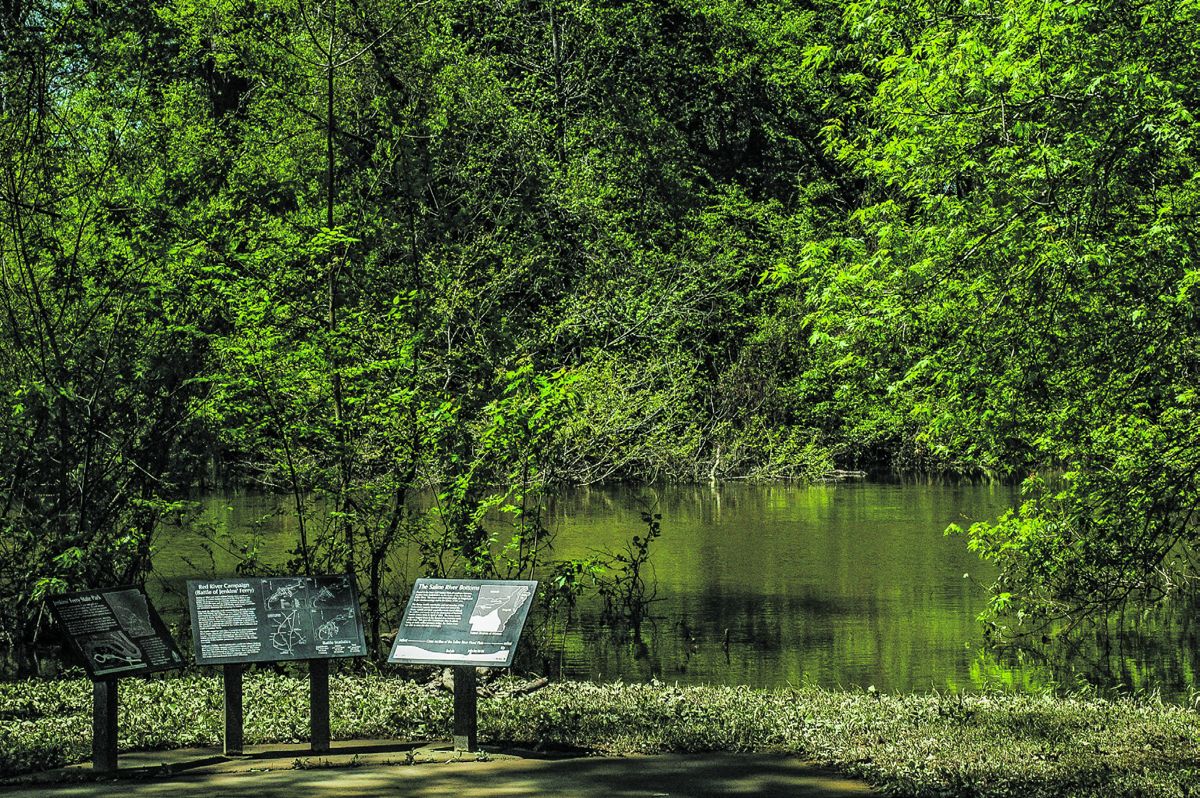
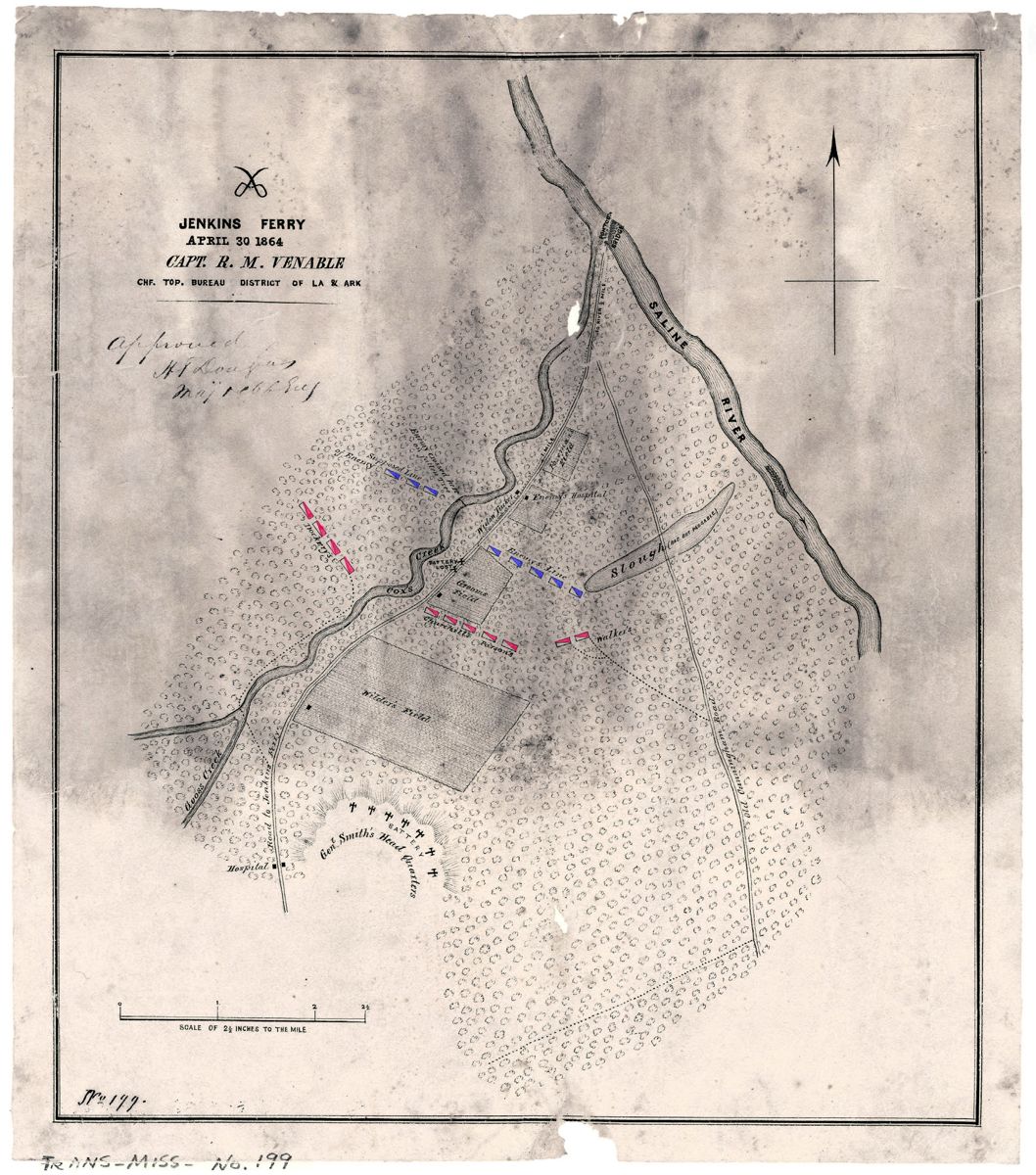
Confederate overall war effort. Former Missouri governor Price’s strategy was to be amiable towards Smith. Price not only wanted to vanquish Steele but use the reinforcements to regain Missouri for the Confederacy. Price was known for fighting, and hard drinking; Smith felt he would be more aggressive toward Steele. Smith also weighed the attributes of the Federal commanders as part of his deliberations. Steele was known for “hard fighting;” Banks was known as a political general. To Taylor’s fury, Smith concluded that the priority was to destroy Steele. On April 27, Price’s guards “liberated” Camden. The news of the Federals’ departure spread through the Confederate forces. The Federals took their pontoon bridge with them, lengthening their lead while the Confederates scrambled to build their own. On April 30, to catch up with the Federals at the Saline River, Smith ordered his infantry to move at 1 a.m. through the endless rain and mud. In the dark, mounted officers would ride over a marcher, generating a flood of curses from the men. “At one point, a clumsy horseman knocked down three men as he trotted forward. The angry soldiers cornered the officer, threatening him at bayonet point, to know his name and business. The gentleman ‘replied that his name was E. Kirby Smith, and that his business was to command the army.’ The stunned soldiers sheepishly granted the commanding general the right of way and fell back into ranks.” The Federals spent the night improving their defensive position while Wheeler’s engineers assembled the pontoon bridge over the rain swollen river. Steele ordered Carr’s cavalry to cross first and sweep the route for the enemy. Thayer’s Division would protect the flank while Salomon’s provided security away from the river to allow the army time to cross free from enemy fire. Salomon used fence rails and felled timber to create breastworks. His right was anchored on Cox Creek. Salomon’s left was a cane swamp and thicket, and his front, paralleling thick timber, was a 400-foot-wide field covered in one to three feet of water. The Battle of Jenkins’ Ferry began in the early morning with C.S. Gen. John Marmaduke’s cavalry coming under heavy fire. As the Confederate brigades arrived, they were sent into the fight. “Charge after charge was made by the yelling rebels, only to be broken upon our [Federal] line.” The gun-smoke combined with fog hugged the ground.“The rebels did, indeed, mostly fire too high or to [sic] low. Had they aimed with anything like the usual accuracy, few of us could have escaped. But our men, with that individual thought and action, which makes the term ‘thinking bayonets’ … soon learned to stoop down, and look under the smoke sufficiently to discover the precise position of the rebel masses; and then a horizontal fire at the level of the breast, could not fail to hit its mark, unless a tree stood in the way,” wrote Pvt. Andrew Perry, 33rd Iowa. By 11 a.m., except for the infantry and one artillery unit, Steele’s army had crossed the river. At 12:30 p.m. the battle was over. By 3 p.m., all the troops had crossed, and the bridge was destroyed. Technically, Steele won the battle. Both sides lost a general. U.S. Gen. Samuel Rice and C.S. Gen. William Scurry had been mortally wounded in the battle. Smith succeeded in driving both Federal expeditions out of his territory.
Steele did succeed in diverting Smith’s attention from the Red River Expedition. Subsequently those forces were utilized by Gen. Grant at Mobile, Ala., Atlanta, Ga., and Cedar Creek, Va., in his 1864 campaigns. Not privy to its dual purpose, Perry deemed the expedition “a failure; and it narrowly escaped ending in a terrible defeat. But if examples of stern and determined endurance, of desperate courage … and cheerful fortitude in braving disaster, are worthy of remembrance, our memories of the Camden Expedition need not be less proud than terrible.” Sources: Forsyth, Michael J. The Camden Expedition of 1864 and the Opportunity Lost by the Confederacy to Change the Civil War: McFarland & Company, Inc., 2015. • Sperry, A. F. History of the 33d Iowa Infantry Volunteer Regiment 1863–1866: Mills & Company, 1866. • Johnson, Ludwell H. Red River Campaign: Politics and Cotton in the Civil War: Kent State University Press, 1993. • Taylor, Richard. Destruction and Reconstruction: Personal Experiences of the Late War: D. Appleton and Company, 1879. • O.R., Vol. 34, Part 1, p. 541. •
Stephanie Hagiwara is the editor for Civil War in Color.com and Civil War in 3D.com. She also writes a column for History in Full Color. com that covers stories of photographs of historical interest from the 1850’s to the present. Her articles can be found on Facebook, Tumblr and Pinterest.