
The Graphic War
Naval Battle Charleston, 1863
By Salvatore Cilella · Originally published June 2021 · p. 26
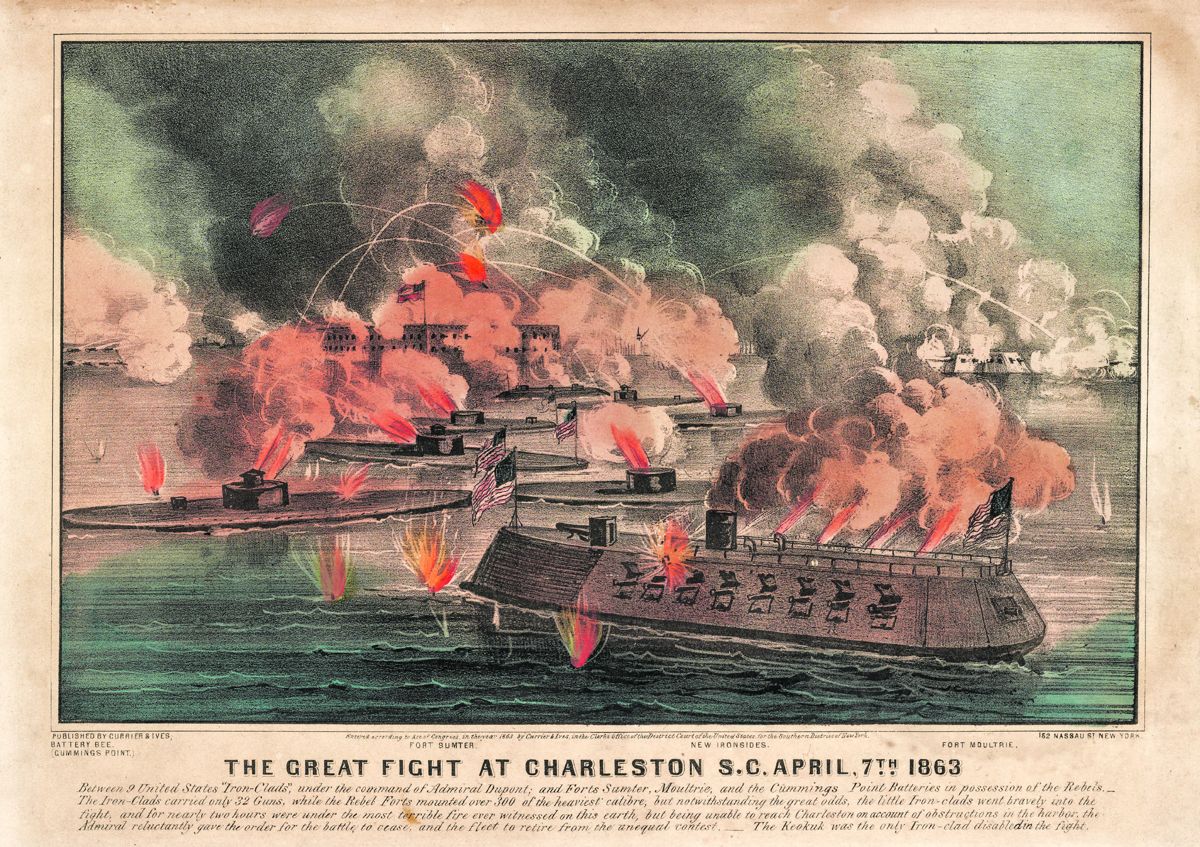
Naval Battle Charleston, 1863 The Graphic War highlights prints and printmakers from the Civil War discussing their meaning and the print maker or artist’s goals. Throughout the war, no battle or minor skirmish escaped the eagle eyes of Currier and Ives. Instead of producing thoughtful, artistic renderings, the firm abandoned its artistic expertise and presented the war as sensational, graphic news items. The “Great Fight at Charleston, April 7th, 1863” is a prime example. Using five lines of text and crude, slapdash renderings, Currier documented the first of two failed attempts by the Federal navy to capture Charleston.
The prior year, in concert with Grant’s victory at Shiloh, Union war ships under Admiral Farragut captured New Orleans. The muscular new naval policy was based on the premise that “if you could blockade a seaport, you could capture it.”1 With Farragut’s victory, the Federal upper command decided that ironclads were the mechanism to implement the strategy. Secretary of the Navy Gideon Welles was finally convinced of the new ship’s potential and ordered Samuel DuPont, who was not convinced, to take Charleston.2 Much like McClellan, Dupont finally, and slowly, moved into action eleven months afterWelles issued the order. Four wooden rafts, employed to float ahead of the attacking ships to detonate Confederate mines before they came into contact with Federal vessels, failed. DuPont failed to make adequate surveillance of the mines. He also “failed to reconnoiter the Confederate defenses to indicate channels to sail and he had failed to order his captains to run the gauntlet” the Confederates had established.3 Currier’s depiction of the battle was misleading and incorrect. It’s title margin reads: “The Great Fight at Charleston S.C. April 7th 1863 / Between 9 United States ‘Iron-Clads,”’ under the command of Admiral Dupont; and Forts Sumter, Moultrie, and the Cummings Point Batteries in possession of the Rebels. / The Iron-Clads carried only 32 Guns, while the Rebel Forts mounted over 300 of the heaviest calibre [sic], but notwithstanding the great odds, the little Iron-clads went bravely into the / fight, and for nearly two hours were under the most terrible fire ever witnessed on this earth, but being unable to reach Charleston on account of obstructions in the harbor, the/Admiral reluctantly gave the order for the battle to cease, and the fleet to retire from the unequal contest. The Keokuk was the only Iron-clad disabled in the fight.” The Keokuk lies in the background between the ironclad flotilla and Fort Sumter. The vessel was hit at least 90 times and sank April 8, 1863. In reality, the navy employed 36 guns against 76 Confederate cannon. “The Confederates fired 2,209 shots and the Union warships slowly returned 151 shots, a ratio of over 14 to 1. The Union warships directed most gunfire on Fort Sumter but made no effort to pass the rope obstruction. The battle continued for nearly two hours at ranges of 550 to 800 yards from Fort Sumter.”4 Nowhere in Currier’s description of the battle is a mention of loss. As historian Syd Overall states: “The Confederacy achieved a spectacular victory at Charleston by repulsing the nine Union warships on April 7. The nine Union warships endured a total of 408 hits, but Confederate artillery had disabled five monitors and two monitors had to be taken under tow.” Welles gave DuPont a letter of censure for his lack of leadership. DuPont blamed “structural defects of the monitors.”5 Featured prominently front center in Currier’s version of events is DuPont’s flagship “New Ironsides.” Because of its draft, the ironclad was unable to close and effectively engage the enemy and was largely ineffective. Yet in Currier’s depiction, all guns are blasting away and the ship is taking fire. Controversy followed DuPont and the loss at Charleston. Navy engineer Alban Stimers examined the monitors and found no structural deficiencies as DuPont asserted. When DuPont learned that Stimers’ report citing “incompetent hands” was going to be published, DuPont arrested Stimers. Welles stepped in, released Stimers, and ordered an inquiry that cleared Stimers and embarrassed DuPont. DuPont and Welles never spoke again. Another attempt to take Charleston with other commanders was made September 7; this also failed. Currier and Ives rosy view of the first battle was incorrect and misleading. Federal Army troops, not the navy, finally occupied Charleston in February, 1865.
Endnotes: 1.
Syd Overall, “The U. S. Navy and the Naval Battles of Charleston, 1863.” The Cleveland Civil War Roundtable, © 2014, All Rights Reserved, Editor’s Note: This article is adapted from a presentation made by the author to the Cleveland Civil War Roundtable on Feb. 12, 2014. www.clevelandcivilwarroundtable. com/the-u-s-navy-and-the-navalbattles-of-charleston-1863. C. R. P Rodgers. “Du Pont’s attack at Charleston.” Battles and Leaders of the Civil War, eds. Johnson, Robert Underwood, and Clarence Clough Buel. Vol. 4, pp. 32-47 Century, 1894; reprint: Castle, 1956, p. 44. Overall, “Battles Charleston.” Ibid. Ibid.
After 43 years in the museum field, Salvatore Cilella devotes his time collecting American prints and maps and writing. His last professional position was President and CEO of the Atlanta History Center. His most recent books are Upton’s Regulars: A History of the 121st New York Volunteers in the Civil War (U. Press Kansas, 2009). His two-volume Correspondence of Major General Emory Upton, (U. of Tennessee Press, 2017), received the 2017–2018 American Civil War Museum’s Founders Award for outstanding editing of primary source materials. His latest book “Till Death Do Us Part,” an edit of Upton’s letters to his wife 1868-70, was published last year by the Oklahoma University Press.