
The Unfinished Fight
Early Civil War Imported Arms
By Craig L. Barry · Originally published June 2021 · p. 8
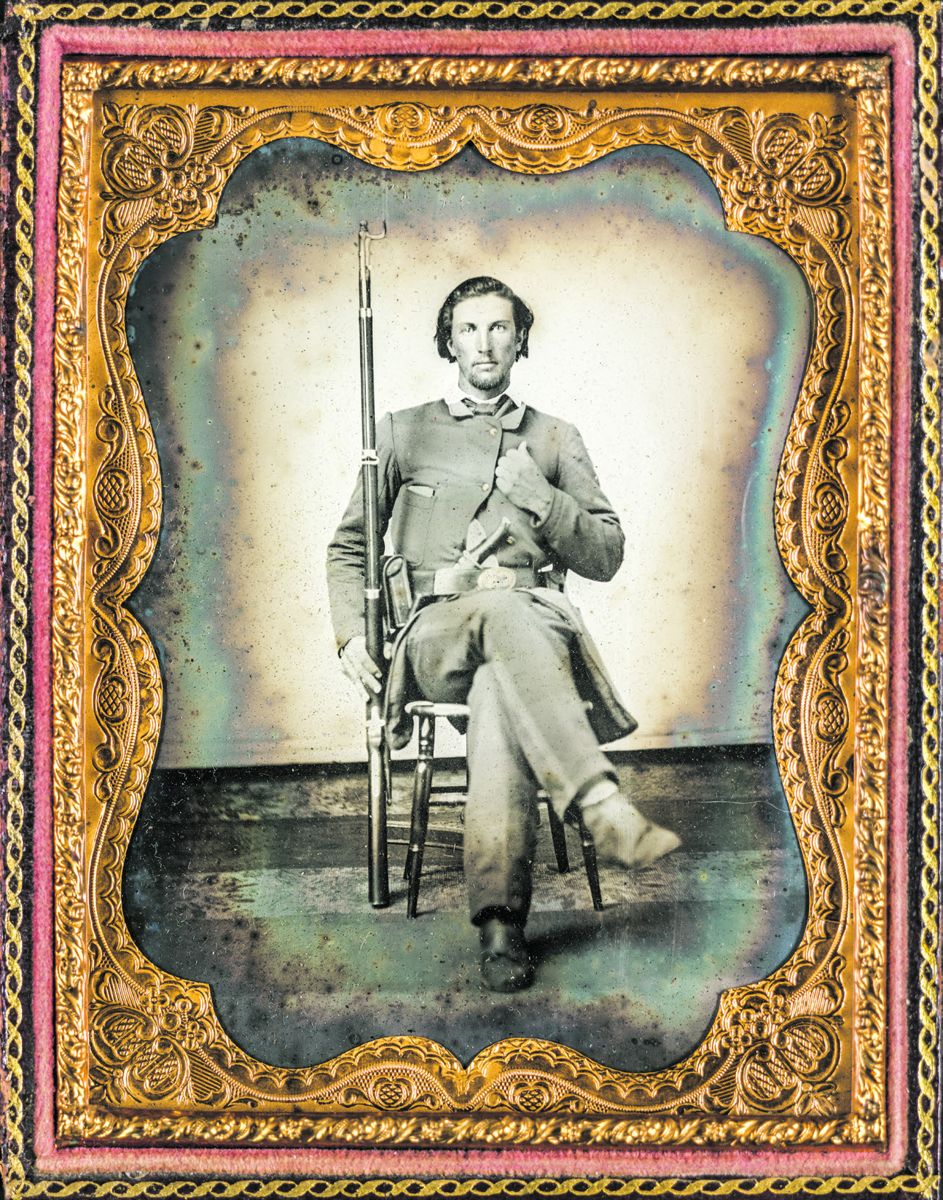
There is a widely held understanding that during the Civil War, U.S. 1861s were produced in America, either at the government Armory in Springfield or by twenty or so domestic contractors; further, that Enfield long rifles were produced and exported to both the U.S. and C.S. governments (and states) by the hundreds of thousands from commercial gun-makers in London and Birmingham, England. This is certainly true, but it was not always the case. Early in the Civil War, both Union and Confederate buyers were scouring Europe for anything that would shoot, as long as it was in percussion; at least until they could enter into contracts for newer more modern infantry weapons. Some arms were provided on contract with German gun-makers. At the time, Germany was divided into individual states and the gun manufacturing center was at Suhl, a city located in the district of Thuringia that shared borders with Bavaria and Saxony. Union buyer Marcellus Hartley of Schuyler, Hartley & Graham New York, initially had little luck contracting for Enfield rifles in Birmingham and London, so he headed to the Continental Europeangun-makers.Hebought 80,000 Model 1854 Austrian rifles (Lorenz) at $10.40 each. He spent so much that he overdrew his account and had to approval from Washington to honor the outstanding drafts. Then Hartley went to Prussia, the dominant German state, where he entered into contracts for copies of the new U.S. M1861 pattern rifle musket. Over a few months he recorded the following deliveries:
Date 2-17-62 3- 7-62 3- 8-62 3-10-62 5-7-62 5-26-62 6-21-62 6-30-62 7-15-62 7-26-62
Number and Kind 200 Suhl rifles 149 Suhl rifles 1 Suhl rifles 50 Suhl rifles 179 German Springfield pattern 550 Suhl rifles, Enfield Pattern 225 Suhl rifles, Enfield Pattern 223 Suhl rifles, Enfield Pattern 302 German Springfield pattern 275 Suhl rifles, Enfield Pattern
Amount $14.00 $14.00 $14.00 $14.00 $16.50 $16.25 $16.25 $16.25 $14.60 $16.25
This information is included in “The Suhl Springfield: A Puzzle for Arms Collectors” by Mary E. Good. What is interesting to note is that sometime after March 10, 1862, the Prussians shifted production from the U.S. 1861 to the Enfield P53 long rifle pattern. One would think it would be the other way around? Along those lines, some shipments identified as “Enfield pattern” may have been U.S. 1861s or a mixture of Enfield rifles and U.S. 1861s. For some reason though, a change was made and it was not because of cost, as the U.S. 1861s were less expensive to produce at Suhl than Enfields, pretty much across the board. Were there too many rejections of the Germanmade 1861s by picky Federal inspectors, as Eli Whitney Jr had learned the hard way with his U.S. 1841 percussion rifle contracts a generation earlier? This much is known, Union soldiers originally issued the Suhl contract U.S. 1861s complained about them, which seems to be a common enough occurrence with most of the first imported European arms. There may have been something more to it because a crate of unopened Suhl U.S. 1861s was discovered about fifty years ago in unissued condition packed in Cosmoline. According to Claud E. Fuller in The Rifled Musket (Stackpole Publishing, 1958), some of the March 10, 1862, deliveries were U.S. Springfields but listed as “Enfield type.” Sometimes they are just listed as “guns” or “rifles.” Some barrels of the Germanmade U.S. M1861s are marked underneath with the name C.H. FUNK. If records are scant on the English gun-makers, they are virtually non-existent on the Germans. There was a “Funk &
Sohn” listed as a manufacturer of “needle guns, percussion rifles and muskets” from 1858 to 1870 in Suhl, Thuringia. Funk appeared to act in the capacity of agent in Germany for Herman Boker & Co., the New York sword, cutlery, and gun importer. The transactions can get somewhat confusing as there was also a German banker named Funke involved with Herman Boker and the spellings don’t always jibe. The total numbers of German U.S. 1861s recorded by Marcellus Hartley are quite modest, a mere 1,673. This was a comparative drop in the bucket compared to the 265,129 U.S. 1861s manufactured by Springfield Armory plus about twice that figure from twenty or so U.S. government contractors. However, the German arms were some of the first contractor produced U.S. 1861s delivered to America. Most Union contractor deliveries did not reach appreciable numbers until mid1863 or later. Being hand-made weapons with all individual parts numbered (for ease in final assembly), the German weapons were classified as “grade two, non-interchangeable.” About all that can be said with certainty is that they are all found dated 1861 behind the hammer, with unique lock plate markings including the “US” stamp well forward on the plate. The Federal spread eagle stamped on the German U.S. 1861 lock plate bears a resemblance to what is found on the lock plate of most U.S. model infantry arms, but is not quite identical. This is in keeping with the ‘second class’ nature of the rest of the arm. Some so-called “Suhl Springfields” were shipped to Ohio, or are Ohio marked, while others went to the U.S. War Department, and have Federal inspection stamps. Hence, there were several different U.S. 1861 contracts placed with German gun-makers. At least one contract was a state order (Ohio) and apparently one or more additional contracts were with the U.S. government through a broker. Some stocks are walnut and others are maple. In general, they are slightly heavier than the U.S. 1861s made in America, which could be due to the type of wood used to stock the weapon. The stocks often have a light brown color with orange tones that are reminiscent of the beech wood found in Potsdam musket and Austrian rifle (Lorenz) stocks. German hand-made P53 Enfield Long Rifles were manufactured in Suhl. The lock is marked with the initials VCS. Valentin Christoph Schilling was a member of Spangenberg & Consorten. S&C was a consortium that included not only gun-makers Spangenberg, Sauer and Schilling, but also Sturm and C.G. Haenel; familiar names to students of 19th century German military arms. Apparently, a single “lot” consisting of an unknown number of German Enfield rifles were purchased by the Union, though surviving examples are rare. Perhaps these were actually Liege produced P-53/56 Enfield rifles brokered by German middlemen? Liege is located in Belgium very near the German border, and there is evidence of commercial exchange in the region across borders.
There are German saber bayonets marked “SK” accompanying Belgian P-56 Enfield rifles imported to America. It is hard to say, since there were actual German-produced contract Enfield rifles. Who knows? These are marked either in the same fashion as the earlier Suhl produced muskets, or with just the maker’s initials on the lock. For reasons lost to history, the soldiers who got these were not happy with them. They were said to be “beefier” and more cumbersome than the commercial P-53s from Britain that had more graceful contours through the wrist.
Craig
L.
Barry was born in and
Masters degrees from
Craig served
The
Charlottesville, Va. He holds his BA the University of North Carolina (Charlotte).
Watchdog Civil War Quarterly as
Associate Editor and Editor from
2003–2017. The Watchdog published books and columns on 19th-century material from and donated publications to all funds battlefield preservation. He is the author of several books including The Civil War Musket: A Handbook for Historical
Accuracy (2006, 2011), The Unfinished Fight: Essays on Confederate Material Culture Vol. I and II (2012, 2013). He has also published four books in the Suppliers to the Confederacy series on English Arms & Accoutrements, Quartermaster stores and other European imports.