
Inspection, ARMS!
Courtney & Tennent Marked Imported Confederate Naval Cutlasses
By Tim Prince · Originally published June 2021 · pp. 22–24
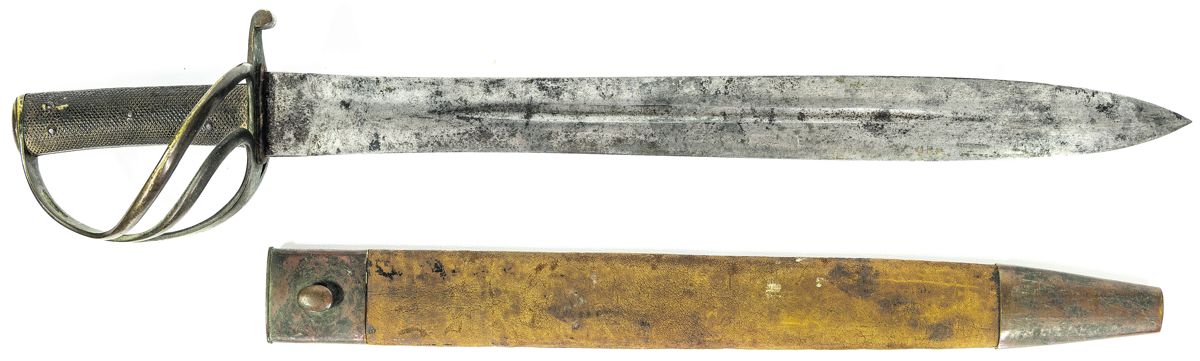
Courtney & Tennent Marked Imported Confederate Naval Cutlasses Over the years collectors have noted a number of Confederate imported naval cutlases and naval officer’s swords marked by the Charleston wholesale import merchants Courtney & Tennent. This month we will take a closer look at this enigmatic company and try to discover more about the company’s relationship with the Confederate Navy. In June 1848 a notice in the Charleston Mercury noted that Gilbert B. Tennent was joining the wholesale hardware business of [W.R.] Morton & [W.C.] Courtney. On June 1, 1849, a year later, another Charleston Mercury notice announced that “The Subscribers having purchased
Courtney, Tennent & Co. directory listing. Source: Campbell, John P. The Southern Business Directory and General Commercial Advertiser. Charleston, SC: Press of Walker & James, 1854, p. 340.
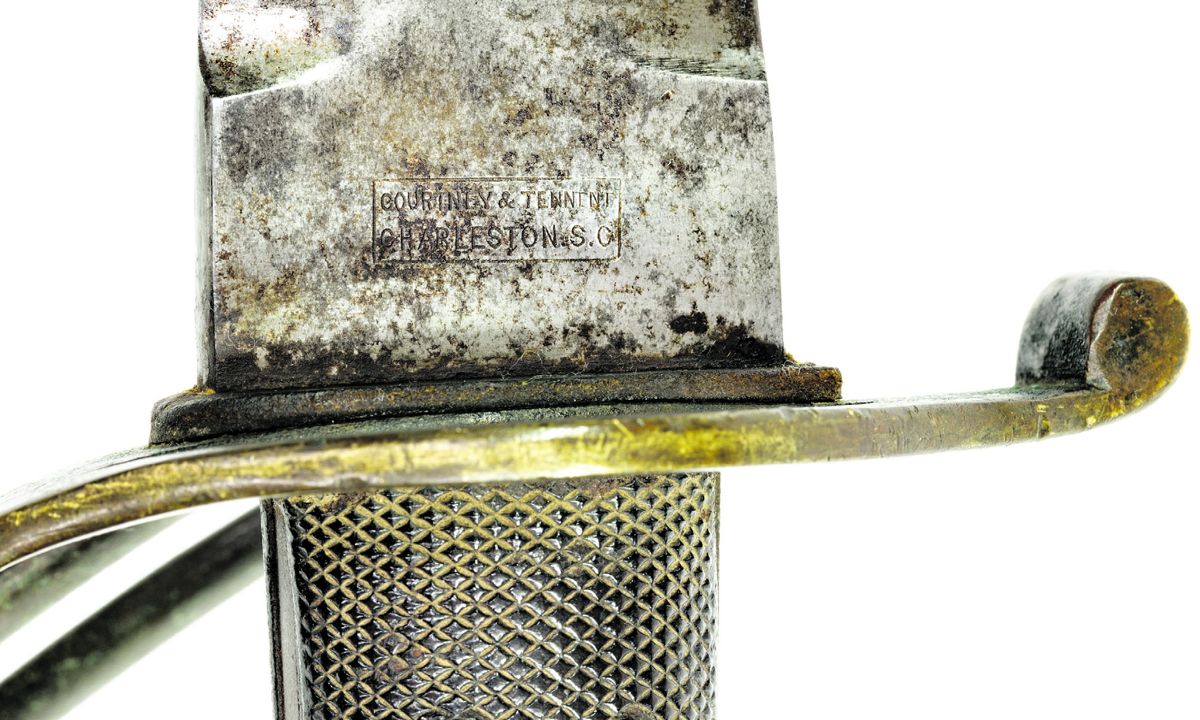
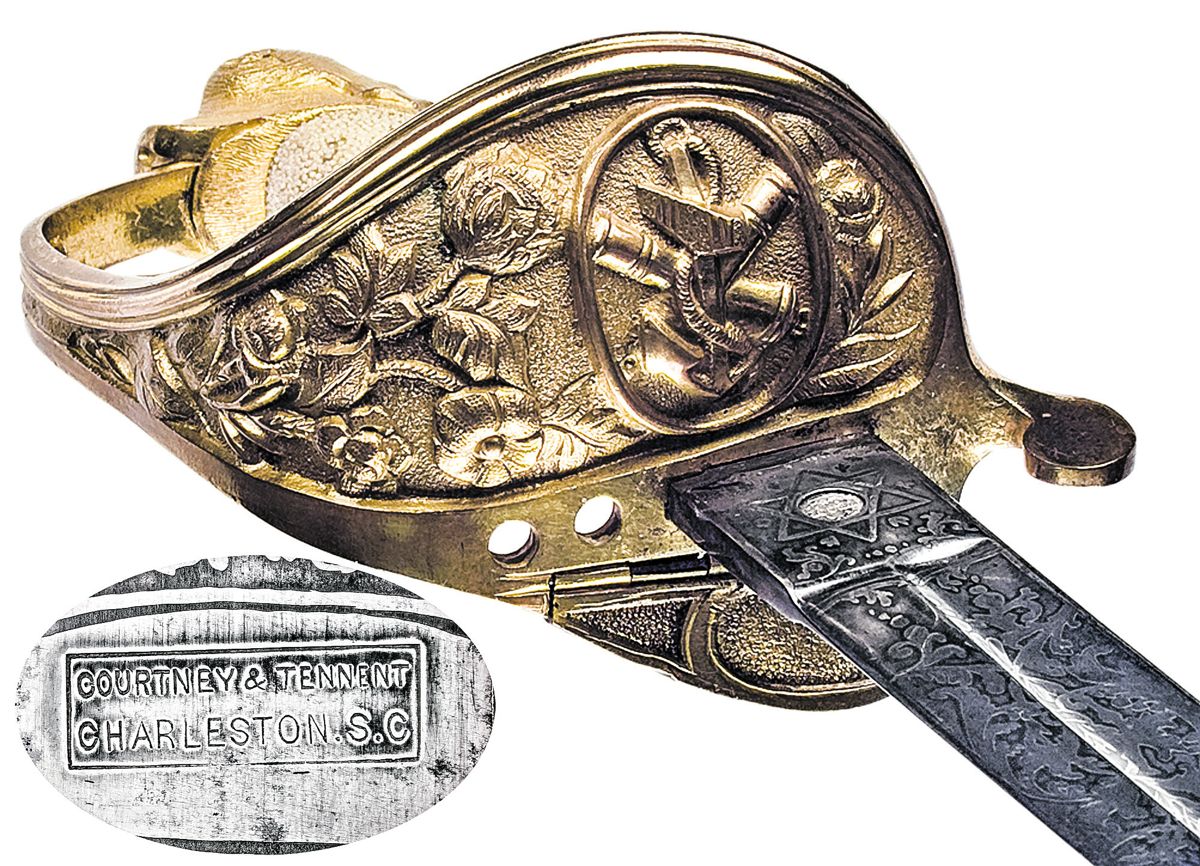
W.R. Morton’s interest in the concern of Morton, Courtney & Co. will continue the business under the firm of Courtney & Tennent. (Signed) W.C. Courtney & G.B. Tennent.” Thus, was established the firm of Courtney & Tennent, a major player in the importation of goods to the Charleston market for the next decade and half and one that would help equip the Confederate Navy during the Civil War. An additional partner, James B. Evans, joined the firm in June 1852, creating the first iteration of the firm of Courtney, Tennent & Co. The firm was listed in period directories as an importer of “Hardware, Cutlery &c.” and at least initially was focused on the wholesale sale of their imported goods to the retail trade. An 1852 advertisement that ran in the Charleston Daily Courier October 15 that year stated the firm was also an importer and seller of “Tin Plate, Iron Wire, American & Russia Sheet Iron, Solder, Bar Copper, Rivets” and further noted that, “A large assortment of the above goods kept constantly on hand and will be sold low.” The business was located at 35 Hayne Street in Charleston. Like most businesses of the period one of the most feared business catastrophes was a fire. A May 2, 1854 notice in the Charleston Daily Courier noted that day an Underwriters Sale would occur at 186 King Street where the salvaged inventory from a recent fire at Courtney, Tennent & Co. would be sold. Among the items listed for sale in the notice were: “Table knives and forks, Pen & Pocket Knives, Scissors, Razors, Files, Chisels, Hatchets, Hammers, Saws, Pocket Books & c. & c.” This partial list indicates that the firm was well acquainted with the English cutlery trade and certainly had strong connections within it. As with most period firms, Courtney, Tennent & Co. rebuilt after their fire and resumed their business, despite the financial setback. In 1858, partner James Evans passed away and the firm returned to their original business name of simply Courtney & Tennent. Two years later, in June 1860, both J. Waring Axson and Jasper W. Lillard joined the company as partners and once again the Courtney, Tennent & Co. moniker went into use. This four-way partnership would be the company owners through the Civil War. At some point between the 1854 fire and the addition of new partners in 1860, the company expanded their imported product lines and apparently began to deal in a wider range of items. The masthead of the firm’s invoices immediately prior to the Civil War noted that the firm was “Direct Importers & Wholesale Dealers in Hardware, Cutlery, Guns, Pistols, &c.” As the Civil War erupted, the company used their contacts in Great Britain to make a variety of imported goods available for the Confederacy. It is at this point that the company’s work to support and supply the southern Confederacy becomes somewhat more enigmatic. Over the years two very specific forms of Confederate edged weapons have been specifically associated with the Charleston firm of Courtney, Tennent & Co. These were the Confederate naval officer’s sword, known colloquially by modern collectors as the “Dolphin Head” sword and a naval cutlass produced in two variations. All these edged weapons were manufactured by Robert Mole & Sons of Birmingham and are found marked with a twoline boxed cartouche that reads COURTNEY & TENNENT / CHARLESTON. S.C. It is quite likely that Courtney, Tennent & Company’s contacts in the English cutlery trade led to their association with Mole for the production of these edged weapons. At the outbreak of the war, Gilbert Tennent traveled to England for several reasons. One was clearly to conduct business on behalf of his firm with the numerous contacts that he had with British industrial and manufacturing firms. He was also asked to represent the Charleston firm of John Fraser & Company in selling Confederate cotton bonds to raise funds for acquisition of military equipment and for financially supporting the war.. John Fraser & Co was intertwined with the New York firm of Trenholm Brothers as well as the Liverpool (England) based firm of Fraser, Trenholm & Company. The principle in all three of these companies was George Alfred Trenholm of Charleston. Trenholm served as one of the primary financiers of the Confederate cause and used his financial firms in New York and, most importantly, in Liverpool, to facilitate the majority of the Confederate arms purchases in England. He subsequently arranged transportation of many of these goods via a small fleet of blockade runners that he either owned, controlled, or had a financial interest in.
George Alfred Trenholm. Fraser, Trenholm & Company would essentially become the financial clearinghouse for most Confederate governmental purchases in Great Britain. The firm would eventually be ruined due to the failure of the Confederate government that resulted in massive defaults on financial obligations on both sides of the ocean. It was in this dual capacity as a financial agent for one of the Confederacy’s primary financial supporters and to further the goals of his own company that Tennent found himself in a position to influence types of equipment purchased by the Confederate Navy. Tennent was tasked with providing samples of a wide variety of naval items to Confederate Secretary of the Navy Stephen Mallory as well as to Commander James H. North who was involved in procuring Confederate naval equipment for ships being outfitted in English and Scottish shipyards. Tennent helped supply items as varied as buttons and telescopes to the Confederate Navy, as well as a small number of Wilson’s Patent naval rifles and
Confederate Secretary of the Navy Stephen Mallory. financial resources. Thus, an officer purchased his own sword and Courtney, Tennent & Co. clearly imported the “Dolphin Head” swords on a speculative basis for private sale to Confederate naval officers. The naval officer’s sword was a pattern then in production for use by Royal Navy officers, so only changing the motifs of the blade etching and guard decorations was necessary to make them appropriate to the southern market. The speculative sale of naval motif buttons in Charleston, S.C., explains the presence of buttons with the Courtney & Tennent Commander James H. North. backmark as well. These did not of course, the previously men- have to be contracted for by the tioned edged weapons. Confederacy; they were simply There remains some confu- acquired by the firm and shipped sion regarding acquisition of to the South for sale. these edged weapons by the The cutlasses are somewhat Charleston importers, as there more problematic. First, they do is little evidence that Courtney not follow any British pattern of & Tennent were contracted with the period and in fact are more the Confederate government to like some southern-made cutprovide the swords and cutlass- lasses produced by New Orleans es. In the case of the officers’ makers like Cook & Brother and swords, this is quite understand- Thomas, Leech & Company. able as Confederate officers, like The two types of cutlass protheir northern brethren, were re- cured by Courtney, Tennent & quired to purchase their own uni- Co. from Mole were nominally forms, arms, and equipment from 25-inches in overall length with a an allowance provided by the wasp-waisted 20-inch long spear army or navy or from their own point blade and a nominally 10 Photo by Tim Prince.
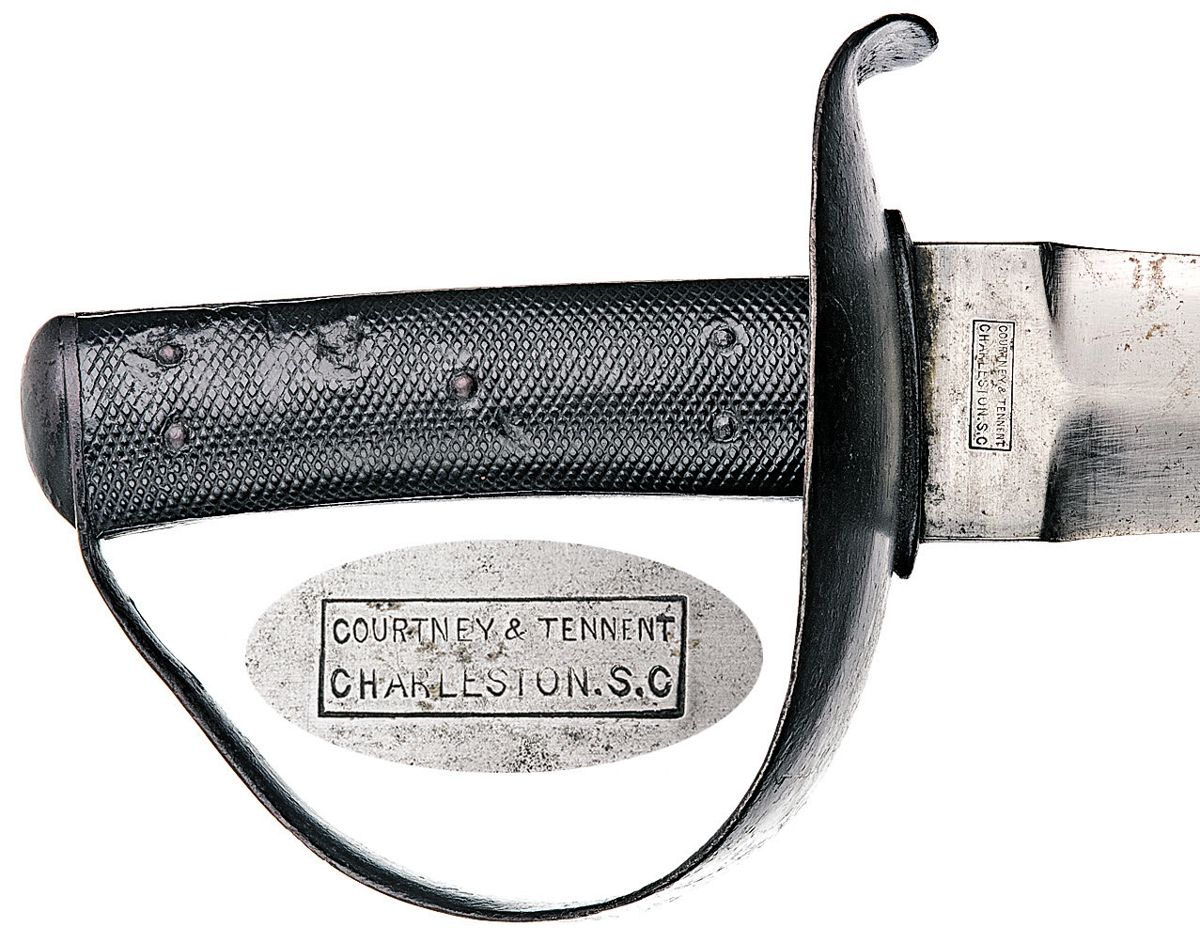
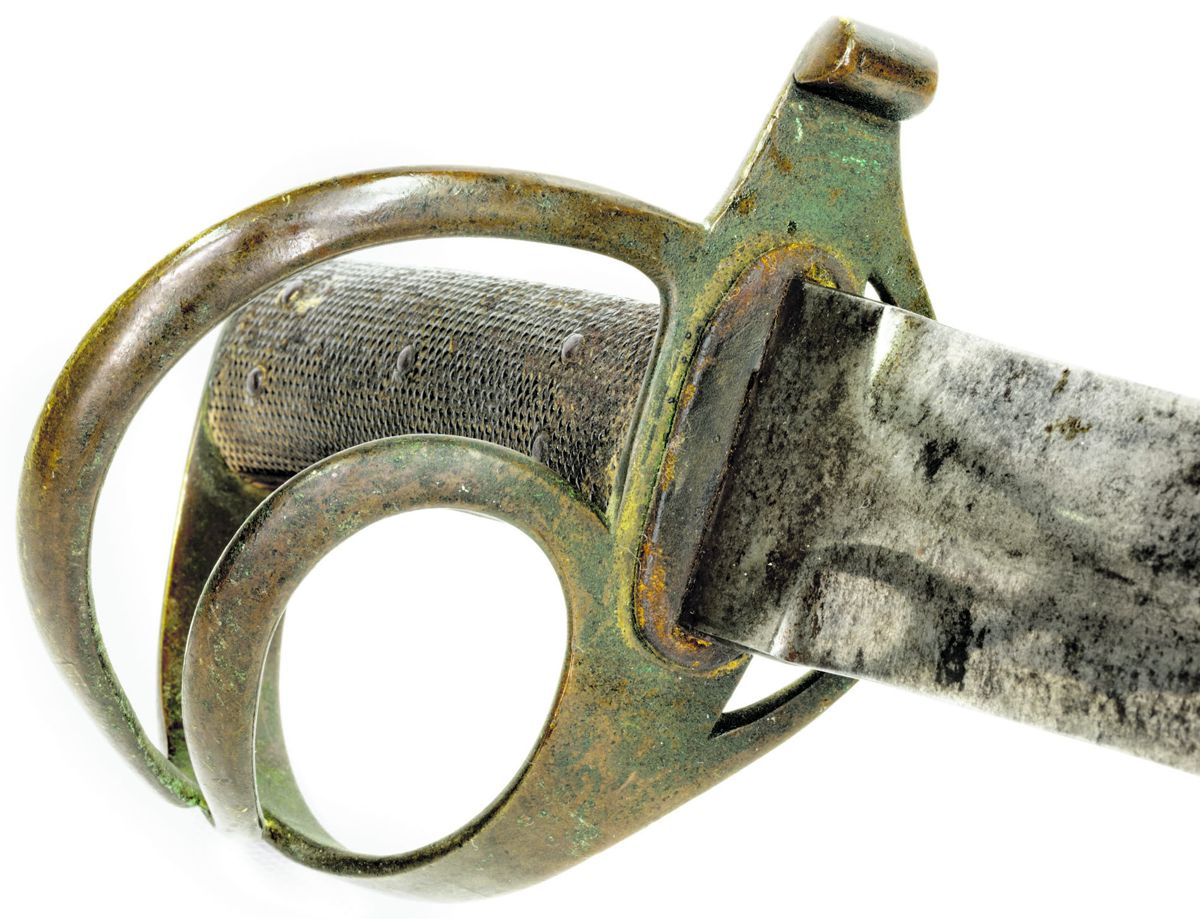
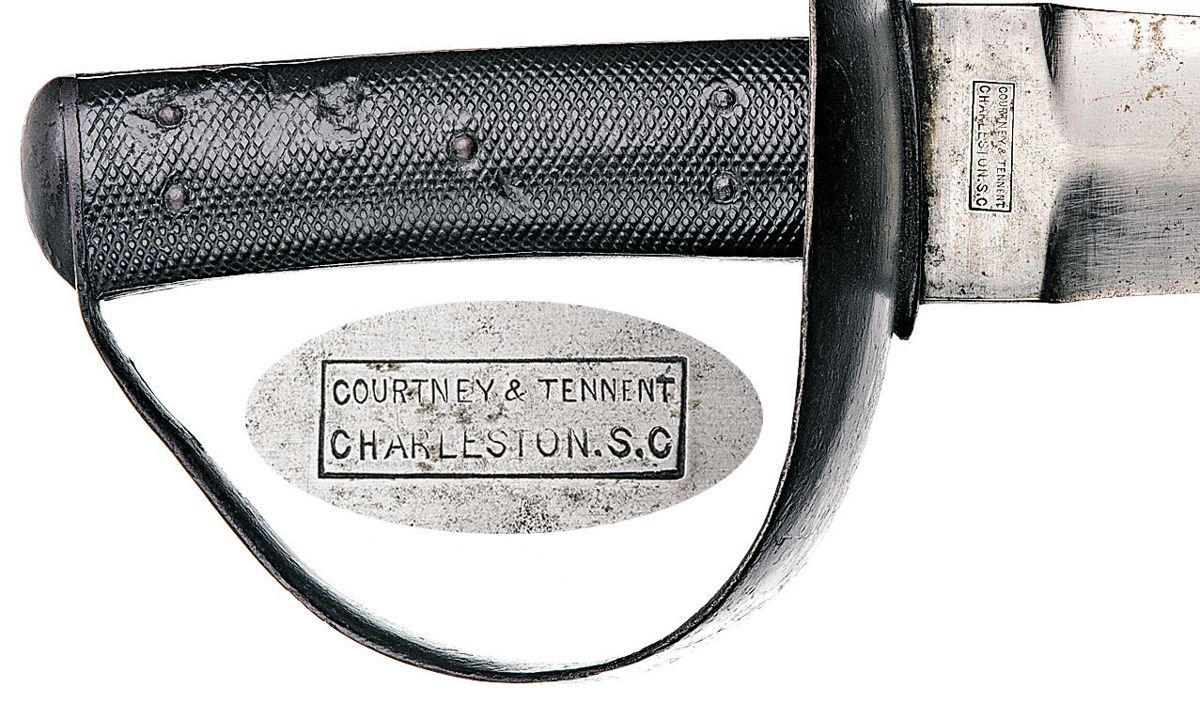
½-inch median fuller in the blade. The blade was reminiscent of the Roman gladius and bore more resemblance to the U.S. Model 1841 naval cutlass than any period English cutlass. This same blade profile was used on a number of southern-made naval cutlasses, suggesting that Tennent may have provided a sample Thomas, Leech & Company, Cook & Brother, or even a U.S. M1841 naval cutlass to Mole as a pattern. The balance of the Moleproduced cutlasses were much more English in their design and construction. The southern-made cutlasses typically involved a cast brass hilt based on the U.S. M1841 cutlass with a cast brass hilt and a brass basket guard. The Mole cutlass relied upon the tried and true English two-piece press-checkered multi-layer leather grip panels secured to the full-length blade tang that formed the base of the grip with a series of iron pins. Two forms of guards were used by Mole. The most common was a three-branch brass guard with an oval, forward-swept quillon at the top of the guard. The guard was essentially the same as the English Pattern 1853 cavalry saber guard, although the P1853 saber used an iron rather than brass guard. Interestingly, Mole produced a variant of the P1853
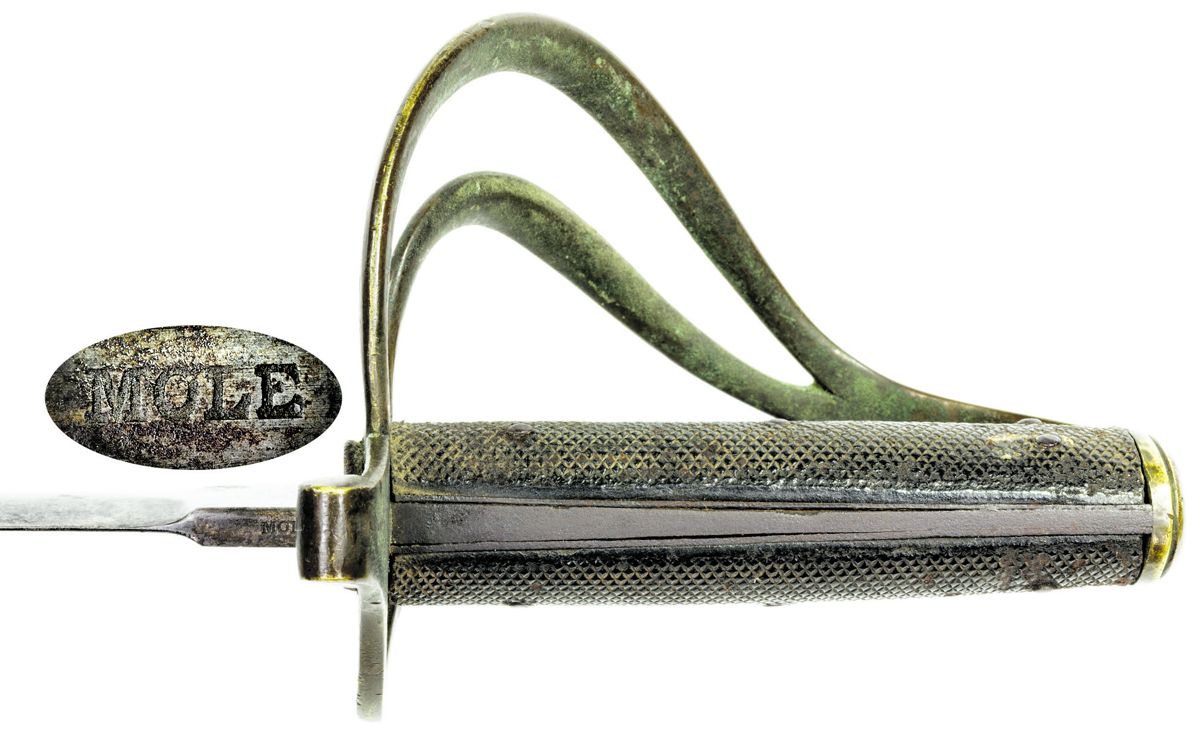
Top of hilt on a 3-branch Courtney & Tennent naval cutlass with the MOLE mark on the upper spine shown in the inset. Photo by Tim Prince.
cavalry saber for the Confederacy that also used a brass rather than iron guard. The less common variant of the Mole cutlass used a sheet iron basket guard typical of period British naval cutlasses, but still used the press-checkered leather grip scales. An oval buff leather throat washer was included on the face of the guard as well. Both cutlasses were delivered with a brass mounted leather scabbard with a large button on the face of the throat to engage a belt frog. The cutlasses were marked MOLE on the upper spine of the blade, just forward of the guard and were stamped with the Courtney & Tennent mark on the reverse ricasso. The design essentially mated a traditional English pattern saber or cutlass hilt with a Roman inspired, southern-style blade. It is my belief that the much less common sheet iron guard Mole cutlasses were the first ones delivered at Tennent’s request, as they more closely resembled the southern-made cutlasses. I further believe that after these initial deliveries Mole offered to provide cutlasses with the brass cavalry style hilt he was using on cavalry sabers. This would make production sense for Mole as it simplified the process and eliminated manufacturing of the other pattern guard. Mole more than likely offered to reduce the unit price of the cutlasses if the three-branch guard was adopted by Tennent. This rationale helps explain both patterns of cutlass produced by Mole and delivered byTennent and why the sheet iron guard examples are quite scarce. The second problematic issue regarding production of these cutlasses for Courtney &
Tennent is the lack of primary source evidence that the cutlasses were actually ordered by the Confederacy. A search of available purchase records and surviving receipts in both the files of Courtney, Tennent & Co. and the Confederate Navy show no receipts or orders for naval cutlasses from Courtney, Tennent & Co. In fact, most of the firm’s receipts in the Confederate Citizen Files folder are for Confederate purchases of hardware, the primary business of the firm. These receipts cover everything from files to anvils, pad locks to nails, and grindstones to sledgehammers, just to name a few items, but no weapons. In the Confederate Naval Files, receipts and orders for cutlasses from Thomas, Griswold & Company, Cook & Brother, and Charles Wellford, among others are present, but no orders or receipts are present to or from Courtney, Tennent & Co. Admittedly, the surviving files are far from complete, but the absence of the firm’s name is strange on the subject of cutlasses. A clue may be found in a letter dated July 10, 1863, from Commander James H. North, CSN to Confederate Secretary of the Navy Stephen Mallory. North was, at the time, writing from Scotland after a stopover in London to check on the progress of constructing the would-be Confederate iron-clad Alexandra, as well as other ships being built for the Confederacy. Halfway through the letter North notes that: “As our Navy is now in its infancy, and thinking that it would be your wish to have a uniformity in everything, I have written to Mr. Te n n e n t , a wholesale hardware merchant of Charleston, now in Liverpool, requesting him to obtain samples of everything we have ordered (rifles and pistols excepted), with the prices attached, so that I may send them to you by Lieutenant Whittle, if he should be able to take charge of them. I hope you may approve of these patterns, as we have gotten them up in much care. These patterns represent the articles ordered by Commander Sinclair and myself. [Emphasis added] The swords and buttons are the same as used by Captain Semmes and his officers, and I think the same were carried home by Commander Pegram.” North saying, continues later by
“I avail myself of this opportunity to call to the favorable notice of the department the obligations we are under to Mr. G.B. Tennent, of the firm Courtney & Tennent of Charleston and also to Mr. James Galbraith, of the house of Patrick Henderson & Co of Glasgow. These gentlemen have been untiring in their zeal and efforts to assist us in every way in the good cause that we are engaged in.” From this correspondence it is clear that North was already procuring naval material from Tennent, in particular swords and buttons, although it is not clear whether by “swords” he means cutlasses, naval officer’s swords, or both. As a number of Confederate ships were built or repurposed in England and Scotland, it would make sense to procure their arms and equipment “on site” during the construction process. Thus, it seems likely that much of the material provided by Courtney, Tennent & Company was delivered to ships under construction or recently completed in Great Britain. These items were not shipped through the blockade but rather were delivered directly to the ships prior to their putting to sea. This may explain why there are no receipts or orders in the Confederate Navy files, as these orders may have all been made in Great Britain and the bills paid there as well. Certainly, the Confederate Navy must have been buying a substantial amount of equipment from Tennent and his partners, as North notes in the letter that the C.S. Navy should be cognizant of the “obligations we are under to Mr. G.B. Tennent, of the firm Courtney & Tennent of Charleston.” Clearly as of July 10, 1863, the Confederate Navy owed money to Courtney,
Tennent & Co. From a timeline perspective, the reference to the buttons and swords being of the pattern used by Captain Raphael Semmes and the officers of the commerce raider Alabama, suggests that Tennent had supplied these items no later than the summer of 1862. The Alabama had been secretly constructed in the shipyard of John Laird, Sons & Co near Liverpool and was launched as the English steamer Enrica in May 1862. In July 1862 the ship traveled to Terceira Island in the Azores, where Semmes took command and saw to the refitting and arming of the ship with guns produced in Liverpool as well. Interestingly, it was the firm of Fraser, Trenholm & Company, who had arranged the construction of the ship. It is my general belief that the many items purchased for use on the soon to be “Alabama” and other southern ships outfitted in Great Britain were acquired locally through Tennent, who was acting much like a Royal Navy ship’s chandler, brokering the sales of the supplies for a commission. The purchasing process, which essentially short circuited the traditional military procurement process through government contracts, may well explain the lack of information regarding the cutlasses that were apparently acquired from Courtney & Tennent in some quantity. Tim Prince is a full-time dealer in fine and collectible military arms from the Colonial Period through WWII. He operates College Hill Arsenal, a web-based antique arms retail site. A long time collector and researcher. Tim has been a contributing author to two major book projects about Civil War era arms including The English Connection and a book on southern retailer marked and Confederate used shotguns. Tim is also a featured Arms & Militaria appraiser on the PBS Series Antiques Roadshow.