
The Graphic War
Andersonville
By Salvatore Cilella · Originally published July 2021 · pp. 12–13
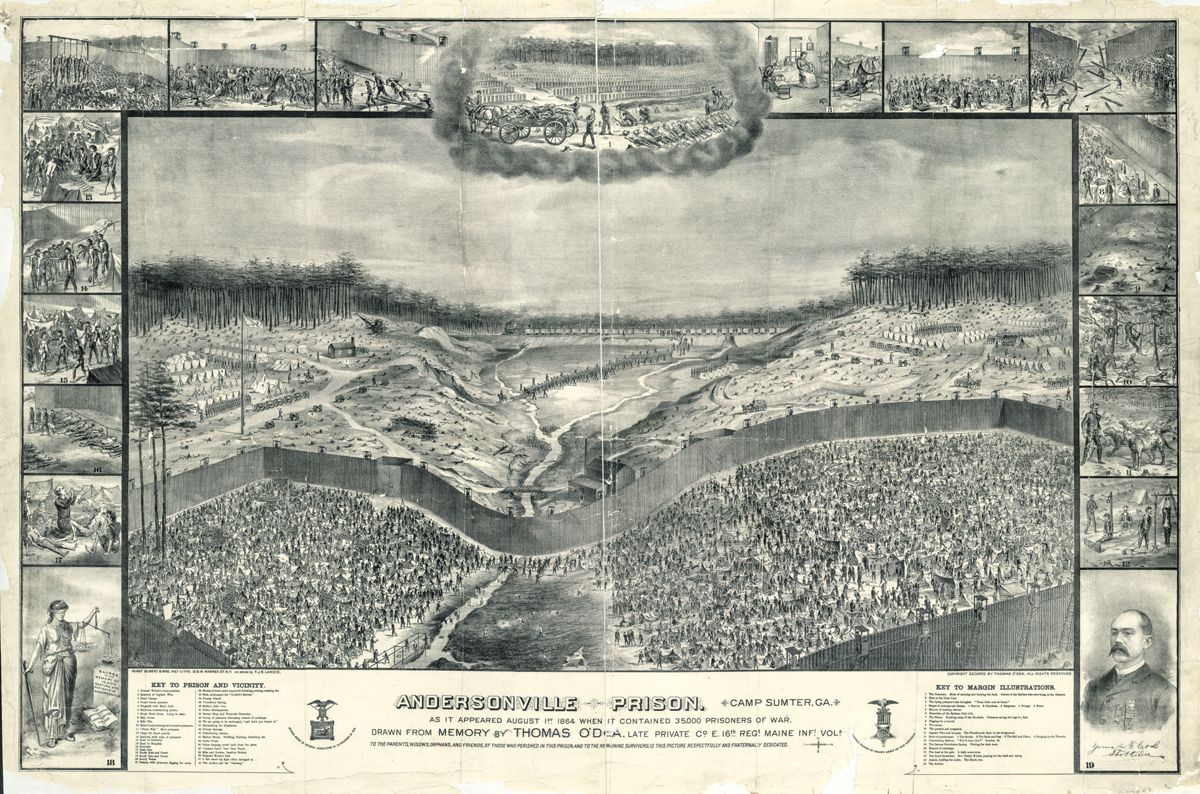
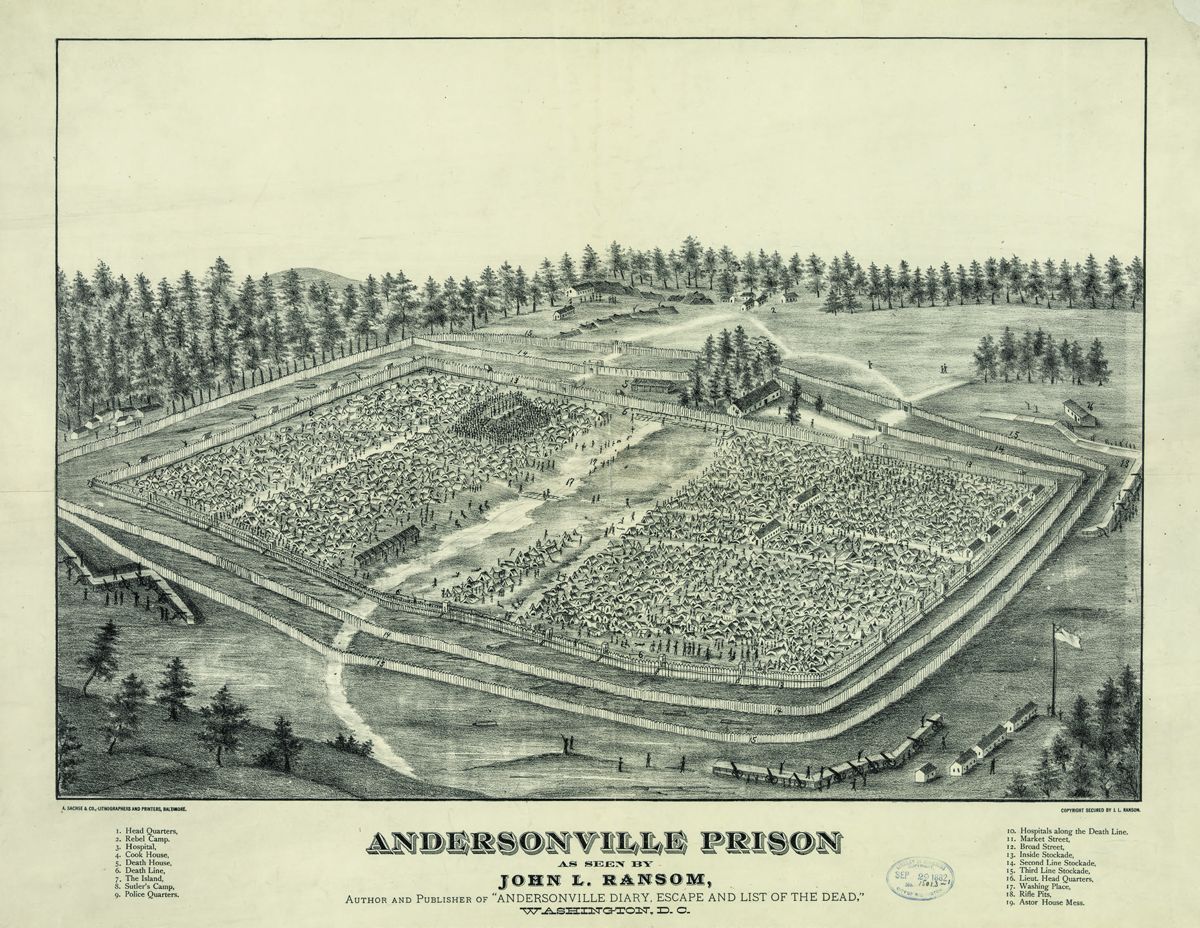
Andersonville The Graphic War highlights prints and printmakers from the Civil War discussing their meaning and the print maker or artist’s goals. During and after the war, several lithography firms produced large folio prints. Collectors and dealers designate prints over 14 by 20 inches as “large folio.” Thomas O’Dea’s haunting view of Andersonville is probably the largest lithograph produced with a Civil War theme. A full 40 by 60 inches, it captures the horrors of daily life in the War’s most notorious prison camp. Most lithographs of the time were meant for decoration. O’Dea’s vision of hell was never meant to be hung above the fireplace or any other place of honor. A psychologist might attribute it to the artist’s attempt to purge the memories of Andersonville from his memory. O’Dea was only 18 when he enlisted with the 16th Maine on Sept. 19, 1863. His death date is given as 1926 and if he enlisted at age 18 in 1863, he must have been born in 1845.1 But it wasn’t until 1885 that the artist/veteran was able to put his memories of Andersonville on paper. In his 1887 pamphlet entitled History of O’Dea’s Famous Picture of Andersonville Prison, he wrote: “I never drew a picture before in my life. Were I an artist, I could have completed it in a short time. I commenced this work in the winter of 1879 and finished it in 1885 devoting to it my leisure moments for over 5 years. To gratify my own desires I resolved to attempt the task knowing that if successful, my production would be immediately recognized as a faithful and accurate picture of the original prison and vicinity. I have seen different pictures of the subject by different authors. The inaccuracies of all these pictures induced me to try my hand at producing one, hoping in the venture that I would be able to supply the deficiencies, correct the misrepresentations of the rest, and give the public a true description of the prison, and view of the sufferings of its inmates. In executing the work, I had no picture, map, plan, or scale to guide or instruct me, but I relied upon and drew the whole subject from memory. To the casual observer, such a thing may be looked upon as absurd and impossible, that it is impossible after such a length of time for “memory” to retain such a perfect list and one of details as here portrayed and that I must have had assistance from some other source to be able to present such a vast combination of characters and situations in so perfect manner. Ah, my friends, had you been there and experienced the sufferings that, in common with the thousands of other unfortunates who ‘were there,’ you too, like myself, would have the whole panorama photographed in your memory to remain there to your dying day. For a period of 12 months I resided in the ‘Prison Pens’ of the South, as a ‘Guest’ of the ‘Confederacy.’ There is not a man born that can accurately describe the scenes and sufferings of those who were imprisoned in those southern hells. ONE HAD TO BE THERE TO WITNESS AND UNDERSTAND IT!”2 Looking at it from the perspective of almost 160 years, O’Dea captured the bleak essence of the place. It’s large size speaks volumes of the horrors of Camp Sumter. Taking center stage is the prison showing the crowding, which according to the legend represents the population of the camp at 36,000 prisoners on August 1, 1864. O’Dea was an inmate from his capture at the Wilderness in May 1864 until his release Feb. 24, 1865. Surrounding the central feature are 20 smaller vignettes depicting in detail the prison’s horrors. He left the lower two vignettes for depictions of liberty on the left and a self-portrait on the right. Keys in the title margin describe the important features of the camp’s large depiction and a second key reveals the vignettes for the viewer. Above his portrait, an inset vignette shows Captain Wirz with his dogs; another portrays the Angel of Andersonville, Father Peter Whelan. In his pamphlet, O’Dea aptly described the scenes he depicted:
“The scene of indescribable confusion among the prisoners presents them in every imaginable position, standing, walking, running, arguing, gambling, going to or coming from the Branch with cups, dippers, canteens, or rude pails with water, lying down, dying, praying, giving water or food to the sick, crawling on hands and knees, or hunkers, making fires and cooking rations, splitting pieces of wood almost as fine as matches, the sick being assisted by friends, others “skirmishing for graybacks”, washing clothes and bodies in the branch, trading in dead bodies, fighting, snaring, shouting …”.3 After the war, O’Dea returning to civilian life became a brick layer. According to his own reckoning, he had seen several depictions of Andersonville and
O’Dea’s Vision of Hell. Library of Congress. found them wanting.4 For the next six years, from 1879 until he finished, O’Dea returned home each night from his labors and worked on his magnum opus. According to one author, the print was popular with 10,000 copies selling for $5 each. By then, O’Dea had moved from Boston to Cohoes, New York, north of Troy and Albany. At one point he changed his listing in the city directory from “mason” to “author and proprietor of O’Dea famous pictures of Andersonville Prison.5 O’Dea passed away in Cohoes and is buried at St. Agnes Cemetery, Cohoes. He left one son and four daughters. In 1914 he revisited Andersonville where he picked up a federal uniform button and noted that Providence Spring was still running. “One thing he did not find was a copy of his picture which had been removed due to Southern objections.”6
Endnotes: 1.
According to the website of the 5th Maine, Peaks Island History Museum, O’Dea enlisted at 16, in 1863 and was born ca. 1848, which does not compute. https://www.fifthmainemuseum.org/2020/12/14/
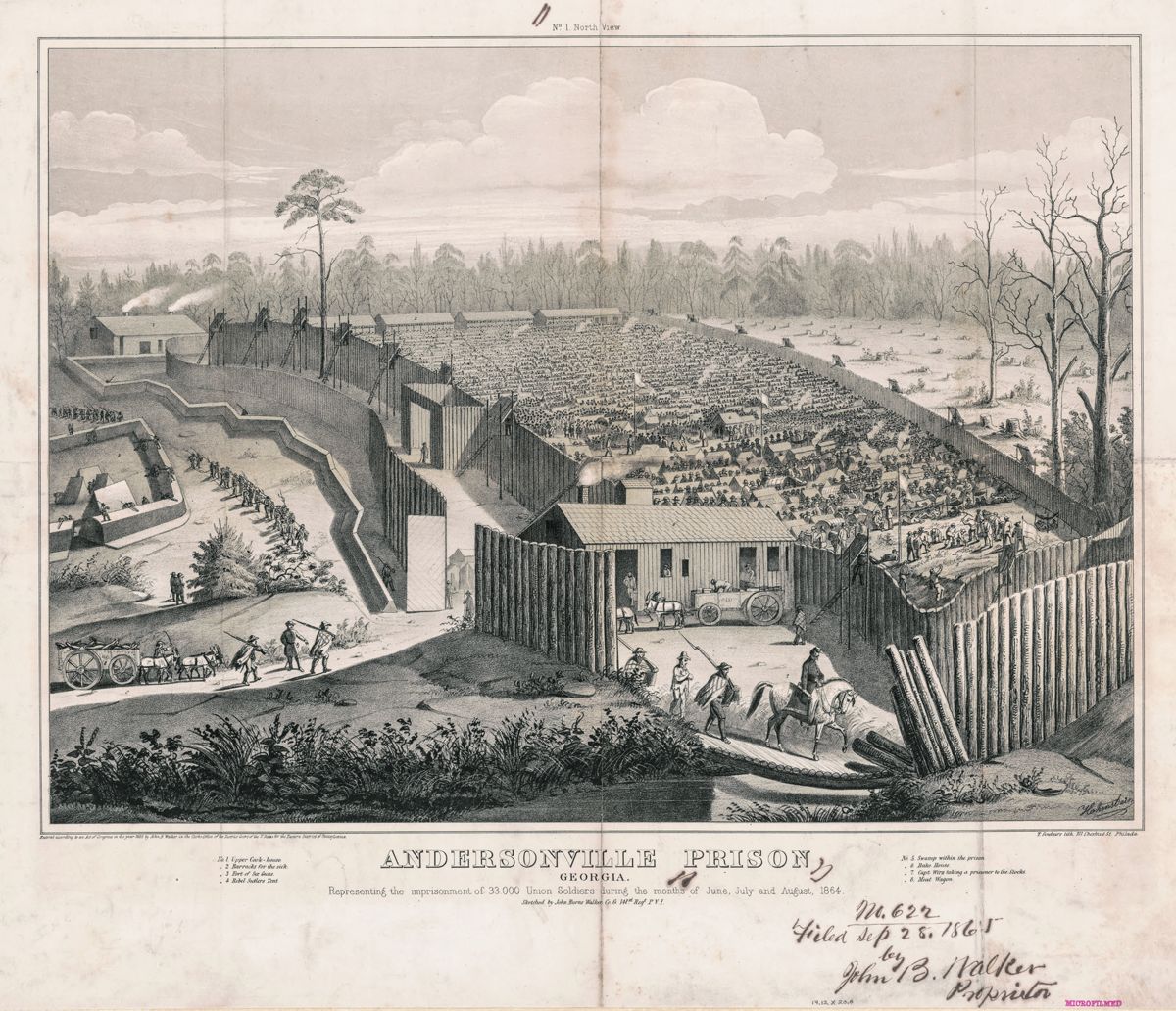
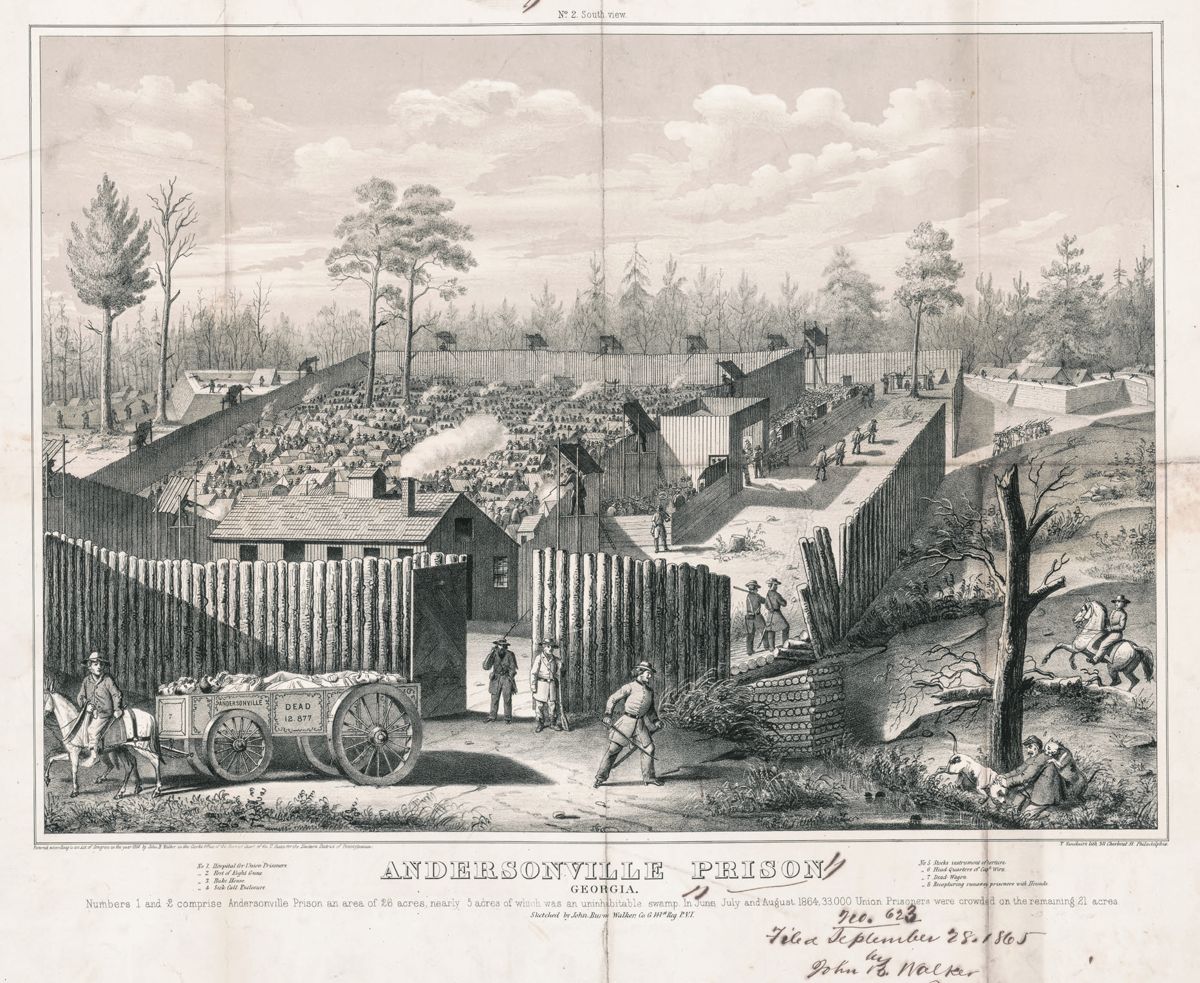
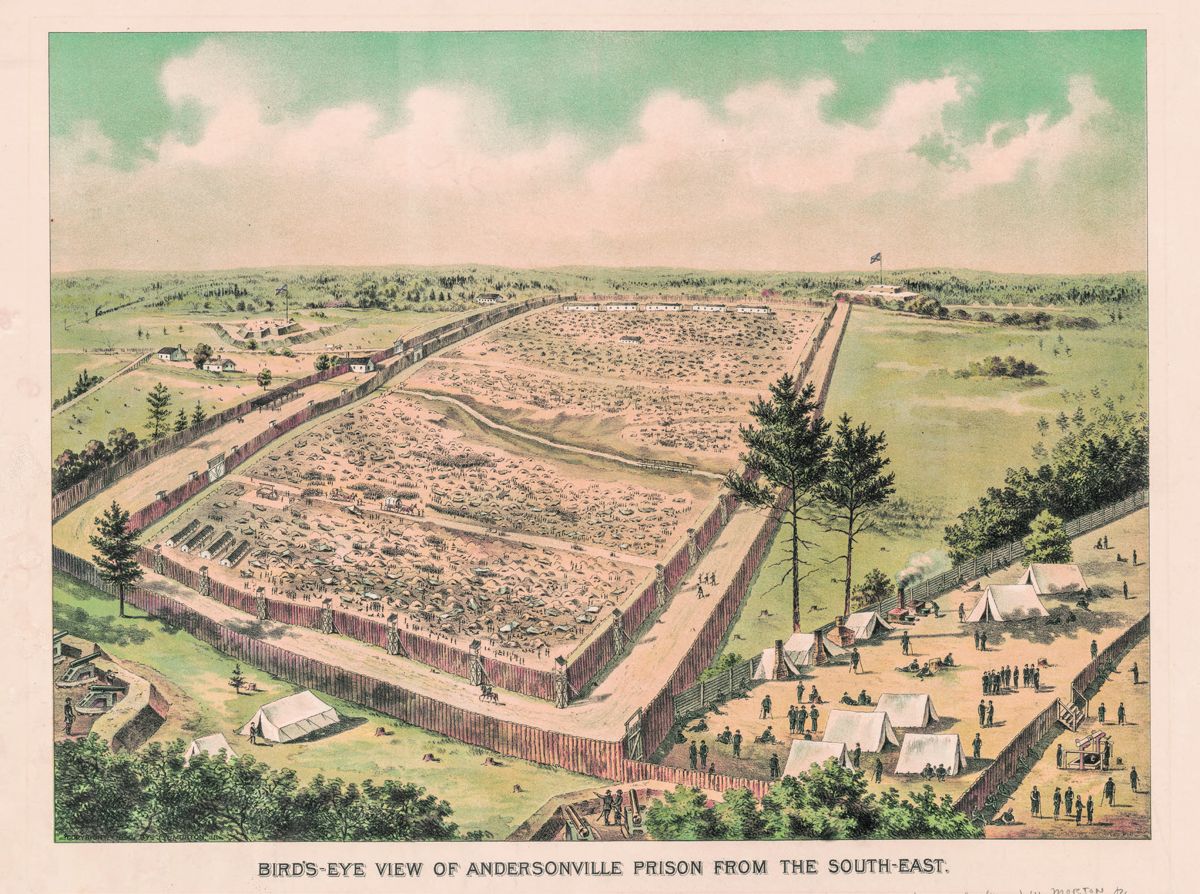
hell-upon-earth-the-andersonville-prison-lithograph/. The Civil War database indicates his age at 18 and enlisting 9/19/1863. http://www.civilwardata.com/active/hdsquery. dll?SoldierHistory?U&2264870. Cited in https://www.fifthmainemuseum.org/2020/12/14/hell-upon-earth-the-andersonville-prison-lithograph/. Paul Perreault, Town of Malta Historian. http://www.malta-town.org/DocumentCenter/View/1913/O-Deas-FamousPicture-of-Andersonville. Several prints of Andersonville were published almost immediately, in 1864 and 1865, well before the war’s end, and later in the 1870’s.. See Applewood Books, An Album of Civil War Battle Art, 1988, 104-105. Paul Perreault, Town of Malta Historian. http://www.malta-town.org/DocumentCenter/View/1913/O-Deas-Famous-
Picture-of-Andersonville. Ibid. O’Dea’s obituary is available on line at https://www.findagrave.com/memorial/84603587/thomas-o_dea.
After 43 years in the museum field, Salvatore Cilella devotes his time collecting American prints and maps and writing. His last professional position was President and CEO of the Atlanta History Center. His most recent books are Upton’s Regulars: A History of the 121st New York Volunteers in the Civil War (U. Press Kansas, 2009). His two-volume Correspondence of Major General Emory Upton, (U. of Tennessee Press, 2017), received the 2017–2018 American Civil War Museum’s Founders Award for outstanding editing of primary source materials. His latest book “Till Death Do Us Part,” an edit of Upton’s letters to his wife 1868–70, was published last year by the Oklahoma University Press.