The Unfinished Fight
Tin Cups vs Muckets
By Craig L. Barry · Originally published January 2021 · pp. 8–9
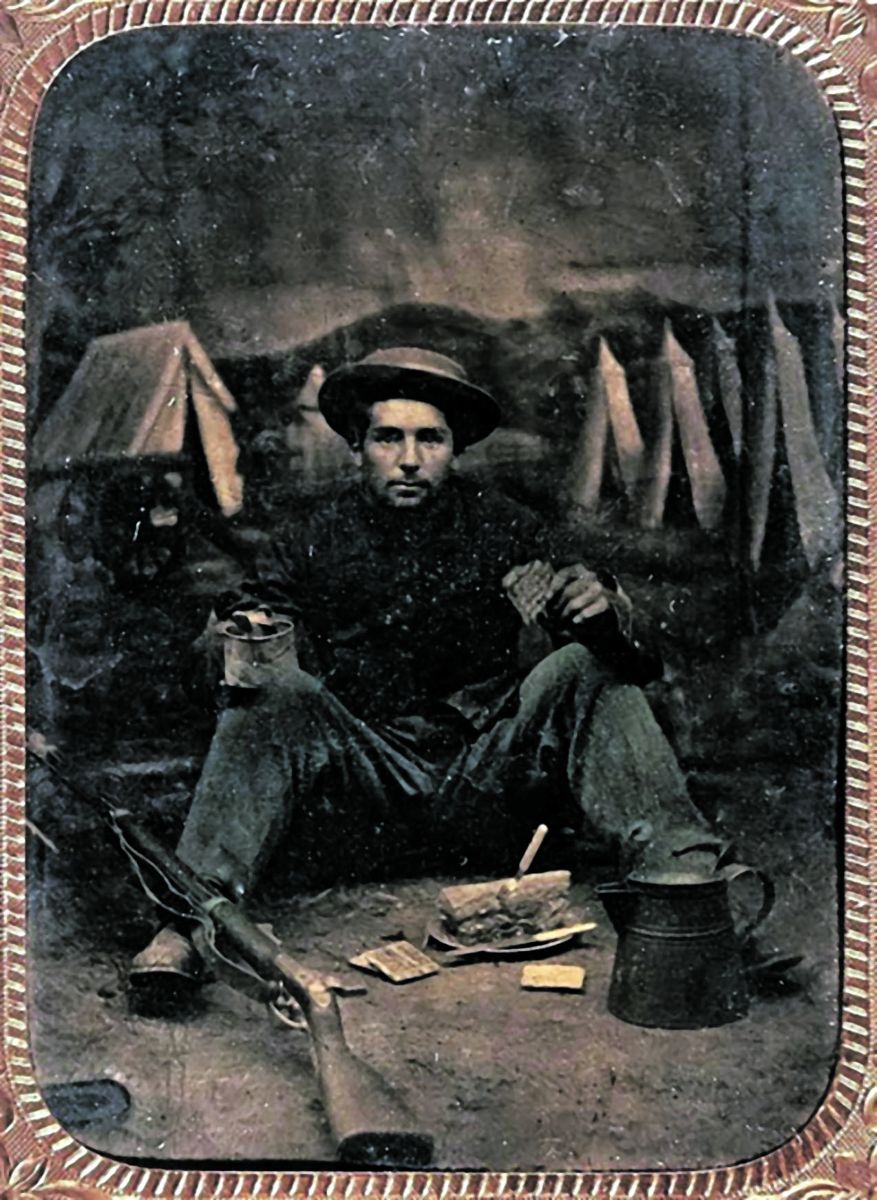
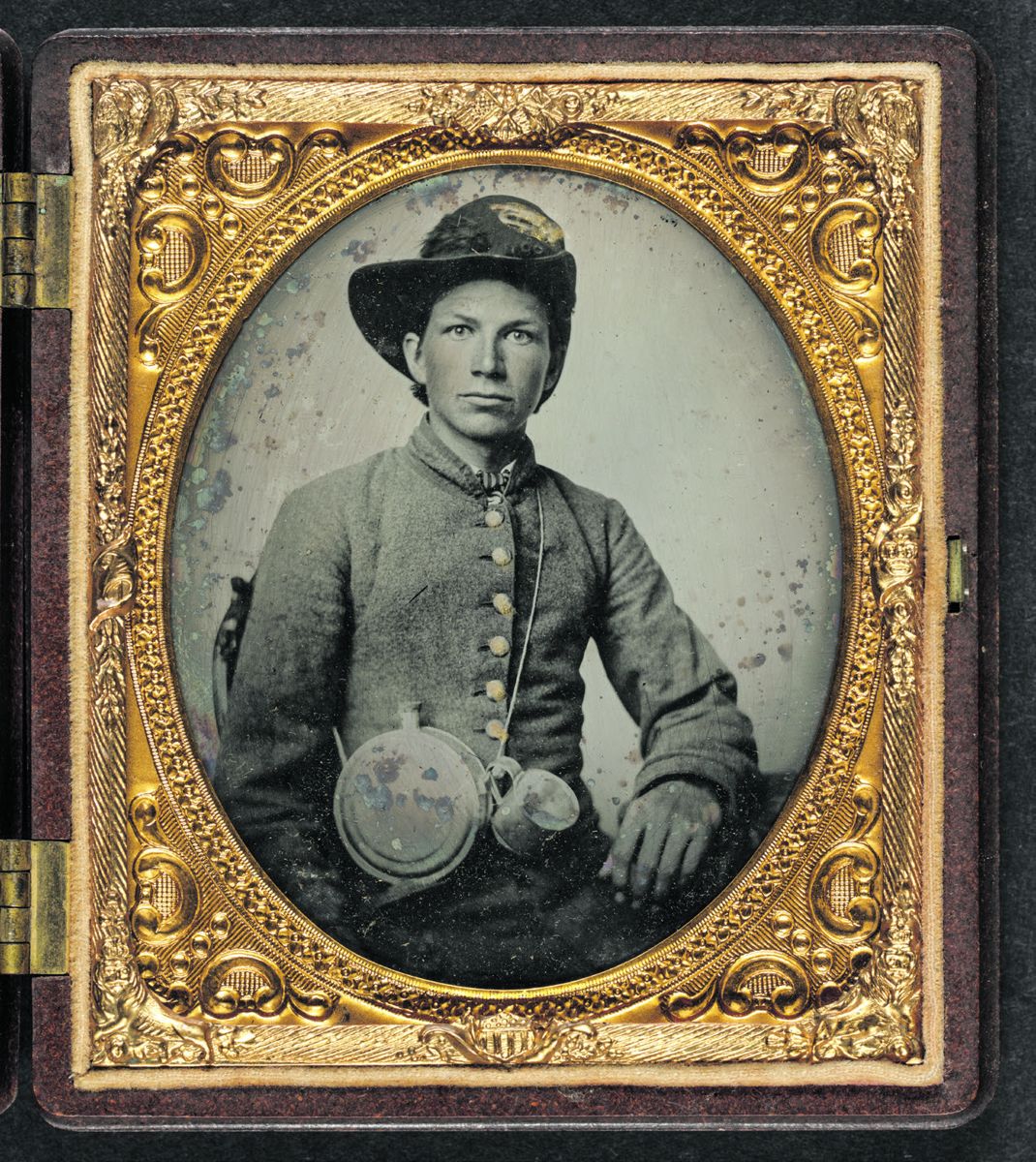
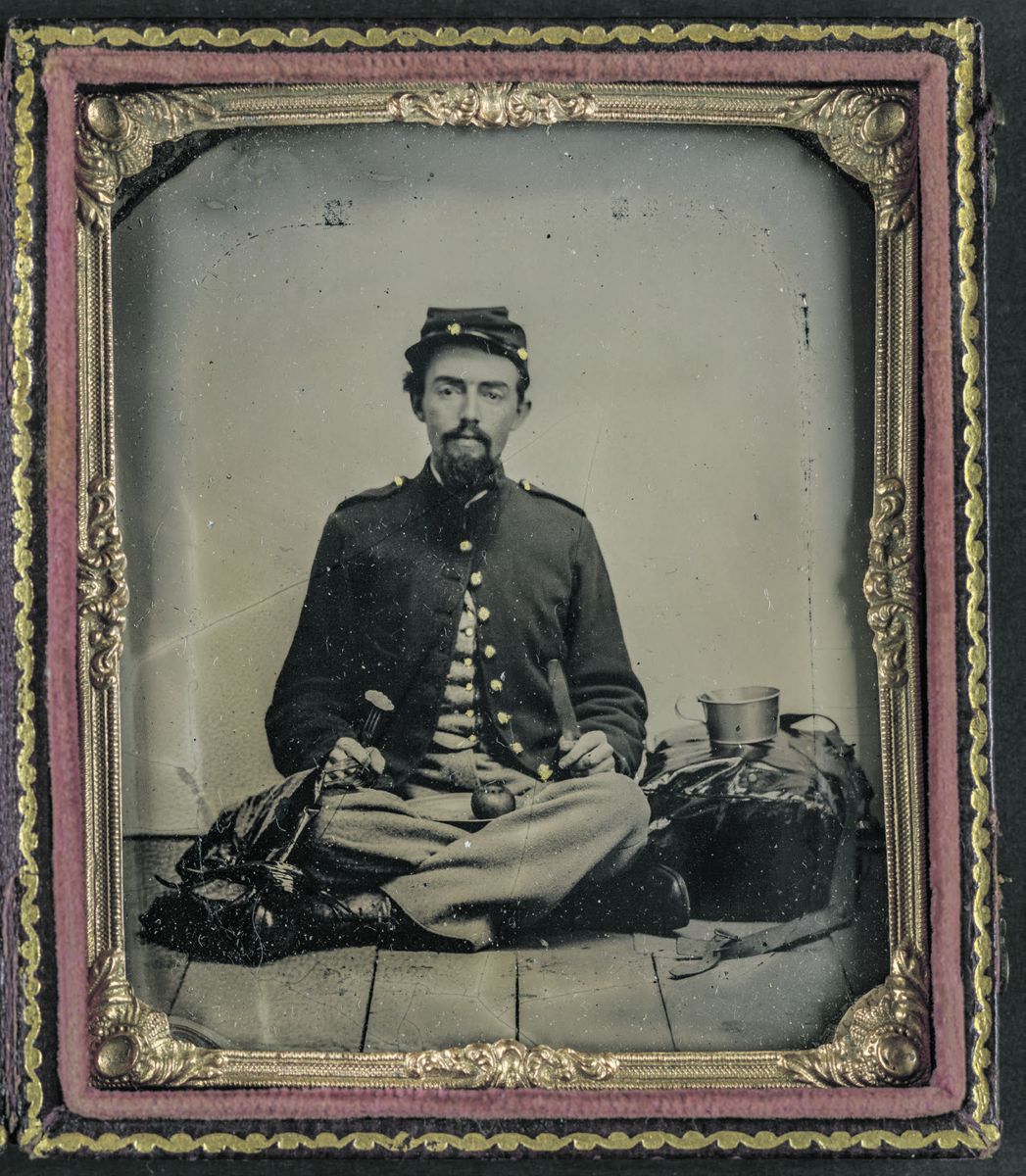
A common feature of Civil War living history is a larger tin vessel loosely referred to as a “mucket.” The term seems to originate as a portmanteau of “mug” and “bucket.” They were not an item of government issue to soldiers in the field, so the question arises whether they are historically accurate to the time period? On that subject, there were a variety of other items in the common soldier’s possession that were not government issue. Two items that spring immediately to mind are pocket knives, which every man over the age of five probably carried at all times and braces (suspenders). There is no evidence these items were issued but virtually every soldier and most civilian men had Unidentified soldier in Union uniform with fork, knife, plate, and them. cup sitting on the floor and preparing to eat a slice of the apple As far as the vessel with which on his lap. Library of Congress. Liljenquist Family collection. to make campfire coffee, I am a tin food can/bailing wire coffee boiler advocate, personally. Simpler is better. I think it would be difficult to find surviving documentation on an item that was not issued? This is framed as a question because these things are found dug, and we don’t know of the paper trail for the individual piece of the mess kit called a “mucket.” In period descriptions from the Civil War, what we know as a mucket seem to be most often referred to as “coffee boilers.” Men describe a large cup with a hinged lid. The term, however obscure in origin, was in use at the time although probably not widely in use. See the following…from the letters of Oliver Wilcox Norton, Yorktown, Va., April 12, 1862: “I was sitting by the fire with several others making coffee. Each of us has a small tin kettle holding three pints or so, fitted with a tight cover. We call them muckets for want of a better name. By the way, I believe almost any of us would throw away a blanket before he would his mucket, they are so indispensable. The cover of one was crowded down so tight that there was no room for the steam to escape. It swallowed the indignity with commendable patience for a time, but finally it lost all self control and exploded, throwing hot coffee in all directions, but particularly in the direction of my left foot. It was not very badly scalded, and I hope will be well in a few days.” A broader point should be made on how to carry such a vessel while on the march. Unless you’ve just drawn three days rations and have absolutely no room in your haversack, you should keep your assortment of tin ware stored inside. We often bang around like tinkers because of all the tin hanging on our haversacks. In my case a tin can boiler tied to the rear strap serves all purposes, including cooking vessel, and it mostly stays out of the way back there when it will not fit in the haversack. The U.S. style Gaylord bayonet scabbards are worse than tin cups or muckets for rattling around and getting in the way in my opinion. Unless you tuck the scabbard under the haversack it has a very annoying tendency to catch on the gear worn by the guy next to you whenever you are ordered to front. Living historians and reenactors like a noisy spectacle and clanging tin is apparently music to their ears. There appears to be no exception to this rule. One final thought on the mucket or whatever you chose to carry, whether it is a mug, cup, or a coffee boiler. It should be hot dipped tin and not stainless steel, as is the case with some modern reproductions. Steel, which is a purified form of iron, was not a thing unknown to metallurgy during the 19th century. However, stainless steel, which is steel with the addition of chromium to prevent rust, is a decidedly post-bellum innovation and was not used to manufacture cooking or drinking vessels during the Civil War-era.
Craig L. Barry was born in Charlottesville, Va. He holds his BA and Masters degrees from the University of North Carolina
(Charlotte). Craig served The Watchdog Civil War Quarterly as Associate Editor and Editor from 2003–2017. The Watchdog published books and columns on 19th-century material and donated all funds from publications to battlefield preservation. He is the author of several books including The Civil War Musket: A Handbook for Historical Accuracy (2006, 2011), The Unfinished Fight: Essays on Confederate Material Culture Vol. I and II (2012, 2013). He has also published four books in the Suppliers to the Confederacy