
Inspection, ARMS!
The Legacy of CD Schubarth’s M1861 Musket Contract
By Tim Prince · Originally published January 2021 · pp. 24–26
The Legacy of CD Schubarth’s M1861 Musket Contract During the course of the American Civil War a large number of contracts were let by the Ordnance Department to various makers to produce the U.S. Model 1861 rifle musket. Some contractors were established gun makers, while others had never been involved in the arms production business. The success of these contractors in producing contract arms ranged from very successful to utter failure, with many contractors falling between these two extremes. In some cases, contracts were obtained via political influence rather than by the reputation and good efforts of those seeking them. In such cases, it was often expected by those who exerted the political influence that a “commission”
would be paid by the contractor to the politician who arranged the deal. Such political graft was somewhat commonplace during the 19th century in the United States, and amazingly was not actually illegal as a matter of law. While certainly unethical, it was apparently accepted as matter of standard practice by the creatures that inhabited the Washington City swamp during that time. The contract for U.S. Model 1861 rifle muskets granted to Casper D. Schubarth resulted in a clause being added to future Ordnance Department contracts that read in part: And the said parties of the first part (contractors) do further engage and contract that no member of Congress, officer of the Army or any agent of the military service, or other person forbidden by law to do so, shall be admitted to any share of part of this contract or agreement, or to any benefit to arise thereupon. The story of Casper Daniel Schubarth begins in Norway, where he was born in 1839. Casper’s father served as the local equivalent of the sheriff in the town of his birth. Young Casper apparently trained as a gunsmith during his early life, likely in the roll of an apprentice to a Norwegian gunmaker. Around 1850, Casper immigrated to the United States and settled in Massachusetts. In 1853 he married Sarah Lincoln of Dighton, Mass., and the couple apparently settled in Taunton, Mass. It is likely that during his first few years in the United States Casper continued his training as a gunmaker by working for one of the many Massachusetts gunmakers. Casper Schubarth first appears in period directories in 1855, operating as a gunsmith located at 6 North Main Street in Providence, R.I. There he had a small two-room shop and likely did what most small gunsmiths of the period did; repaired guns, made a small number of new guns, retailed guns by larger manufacturers, and sold accessories needed by gun owners. He also apparently tinkered and experimented with gun designs, and received U.S. Patent #32,895 for an “Improvement In BreechLoading Firearms,” July 23, 1861. The dovetailed hinged breech design looks quite similar to that of the Smith Carbine, with the difference being that the Schubarth design relies on a long loop lever to actuate the action for opening and closing, rather than the Smith’s push button that releases the top mounted spring lock. Like the Smith, the Schubarth design utilizes a proprietary waterproof cartridge. The patent drawings show an elegant design that appears simple and effective. Apparently Schubarth was convinced of the potential of his design and started to search for financial backers to help him produce the guns and hopefully obtain a U.S. military contract. At this point, Schubarth entered into a tentative agreement with brothers Amos D. and James Y. Smith. The Smith brothers had moved to Providence in 1826, and were involved in the lumber trade, working for a James Aborn. The pair quickly changed course and started to work in the wholesale grocery business, then began to enter the textile trade by investing in local mills. By the 1840s their wholesale grocery business was quite successful; they were also owners of several local textile mills. By the outbreak of the Civil War the pair was both rich and well connected and major players in both the financial and political life of Providence and Rhode Island. The brothers introduced Schubarth to Rhode Island Republican Senator James F. Simmons, in hopes that Simmons would connect Schubarth with the right people to obtain a contract for Schubarth’s carbine design. Simmons apparently arranged meetings with Secretary of War Simon Cameron, Chief of Ordnance James W. Ripley, and Captain Andrew A. Harwood, Chief of the Bureau of Ordnance & Hydrography for the United State Navy. None were receptive to the design and no orders for the Schubarth carbine were forthcoming. General Ripley noted Oct. 10, 1861, that: The breech-loading arm was brought to this office yesterday, and the party bringing it in was told that it was not considered a suitable arm for the military service and that we did not want to contract for it. In desperation, Schubarth offered to undertake manufacturing U.S. Model 1861 rifle muskets. More than likely this was an attempt to “get his foot in the door” and make it more probable that his breechloading design might be given further consideration at a later date. Due to the influence of Senator Simmons, Schubarth received a contract for 20,000 U.S. M1861 rifle muskets at the price of $20 each. Simmons apparently strong-armed Secretary of War Cameron, who then passed the order to General Ripley, who in turn offered the contract to Schubarth on Oct. 11, 1861, only one day after writing that he had no interest in Schubarth’s breechloading design. The contract for 20,000 stands of arms was a mixed blessing for Schubarth. It was not large enough to make the tooling and production set up worth undertaking, so Schubarth’s partners pressured him to return to Washington and get the contract increased to a profitable number of arms. Again, relying on Simmons’ help, Schubarth obtained a larger contract for a total of 50,000 stands of arms on Nov. 26, 1861. He also received
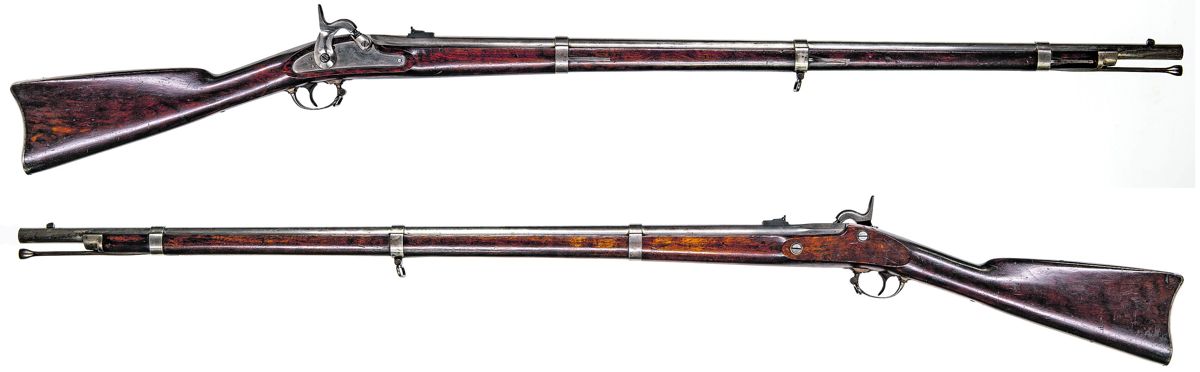
Overall views of a C.D. Schubarth contract U.S. Model 1861 rifle musket.
an invoice from Simmons for $50,000, which Simmons considered his “commission.” At this point the Smith brothers decided they did not want to be involved with what they considered an unethical bribe being paid to Simmons and they exited the stage, leaving Schubarth with no investors and no ability to produce the arms or pay Simmons his money. More than likely James Smith, who had political aspirations himself, wanted no part of a potential scandal. It was a good decision, as he would be elected Governor of Rhode Island in 1862. As a result, Schubarth was left to look for new financial backing for his enterprise. It is worth noting at this point that while Schubarth was a gunsmith he never intended to fully produce the U.S. M1861 rifle muskets, rather he intended to rely primarily on subcontractors to supply most parts and then he would assemble the guns. On February 15, 1862, Schubarth formed the C.D. Schubarth & Company with the financial backing of his new partners, James M. Ryder of Pawtucket, R.I., and Frederick Griffing of Brooklyn, N.Y. In order to get the new investors involved, Schubarth had to promise both one-third of the contract’s profits. Things started to go awry when Schubarth explained the commission structure and the payments that were due to Simmons. To emphasize how serious Simmons was about receiving his “commission,” Simmons met with the new partners and requested a written contract regarding the arrangement as well as the signing of promissory notes. Sources are somewhat unclear as to what the final arrangement was; some indicate that an additional $10,000 was added to the original $50,000 “bribe,” while others suggest Simmons lowered his price to $20,000. In any event, he apparently left the meeting with two $10,000 promissory notes payable in August and September 1862, respectively. However, for Schubarth the house of cards was starting to collapse. In January 1862, Secretary of War Simon Cameron was replaced by President Lincoln with Edwin Stanton. One of Stanton’s first projects was to look into the large number of outstanding Ordnance Department contracts that were yet to be filled. He was looking for corruption, graft, waste, and any form of impropriety. This seemed quite likely on the surface as the Ordnance Department had contracts for more than one million rifle muskets by the time Stanton took over, and few of these contract arms had been delivered. In fact, only about 11,000 U.S. M1861 contract rifle muskets would be delivered by the end of 1862! It was a massive number of guns to have on order, significantly more than the period’s conventional wisdom thought necessary to bring the war to a conclusion. Thus, the Holt-Owens Commission was born, created by Stanton at the request of the senate to investigate contracts and contractors. By May 1862, Casper Schubarth was subpoenaed to appear before the commission, which he did on June 2, 1862. Schubarth was facing multiple problems. First, he had yet to deliver any arms under the November 1861 contract, that initially specified January 1862 for delivering the first 1,000 guns. Although an extension had been granted to Schubarth that allowed the first 1,000 guns to be delivered in May 1862, that had not happened either. Secondly, details of the arrangement with Simmons had come to the attention of the commissioners and they were looking for answers. During his testimony Schubarth blamed his lack of ability to deliver arms on his Counterpane of the Schubarth contract M1861. Note the lack of cartouches, indicating the gun never passed final acceptance from the Ordnance Department. subcontractors, laying blame on his barrel producer who could not supply barrels that would pass proof, and other subcontractors who were late in delivering components. Regarding the arrangement with Simmons, both Schubarth and the Senator were amazingly candid. When questioned about the propriety and legality of the “commission” arrangement between himself and Senator Simmons, Schubarth noted that “I understood, on the contrary, that it was customary to make compensation for such services, and I have heard of many cases in which it was said to have been done.” Interestingly the commission agreed that the arrangement was not technically illegal, as the laws governing such arrangements did not explicitly forbid a contractor from paying a government official. While not illegal by the letter of the law, it was certainly a violation of the law’s spirit or intent. The commission found that Schubarth was innocent of any nefarious intentions, suggesting that his foreign birth and his attempt to enter the world of government contracting had led him to believe that what he was doing was standard business practice in America. The commission was harsher with Senator Simmons, who was considered to have taken advantage of both a national emergency and the emigrant Schubarth. The embarrassment of Simmons’ actions was too much for the senate, and Congress quickly passed a bill that made what Simmons had done illegal. President
Lincoln signed the bill into a law that stipulated a fine of up to $10,000 and a two-year term in prison as the potential punishment for accepting bribes from contractors. The senate further opened an investigation into Simmons’ conduct which determined that his actions were “entirely inexcusable.” With pressure mounting on him, Simmons resigned on Sept. 5, 1862, before the senate could vote to expel him, which they almost assuredly would have done. Casper Schubarth was not completely unscathed as a result of his appearance before the commission. While he did not face any ramifications over the kickback arrangement, the commission reduced his contract from 50,000 to 30,000 guns. The rational was that the reduction represented the weapons originally due for delivery that had never been produced. Schubarth returned to Providence and continued to work on the contract, but it would be Dec. 19, 1862, before the first guns were delivered to the Ordnance Department. On that day he delivered 500 rifle muskets, with 254 rated “1st Class” at $20 each, 206 rated “2nd Class” at $19.90 each, and 40 rated “3rd Class” at $18 each. He would not deliver any additional guns until April 1863, when he delivered an additional 950 guns, with only 685 being “1st Class,” 233 being “2nd Class,” and 32 being “3rd Class.” Schubarth would make eight additional deliveries in 1863, the last on October 14. In all he would deliver 9,450 guns, with only 4,463 (47%) being “1st Class.” The balance of the guns delivered were either “2nd Class”
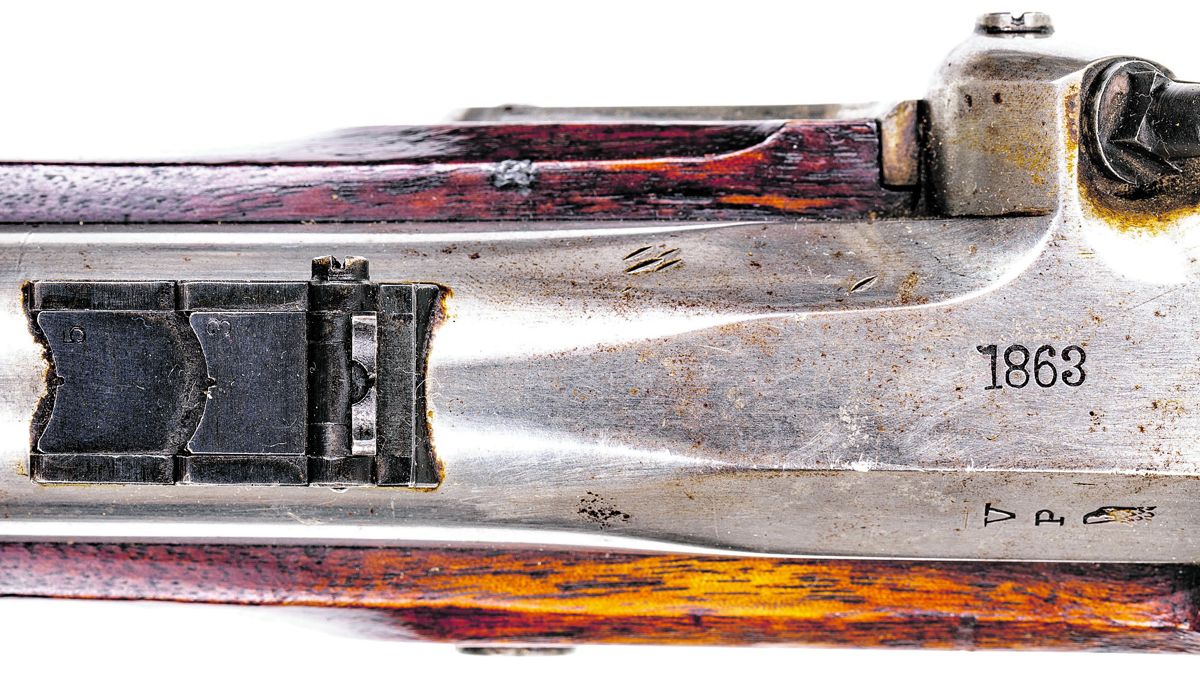
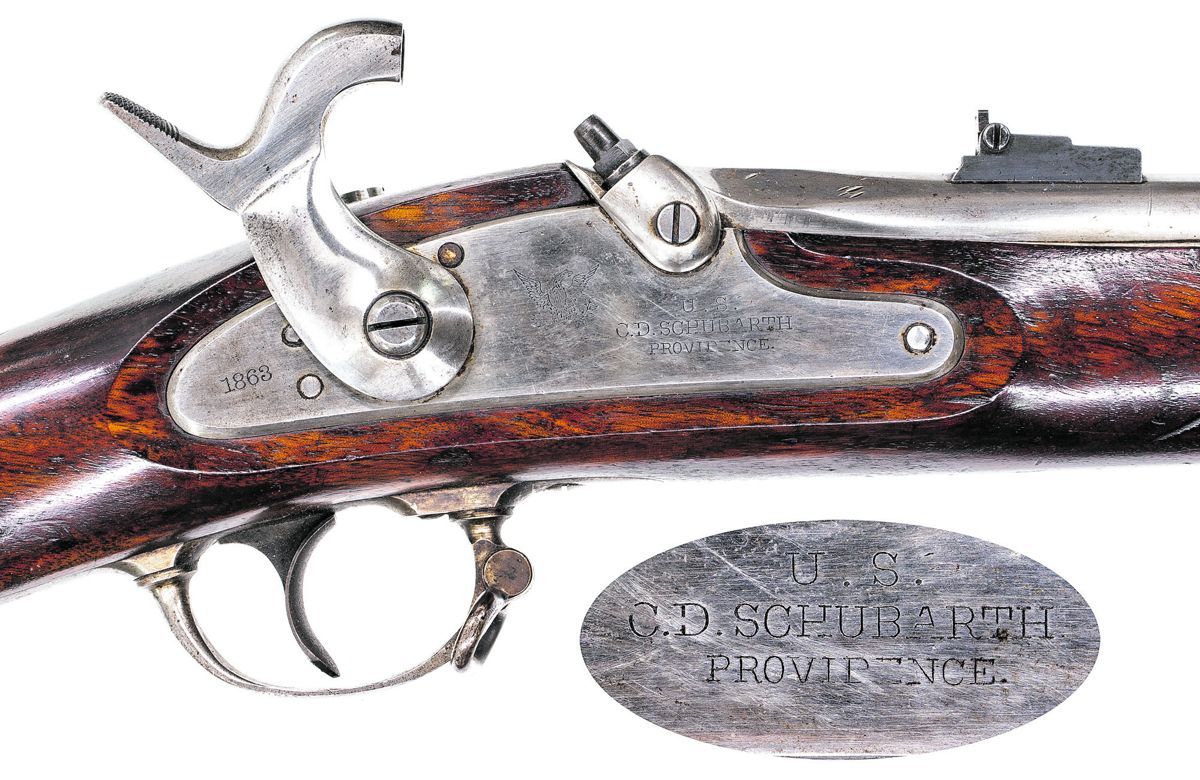
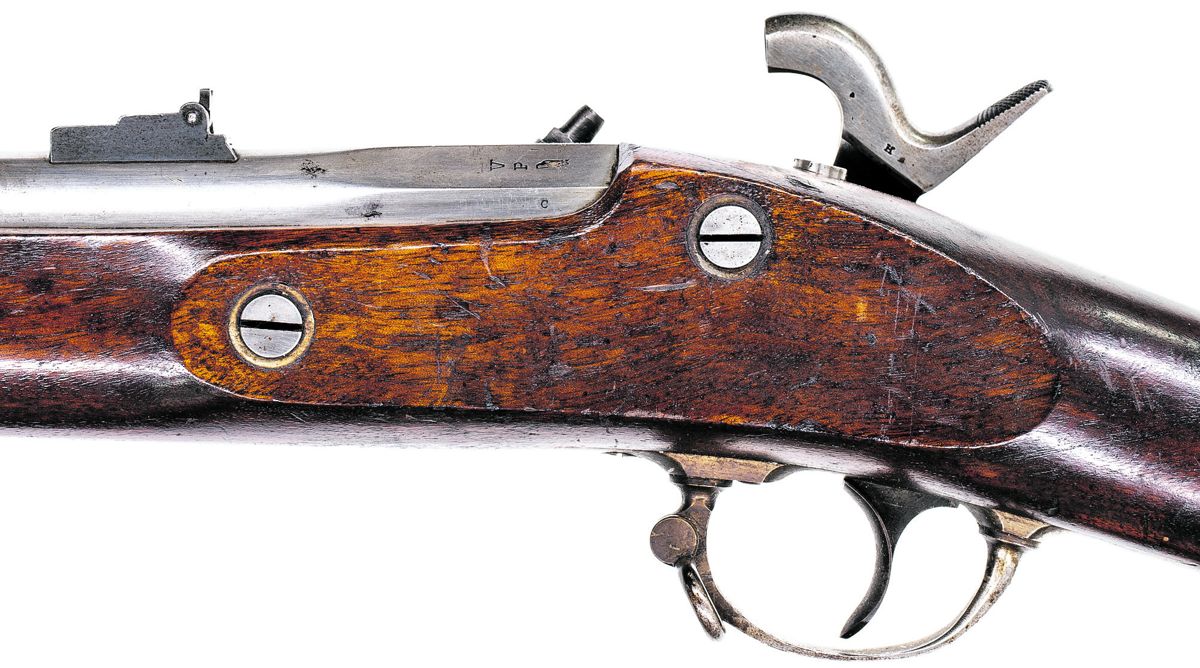
(4,915 or 52%) or “3rd Class” (72 or slightly less than 1%). While most sources indicate that Schubarth delivered a total of 9,500 guns between December 1862 and October 1863, the detailed breakdown above indicates that he only delivered 9,450. The missing 50 guns appear to be from the April 24 delivery that included only 950 guns, not the full 1,000 as did all the subsequent deliveries. It is possible that 50 guns were simply not accepted, thus they were not paid for, even though they were technically “delivered.” Research by arms collector, historian, and author George Moller suggests that only about 500 Schubarth arms were delivered with Schubarth marked locks. It is hypothesized that the balance of the guns delivered were either marked by Providence Tool or Alfred Jenks, further suggesting that at least some guns Schubarth submitted were not even assembled by him, but rather produced by other makers. Moller suggests that at least some Schubarth deliveries were produced by the Norwich Arms Company. With less than 10,000 guns delivered by Schubarth, and only an estimated 500 or so produced with his lock markings, these are incredibly scarce guns today. Slightly more than 448,000 contract U.S. M1861 rifle muskets were delivered by contractors between 1862 and 1865, so Schubarth produced guns represent only about 2% of those M1861 contract arms. Thus, Schubarth marked guns only represent about 1/10th of 1% of all contract M1861s. Due to Schubarth’s inability to deliver his arms on the specified timeline, his contract was not renewed and no extension was granted. Thus, no further arms were delivered after Oct. 14, 1863. Schubarth returned to his gunsmithing and hardware business in Providence at the conclusion of the failed contract, where he worked until 1866. He then gave the shop over to his brother. Schubarth moved to New York City where he lived until his death in 1908. While Schubarth’s contract work for the U.S. government during the Civil War can rightfully be looked at as a failure, his legacy was the passing of a new law that would help limit the graft in U.S. military contracts. The Schubarth contract U.S. Model 1861 rifle musket pictured in the accompanying photos is one of the extremely rare C. D. Schubarth marked examples. The lock of the gun is marked with a {Spread-Winged Eagle} between the hammer and bolster and under the bolster in three lines: U.S. / C.D. SCHUBARTH / PROVIDENCE. The tail of the lock is dated 1863; the breech is also 1863 dated. Interestingly, despite being fully sub-inspected, the gun bears no sub-inspection or final inspection cartouches on the counterpane of the stock; the wood is so crisp it is clear that no such mark was ever applied suggesting that this particular gun may be one of the 50 missing guns from the April 1863 delivery. While it is not clear exactly why, this gun was simply not accepted for some reason. It is worth noting that, like many U.S. M1861 contract guns produced under the earliest contracts issued during 1861, the gun is mounted with the M1858 style rear sight, rather than the later M1861 pattern rear version. The M1858 pattern was used on early production M1861 rifle muskets at Springfield through July 1861. The sight has the concave curved tops to the sight leaves as well as the exposed tension screw; these were changed after adopting the Elisha Root designed M1861 rear sight in July 1861. Many contractors who re-