
The Graphic War
Sixth Street Wharf
By Salvatore Cilella · Originally published January 2021 · p. 22
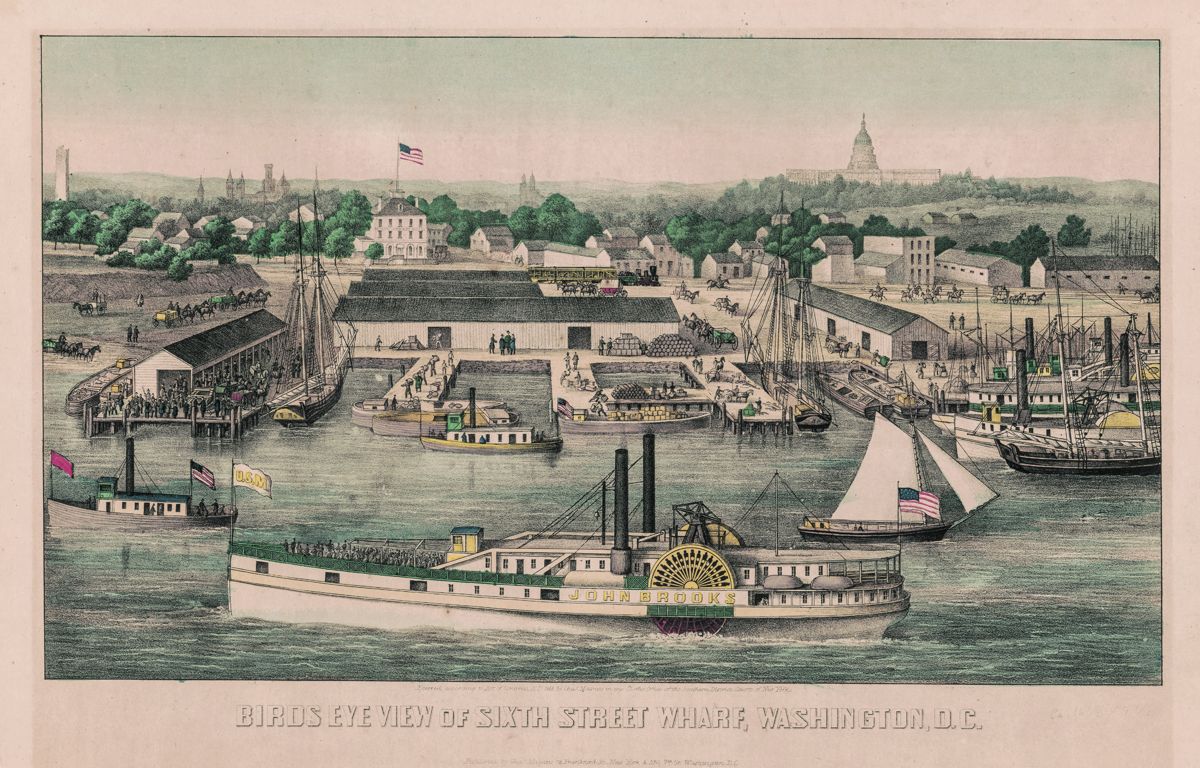
Sixth Street Wharf The Graphic War highlights prints and printmakers from the Civil War discussing their meaning and the print maker or artist’s goals. The Sixth Street Wharf in Washington, D.C., during the Civil War was a critical point of arrival and departure by boat along the Potomac. When Jubal Early threatened the capital in July 1864, Ulysses Grant responded by dispatching, among others, the VI Corps from its positions around Petersburg. The VI Corps steamed around Fortress Monroe in Hampton Roads and up the Potomac arriving the morning of July 12 at the Sixth Street Wharf. The troops promptly disembarked and marched up Seventh Street through Northwest Washington. Early was threatening the outer ring of forts and he determined that Fort Stevens at the apex of the District of Columbia between Thirteenth and Sixteenth Streets in northeast Washington was a vulnerable point. The existing garrison defensive force, backed by the newly arrived VI Corps, repelled Early and saved the city.1 Charles Magnus produced hundreds of views of Civil War locations. This print depicts the bustle of shipping arriving and leaving with wounded soldiers. The wharf was a central location for distributing the wounded to the several hastily built hospitals in the nation’s capital. The war’s poet laureate, Walt Whitman, wrote of the wharf: “You ought to see the scene of the wounded arriving at the landing here foot of Sixth street, at night. Two boat loads came about half-past seven last night. A little after eight it rain’d a long and violent shower. The poor, pale, helpless soldiers had been debark’d, and lay around on the wharf and neighborhood anywhere. The rain was, probably, grateful to them; at any rate they were exposed to it. The few torches light up the spectacle. All around— on the wharf, on the ground, out on side places—the men are lying on blankets, old quilts, &c., with bloody rags bound round heads, arms, and legs.”2 This small folio lithograph, usually hand colored, shows the U. S. M. paddle wheeler, the John Brooks, filled with Union soldiers in the foreground. Soldiers stand on the covered dock at left; the Mount Vernon Hotel is flying the American flag. The hotel was originally the Thomas Law House, built in 1794 for Thomas Law and his new wife, Eliza Parke Custis, Martha Washington’s granddaughter.3 To the far-left background is the unfinished Washington Monument. At its right is the Castle of the Smithsonian Institution. The unfinished U.S. Capitol building, its dome not completed until after the war, stands in the background. Charles Magnus, a German refugee from the upheavals in Europe in the 1840’s, established himself first as a mapmaker. He soon branched out producing patriotic covers (envelopes with patriotic motifs), camps, hospitals, city views and battle scenes. As one author summarized Magnus “he was a Jack of all trades.”4 He was not as prolific as Currier and Ives, but much of his work was superior. He initiated producing stationery with patriotic themes and city views on a single sheet’s upper half. He also lithographed single page song sheets with the lyrics below an image on the top third. He died in his adopted city, New York, in 1900 after a six-month long battle with cancer. He had just celebrated his 74th birthday.
See Benjamin Franklin Cooling III and Walton H. Owen II, Mr. Lincoln’s Forts: A Guide to the Civil War Defenses of Washington, Latham, The Scarecrow Press, 2010, 172-184 and Salvatore G. Cilella, Upton’s Regulars: The 121st New York Volunteers in the Civil War, Lawrence Ks, University Press of Kansas, 324-327. Walt Whitman, May, 1863, Memoranda During the War. As cited in “Finding the Civil War in Washington, D. C.” National Museum of American History, April 21, 2011. https:// a m e r i c a n h i s t o r y. s i . e d u / blog/2011/04/finding-the-civil-war-in-washington-dc.html. The Law House was added to the National Register of Historic Places in 1973. Raymond Marsh, “Who Was Charles Magnus?” Yesterday in Stamps (From STAMPS Magazine, February 12, 1949) In Stamp News on Line, Issue
20, August 3, 2012. http:// w w w. s t a m p n e ws o n l i n e. net/StampNewsOnline-PW/ YesterdayinStamps/YIS%20 2012/YIS_0812_Magnus.pdf. See also E. Richard McKinstry, Charles Magnus, Lithographer: Illustrating America’s Past, 1850–1900. Winterthur Museum, Oak Knoll Press, 2013. After 43 years in the museum field, Salvatore Cilella devotes his time collecting American prints and maps and writing. His last professional position was President and CEO of the Atlanta History Center. His most recent books are Upton’s Regulars: A History of the 121st New York Volunteers in the Civil War (U. Press Kansas, 2009). His two-volume Correspondence of Major General Emory Upton, (U. of Tennessee Press, 2017), received the 2017-2018 American Civil War Museum’s Founders Award for outstanding editing of primary source materials. His latest book “Till Death Do Us Part,” an edit of Upton’s letters to his wife