
Civil War Provost Guards
By Joan Wenner, J.D. · Originally published January 2021 · pp. 28–31
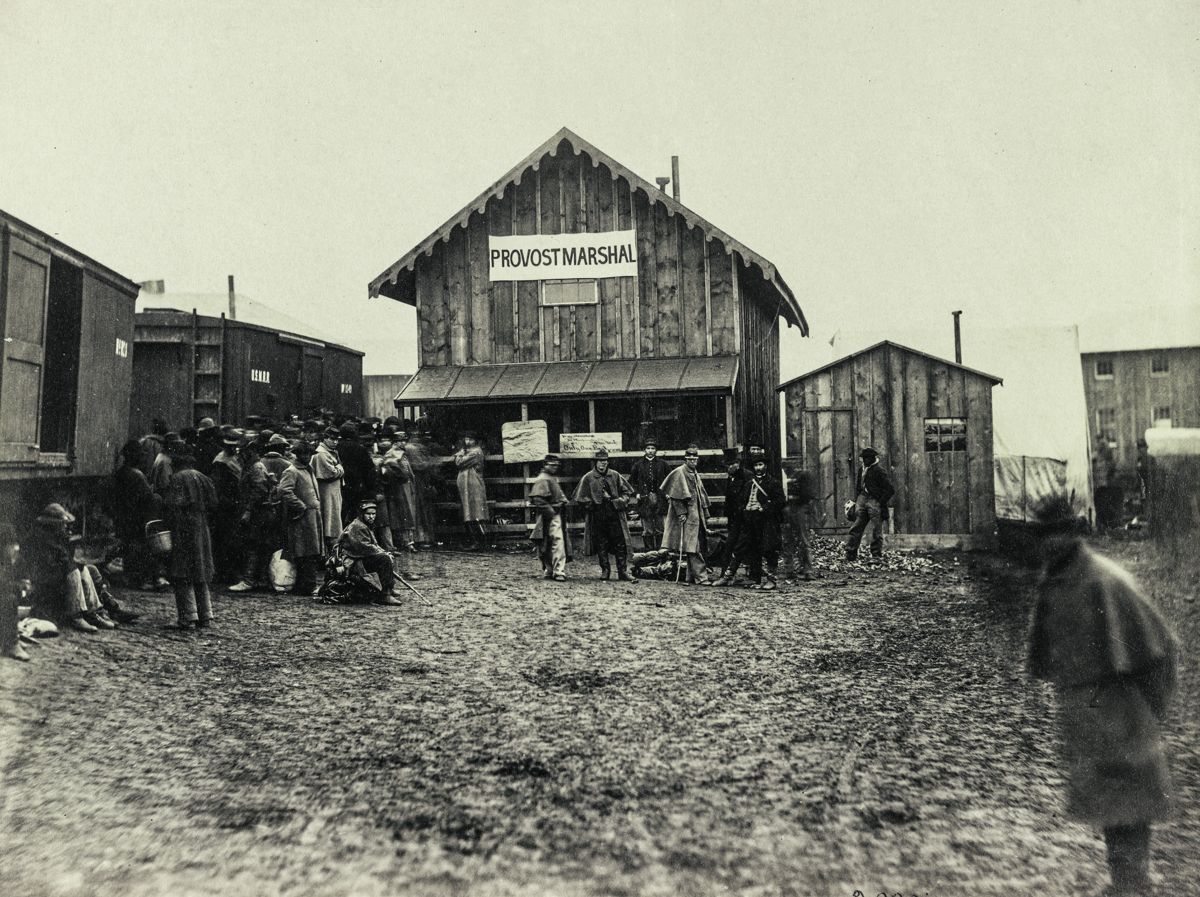
Civil War Provost Guards by Joan Wenner, J.D. America will never be destroyed from the outside. If we falter and lose our freedoms, it will be because we destroyed ourselves. – Abraham Lincoln “With the bombardment of Sumpter [sic, Sumter] the war has now begun in earnest,” Harper’s Weekly told its readers in the spring of 1861. Only a couple of minor battles would occur however until the embarrassing Federal defeat near the end of July outside Washington at Manassas. At this Bull Run fight, “where the noise and sounds from the battle were in terrible variance with the tranquil character of the landscape,” four Federal divisions confronted two Confederate armies, one under P.G.T. Beauregard, the other led by the immensely capable Joseph E. Johnston The first recruits, uninitiated in the ways of military life, had earlier been learning in camps to be soldiers, included was instruction in proper military conduct though the problem of punishments for infractions would as usual prove as vexing as it had for armies since Alexander the Great. The Confederate provost system, the primary focus of this article, was designed primarily to maintain military discipline in its armies. According to historian Kenneth Radley in his definitive Rebel Watchdog: Provost Guards of the Confederacy, an American provost system, largely based on British precedent, had existed since the Revolutionary War mainly restricted to purely military police functions. With the fielding of Southern armies commencing in February 1861, many provost duties initially were performed by civilians, while the Articles of War adopted the following month provided for military provost marshals and for military courts to try army personnel charged with offenses against military law. One of the earliest references to provost activities in the field is in correspondence of the Army of the Mississippi early in 1861 where a general order directed that disciplinary matters were the concern of the adjutant general of the army and later to assistant adjutants and appropriate staff officers at the various levels of command. A battalion officer of ‘Stonewall’ Jackson’s Second Corps wrote in an article years later that in June 1861, the beginning period of provost was “quite an easy time.” It would of course not remain so. In 1862 a subsequent act authorized a military court for each army corps and a provost marshal to execute its orders. The jurisdiction of these courts included offenses against the Articles of War, customs of war, and against Confederate or state laws. An 1863 Army of Tennessee report contained: “A provost marshal general will be assigned to duty at army headquarters with one assistant. Corps commanders will detail a field officer, with one assistant, for duty at corps headquarters, a captain for division headquarters, and a lieutenant for brigade headquarters. These officers will … report regularly to the provost marshal of the army.” As the war wore on, several secessionist governors tried and mostly failed to gain direct control of the provost as it increasingly affected the public. They wanted to at least rein in provost authority, especially its existence outside the Army’s operational sphere in the belief that military jurisdiction must be strictly defined to prevent abuses against the civilian population. But legislative efforts were generally unsuccessful in limiting the War Department’s authority of provost marshals over the citizenry. Evidence shows their fears of this extension of power would later prove justified as its original purpose, to preserve order in the armies, was enlarged by the pressures of war. For example, the Confederate provost was compelled to monitor transportation services such as trains if it was to have any shot at decreasing the desertion rate and restricting the movement of Yankee spies presumed to be everywhere. A system of passes was soon devised to regulate travel, annoying citizens and soldiers alike. Vigorous debate continued among Confederate Congress politicians who believed the provost marshal’s powers could not extend beyond the army; an amended resolution did eventually pass as the conflict intensified though, as the Confederacy’s military fortunes declined, the army often ignored relevant provisions.
Basically, the “military necessities had more weight than the political niceties” of catering to the strict constitutionalism arguments of state and other officials; not unlike other times in history. The widespread unpopularity of ‘passports’ conferred both a high profile and a heavy burden on the provost, and as battle fronts grew, practically every Confederate citizen was subject to the provost’s control of his or her right of movement, even General Lee’s wife during a trip, until her identity was confirmed, according to one story. Over time oppressive measures continued to be hotly debated and the provost was to a degree curtailed in areas outside the actual fields of military operations. Additionally, provost marshal appointments were carefully controlled in rear areas when judged by generals commanding armies and departments as essential to public services. Early on, Confederate commanders requested authority to raise companies of exempt men to be used by provost marshals to enforce orders. In addition, local defense units organized from the reserves, men between 17 and 18, and 45 and 50 years of age, and those determined unfit for active service. In at least one major department a provost organization was formalized on a district and subdistrict basis and necessary police officers appointed with local militia being used as provost when possible or necessary to keep order, guard public property, prisons, and bridges. In many regions the absence of any other manpower made use of these classes of men inevitable. While there were cases of provost detachees, as one battalion officer complained in a letter that he “was tired with being on Provost duty and should greatly prefer being with the Brigade where there is a chance for promotion and where I could feel I was performing some service,” there were not surprisingly, numerous instances of men using provost duty to avoid the rigors of active service, reaching serious proportions in the last two years of the war. Some Confederate Congress representatives also called for steps to prevent enrolling officers from abusing their power to grant exemptions from conscription along with limiting an officer’s tenure in one area. On this point it was thought enrolling officers who stayed a long length of time in one locality, and who themselves were frequently averse to hard, frontline service, became overly familiar with the local citizens and were prone to “keeping men out of the army in the field who should be there and putting in some who ought not to be put in.” In departments the provost chain of command ran upward from subdistrict to district and finally to the department’s provost marshals. In the field armies a chain of command extended through the levels from brigade, division, corps, and upward. Staff responsibilities were fairly well defined with provost receiving their orders either directly from formation commanders or through appropriate staff officers. Considerable documentation examined by Radley shows, he says, that even in the most remote commands, the provost machinery was firmly in place, and sometimes entire brigades were placed on provost duty. Not until February 1865 was a bill providing for the more formal appointment of a provost marshal general introduced in the Confederate Senate. The purpose was replacing long serving, and recently deceased,
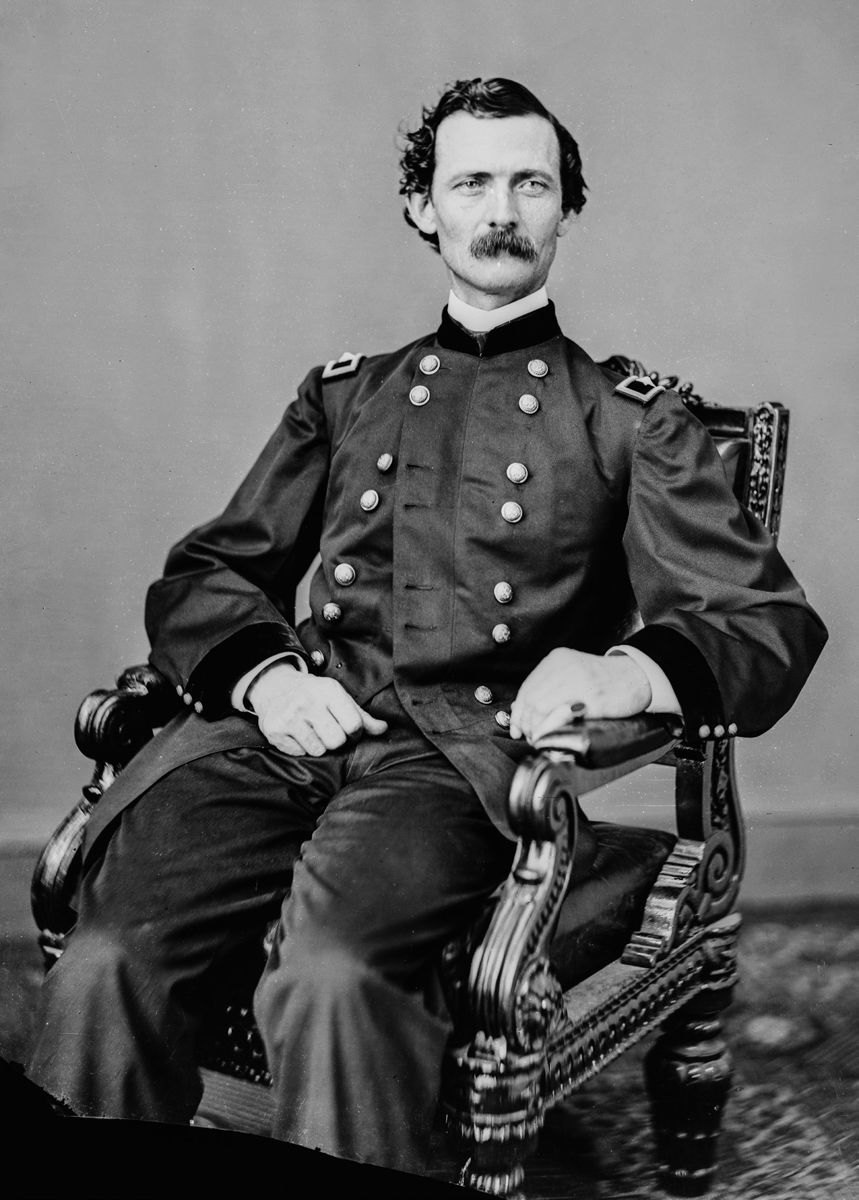
General John H. Winder, and naming Brigadier General Daniel Ruggles as his replacement. Winder’s most notable Union counterpart was provost marshal of the army Brigadier General Marsena R. Patrick, a crusty, “gruff old party with flowing white hair and whiskers” who, for example, was known to hold “little prayer meetings in his tent every morning then biting the heads off tenpenny nails.” While serving with General George Gordon Meade he criticized his old West Point classmate fiercely, along with just about everyone else, but was said to be the ‘perfect policeman.’ There was also the Union’s Provost Marshall General James Barnet Fry of the War Department’s Bureau of Accounts, issuing various circulars. There were a number issued in 1863 and one in November called for collecting filled out forms and lists of recruits, drilling and organizing volunteers, along with forms given to disbursing officers for paying the $25 premium for accepted recruits (veterans), or $15 for accepted non-veteran recruits. Colonel James Barnet Fry, later Major General and author, was born in Carrollton, Ill., in 1827, and graduated from West Point in 1847 as an artillery specialist. Fry directed paperwork be kept in books for reference by acting assistant provost marshals of states and districts. Traveling expenses were also allowed for officers of the Union recruiting service inspectors. Supplies included stationery, account books, etc., along with issued regulations of the “enrollment act,” plus reporting instructions. General Robert E. Lee, who never doubted strict discipline, was noted by many who extensively chronicled his military career. In Lee’s opinion too much reliance had been placed on the soldier’s innate “merit” and not enough had been done to instill instinctive obedience. He believed the primary duty of the Confederate provost was the maintenance of discipline, perhaps because he was of the opinion everything else stemmed from it. It did not diminish the authority of commanders to maintain internal discipline of their commands, but beyond that, the provost was to assist with the key, and time consuming, responsibilities of crime prevention and investigation of crimes committed by military personnel, custody and escorting of offenders, and apprehension of deserters and absentees. In the constant battle against vice, Confederate military policemen encountered looting, pillaging (i.e. ‘irregular acquisition’), lax military security, (i.e. ‘loose talk’), and the usual gambling and prostitution pastimes, all complicating conditions in a wartime Confederacy along with ever-present liquor-related offenses. In May 1862, as one example, Hadley cites the Confederate Congress as attempting to control liquor consumption by passing legislation entitled, “An Act to punish drunkenness in the Army.” Of course, he says, such enactments “had about the same deterrent effect as King Canute did in his famous encounter with the North Sea.” Front or rear, a highly visible provost was essential for a measure of acceptable discipline, and a Confederate provost marshal was charged with functioning as policeman, magistrate, and military prison jailer where many inmates, soldiers and civilians, were incarcerated by his direct intervention. The relationship of provost to Confederacy military law began, again, with those 1861 Articles of War that provided for tribunals to try military personnel accused of offenses against military law. Originally the procedures for courts-martial were inefficient, but an attempt to correct deficiencies was subsequently effected a year and a half later in October 1862, authorizing a military court for each army corps in the field that generally exercised unrestricted jurisdiction over military personnel and civil jurisdiction in occupied areas. Each court was permitted to appoint a provost marshal with the rank and pay of a cavalry captain to execute its orders. Provost jurisdiction was extended to include offenses against the articles and customs of war, as well as Confederate and state laws. Occasionally general courts-martial were established that had their own appointed regimental officer as provost marshal with duties likened to that of a sheriff in a civilian court plus additionally recording court proceedings and testimony of attendant parties. There were provost assignments to naval courts as well since Confederate Cabinet member Stephen Mallory headed the Navy and decided the Confederacy should embark on a policy of commerce destroying conducted by commissioned naval ships rather than attempt controlling a legion of privateers and all that would entail. Although the Articles of War provided for the trial of military offenders against military law, imprecise wording could be construed as making civilians answerable to military courts. It can be easily understood how interpretation and application of certain language, “who ever shall relieve the enemy with money, victuals, or ammunitions, or shall knowingly harbor or protection the enemy, shall suffer death, or such other punishment as shall be ordered by … a court-martial,” for example, or conviction “of holding correspondence with or giving intelligence to the enemy…” could be made in the particular departments by individual field commanders. The disciplinary standards of the marshals and their subordinate officers, and the degree to which “inhumanity would be tolerated in the imposition of discipline,” varied. Some provost officers quite naturally assumed powers to an extent aligned with the attitudes of their superiors and there were certainly those who viewed the activities of the provost with more than mild irritation. The Nathan Bedford Forrest’s cavalry provost was noted as especially efficient in handling prisoners. While problems were arose with various state supreme courts acting on writs of habeas corpus concerning prisoners the military said it had positive proof of intent to commit treason, aiding the enemy, and other offenses, the pull of the military over the issue of custody of civilians accused of crimes against the Confederacy was quite powerful. Jefferson Davis’ authority to suspend habeas corpus was quashed by the Confederate
Congress as was virtually anything else that smacked of a threat to states’ rights. Army officers also criticized the military legal and penal system. In Rebel Watchdog, Hadley cites a reference in the OR’s that Robert E. Lee himself raised the matter with Jefferson Davis just before the Battle of Sharpsburg (Antietam) writing that, “We require more promptness and certainty of punishment.” The subject of punishment of course led to provost involvement with Confederate States prisons. Provost responsibility here simply stated was the operation of detention facilities and military prisons for the confinement of service offenders, with John Winder tasked with their administration. Winder met with constant disapproval from the majority of civilian Richmonders who ”summed up the provost as active but outrageous.” Much has been written of Winder and his detectives’ actions there, and as some wrote, “Evildoers were the only ones the police did not trouble” and were “oppressive only to the . . .peaceful.” Unceasing efforts to control desertion occupied more and more troops, and as the Confederacy’s fortunes deteriorated, large areas of the Confederate States of America, in particular western North Carolina’s rugged Sauratown Mountain region, and parts of Georgia, Alabama, Tennessee, and Mississippi, became sanctuaries for such huge numbers that the provost was unable to cope with them. Requests to the Confederate government for assistance were met with limited help. Constant appeals to deserters to ‘rejoin the colors’ fell by the wayside, in many cases not due to their cowardice or desire to pillage and plunder, but to increasing concerns for and acute anxiety over the welfare of their families in the war-ravaged South. Lee’s message on desertion, from November 1864 to March 1865, was virtually the same: “Hundreds of men are deserting nightly” and “I do not know what can be done to put a stop to it.” He was also reported as saying at Appomattox: “I could always rely on my army for fighting, but its discipline was poor.” Most historians believe the decline in confidence and morale significantly decreased the chances of a Southern victory. It is perhaps telling that reportedly one of the last operational tasks performed by the provost occurred during the April 1865 evacuation of Richmond, seven days before Lee’s surrender. It involved a Local Defense Brigade officer defending the last bridge over the James River as the remaining provost troops withdrew. As the last cavalrymen crossed and an engineer officer set it afire, one cavalryman allegedly said, “All over, goodbye; blow her to hell.” It seemed fitting to Hadley “that the provost should have been among the last out of the burning capitol, serving as the rear guard of a nation also blown to hell.”
•
•
•
References: •
•
War of the Rebellion: A Compilation of the Official Records of the Union and Confederate Armies, Washington, D.C., Government Printing Office, 1890. Various volumes in Series I-IV consulted re CSA provost (Jackson’s Division, Forrest’s cavalry in Dec. 1864, and others), including Series II, Vol 3, p. 122. March 1, 1862 proclamation by Jefferson Davis declaring Richmond under martial law, with Brig. Gen. John H. Winder charged with its execution and appointing military police). Brig. Gen. J.H. Winder Papers, Southern Historical Collection,
•
•
University of North Carolina, Chapel Hill. Bruce Catton, Glory Road, Doubleday & Co., Garden City, NY (1952), pp. 128, 129. Robert H. Jones, Disrupted Decades: The Civil War and Reconstruction Years, Robert E. Krieger Publishing Co., Huntington, NY (1979), p. 238. Ilana D. Miller, Reports from America, Britain’s William Howard Russell [London Times] and the Civil War, Sutton Publishing, Great Britain (2001), pp. 167, 169. Fletcher Pratt, Civil War in Pictures, Garden City Books, Garden City, NY (1955), pp. 8, 9. Kenneth Radley, Rebel Watchdog: The Confederate States Army Provost Guard, Louisiana State University Press, LA (1989). Jay W. Simson, Naval Strategies of the Civil War, Cumberland House Publishing, Nashville, TN (2001), p. 38. David K. Snider & William R. Brooksher, Glory at a Gallop: Tales of the Confederate Cavalry, Brassey’s Washington/ London, (1993), p. 56. Scott Walker, Hell’s Broke Loose in Georgia, University of Georgia Press, Athens, (2005), p. 13. (CSA conscription acts; Georgia infantry diaries re furloughs.) William Butler, “Days in Confederate Prisons,” The New