
Burger and Brothers First National Guidon
By Shannon Pritchard · Originally published January 2021 · p. 35
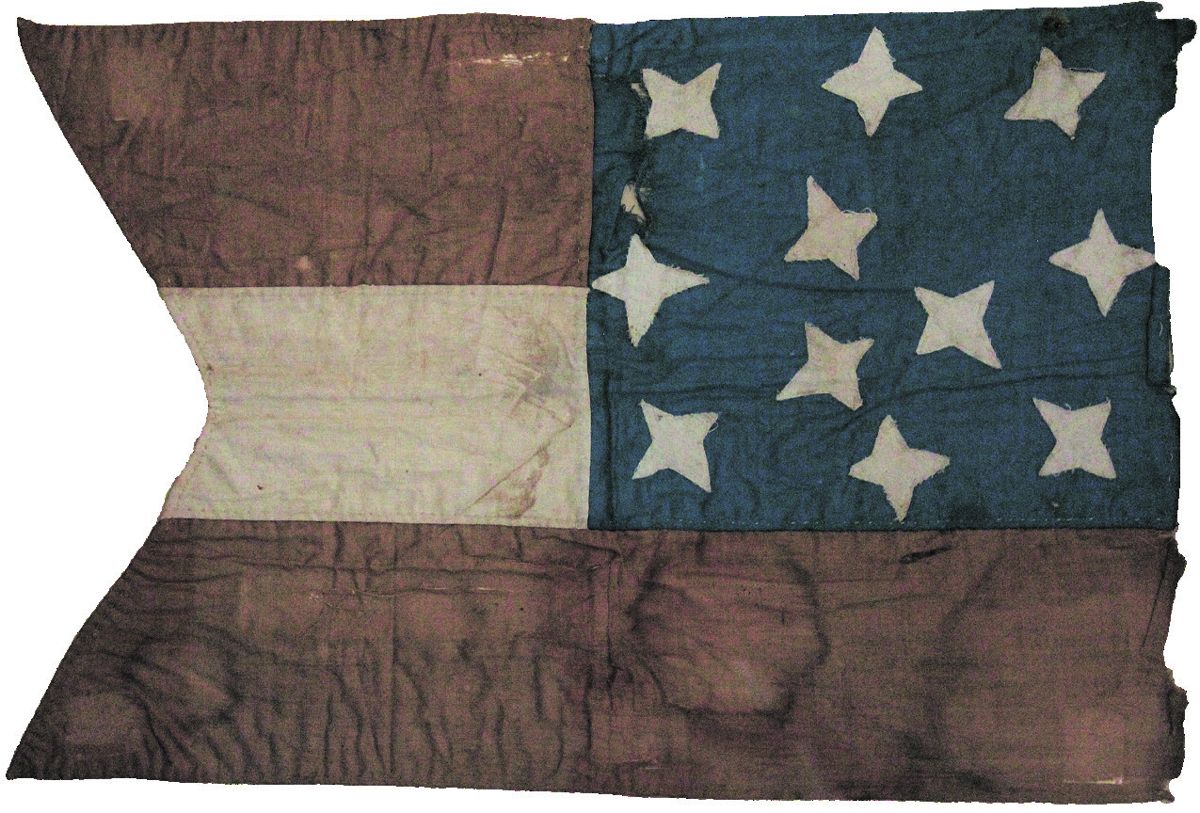
The swallowtail guidon shown below was used by the Army of Northern Virginia’s cavalry companies and, just as the name implies, they were used to guide on. When formed for battle, cavalry was stretched out in a line running from left to right. At the center of the regiment, the battle flag would be displayed. At intervals up and down the line, company flag bearers carried guidons attached to lances. During the advance, it was essential that the troopers maintain alignment to maximize the shock of the charge. Each guidon bearer advanced in echelon, slightly behind the regimental standard. This allowed the troopers to maintain alignment with their comrades left and right even if their view was limited by smoke, dust, or obstacles. This First National pattern guidon measures seventeen inches on the fly, by twelve inches on the hoist. The stars on this example, as with all of this pattern, are only on the left side. In William Albaugh’s 1960 edition of Confederate Edged Weapons, he makes note of the fact that in his youth, this pattern was “relatively common in Richmond. All seen at that time were identical, having attached to the 8-foot ash staff, by means of three tacks, a small Stars and Bars
Confederate flag which contained 11 four pointed stars. The flag was of the swallow-tailed guidon variety and very poorly made, the stars being only on the left side of the flag.” He also noted the size, “seventeen by twelve inches.” Albaugh did not know who made them, but he referenced an 1896 dated receipt for a lance “taken at the fall of Richmond.” I have in my possession, a copy of a January 1862, bill from Burger and Brothers, charging the Confederate States of America, for 283 “Lances and Flags” at six dollars each. Undoubtedly there were many other shipments, but the invoices have not survived. Greg Biggs recently learned that Richmond’s most famous belles: Hettie, Jennie, and Constance Cary, made and sold these guidons for five dollars to Burger and Brothers who then marked them up a dollar and resold them. These same ladies sewed the very first Confederate Battle Flag. Shannon Pritchard has authored numerous articles relating to the authentication, care and conservation of Confederate antiques, including several cover articles and is the author of the definitive work on Confederate collectibles, the widely acclaimed Collecting the Confederacy, Artifacts and