
The Unfinished Fight
Paper Cartridges for the .577 Enfield Rifle Musket in the Civil War
By Craig L. Barry · Originally published February 2021 · pp. 8–9
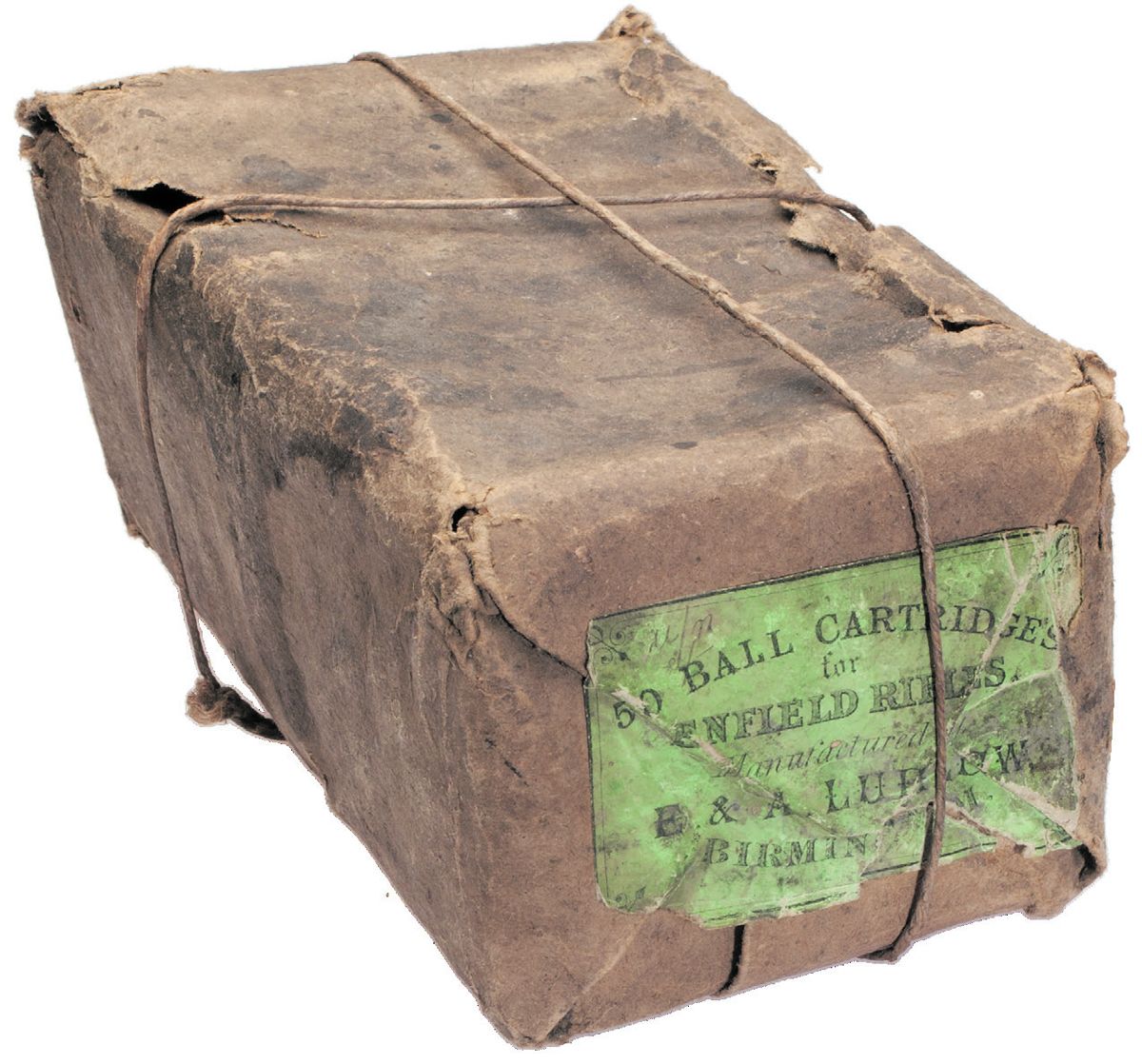
The only pattern of cartridge to be hereafter used with muzzle loading rifled small arms shall be that known as the English pattern of Enfield cartridge.” – Colonel Josiah Gorgas, Chief of Ordnance, C.S.A., February 9, 1864 Paper cartridges were first used in a military application as early as the 1600s in Europe, about the same time that smoothbore muskets came into wide use. Soldiers carried their powder and ball together in a cylindrical tube made of paper or linen that was closed in some fashion on each end. Some were twisted or tied with string, others folded over to prevent losing the powder charge before loading. During loading, the cartridge was torn, and the charge emptied down the barrel. Then the musket ball and the remaining paper were rammed down the barrel to seat it. This was a safer alternative to loading loose black powder from a powder flask or an apostle. The flask had the potential for accidentally exploding in-hand if a “cook off ” ignited the charge prematurely, which had been known to happen. Chauncey Cooke of the 25th Wisconsin noted in, Letters of a Badger Boy in Blue, “I know what father would say. He would quote Napoleon, who said, “Put your trust in well drilled troops and keep your powder dry.” Most of the rounds used by infantry in the U.S. Civil War were fixed ammunition, in other words paper cartridges fabricated in government arsenals and issued to troops in the field “ready to use.” United States Ordnance regulations in 1834 provided powder flasks made of copper for “Riflemen.” The powder flask was last mentioned in the 1850 Ordnance manual but was eliminated from later editions presumably because manufactured paper cartridges were by then becoming the norm. The 1861 edition has no mention of flask loading at all. During the Civil War-era the cartridge paper was often treated with potassium nitrate to make it completely combustible, especially for revolver cartridges. Hence, smoking tobacco in direct proximity to a supply of paper cartridges loaded with black powder was not encouraged. Cartridge paper was not water resistant and black powder does not ignite when wet. There were many references to the practicality of maintaining a buffer zone between water, fire, and paper cartridges, such as the quote above. Cartridge boxes of the time period feature very tight stitching with “kit” coated thread to aid in keeping water from the loose paper cartridges inside. The vast majority of arms used during the Civil War required some form of paper cartridge and loaded from the muzzle (front of the barrel) or at least the front end. Even handguns loaded from the front of the revolving cylinder, if not the barrel itself. The exceptions such as the Maynard carbine, Henry, and Spencer rifle(s) that used metallic cartridges were by far in the minority during the early to mid1860s. More than a billion paper cartridge rounds were manufactured during the Civil War-era on both sides in a variety of calibers and configurations. The image of Civil War soldiers sitting around a campfire rolling rounds is a modern anachronism for which there is no historical basis. During the Civil War, cartridges were produced in packages of ten with an eleventh tube containing twelve percussion caps. This is easily remembered by the numerical order 10…11…12. They were wrapped and tied in a paper package, and if packaged by a Confederate Arsenal, often labeled with such information as the date, originating arsenal, caliber, and type of bullet. With some exceptions, U.S. Arsenals largely abandoned the practice of labeling or stamping arsenal packs by 1861. The Confederate States imported Enfield cartridges by the hundreds of thousands from England, even late in the war. Frances B. Wallace noted in Memorial of the Patriotism of Schuylkill County in the American Slaveholder Rebellion that “The rebels used English bullets almost entirely. I picked up a rebel cartridge, and on examining the cartridges found the makers’ stamp on them; it was E. & A. Ludlow,
.577 caliber Enfield bullet.
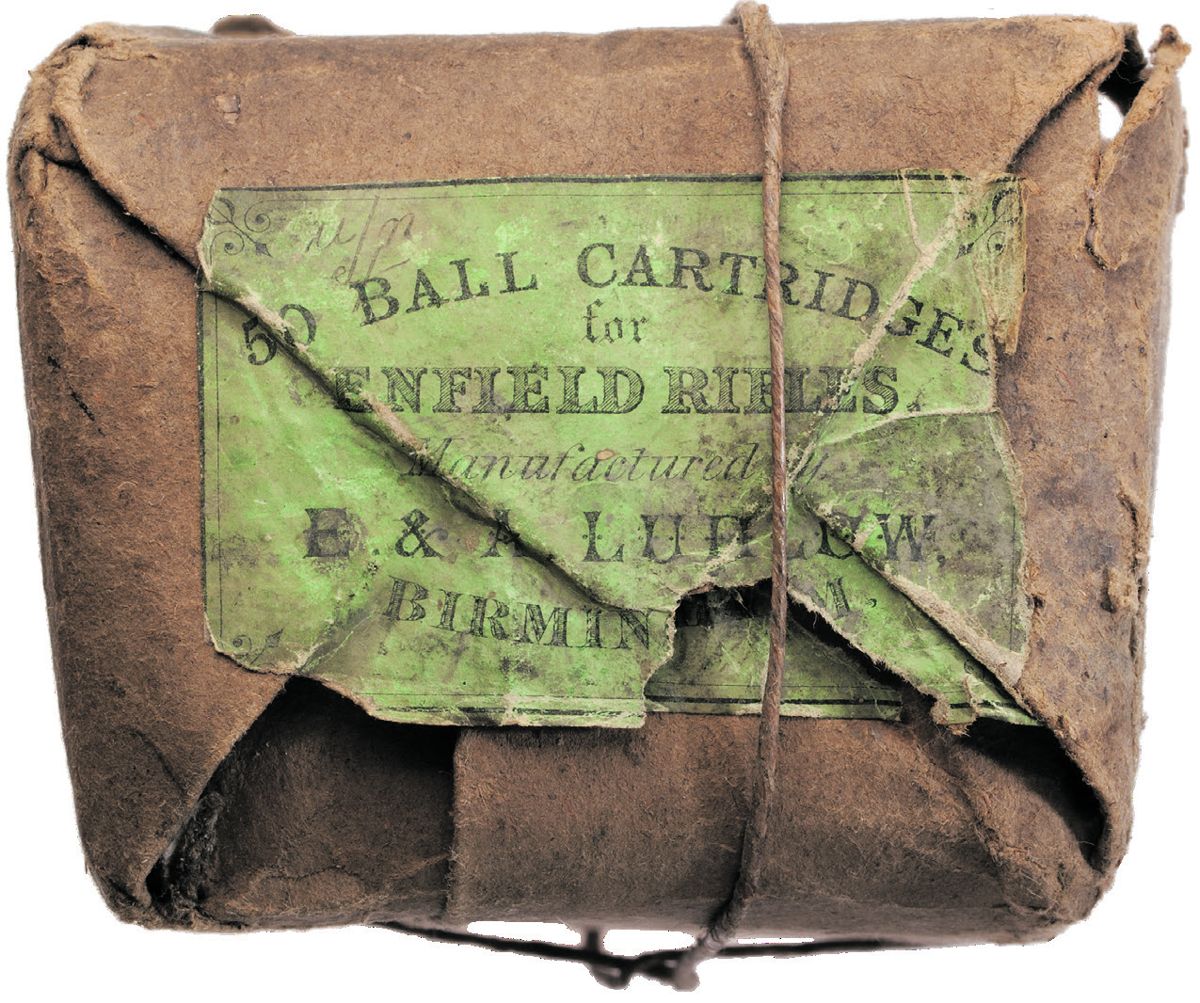
Birmingham, England.” The imported cartridges were too tall to fit into tins for the U.S. and C.S. pattern .58 cartridge boxes. Even though the similar sized rounds would theoretically “work” in both arms, it required adaptation before the Enfield cartridge could be issued in the field. C.L. Bragg noted in, Never For Want of Powder: The Confederate Powder Works at Augusta, Georgia, that difficult as it is to believe, the Augusta Arsenal (and others) supposedly re-rolled or “overhauled” large quantities of .577 imported English cartridges to fit in the C.S./U.S. cartridge boxes. The reason for this extra effort was, while there were a great many English accoutrement sets imported into the Confederacy, they were still fewer in total numbers compare to domestically produced C.S. and captured U.S. accoutrements. The C.S./U.S. style inner flap would not close over the imported .577 English cartridges in .58 caliber American type tins. Although these were two very common cartridges in the Confederate armies that were in wide use and should interchange, they apparently required different methods of loading and a different cartridge box system for transport and storage. For the U.S. model 1861 .58 caliber rifle musket, and domestically-made cartridges for the .577 caliber British Enfield rifle musket, the paper wrapper held the powder charge with a grooved, lubricated Minié ball sitting on top of it pointing up. The whole was then wrapped in another piece of paper and folded to make a completed cartridge. In loading, the soldier bit or otherwise tore off the end of the cartridge, dumped the powder into the muzzle of his gun, and with or without the remaining paper, inserted the bullet, and rammed it down the barrel. British, and some Confederate-made .577 Enfield cartridges, although still made of paper, were constructed differently, with a smooth, un-grooved, slightly undersized conical projectile, wrapped in lubricated paper, and placed point downward. After biting off the end of the Enfield cartridge and dumping the black powder down the muzzle, the soldier reversed the cartridge and seated the bullet, still wrapped in the lubricated paper into the muzzle, discarded any excess paper, rammed it home, and then capped the percussion cone. The point is that without some form of lubricant, the projectiles became very hard to seat over the powder charge after the barrel heated up and fouling began to line the barrel. Beeswax, tallow, and a variety of other substances worked well up to a point, but after a while the bullet could become stuck in the barrel part way down. This was a common cause of barrels bursting or bulging. Shooting the rifle-musket with imported British or some Confederate arsenal .577 rounds resulted in less fouling than the Union grooved .58 caliber Minié ball coated with tallow or at least that was what Colonel Josiah Gorgas, C.S. Chief of Ordnance, believed. Craig L. Barry was born in Charlottesville, Va. He holds his BA and Masters degrees from the University of North Carolina (Charlotte). Craig served The Watchdog Civil War Quarterly as Associate Editor and Editor from 2003–2017. The Watchdog published books and columns on 19th-century material and donated all funds from publications to battlefield preservation. He is the author of several books including The Civil War Musket: A Handbook for Historical Accuracy (2006, 2011), The Unfinished Fight: Essays on Confederate Material Culture Vol. I and II (2012, 2013). He has also published four books in the Suppliers to the Confederacy series on English Arms & Accoutrements, Quartermaster stores and other European imports.