
The Graphic War
Lincoln’s Home
By Salvatore Cilella · Originally published February 2021 · pp. 22–23
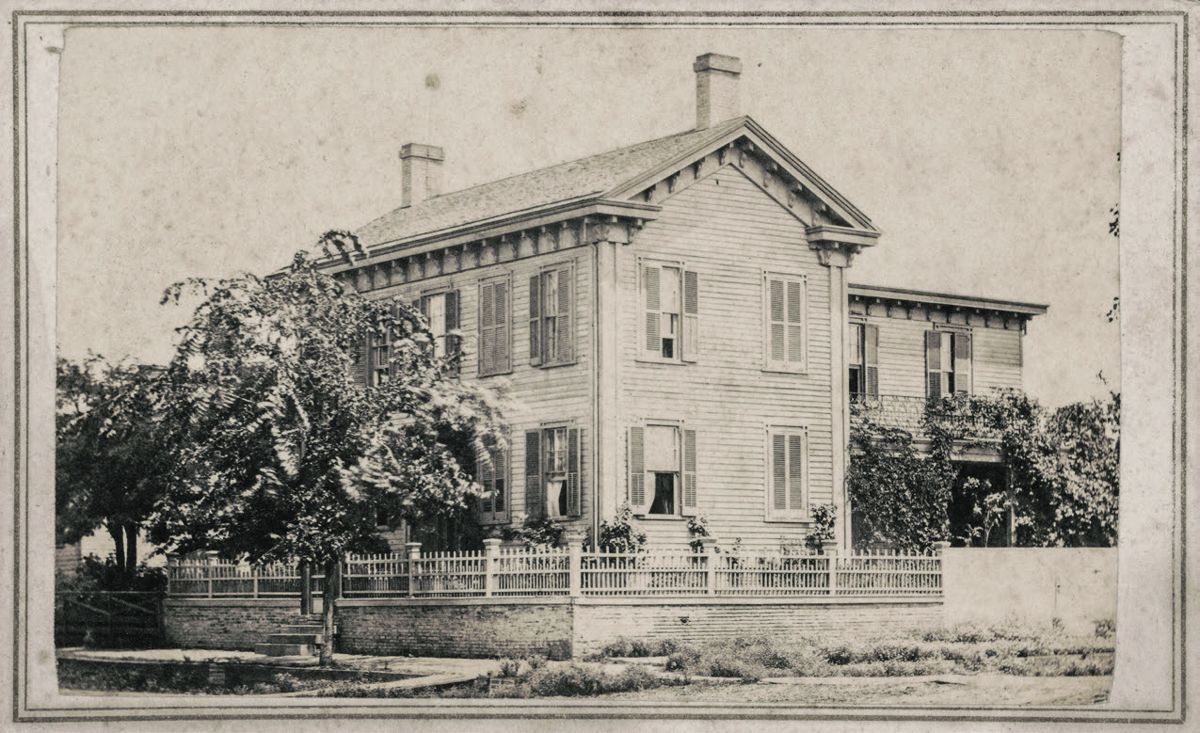
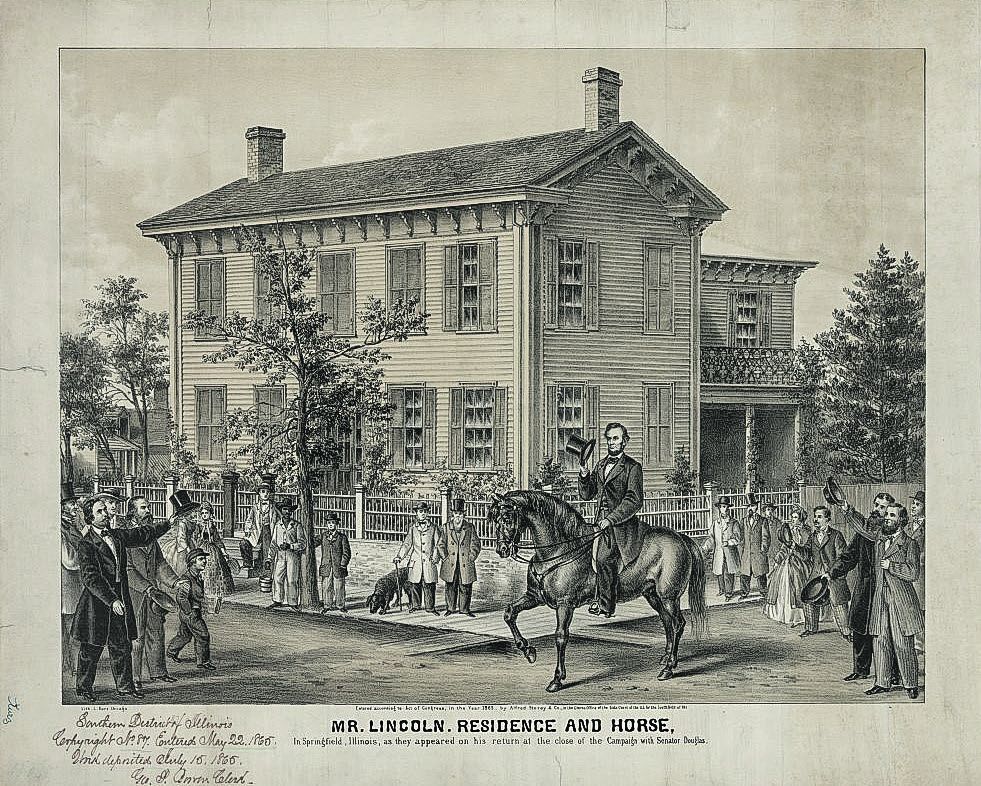
The Graphic War highlights prints and printmakers from the Civil War discussing their meaning and the print maker or artist’s goals. Imagine today someone displaying a picture of Trump Tower, former President Obama’s home in Chicago, or Jimmy Carter’s in Plains, Ga., in his or her living room. During America’s mid19th century existential threat of civil war, printmakers obviously determined that there was a market for pictures of the new 16th president’s home in Springfield, Ill. Early depictions of presidential domiciles were not uncommon particularly when one party was keen on portraying their candidate’s humble origins. From Washington on down, images of homes were more commonly relegated to the interior of the home with the main subject surrounded by his loving family. With Lincoln’s ascension to the land’s highest office, printmakers geared up interior and exterior images for public consumption. A deluge of “Lincoln at Home” or “Lincoln with Family” were produced between 1865 and 1870. At this point the interior views were more than decorative, they were meant as a solace to the grieving public. The family and the home were sacrosanct and in Lincoln’s case, they had been violently invaded. As Lincoln scholar Harold Holzer has pointed out, they were cheap and inferior.1 Unfortunately they were also un-trustworthy. In 1865, just over a month following Lincoln’s assassination, Chicago lithographer Louis Kurz produced a print of the deceased president’s Springfield home, with the slain leader on a horse doffing his hat to well-wishers. It is a problematic image. The caption claims that this is a scene showing Lincoln returning home from his “campaign” against Stephen Douglas. It reads: “Mr. Lincoln, Residence and Horse, / In Springfield,
Illinois, as they appeared on his return at the close of the campaign with Senator Douglas.” Taken at face value, this appears to be a depiction of Lincoln’s return home from his famous debates with Douglas in 1858. The two were campaigning against each other for the Illinois Senate seat that at that time was chosen by the Illinois State Legislature, not by direct vote of the period.
Lincoln scholars, Harold Holzer, Gabor Borritt, and Mark Neely in their book The Lincoln Image, draw an entirely different conclusion of the print’s meaning. They assert that the lithograph gives a “false impression about presidential campaigns….” They correctly maintain that Lincoln “adhered to the view that presidential candidates should not campaign; he never left Springfield for the canvass and therefore could not have returned.” If lithographer Kurz meant the presidential election, it is curious that he mentions only Douglas as Lincoln’s opponent and omits John Bell, Constitutional Union ticket, and John C. Breckinridge. Southern Democratic slate, who were part of the four-man race in 1860. They correctly point out that in either case; the depiction of a bearded
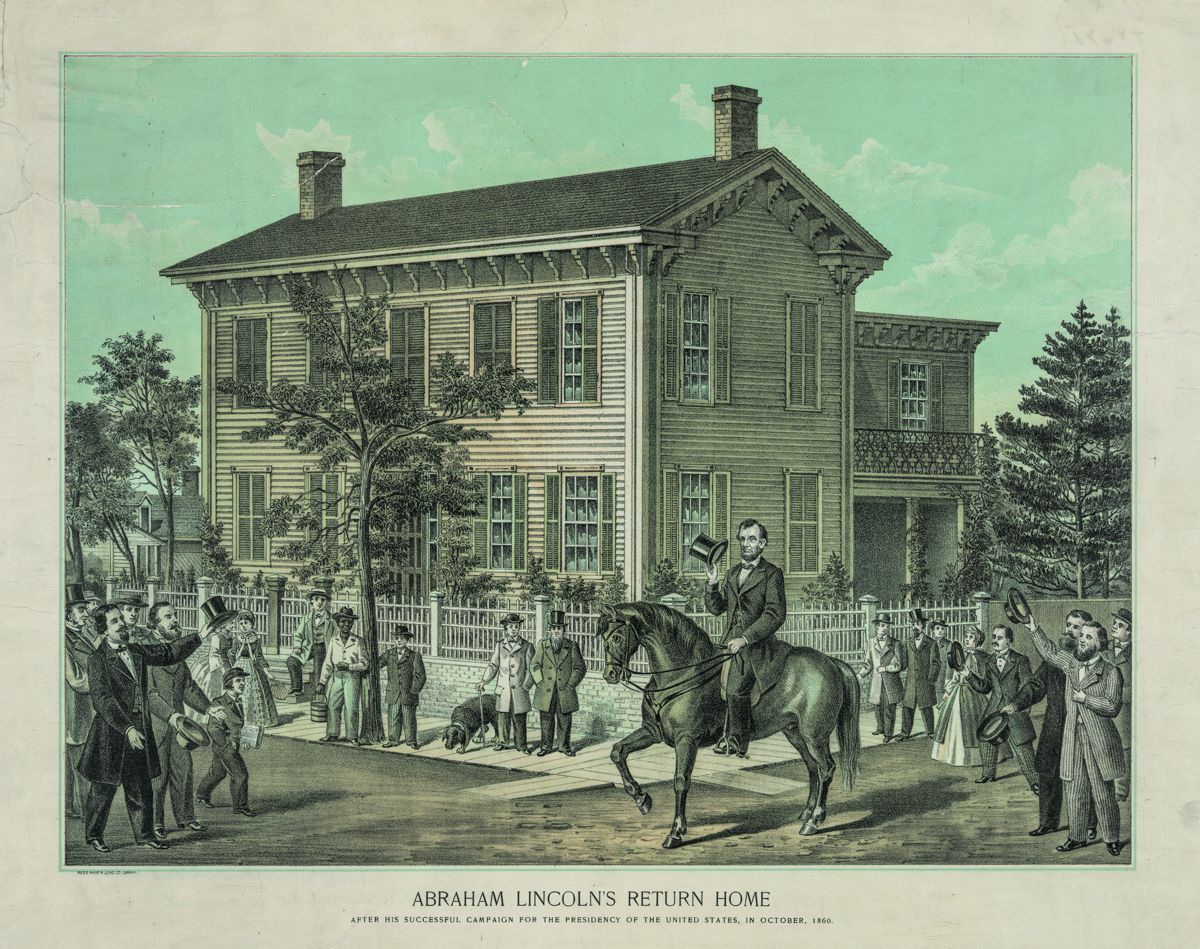
Lincoln is an “anachronism.”2 It all becomes murkier with the inspection of another version of Louis Kurz’ print. An identical second edition bears an entirely different title: “Abraham Lincoln’s Return Home/After His Successful Campaign for the Presidency of the United States, in October 1860.” It is unknown which version came first but it is almost as if Kurz realized his first confusing title and rushed out a “corrected version;” or, he planned to sell both versions. Either way, the print with the caption “The Return Home,” had more appeal than one which merely stated the obvious,“Mr. Lincoln, Residence and Horse.” In competition, the print firm of Louis Prang published two versions of the same view of Lincoln’s home without the president. One edition (it is unknown which came first) merely had the title: “Home of Abraham Lincoln.” The second version read: “Home of Abraham Lincoln. / Springfield, Ill, 1860 / He left it in peace, to preside over a nation, then in bondage. / He now reposes under its soil a martyr to the freedom he won.” Both were published in or after 1865. Neither depicts Lincoln or his family, just the home. Both are unattractive physically and aesthetically. During his life, prints showing Lincoln’s home life were legion. According to Holzer et. al., political operatives viewed those prints as key to managing the candidate’s image. In other words, bucolic images of Lincoln with his family were the products, and therefore examples of, early presidential marketing. Not so, the exterior of Lincoln’s home. They were produced after his death and “sentimentalized” his image. “They met a grass-roots need. They were not an invention of the politicians.”3 Refreshing, yes? Endnotes: 1.
Harold Holzer, Gabor Boritt, Mark E. Neely, Jr. The Lincoln Image: Abraham Lincoln and The Popular Print, New York: Scribner Press, 1984, 184. Ibid., 185. Ibid., 187.
After 43 years in the museum field, Salvatore Cilella devotes his time collecting American prints and maps and writing. His last professional position was President and CEO of the Atlanta History Center. His most recent books are Upton’s Regulars: A History of the 121st New York Volunteers in the Civil War (U. Press Kansas, 2009). His two-volume Correspondence of Major General Emory Upton, (U. of Tennessee Press, 2017), received the 2017–2018 American Civil War Museum’s Founders Award for outstanding editing of primary source materials. His latest book “Till Death Do Us Part,” an edit of Upton’s letters to his wife 1868– 70, was published in May by the Oklahoma University Press.