
A Welcome Return to Skirmishing at the N-SSA 144th Nationals
By Bruce W. Miller · Originally published December 2021 · pp. 1–7
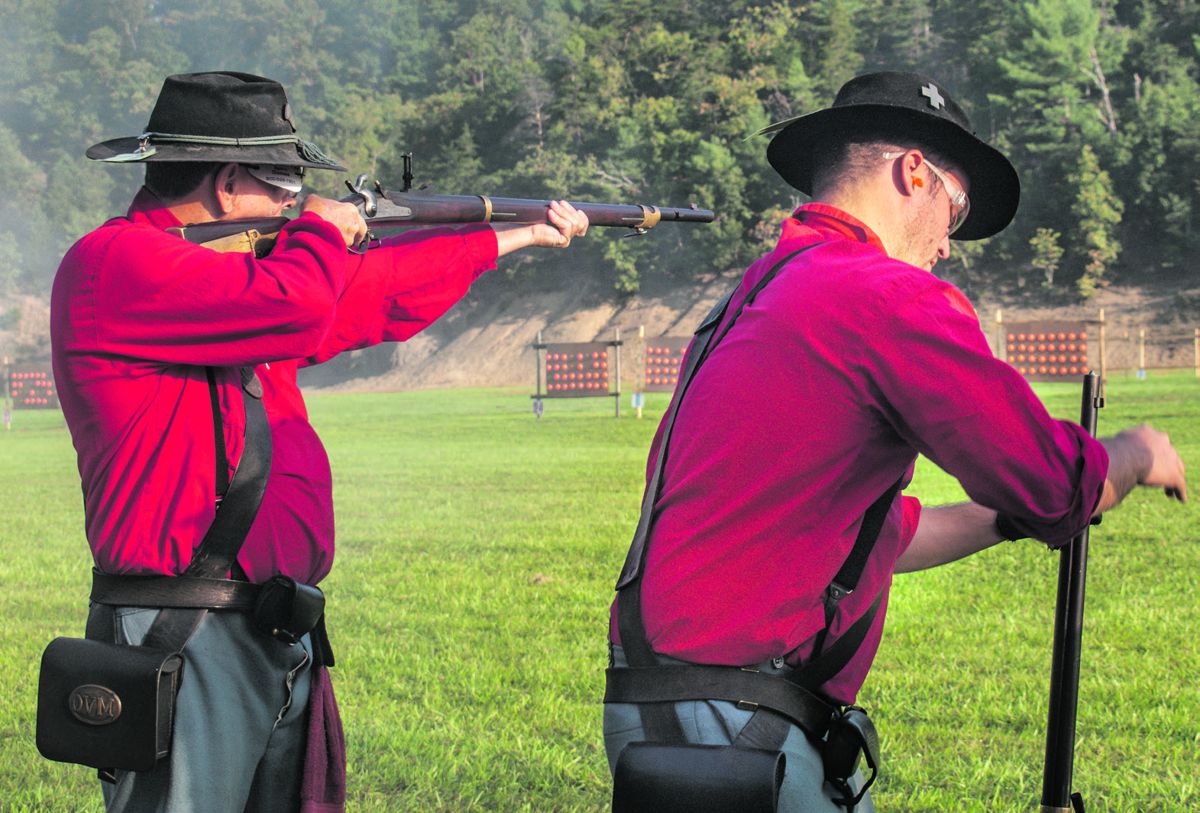
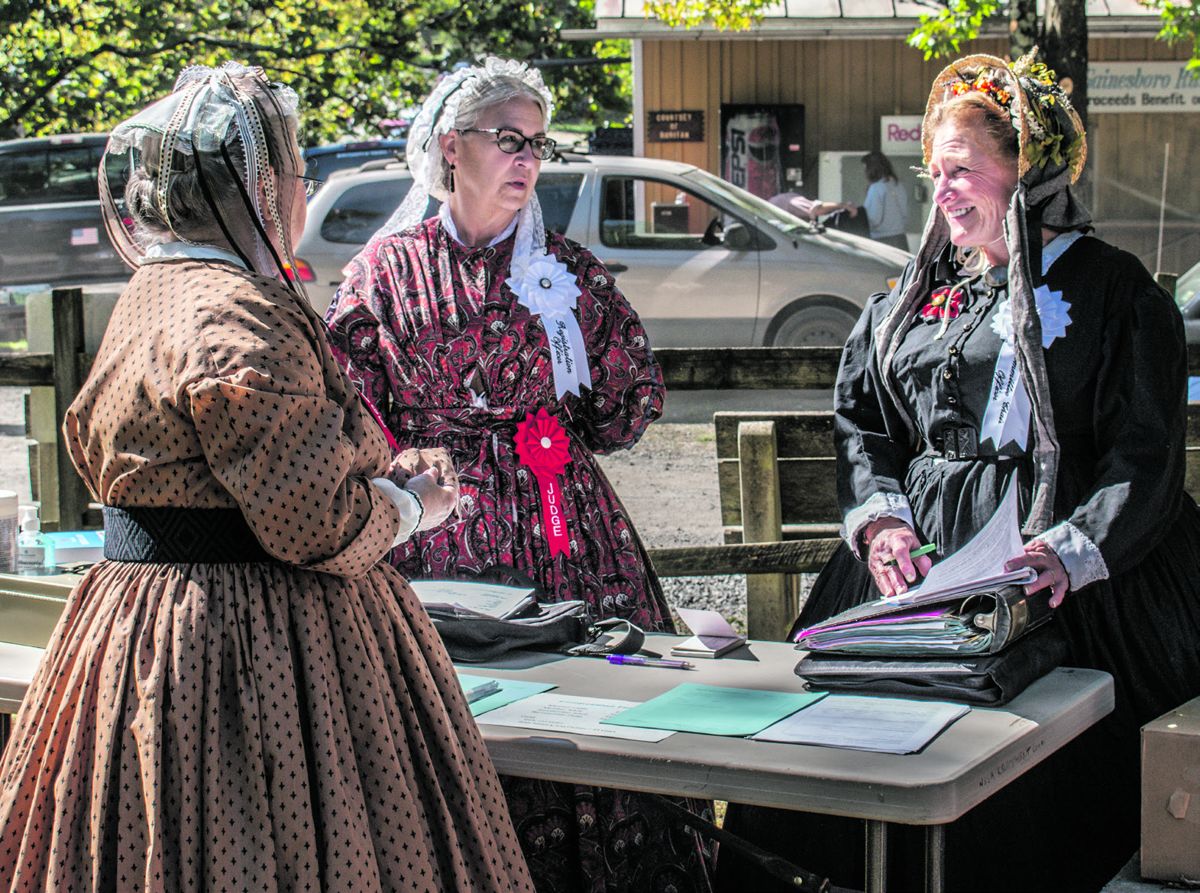
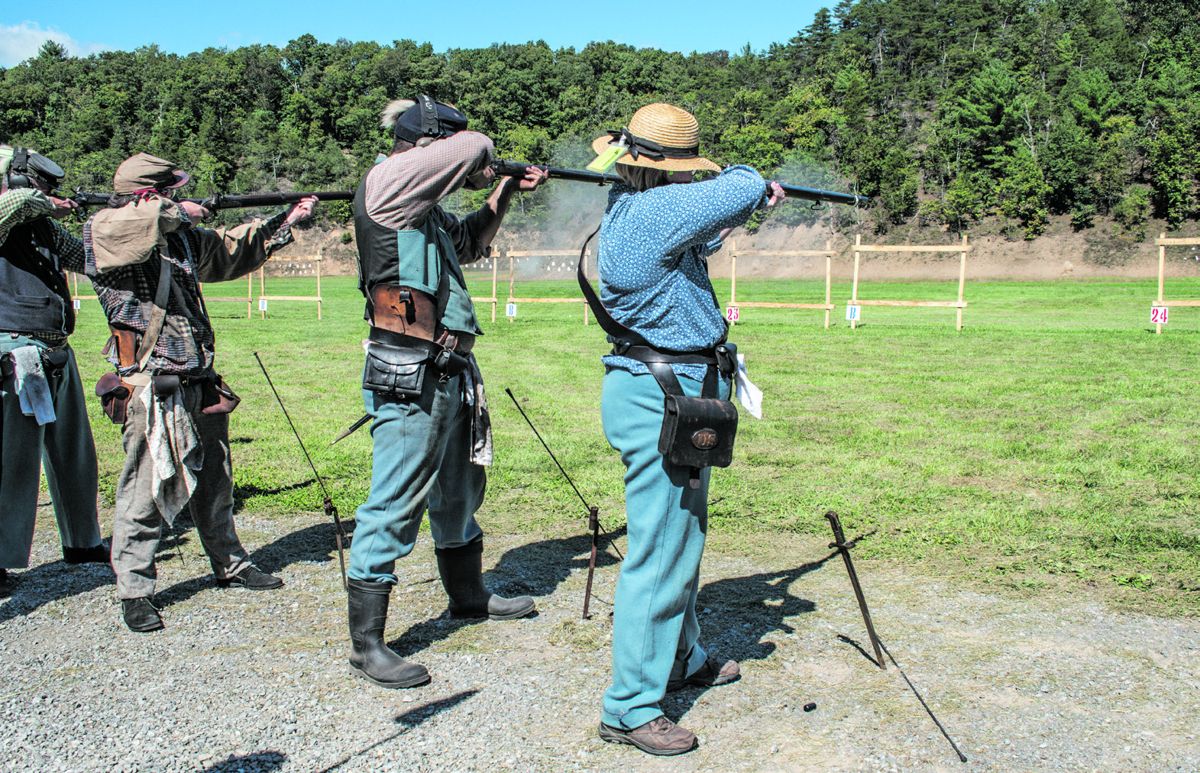
After the COVID pandemic caused cancellation of the two 2020 nationals and the spring 2021 national, the North-South Skirmish Association (N-SSA) was finally able to hold its 144th National Competition Sept. 29 thru Oct. 3, 2021. Member units competed in live-fire matches with original or authentic reproduction Civil War period muskets, carbines, breechloading rifles, revolvers, mortars, and cannon. It is the largest Civil War event of its kind in the country. After two days of individual matches, seven team matches were held over the three-day weekend. The weather in the scenic Shenandoah Valley was absolutely spectacular. Sunday’s Rifle Musket Team match, the N-SSA signature event, was particularly exciting. All targets are breakable and the pieces flew as clay pigeons, ceramic tiles, and pot silhouettes were blasted by Minié balls at ranges of 50 and 100 yards. A total of 147 eightmember teams participated in this classic competition. The remarkably consistent 110th Ohio Volunteer Infantry (OVI) dominated the match once again. They won the musket match with an excellent time of 417.7 seconds for the five-event program, besting the next closest unit by almost a full minute. This makes an amazing 26 riflemusket championships since the year 2000. Two of their members, Mike Rouch and Jerry Smith, have been on all 26 team wins. The always competitive Harlan’s Light Cavalry won Saturday’s Carbine Team match with a time of 390.4 seconds
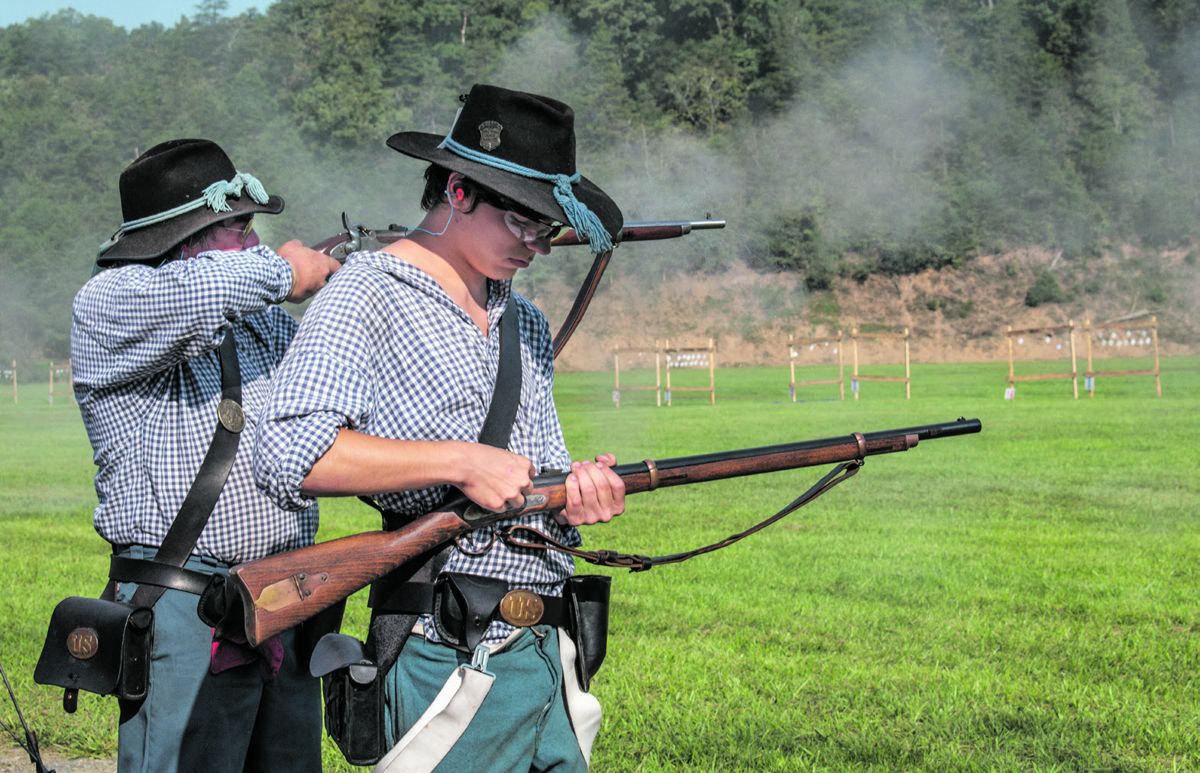
Skirmishers with the 1st Maryland Infantry load and fire during the musket match. Ericka Hoffmann Curley.
and beat the next closest unit by a massive 77.8 seconds. One hundred seventeen teams participated in this match of speed and accuracy. Smith carbines are a favorite in this match, and many are valuable originals. Skirmishers are also fond of Sharps’ carbines and you will often see Burnside’s, Maynard’s, and even muzzleloading carbines and musketoons on the firing line during the carbine competition. Friday morning dawned cool and bright as 60 teams squared off in the Revolver Team match. The four-member teams participated in the four event match: 12 clay pigeons on a cardboard backer, eight hanging 6-inch x 6-inch ceramic tiles, eight hanging clay pigeons, and eight hanging 4-inch x 4-inch ceramic tiles. The Iredell Blues finished first and claimed the gold medals with a time of 181.8 seconds, just edging the Washington Blue Rifles, one of the N-SSA’s founding units. The Nansemond Guards won the gold in the Smoothbore Musket Team match, besting
Black powder smoke hangs in the morning air as musket teams compete in the N-SSA rifle musket match national championships. Liz Cole.
114 other units to finish first with a solid total time of 187.7 seconds. This match has become increasingly popular and, as you can imagine, is a great test of skill. Competitors participate with many different firearms, including the U.S. Model 1842; Confederate Macon Arsenal conversions of the Model 1842; the Hewes & Philips conversion of the U.S. Model 1816 (which features a rear sight), and the occasional European Potsdam in .72 caliber. The match consists of four events, including the extra challenging silhouette of a tiny clay pot at 25 yards and 6-inch x 6-inch ceramic tiles at 50 yards. Three additional shoulder arm team matches were held. In the Single-Shot Rifle Team match, the ever present 110th OVI finished first. In the Breech-Loading Rifle Team match, the 2nd Maryland Artillery edged out the 110th OVI by 1.3 seconds to capture the gold and in the Spencer Team match, the 1st Illinois Light Artillery took the first place medals.
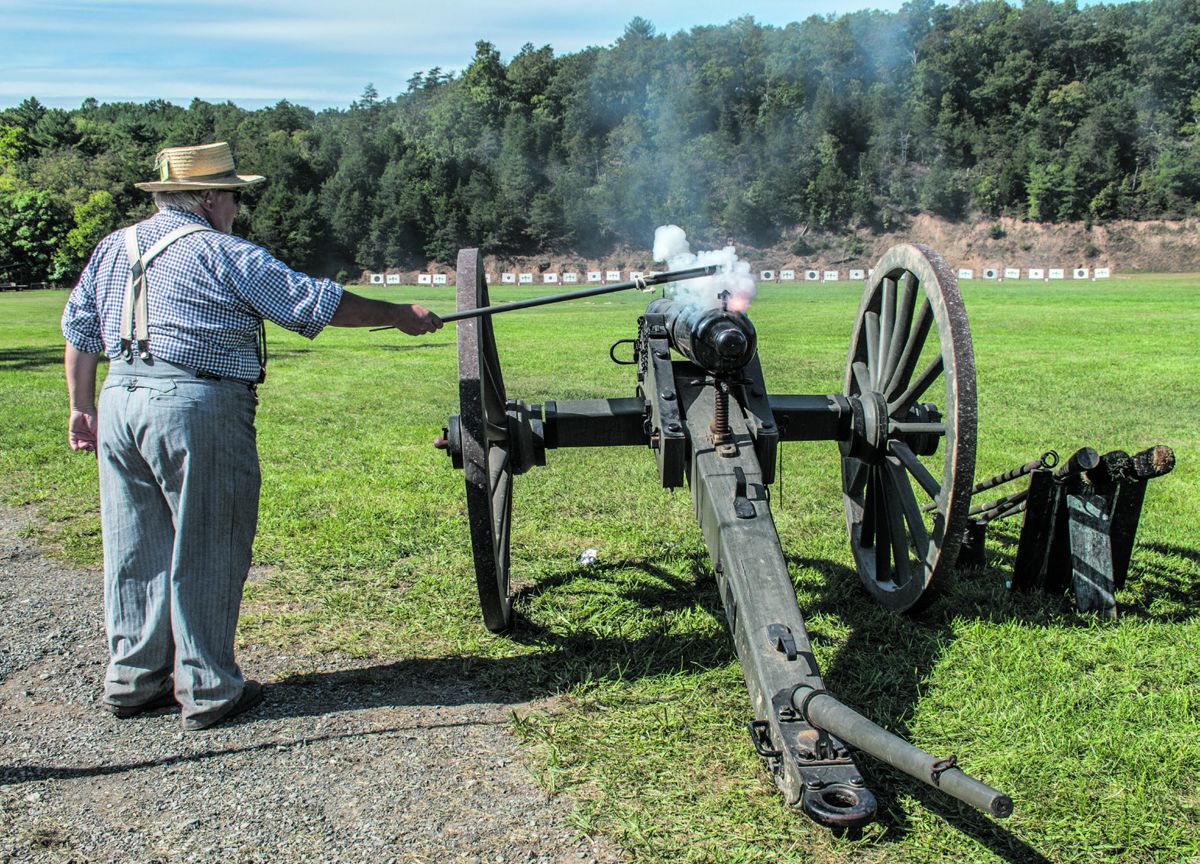
Forty-five units participated in the Mortar Team match. The mortar teams fire seven shots at a stake 100 yards down range. Officials then carefully measure the distance from the stake and tally the best five shots for score. The overall winner was the 5th Virginia Infantry with a terrific five shot aggregate score of 26 feet-2 inches; a huge seven feet better than any other team. The Artillery Team matches are a spectator favorite and the perfect Shenandoah Valley weather brought out 41 guns to participate. The range is reconfigured so that the cannon fire perpendicular to the small arms firing line. The guns are classified by type: smoothbore, rifled, howitzer, and rifled howitzer. Target frames with paper targets mounted on drywall backers are mounted at a range of 200 yards for rifled and smoothbore guns and 100 yards for howitzers. Rifled and smoothbore guns fire twelve solid projectiles, with a maximum of seven shots at either of two targets: a bull’s eye and a silhouette of a cannon facing them that represents counter battery fire. The best five shots on each target count for a maximum of 25 points per target; a perfect score is 50-10V. Howitzers each fire a maximum of 12 projectiles at their single bullseye target, with the 10 best shots counted and a perfect score being 50-10V. In the Smoothbore class, the 3rd Maryland Artillery (gun #1) was the winner with 43-2V. In the Rifled class, the 23rd North
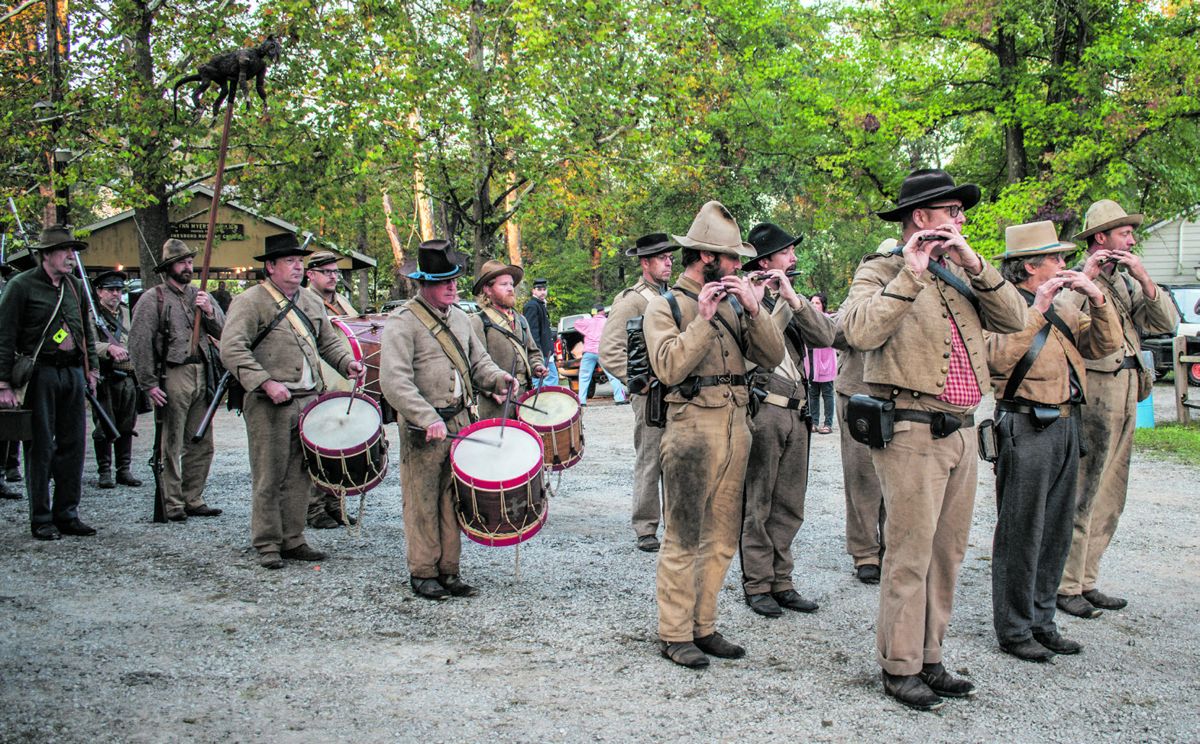
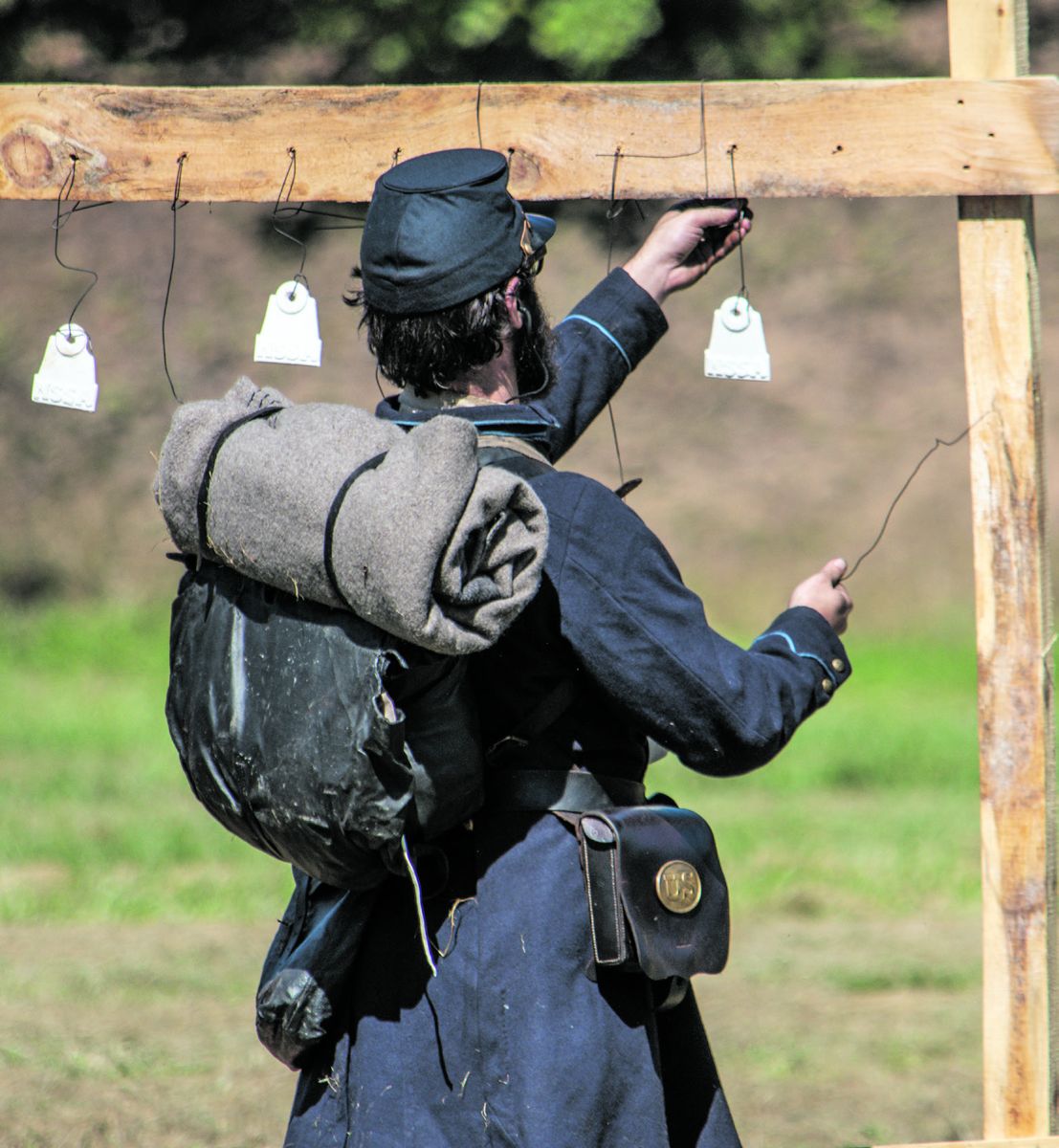
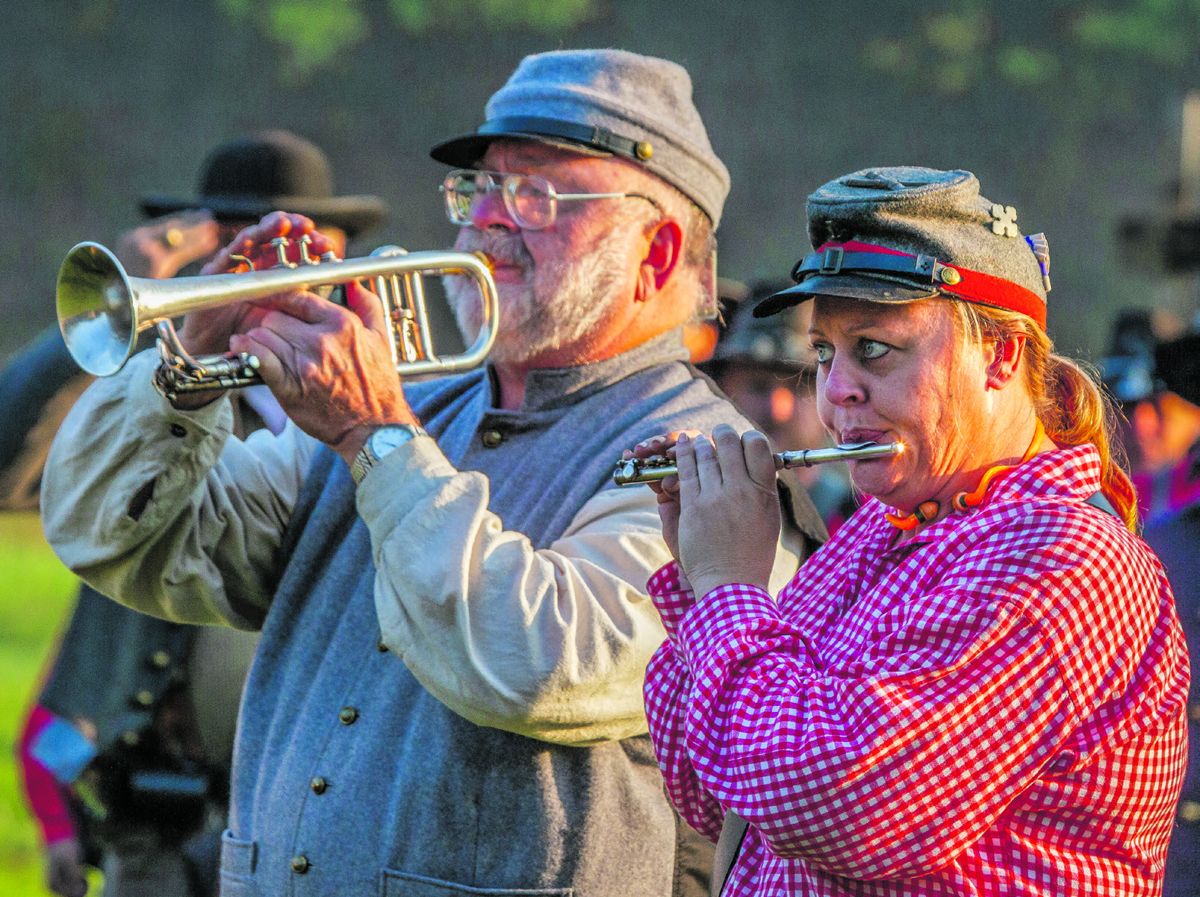
Carolina, Company G, won with a near perfect score of 50-5V. In the Howitzer class, the 3rd U.S. Infantry (Smithgall) won, shooting an impressive 50-7V. The 15th Ind. Battery, Ohio Light Artillery (gun #1) took the Rifled Howitzer class, scoring 41-2V. The accuracy of these Civil War cannon is truly amazing and N-SSA gun crews know how to get the most out of them. The N-SSA is the country’s oldest and largest Civil War shooting sports organization with 3,000 individuals who represent its 200 member units. Each represents a particular company or regiment and proudly wears the uniform they wore over 150 years ago. At the 144th Nationals, fifteen members were recognized for 50 years of membership in the Association; quite The 1st Maryland Infantry always draws a crowd while playing period an accomplishment. The award for the fife and drum music as they march to the range before the opening top Young Skirmisher (under 19 years ceremonies on Sunday morning. Ericka Hoffmann Curley. of age) went to Grant T. Ostner, 9th VA Cavalry, with an aggregate musket and carbine score of 177-1X and the Senior Skirmisher (over 65) award went to Gary Bowling, Nansemond Guards with a 181-2X. The 145th National Competition is scheduled for May 20-22, 2022, at Fort Shenandoah, just north of Winchester, Va. For more information about the N-SSA visit www.n-ssa.org. Jack Boyenton of the 1st Virginia Volunteer Infantry fires his Enfield during the first event of the musket match; 32 clay pigeons on a Brent Feito, 1st Maryland Infantry, hangs clay pot silhouettes cardboard backer. The eight-person musket teams compete to break between events of the Smoothbore Musket Team match. Ericka all of the clay pigeons in the least amount of time. Ericka Hoffmann Hoffmann Curley. Curley.
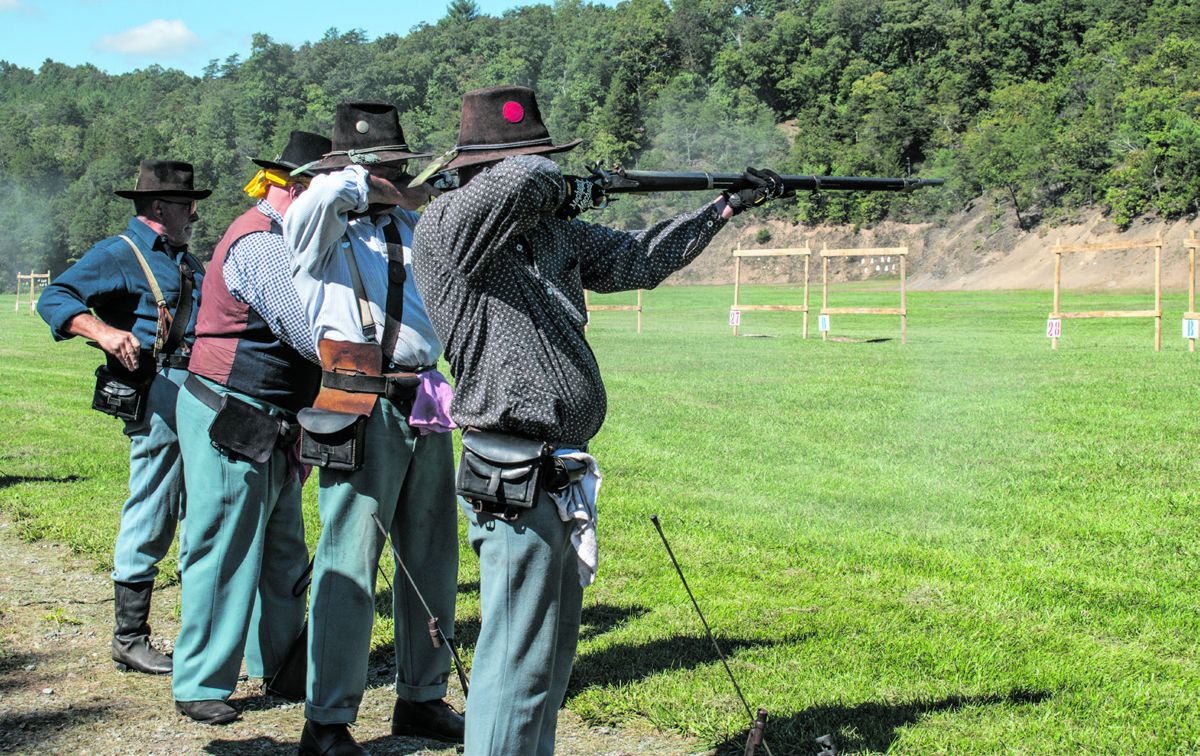
Members of this Union team load and fire at four-inch hanging tiles A member of the 2nd Maryland, Baltimore Light Artillery, CSA, takes during the musket match. At a National Skirmish, musket teams fill careful aim with his Rogers and Spencer during the Revolver Match. 65 line positions; the largest continuous firing line in the country. Walter Zdon Jr. Ericka Hoffmann Curley. Lis Cole. silhouette targets during the smoothbore musket match. Sometimes, skirmishers from different teams will shoot together to make up a full team. Ericka Hoffmann Curley.
As a non-profit organization dedicated to preserving the history of the American Civil War, the N-SSA cares about historical accuracy, and many member units have very authentic uniforms and equipment. Here members of the border state’s First Maryland Infantry, fire smoothbore muskets at 6 x 6 inch hanging tiles 50 yards away. Ericka Hoffmann Curley.
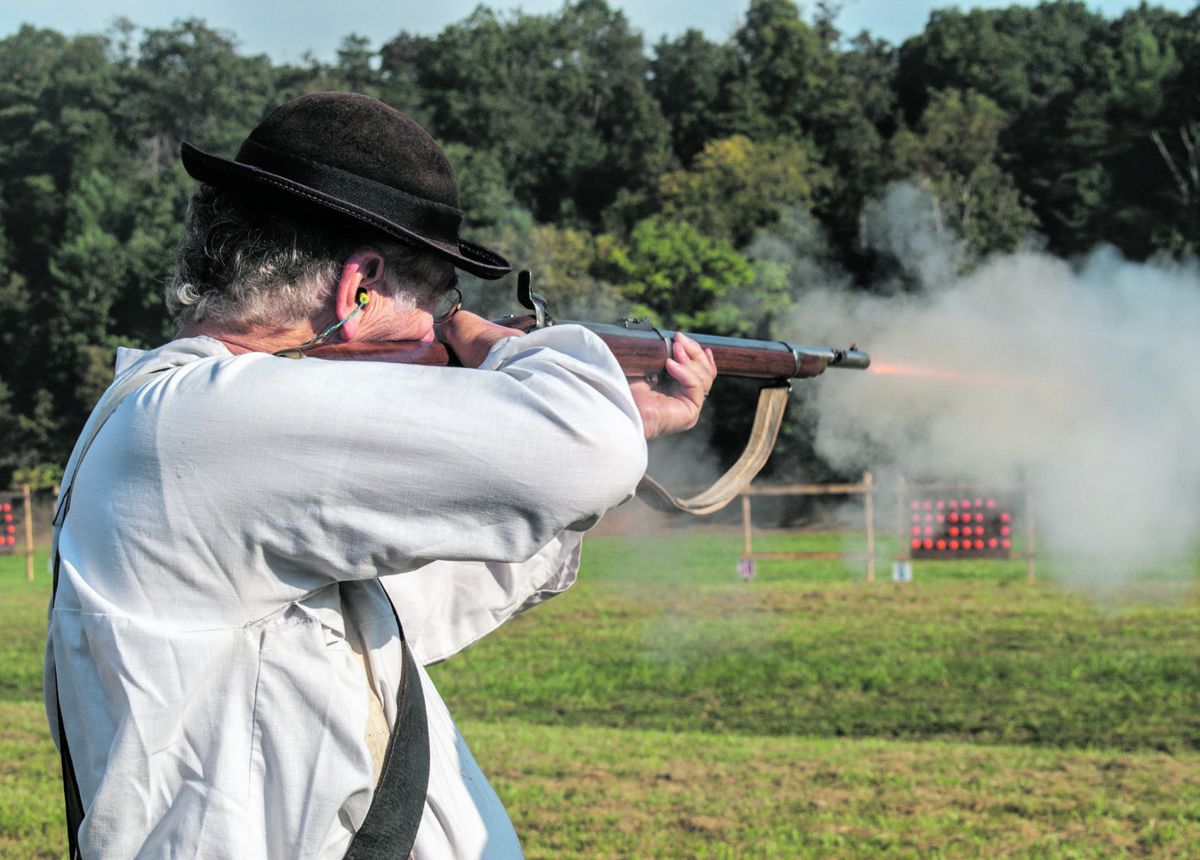
A lot of noise and smoke is produced during the musket match at an N-SSA National Skirmish. Hearing and eye protection is required of all participants, and a safety person with a flag is assigned to each position to ensure that the skirmishers use safe shooting practices. Ericka Hoffmann Curley
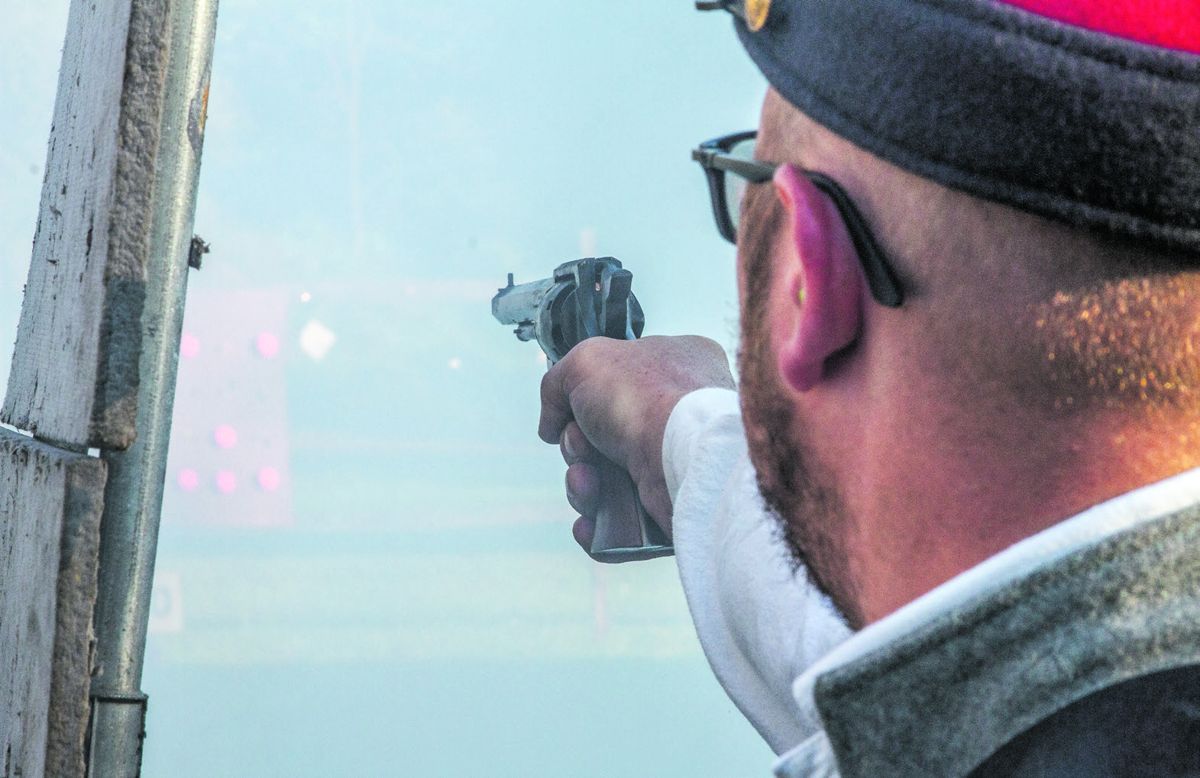
Ben Sims of the 9th Virginia Cavalry loads his revolver, preparing to fire at the next relay of targets. Mr. Sims was also recognized for 50 years of N-SSA membership at the 144th National Skirmish. Walter Zdon Jr.
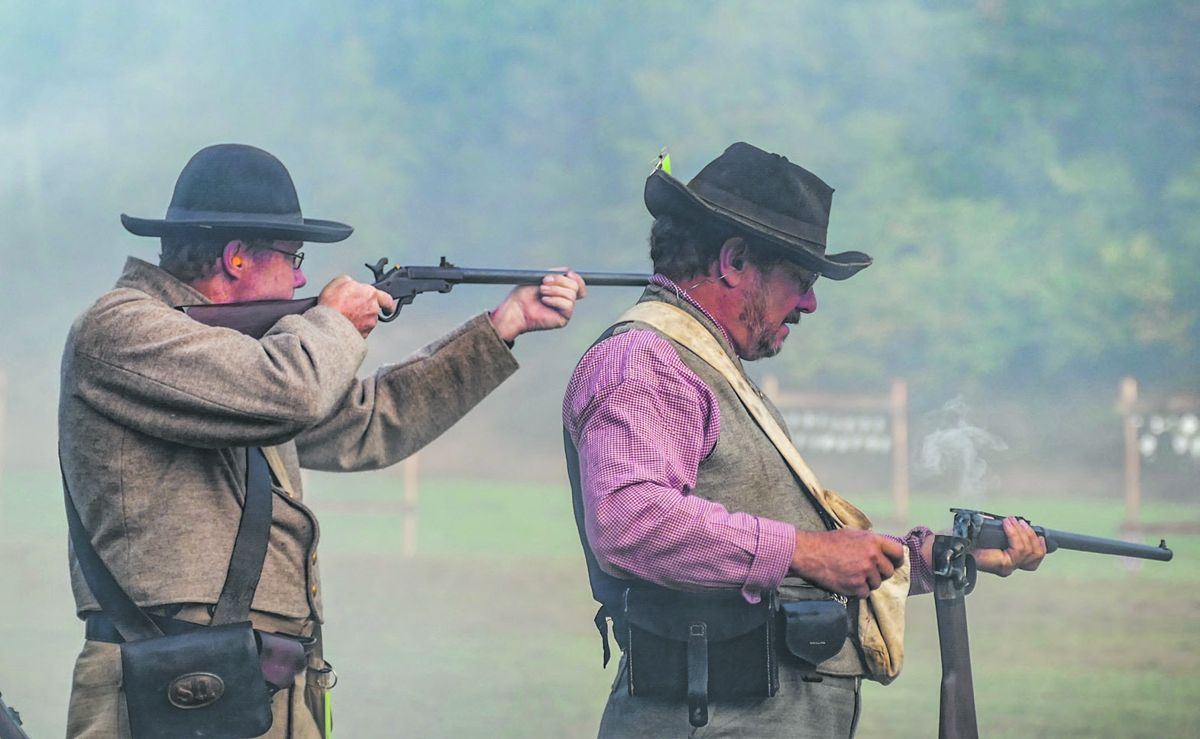
One team member of the authentically uniformed 1st Maryland Infantry rifle musket team has just fired while another one loads his musket for the next shot. Walter Zdon Jr.
The projectile from Dulany Troop, 6th Virginia Cavalry’s mortar arcs toward its mark. The muzzle velocity is sufficiently low that you can follow the flight of the projectile all the way down range. Ericka Hoffmann Curley.