
The Graphic War
Union Volunteer Saloon
By Salvatore Cilella · Originally published August 2021 · pp. 26–27
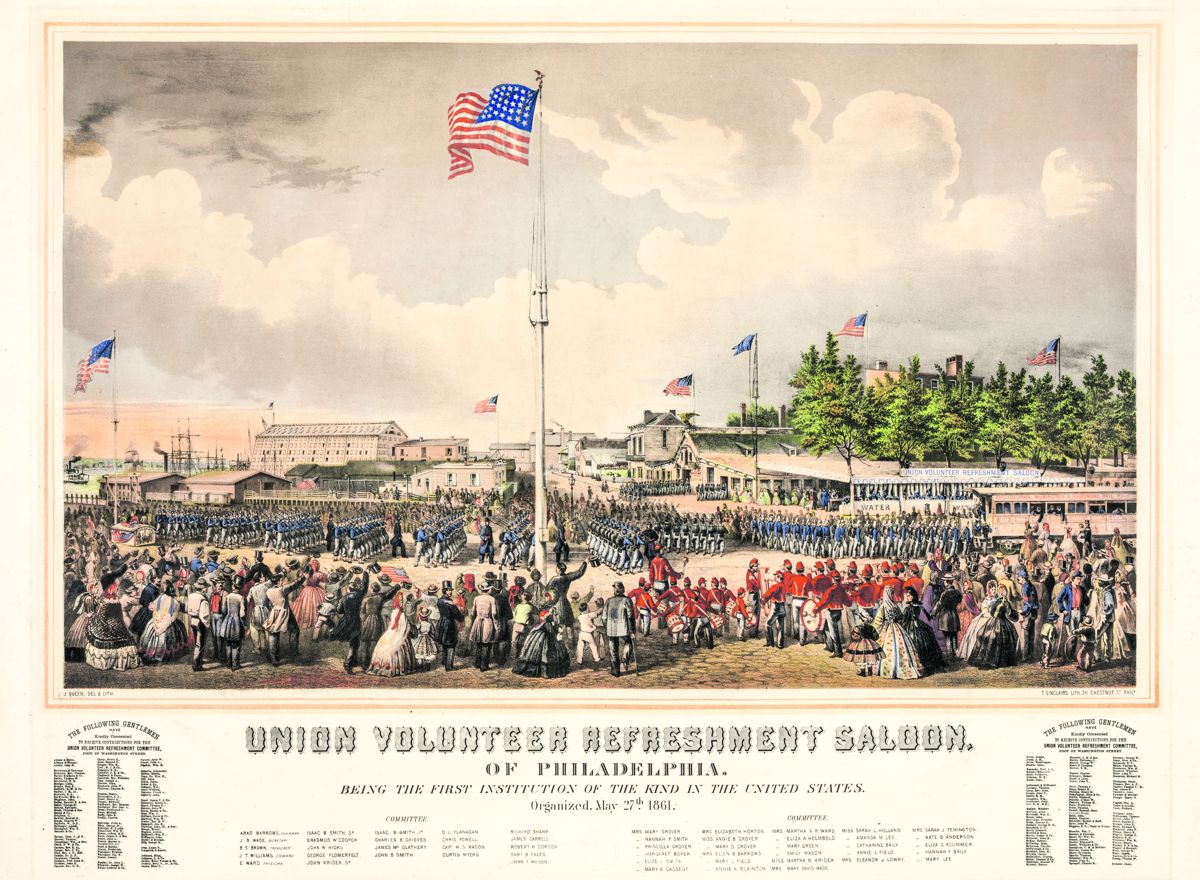
Union Volunteer Saloon The Graphic War highlights prints and printmakers from the Civil War discussing their meaning and the print maker or artist’s goals. The Union Volunteer Saloon in Philadelphia is visually one of the more dramatic scenes captured by lithographers during the Civil War. Artistically it is centered on the American flagpole proudly waving in the midst of bustling activity below. In fact, the viewer can count six U.S. flags and another banner, possibly the Pennsylvania state flag.
As the Library of Congress describes the scene, Union troops have just disembarked “from ferries in Philadelphia, having been transported across the Delaware River from New Jersey. They march in formation toward the Union Volunteer Refreshment Saloon, located at the southwest corner of Swanson and Washington avenues, cheered on by Philadelphians, who have lined up to watch.” These fresh faces occupy the left-hand side of the print while on the right side, troops who have been “refreshed,” tramp toward the “cars” of the Philadelphia, Wilmington, and Baltimore Railroad to take them to the front. Lower right, in their bright, colorful red uniforms, a military band augments the cheering crowd of civilians to its left. The print is another example of the naïve understanding of the horrors of war at an early time, 1861, when most Americans were eager for a quick, decisive war and everyone could go home a hero. In that regard, this print is an excellent piece of documentary evidence of the misplaced enthusiasm for a brutal war no one anticipated. The regiments are in lock step, flags are flying, civilians are cheering as if at a football game, and the band lends a festive air to the entire scene.
“The slant-roofed building just behind the train station is the Refreshment Saloon itself, which offered both food and drink (note the ‘water’ sign visible at right). Over the next four years, the saloon—the forerunner of the USO canteens of World War II— served 600,000 meals and provided space for thousands of soldiers to write letters home.”1 The Saloon was the brainchild of the South Philadelphia grocer, Barzilla S. Brown who “began informally distributing food to Union troops traveling through Philadelphia, an important rail and steamer hub.”2 Beyond food and drink, Brown offered stamps and writing materials. No sooner had the war deteriorated into the blood bath it became, than Brown added a hospital for the sick and wounded. Up until that time, the care of casualties fell to the Sanitary Fairs that sprung up throughout the north. “The saloon supported itself through donations of food, clothing, cash, and later through an admission fee to view the Confederate navy vessel Ram that had been captured in 1863. After providing social and medical services for four years, the saloon closed in late 1865.”3 In the title margin, the artist has included the hundreds of names of committee members and contributors to the cause. The Library of Congress lists this print as published in May 1861; however another source puts the first publication in 1863, having been “commissioned by the volunteer organization’s Picture Fund Committee” and reprinted throughout the war.4 It was published by the Philadelphia lithographic firm of Thomas Sinclair, whose work print author and expert Harry Peters described having “a certain crisp touch that raises it above many.”5 The print generated “more than $1,100” (about $15,000) today. Artist James Queen’s original drawing was “larger than two square feet,” cost “$75 and showed the ‘true exterior view of the institution,’ as described by the committee for their annual report.” Sinclair printed 1,600 copies averaging 40 cents each. The view was “reprinted four times until August 1865, with a total of 3,500 impressions being taken.”6 Of course, the market for all these prints was the thousands of soldiers and their families who trooped through Philadelphia on their way to the front. Philadelphia printer and publisher Peter Duval, who worked on several prints with Queen, called him “one of the best artists in the country. He is very useful to us and we have more work for him than he can do.”7 According to another, “his view of the ‘Union Volunteer Refreshment Saloon’ is one of [his] most complex works and perhaps the one for which he is best known.”8 In 1862, as the war provided Queen with a myriad of subjects, he produced a watercolor of the Citizens Volunteer Hospital in Philadelphia that Duval published. In the center, surrounded by interior vignettes of ten various rooms, Queen depicted another view of the saloon’s exterior. In 1864 he sketched the U.S. Sanitary Fair in Philadelphia.9 Queen enjoyed a long, successful career and, unlike other artists, amassed a comfortable life for himself and his family. He died in 1886 of multiple sclerosis.
Endnotes: 1.
Harold Holzer, Mark E. Neely, Jr. The Union Image: Popular Prints of the Civil War North, Chapel Hill: The University of North Carolina Press, 2000, p. 6. Seth Kaller, website product description. https://tinyurl.com/4fz9hvwn
Ibid. Erika Piola, ed. Philadelphia on Stone: Commercial Lithography in Philadelphia, 1828–1878. University Park: The Pennsylvania State University Press, 2012, p. 28. Harry Peters. America On Stone: The Other Printmakers to the American People. New York: Doubleday & Co., 1931, p. 369. Piola, p. 28 Ibid., p. 90. Kaller.
After 43 years in the museum field, Salvatore Cilella devotes his time collecting American prints and maps and writing. His last professional position was President and CEO of the Atlanta History Center. His most recent books are Upton’s Regulars:
A History of the 121st New York Volunteers in the Civil War (U. Press Kansas,
2009).
His two-volume
Correspondence of Major General
Emory Upton, (U. of Tennessee Press, 2017), received the 2017–
2018 American Civil War Museum’s
Founders Award for outstanding editing of primary source materials. His latest book “Till Death Do Us
Part,” an edit of Upton’s letters to his wife 1868–70, was published in 2020 by the Oklahoma University Press.