
The Return Of The Tuscarora: Company D, 132nd New York Infantry And The Civil War In Eastern North Carolina
By Donald Collins · Originally published August 2021 · pp. 30–34
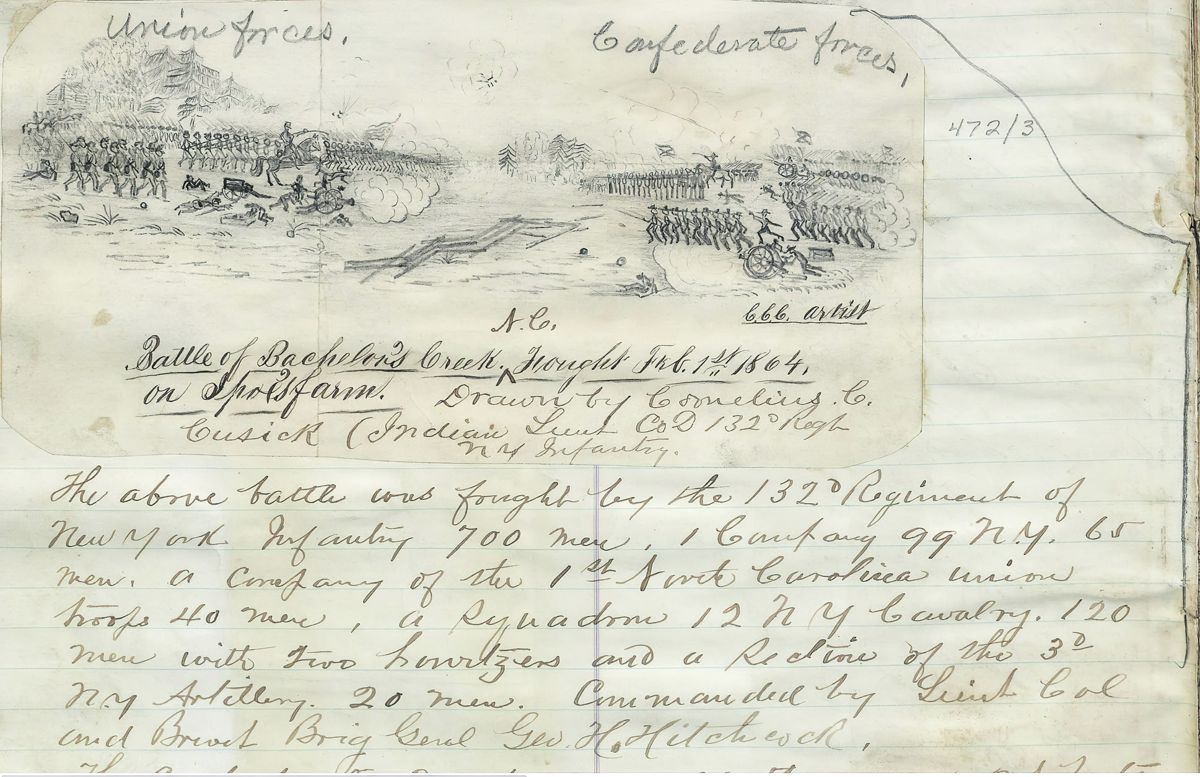
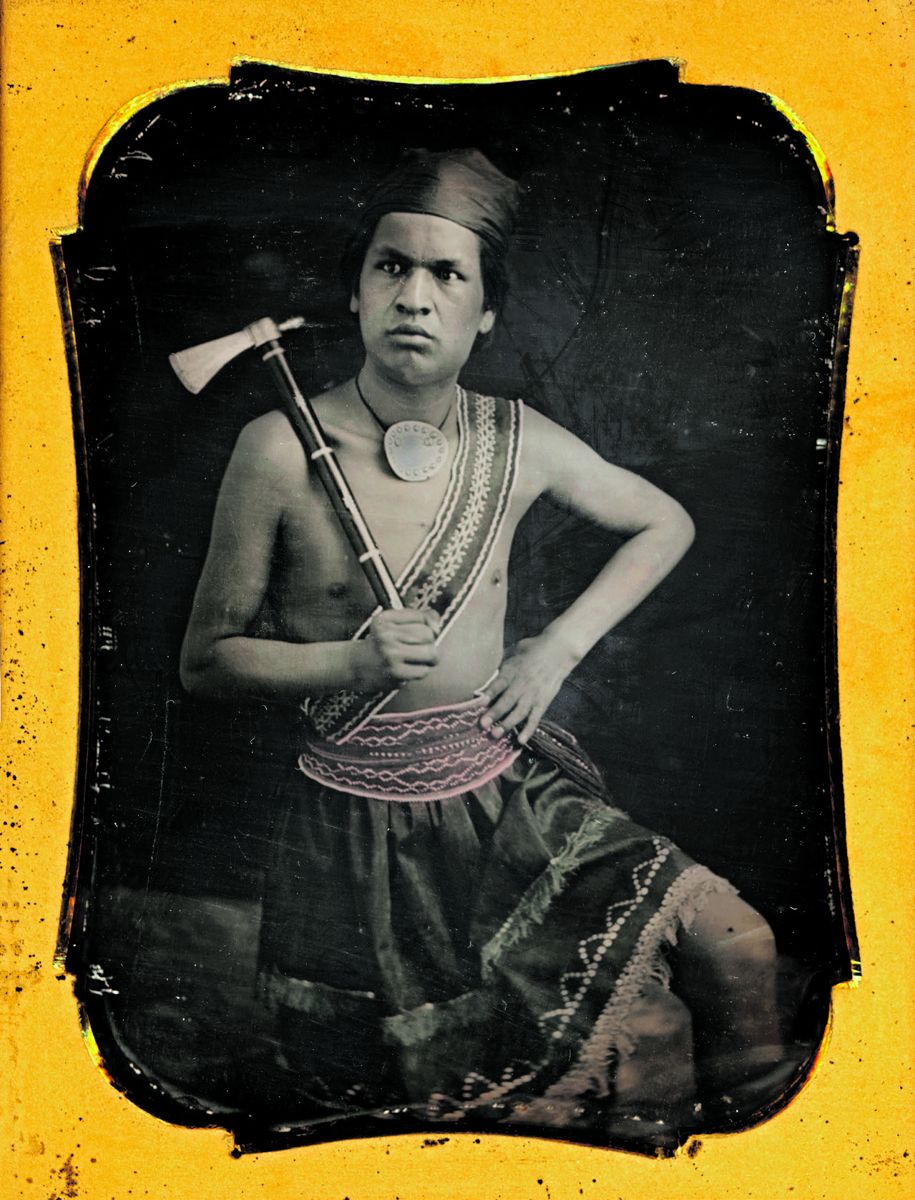
Company D, 132nd New York Infantry And The Civil War In Eastern North Carolina by Donald Collins In March 2013, 140 Tuscarora Indians traveled from their reservation near Niagara Falls, New York, to eastern North Carolina, the land from which their ancestors had been exiled 300 years earlier. The Civil War gave a number of their descendants a different opportunity to return to their former homeland 150 years earlier. In 1711, the tribe initiated a war in retaliation for the loss of lands and sale of tribal members into slavery. That war ended in capture, enslavement, and forced removal from their traditional home in North Carolina to New York, where they became the sixth nation of the Iroquois Confederacy, along with the Seneca, Mohawk, Oneida, Onondaga, and Cayuga. Tuscarora memory runs deep, even today the exiled tribe regards North Carolina as its true “home.” Their return would not be easy. During their lifetime, or those of their parents, the Tuscarora and their Iroquois relatives had experienced more forced removals by the Federal government and discrimination by state government and the public. In 1861, when the Civil War began, New York, unlike neighboring Pennsylvania, forbade military service by Native Americans. The Iroquois Confederation in New York had to fight for the right to serve. Much of the success in their campaign to gain acceptance for military service was due to Cornelius Cusick and, to a lesser extent, Isaac Newton Parker, both leading members of Iroquois tribes; Parker was Seneca, and Cusick, a Tuscarora. Parker would serve in Cusick’s company as a third sergeant and color bearer. His brother Ely gained more fame as a brevet brigadier general on the staff of Ulysses S. Grant. Ely was present at Appomattox Court House; he wrote the surrender document signed by Confederate General Robert E. Lee. Cornelius Cusick was a sachem, or chief, of the Tuscarora tribe. He and his family were among the tribe’s educated, intellectual, and military elite. His grandfather Nichol Cusick had served as a bodyguard and interpreter for General Marquis de Lafayette during the American Revolution; an uncle, David Cusick was author of Sketches of Ancient History of the Six Nations, published in 1828. Following the Civil War, Cornelius would serve as a captain fighting against Indians in the West. For that he would be denied burial on the Tuscarora reservation. An educated man who spoke eight Indian languages, he was appointed special assistant in the Department of American Archaeology and Ethnology at the Columbian Exposition in Chicago. Although his Civil War service was as a first lieutenant of Company D, 132nd New York Infantry, he was at times referred to as its actual leader because of his recruitment activities and leadership. Because of this, Company D was often called the Tuscarora Company, and occasionally as Cusick’s Company.1 Despite its reputation as an Indian company, Native Americans were in fact a minority within the unit. In addition to 25 men from the Iroquois reservations of western New York, it included native-born Americans and naturalized citizens of German birth recruited 1 Company 99 NY 65 men. A Company of the 1st North Carolina Union troops 40 men. A squadron of 12 NY Cavalry. 120 men with two howitzers and a section of the 3d NY Artillery 20 men. Commanded by Lieut Col and Brevet Brig Genl Geo. H. Hitchcock. The Confederates made an assault on our out posts 15,000 strong under Gen. Picket at 2 o’clock AM Feby 1st 64 and were held in check until 11 o’clock AM. a sufficient time to make the woods any disposition of our forces to repel him at every point. Our loss was 84 all told. That of the Confederates being 1500 in killed, wounded, and captured including Col Shaw of North Carolina and Major Rhett of South Carolina. The 132d NY were ordered to place the name of the battled on its colors.” Collections of East Carolina University. at Buffalo, Brooklyn, Lewiston, Manhattan, and Syracuse. After receiving assurances of a $25 bounty, a $2 premium, and a month’s pay of $13 for enlisting, the 25 Indians of Company D, and their regiment, were sent to Camp Scrogg in New York City where they received training during the summer of 1862. On Sept. 28, 1862, the 132nd NY Infantry was sent to Washington, D.C., where it was mustered into service for three years. Sent to Camp Hoffman, in Suffolk, Va., they constructed defensive works, conducted reconnaissance, and did outpost duty during October 1862. The regiment saw limited action at Zuni, where it was in reserve; at Franklin, and on an over-night reconnaissance to the Blackwater River.2 Despite the minor role played in those engagements, the Tuscarora took pride in their first armed contacts with the enemy. John Titus, an Indian member of the Tuscarora Company, wrote “I hope [we] will take another good fight before the month [is] up. I’ll fight the Rebels as long as I live … .”3 In late December 1862, the regiment marched 55 miles to the Chowan River and boarded transports for New Bern, a North Carolina town captured by General Ambrose Burnside in March 1862. Ironically, the Iroquois soldiers now found themselves in the precise area from which the Tuscarora had been exiled 150 years earlier. A nearby settlement west of New Bern was even named Tuscarora. Service in New Bern had a pleasant side. The camp included a bowling alley and theater, and military activities were occasionally broken up by parties and other entertainment. Whiskey rations, referred to as an “army gallon,” were dispensed to the troops.4 Until the final months of the war, much of eastern North Carolina remained contested territory where the countryside was effectively controlled by neither Federal nor Confederate forces. As a result, the 132nd was called upon to participate in reconnaissance missions deep into the contested zone. Years later, in 1896, Colonel P.J. Claassen recalled one such mission. Although he failed to disclose the location or date of the incident, it is evident that it took place during the regiment’s sojourn in New Bern. The 132nd, accompanied by a detachment of cavalry, was ordered to march and cross a certain creek. Upon arrival at the stream, they found it swollen by heavy rains, and a masked Confederate battery on the opposite side made it impossible improvise a bridge by felling trees without receiving unacceptable casualties. Claassen ordered Lt. Cusick to send out an Indian scout, known only as “Big Ike, who was known as a “famous
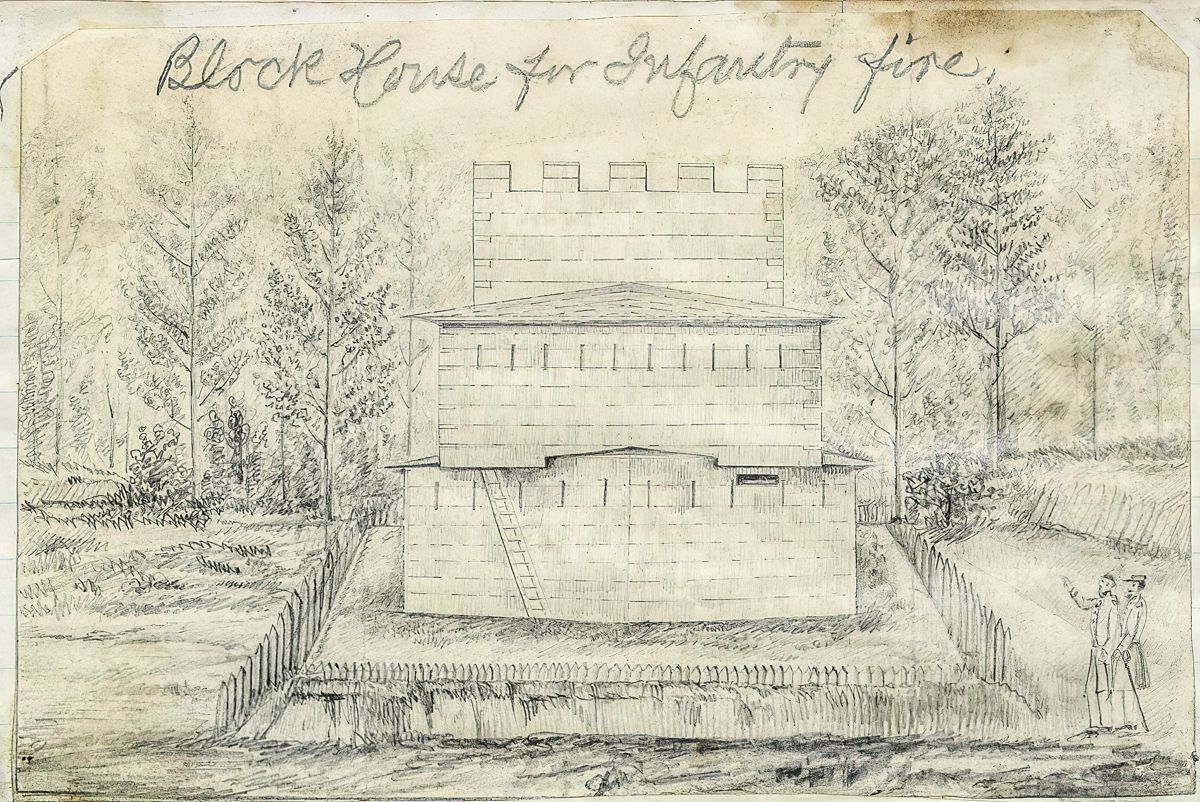
Beech Grove blockhouse.
shot.” With his telescopic rifle, Ike picked off every man who showed himself until the Rebel force was so depleted they could not man their guns. This “unusual slaughter of brave foes,” enabled the 132nd to cross and continue their reconnaissance.5 An unsubstantiated rumor of scalping appeared soon after completing the expedition. Portions of a letter from a Union officer in New Bern appeared in the June 1863 New York Church Journal. Included was the statement, “There are two companies of Indians in Colonel [Peter J.] Claassen’s Regiment, and every Rebel they caught yesterday was killed and scalped, and it served the devils right.” The colonel angrily denied the allegation in a letter to the Journal, and demanded that the writer be sought out and punished. No further action appears to have been taken, and the affair quietly disappeared.6
The Bachelor’s Creek Outpost: The comforts of New Bern’s camp life were replaced in May 1863 by transfer to outpost duty eight miles west along Bachelor’s Creek, the western-most defensive line of the Federal occupation force. Beyond the creek was a no man’s land where elements of both opposing armies operated freely. Until then, the outpost between Union-occupied New Bern and Confederate-held Kinston some thirty miles farther west had been performed by the 58th Pennsylvania Volunteer Infantry Regiment under Colonel John Richter Jones. Shifting the 132nd to outpost duty was the result of a successful May 22nd raid on a Southern outpost at Gum Swamp, a few miles east of Kinston. Jones’ poorly conducted return to New Bern cost him his life. A Confederate force under General Daniel H. Hill followed and caught the Federals unaware of any pursuit at the Neuse Road Bridge. While rallying his men, Jones was shot through the heart by a Southern rifleman. On May 23rd, the 132nd, with a battery of the 3rd New York Artillery and a 3rd New York Cavalry squadron, was ordered to support the 58th Pennsylvania. The Tuscarora Company, along with Company I and a half-section of artillery, was ordered to keep communications with New Bern open while the remainder of the relief force continued to the Neuse Road Bridge. Before Claassen and the 132nd reached them, the 58th Penn. Inf. retreated but were ordered back to the bridge. When within easy supporting distance of the 58th, Claassen encamped for the night, but on receiving information of enemy movements, companies C and G were ordered to the bridge crossing. Arriving at one a.m., the two companies occupied rifle pits guarding the bridge, but found nothing of interest. Next morning, 16 men reconnoitered beyond the creek for three miles and learned the Rebels had withdrawn and took three prisoners. During the return march to Bachelor’s Creek, news reached Claassen that Colonel Jones had been killed. This placed him in command.7 The 132nd New York was then ordered to replace the 58th Pennsylvania on the Bachelor’s Creek line. The New Yorkers arrived on May 26, 1863. As the westernmost defensive line for Union New Bern, the 132nd was to keep an eye on any Confederate activity that might threaten the town, a duty they kept up for the next two years. Picket, reconnaissance, and scouting became the primary duties of the New York regiment. Another duty involved intercepting Confederate deserters and retrieving their families. On one occasion, the Tuscarora Company took part in an expedition to nearby Trenton and retrieved four families of Southern deserters. These men often enlisted in the First and Second North Carolina Union regiments. In December 1863, Company F, Second NC (Union) joined the 132nd on picket duty at Beech Grove, the northernmost post on the Bachelor’s Creek line. Sergeant Isaac Newton “Newt” Parker, a Seneca Indian in the Tuscarora Company, described the outpost in an August 15, 1863, letter to his sister-in-law: “We hold a front here of nigh seven miles running at right angles to the R. R. and the R. R. being the center of our line. Then there are three miles upon each flank that are picketed by cavalry. But in the two recent expeditions from here, the cavalry were drawn off and then we picketed those six miles, making nigh 13 miles of front and me, not having now 600 effective men …”8 Parker, in the same letter, expressed confidence that the nature of the land made an attack by the enemy on the outpost difficult, if not nearly impossible. “We are considered bold by holding so large a front — and lively will be the time whenever we will be attacked, but that is rather doubtful, for it is difficult of access to our camp or fort, being much surrounded by swamps and heavy pine wood lands for miles around, so much so that heavy artillery can’t come in, and hard for infantry to penetrate in so on the whole we are right well fortified by the country itself.” Although not mentioned by Parker, the most formidable obstacle to attackers was Bachelor’s Creek itself, which is why it formed the base line for the outer Federal defenses. According to one 132nd soldier, the creek “is a narrow, marshy bordered and some places impassable little stream … For one party or the other to cross in small bodies is most certain capture or death. Along the outer banks of the creek our pickets are posted.”9 This feeling, plus “eight months of uninterrupted quiet … , lulled the department into a full-spirit of security.”10 There was little reason to expect any assault on New Bern, an attack that came early on January 31, after “our usual scouting party had returned with the information: no enemy, and we all had laid ourselves down to sleep,” only to be awakened “when on the air [came] the boom of cannon and cracking.”11 What the letter-writer heard was the opening salvo of the Battle of Bachelor’s Creek and the commencement of a full-scale attack on New Bern by an army of fifteen thousand men under General George Pickett. Pickett’s plan to retake New Bern called for a three-pronged attack. Colonel James Dearing’s Brigade was ordered to move on Fort Anderson across the Neuse from New Bern; while General Seth Barton, with Ransom’s and
Terry’s Brigades, were ordered to advance through Pollocksville south of the Trent River, interdict communications with Beaufort, and construct batteries along the Neuse River below its junction with the Trent. Pickett himself joined the six thousand-man center column, under the immediate command of General Robert Hoke, that would move directly east between the two rivers toward New Bern. The only thing that stood between the Confederates capturing New Bern was the thinly stretched line of the 132nd New York Infantry along Bachelor’s Creek.12 To maintain the element of surprise, Hoke’s column camped without fires two miles from Bachelor’s Creek. At one o’clock a.m. the Southerners awakened and began moving along the
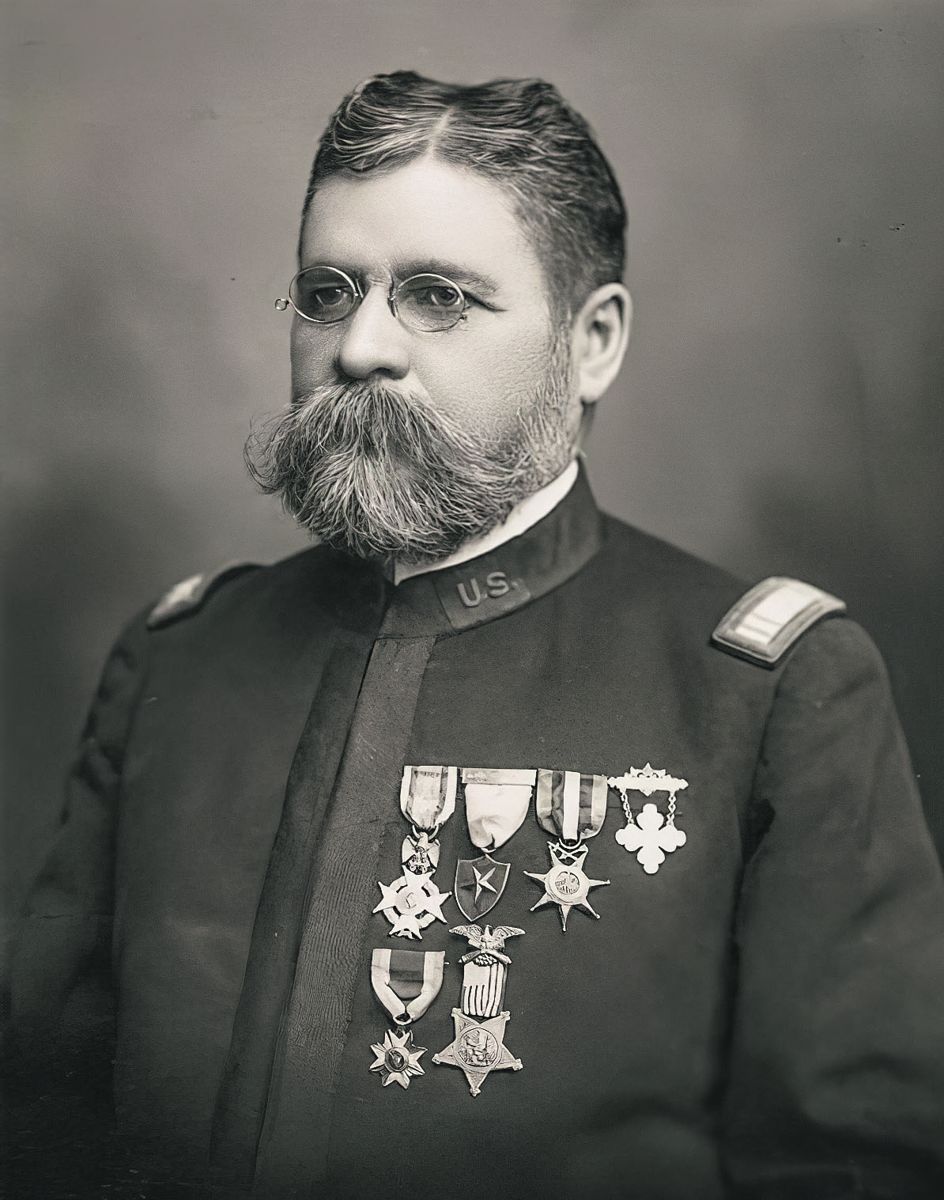
Isaac Newton Parker after war.
Isaac Newton Parker, Sgt. 132nd NY.
Neuse Road toward Bachelor’s Creek, which, if crossed successfully, would put them at New Bern before sunrise. At 2:30 a.m., the first 132nd New York pickets were quietly taken. Pickets at a third outpost, however, opened fire and escaped over the bridge in time to warn the tiny nine-man reserve post stationed there. The warning enabled them to remove seventy-five feet of bridge flooring, already loosely placed to slow any crossing.13 The small Federal outpost under Lieut. Abram Haring consisted of a blockhouse with breastworks on both sides of the road where it crossed the bridge. Aiding the Union garrison was a drizzling rain, darkness, and later a dense morning fog that kept Hoke ignorant of the number of men holding the bridge. Initially, the Confederates attempted to charge across the floorless bridge three times, each attack being repulsed by Haring’s men. A number of Hoke’s men, wounded on the bridge, were seen falling into the creek. Failing to move his men over the bridge, Hoke placed more men along the creek to keep up a steady fire on the defenders.14 The situation remained static for an hour and a half. Captain Charles G. Smith, the regiment’s officer of the day, was sent by Claassen to learn the situation. Smith noted the Confederates were “yelling like devils,” and, “feeling conscious of their strength, had advanced to the edge of the creek in considerable numbers, in front and on the right, and were trying to hit wherever they saw a head or heard a noise.” The rebel fire was severe, and four Napoleons added their shell and canister. The four 12pdrs had the range but generally fired too high.15 Federal sharpshooters, firing from the blockhouse, forced the rebel artillery to move several times. As Haring’s men fired their last ammunition, Company D arrived. They immediately “took position at the breastworks and deployed along the creek to the left, firing with great spirit, holding the enemy in check, and apparently doing considerable execution, as the rebel fire slackened for a few minutes.” The North Carolina Times, the Union army’s New Bern newspaper, stressed the role Native Americans played in relating details of the fight. “The company numbers in its ranks thirty Indians of the Tuscarora tribe, with Lt. Cusick, himself a chief of the Tuscaroras.” “The native impetuosity of the red man, in all it’s wouted [sic] violence burst forth, in well nigh uncontrollable fury. Onward they pressed amid a deluge of bullets
… gallant [company commander Thomas B.] Green urging [them] … on with dauntless bravery, twice were they driven back by the surging columns of the enemy and twice did they advance again to the attack. As if impelled by super human energy they charged upon the rebel ranks, and again were compelled to retire, the voice of Green ringing loud above the clash of battle in appeals to his men with undiminished courage and heroism.”16 The Tuscarora Company was followed by companies E and G, under Capt. Peter S. Geraty and First Lieut. Joseph A. Gearing. Their men were immediately deployed across the road and to the right of the bridge. At 5 a.m., Major John B. Honstain was sent by Claassen to assume command. The Federals were suffering heavy losses. Lieut. William Ryan of Company G fell seriously wounded attempting to “dislodge an enemy body from an advantageous point the enemy had gained.” Lieut. Gearing received a serious wound on the side of his face fracturing his jaw. Around nine a.m., Lieut. Arnold Zenetti was killed, shot in the forehead while passing out ammunition.17 By this time, the bridge defenders had frustrated the move toward New Bern for six hours. The delay came to an end when the General Hoke sent his men across the creek using fallen trees as make-shift bridges. Two regiments under Colonel John T. Mercer of the 21st Georgia crossed the stream and moved against the Federal flank and rear, while Hoke repaired the bridge under fire and then sent the remainder of his command across.18 These moves were accomplished by nine a.m. Hoke then moved his men down the road and along the railroad tracks. With Confederates pressing on three sides, Claassen ordered a general retreat. He ordered the outpost burned, including both military and personal possessions. Claassen himself remained until he saw Confederate bayonets in the woods.19 The battle and retreat from Bachelor’s Creek cost the outpost defenders heavily: 326 killed, wounded, or captured. Companies C, D, and G, which had carried the brunt of the battle at the Neuse Road Bridge suffered two killed, three wounded, and thirty-two missing. When the 132nd New York reassembled behind the New Bern breastworks, the Tuscarora Company had lost five men at the bridge and during the retreat. All would die as prisoners of war. The defense at the bridge had delayed Pickett and Hoke by six hours.
The Confederates waited outside New Bern until February 4 then withdrew without taking the town. In all likelihood, the failure to take New Bern was the six hours lost by the 132nd’s defense at the Neuse Road Bridge. But for that, the Confederates would have surprised the Union forces, giving them little time in which to ready their defense against the superior Confederate numbers.
Mine Disaster, May 26, 1864: The 132nd returned to outpost duty at Bachelor’s Creek on February 5, 1864, where it experienced a temporary rest period. The calm was broken by an accidental explosion that brought more casualties in a split second than the regiment experienced during any single combat action. On May 29, 1864, Lieut. and Tuscarora chief Cornelius Cusick wrote the Niagara County Intelligencer of an accident in which “35 [men] were instantly killed and 32 mortally injured.” The incident Cusick described took place on May 26, when the four p.m. military train from New Bern rolled up to the Bachelor’s Creek outpost adjacent to the 132nd New York’s camp. The platform was crowded with Negro contrabands and soldiers from the 132nd, 12th New York Cavalry, and 158th New York. Some were waiting to unload the train and others to hear news from the outside world. All were ignorant of the fact that four wooden barrels, each filled with 250 pounds of powder, were on board. They were the last of thirteen torpedoes, or mines, sent from New Bern to be placed in the Neuse River for protection against a Confederate ironclad known to be under construction in Kinston. When the train arrived, a Lieutenant Jones, commander of the unloading detail, failed to inform his men of the barrels’ contents, and carelessly left them unguarded. The regimental quartermaster-sergeant assumed the barrels were supplies and ordered them removed from the train. He personally rolled the first one safely onto the platform. When the second was unloaded, a trigger was tripped detonating the four torpedoes almost simultaneously. The concussion was heard 20 miles away in Kinston.20 In that instant, the commissary building, the one hundred feet long loading platform, and a ninety feet tall signal tower were blown into splinters. The train was covered with “blood and gore,” but otherwise undamaged. “Heads, bodies, and limbs were scattered for a quarter of a mile around, and in many instances it was found impossible to recognize the remains of the victims.” Many of those killed were so mutilated and dismembered as to be “unrecognizable to their dearest friends.” The quartermaster sergeant who unloaded the first barrel was identified by a ring on his dismembered arm. Forty wounded were taken to New Bern on a platform car covered with straw.21 Estimates of the dead and wounded varied. Some were listed simply as missing, as their remains were unidentifiable. The 132nd New York suffered the most. Lt. Cusick reported 35 killed instantly and 32 mortally injured; the New Bern paper estimated 40 killed and 17 wounded. Casualties were also suffered by the 158th New York Infantry, the 12th New York Cavalry, and the Second North Carolina (white) Union Infantry. In addition to military deaths, 20 to 25 contrabands were estimated to have been among the dead and wounded. These figures do not include those that later died of their wounds.22
The Fight At Jackson’s Mills, On June 20, Claassen received orders to move with a portion of his command against Confederates outposts at Jackson’s Mills and Wyse’s Forks, outside Kinston. If the outposts were taken, they were to move on the rebel town itself and destroy the ironclad CSS Neuse being completed. For the expedition, he selected men from the132nd NY, the 15th Conn., two batteries with four 3-inch guns from the 3rd NY Artillery, and two companies from the 12th NY Cavalry, a total of approximately 900 men. Claassen’s tactics called for a three-pronged attack. The Tuscarora and two other companies (I and K) of the 132nd, under Capt. Thomas Green, were to move early and take back-roads to avoid detection. They were to take the Confederate outpost at Jackson’s Mills where a bridge crossed Southwest Creek. This attack was expected to cut off any retreat when the main column under Claassen attacked Wyse’s Forks via the Dover Road, and another column attacked along the Neuse Road. All three columns were to attack at precisely ten p.m. on June 21, 1864. The largest force was devoted to the works at Wise’s Forks, as it was believed to be the stronger objective. Once reunited, the three Union units would determine the feasibility of moving on to take
Kinston. The plan to take Wyse’s Forks and Jackson’s Mills worked to perfection. On June 20, at five p.m., Capt. Green left the Bachelor’s Creek camp guided by a local Unionist who took them via back-roads and swamps to a point near Jackson’s Mill where they hid until the attack. Cusick, the highly literate Tuscaroran, described this tortuous aspect of the affair in great detail in an August 16, 1896, article for the Albany (NY) Argus:23 “The march to this point was a most laborious one—being over tortuous by-paths, through thick jungles, interlaced with brier-wood vines, and frequently having to wade waist-deep through many swamps, the water of which was covered with green and black sticky scum, and infested by snakes and other poisonous reptiles…” Reaching the point from where the objective would be assaulted, Green’s column remained hidden in a cornfield to await the designated hour. The other two columns waited until five a.m., June 21, to leave Bachelor’s Creek since their march took more direct roads to Wyse’s Fork. Both met unexpectedly light resistance. Claassen first encountered Rebel pickets on the Dover Road 14 miles from Kinston, while Hitchcock met them nine miles out along the Neuse road. The attacks on the pickets began at precisely ten o’clock p.m. as previously arranged and a running skirmish took place. On the Neuse Road, rebel cavalry withdrew in front of Hitchcock’s men. Succeeding posts were taken with little difficulty, causing little delay in moving toward the main target at Wyse’s Fork. On the Dover Road, when Claassen attacked the works at Wise’s Forks, the enemy broke and fled in such haste they left behind muskets and meal “to be destroyed or gobbled up by the audacious Yankees.”24 Two hours before the main column attacked Wyse’s Fork, Green struck at Jackson’s Mills. Cusick described the event in his Albany Argus article: A flanking position having been taken, the captain (Green) awaited signal shots from the main center column, which had been designed to attack the enemy’s outpost camp. Hearing none, and the hour for his continued march in the direction of the… the cornfield was left… … After a march of half an hour, the column found itself within 200 yards from the Mills, where it was halted, Captain Green, in an undertone, his voice just above a whisper, said, “Corneal,”
meaning Lieutenant Cusick, “you continue in full charge of our company, as you have been during the day; proceed with it as vanguard about 50 yards in advance of the other two companies; fix bayonets; advance quickly, but quietly; if challenged, halt, and reply, ‘friends!’” threaten the sentinel with instant death if he gives an alarm, or makes any noise. A few moment’s (sic) march brought the vanguard … [to] a soldier … nearly 200 yards from the main guard, which occupied works 100 yards beyond the mills. The sentinel was approached…the instructions of Captain Green were fully, successfully and happily carried out. Capt. Green’s flanking column completely surprised the main guard at Jackson’s Mills … not a shot was fired, all quietly and peaceably surrendered. The works found were in the character of entrenchments and rifle-pits and were speedily manned … the Tuscarora or Iroquois company under Lt. Cusick posted several yards in the rear of the works and in the direction of Kinston. Shortly after these dispositions were made a mounted courier came dashing along from Kinston. The company stationed on the roadside in the rear of the works permitted him to approach and quietly gathered him in, horse, bag, countersign and letter of instructions, etc. He was a bearer of a dispatch from Gen. Foulk [sic Colonel Nathaniel Folk, 65th Inf., NC State Troops], commanding forces and defenses of Kinston …The letter captured contained instructions to withdraw at once from the outpost and occupy the intrenchments at Jackson’s Mills, and that the enemy was approaching his outpost in force, by road to his camp and by roads to the right and left of it. A half-hour passed, when another courier bearing similar message to the first, was also taken prisoner. Gen. Foulk, not hearing from Major Scann, concluded something was wrong at the [Wyse’s Forks] outpost. In this he was mistaken, as the whole trouble was at Jackson’s Mills… at the very gate and door of the inner defenses of Kinston. Still another half hour passed, when the commanding officer himself, with his post adjutant-general, came riding furiously down from headquarters at Kinston to learn what had become of his couriers. They were permitted to approach the Tuscarora company within five yards, when its commander, in a clear and steady voice, commanded, “Halt!” dismount and surrender!” The general was angered that he should be thus delayed and answered back, “Men, I am General Foulk. You all know me.” “Yes, we all know you, and the second time I order you to dismount and surrender.” By this time the general and his aid [sic aide] were well surrounded by the dusky soldiers. He was greatly mortified when he realized his delicate plight and instantly dismounted from his horse, followed by his adjutant. To the second challenge, “Do you surrender?” he answered, “Certainly I do; this is a bad box; there is no help for it. I am your prisoner — I only wish this was your experience instead of mine.” He then offered his side arms to the lieutenant, with whom he had the parley — the writer [Cornelius Cusick] — who declined to receive them, but at the same time said, “Captain T. B. Green, who is in command, will receive them instead of me.” The captain promptly appeared and received the side arms At 10:40 p.m. came the distinct report of musketry in the direction of the Confederate outpost at Wise’s [sic Wyse] Forks. First, a single shot, quickly followed by another — evidently alarm shots from a sentinel. Only a minute’s time intervened when a perfect fusillade of musketry was heard. Col. Claassen had reached and surprised the rebel outpost, it being only two miles away from Jackson’s Mills. A moment later the sound of horse hoofs could be heard — then faint yells from the throats of Union infantry and cavalry. It was deep-toned, quite unlike the shrill rebel sound. Five minutes later rapid firing ceased and became desultory. The pounding and clatter of horse hoofs; the deep rumbling of wagons in flight toward Jackson’s Mills, both in concert became louder and louder than ever; soon curses and cracks of whip lashes became decidedly distinct, indicating and attesting the work of Claassen as being fully accomplished — and in a sweeping and resistless manner, for the enemy was in full flight and only to reach a point where death, captivity and wounds awaited them, for Captain Green and his devoted little band were in possession of the intrenchments [sic] at Jackson’s Mills. At 11:30 p.m., the retreating rebels fleeing by the Jackson’s Mills Road were first sighted in the shape of a baggage wagon, that came rumbling down to the bridge in charge of a Lieutenant Brothers, of the Sixty-seventh N.C. regiment. The lieutenant, outstripping the lightest and headmost wagon in his eager flight, on reaching and discovering the dismantled bridge, became wild with rage, and burst out with curses. He yelled and bawled out to some person he faintly saw on the opposite of the stream, a hundred yards away, “Who ordered that bridge up?” The “some person” on the other side answered that he ordered it up to stop the infernal Yankees from crossing, adding: “But, come over, and if you want to get the wagons across, we will put the planking down.” Over comes the lieutenant on one of the stringers, cursing at the same time incessantly at the stupid fool who ordered up that bridge. He was no sooner across than a revolver was pointed into his face, and he was commanded to surrender instantly. The lieutenant was badly frightened as well as astonished. As he gave up his arms he remarked: “No one but a Yankee could play me such a clever trick as that.” Following this brief episode came the arrival of the retreating Confederate infantry. It was properly challenged and a prompt answer given by the officer in command. He little expected that the challenge was made by an adversary, and that the position was under Federal occupation. He was requested in a low and meek tone of voice to cross the creek by the stringer of the dismantled bridge, and form his command on the immediate grounds as the men crossed over. Captain Green, in a loud, sharp and distinct tone of voice, demanded the instant surrender of the Confederate command. The situation was still not understood by the Confederate commander, as he replied by giving his rank and name, and said that the Yankees were approaching rapidly, and would be here “right, smart, soon.” Another demand was made by Captain Green for the surrender, supplementing the demand this time with these words, “and damn quick at that.” The reply given was, “To whom?” Captain Green promptly answered, “To Federal troops of the One Hundred and Thirty-second New York.” The last and only words expressed by the Confederate commander were, “Surrender yourselves you __ Yankee sons of __.” These words were instantly followed by the clicking of musket triggers of the Confederates, and following quickly, the firing of a volley at the men in the intrenchments (sic). The fire was aimed too high, for not a man was hit. Captain Green and his officers simultaneously and as one voice ordered, “Fire, and fire low!” It was instantly obeyed, and one volley fired from ninety Belgium muskets accomplished its work — it was a bloody execution, … After the volley was fired not a man could be seen standing, and it was followed by heart-rending moans and groans of the dying and wounded enemy. The road was actually blockaded by them. … In less than two hours time five officers and forty-one non-commissioned officers and privates fell into Captain Green’s hands. His [Green’s] position was at last discovered by the enemy and his capture of General Foulk was found out. He fought hard to defend his breastworks and keep well secured his prisoners. Shortly after midnight a troop of the Sixth N. C. cavalary [sic] made a desperate attempt to rescue their general. The troop made a furious and reckless charge, but was speedily repulsed, leaving behind it nine killed, including two officers and fourteen wounded. Among the killed was the young and brave Lieutenant De Hart who led the charge, and refused when commanded (by Lieutenant Cusick, the writer) to surrender. In less than two hours, Green’s three companies had the outpost at Jackson’s Mills fully under control. During that time, they had killed or wounded twenty to twenty-five of the enemy, captured five officers, including the commander of Kinston, fifty-one enlisted men, forty horses and mules, and a wagon-train loaded with commissary stores, officers’ private baggage, arms, ammunition, etc. All the while losing only one killed and one wounded. The outcome of this affair was still unknown to the main body at Wyse’s Forks. Claassen became aware of the fact when he joined eight companies of his own men who had advanced to within three quarters of a mile of Southwest Creek. With Wyse’s Forks and Jackson’s Mills safely in hand, Claassen’s next move was to determine the practicality of attacking Kinston. A reconnaissance found the road to Kinston strongly fortified and garrisoned by infantry, cavalry, and twelve pieces of field artillery. Claassen determined his force was too small to attack Kinston after scouts reported the Confederate position was too strong. As a result, he ordered Jackson’s Mills evacuated and all bridges destroyed. By dawn, the expedition returned to Bachelor’s Creek with a loss of only one killed, no wounded, and three missing. They had marched and fought from 5 a.m. June 21, till 5 a.m. June 23, 1864, having covered a distance of sixty-five miles.
Expedition To Kinston, December 1864: The several months following the return from Kinston were relatively uneventful, with the regiment occupied mainly in picket and scouting duty. Camp routine was broken in December by another expedition to Jackson’s Mills and Kinston. On Dec. 9, 1864, orders were issued for an advance on Kinston to feel out the enemy, and if possible, capture the town. The expedition was composed of the 132nd NY Inf., the 12th NY Cav., the 15th Conn. Inf., and detachments of the 5th RI and 2nd Mass. Heavy Arty., under command of Colonel Charles L. Upham of the Connecticut regiment.25 The 132nd and 12th moved out for Core Creek, where they rendezvoused with the 15th Connecticut, and the Rhode Island and Massachusetts heavy artillery. Weather hampered the expedition from the very beginning. Once the 15th Conn. Inf. and the RI artillery arrived at the rendezvous, the weather caused another day’s delay. This provided time for the enemy to prepare for the attack.26 The next morning, Sunday, Dec. 11, it was still raining, but the command marched at 8 o’clock with the 12th NY in advance. At 10 o’clock the Federals struck the rebel outpost at Wyse’s Forks. The Southerners were driven back under a scattering fire until the Southwest Creek Bridge at Jackson’s Mills was reached about 4 p.m. The cavalry and artillery crossed the creek that night but were compelled to retreat by Confederate cavalry and artillery. The next morning, there was a spirited twenty-minute skirmish at the bridge. The 132nd’s Tuscarora and B companies were unable to take the bridge and rebel breastworks. The mission as a whole was a failure; the expedition began a return to New Bern and Bachelor’s Creek.27 En route, they were subjected to enemy fire at various points. Official reports deny failure, although little had been accomplished. The men complained that it had been “the most disagreeable and fruitless expedition the regiment ever undertook, and that the men were “tired and footsore after the sixty mile cold and rain-soaked march.”28 The Tuscarora Company and their fellow New Yorkers went back to Bachelor’s Creek. Three more months of reconnaissance and scouting duty were followed by success as the Tuscarora Company and the 132nd assumed a leading role in the move to take Kinston en route to joining General Sherman’s armies.
The Battle Of Wise’s (Wyse’s) Forks, March 8 - 10, 1865 By early March 1865, the war’s end was in sight. Lee’s Army of Northern Virginia was under siege in Petersburg, Va.; General Sherman had completed his march through Georgia and South Carolina, and was advancing through North Carolina to join Grant. The last supply line to the Confederates in Virginia had been closed with the losses of Fort Fisher and Wilmington. Federal troops around New Bern were ordered to open the railroad through Kinston as a supply line for Sherman’s army as it neared Goldsboro. Major General Jacob D. Cox, who had moved his force from Fort Fisher, assumed command of the Federal troops in New Bern. The 132nd New York was placed in Brigadier General Innis N. Palmer’s Division of Cox’s Provisional Corps. With an army of 12,000 men, Cox expected little serious opposition around Kinston, which had been lightly defended throughout the war. Unknown to him, Confederate General Braxton Bragg had gathered a force of 8,000 men that he lined up at Southwest Creek to block his advance. Cox selected the railroad crossing at Core Creek, nine miles west of Bachelor’s Creek, as the assembly point for his troops. At Core Creek, Claassen was given command of a brigade consisting of his 132nd NY, the Second Brigade of General Meagher’s Division, and Battery D, 3rd NY Arty. The 132nd New York, being intimately familiar with the area, was given the honor of leading the advance on Kinston. On March 5, Claassen ordered Captain Green, with his Tuscarora Company and companies K, C, and E, to move ahead and seize the Dover Road railroad crossing at Gum Swamp, seven miles beyond Core Creek. Aided by darkness, they marched west, unmolested, along the railroad, where they successfully occupied the abandoned Confederate works guarding the crossing. The next morning, Claassen arrived with the remainder of the regiment, making the new position secure. They were joined at Gum Swamp by two more brigades under
General Harland and Colonel Boughton.29 MARCH 6: At 2:30 p.m. on the sixth, the 132nd, with Graham’s mountain howitzers, and Company L, 1st NC Union Volunteers, began moving along the Dover Road toward Wyse’s Forks. At Tracy’s Swamp, where the railroad crossed the road, they encountered a strong Rebel position. Graham’s cannon, and the two companies, the Yankee Carolinians and Green’s Tuscaroras of the 132nd New York, drove them from position to position until Wyse’s Forks was reached approximately 4:30 that afternoon.30 A Confederate deserter taken at Wye’s Forks, reported that General Robert Hoke’s Division had joined General Braxton Bragg at Kinston.31 MARCH 7: The next day, March 7, Claassen noticed the enemy’s skirmishers fell back regularly and steadily. He saw this as indicating the Confederates had reserve forces either across the creek or on his side so he sent three hundred men under Captain Green west toward Jackson’s Mills, where a bridge crossed the creek. Interestingly, the Company D Tuscaroras found themselves on the site of their July 1864 victory.32 When the Federals encountered a Confederate skirmish line, a hot exchange developed, during which Sergeant Foster J. Hudson, a Seneca Indian of the Tuscarora Company, received a severe wound in the knee. The Confederates captured him and relieved him of his watch. When Green’s force counterattacked, the Southerners withdrew, allowing the New Yorkers to rescue their comrade. As the Southerners fell back to the creek, Confederate artillery behind Jackson’s Mills opened fire on Green’s position, preventing any farther advance.33 Green rejoined Claassen at Wyse’s Forks. This was the last time the Tuscarora Company operated independently of the regiment. MARCH 7 - 8: With the Confederates strongly entrenched all along the Kinston side of Southwest Creek, General Cox formed a defensive line, with Claassen’s brigade on the extreme right where it encamped for the night as a reserve. At noon, March 8, heavy firing was heard on the left toward Wyse’s Forks. Claassen’s brigade was ordered under arms and took a position in the battle line north of the railroad. At one p.m., the brigade moved out on the road toward Jackson’s Mills, but after proceeding half a mile, encountered
Confederates moving in force down the Dover Road. It being evident the enemy’s purpose was to get in the Union rear, a retreat was made in good order back to the British Road, which now became the main Union defense line.34 Claassen was only partially established when the Rebels attacked with artillery and infantry. The Confederate assault was repulsed but Lieut. Abram Haring, who had been awarded a Medal of Honor for his defense of the Neuse Road Bridge during Hoke’s February 1, 1864, New Bern attack, was seriously wounded. The brigade maintained its position until night, when it was moved farther left. Earthworks were thrown up and a skirmish line advanced in conjunction with the brigade to their left.35 MARCH 9 - 10: On March 9, Claassen’s position remained unchanged, with nothing of significance taking place except for occasional brisk skirmish line firing. At noon on March 10, Claassen was ordered to send part of his brigade to the extreme left, which was under heavy attack. This left the 132nd New York regiment to defend a position once held by the entire brigade. Within half an hour, the enemy made a heavy demonstration, repulsed by the aid of the Fifth Illinois Independent Battery, that did not even succeed in driving back the regiment’s skirmish line. Claassen reported that “the fire of the enemy’s sharpshooters was very annoying and destructive in this engagement, and resulted in numerous casualties to the men of [my] command.” Toward evening the enemy gained possession of a portion of the skirmish line, but the line was re-enforced by fifty men from the 132nd, and speedily restored under the protection of the artillery fire.36 That evening, the Federal lines remained intact. March 10th ended combat for the 132nd New York and its Tuscarora Company. Bragg, unable to prevent the fall of Kinston, withdrew across the Neuse River, and left the route open for Cox to join Sherman at Goldsboro. On March 11, reconnoitering parties were sent toward Kinston that showed only a rearguard remained in town and that it could be occupied with ease. On the fourteenth, the Federals occupied the town for use as an advanced depot for the stores en route to Sherman. Cox’s little army, including the 132nd New York, remained in Kinston until March 20, when they departed for Goldsboro. Just before arriving, they could hear the sounds of battle at Bentonville between Sherman’s Federals and Confederates under General Joseph E. Johnston The fighting was over for the 132nd New York and the Tuscarora Company. After joining Sherman’s army in Goldsboro, the regiment marched to Raleigh, where it was when Gen. Johnston surrendered all Confederate forces in North Carolina at Bennett’s Farm. From Raleigh, the regiment moved to Salisbury, N.C., in May, and was discharged there on June 29, 1865. During its time in service, it had fought two battles and at least three significant skirmishes. First Lieutenant Cusick would go on to a long and distinguished career in government and the military. Nonetheless, on his death in 1904, he was denied burial on the tribal reservation because of his service in the western Indian Wars. In summation, the Tuscarora of Company D returned to fight on their ancestral lands; in a sense, they avenged their ancestors who had been defeated by North and South Carolinians in 1715 and then forced into exile.
Endnotes: 1.
Laurence M. Hauptman, Between Two Fires; American Indians in the Civil War (New York: Free Press, 1995), pp. 166-167. 2. Ibid, pp. 166-168. 3. New York State Military Museum and Veterans Research Center. 132nd Infantry Regiment, NY Volunteer Infantry. Civil War Newspaper Clippings. “Letter from an Indian Volunteer.” https://dmna.ny.gov/historic/reghist/civil/infantry/132ndInf/132ndInfMain.htm (Hereafter cited as: 132nd New York Infantry Newspaper Clippings.) 4. Hauptman, Between Two Fires, pp. 169-70. 5. New York State Historian. Annual Report. (Albany and New York: State Printers, 1897), Vol. 2, pp. 129-130. (Hereafter cited as: State Historian.) 6. Ibid, p. 129. 7. Supplement to the Official Records of the Union and Confederate Armies; Part II, Records of Events. (Wilmington, NC: Broadfoot Publishing Co., 1994–2001), Vol. 46, pp. 716, 740, 743. (Hereafter cited as Records of Events.) 8. Laurence M. Hauptman, ed., A Seneca Indian in the Union Army; the Civil War Letters of Sergeant Isaac Newton Parker, 1861–1865 (Bird Street Press, 1995), p. 81. 9. 132nd New York Infantry Newspaper Clippings. 10. Ibid. 11. Ibid. 12. Lee W. Sherrill, Jr., The 21st North Carolina Infantry; A Civil War
History, with a Roster of Officers. (Jefferson, NC: McFarland and Company, 2015), pp. 296-297. Ibid., 298. Ibid. U.S. War Department, The War of the Rebellion: A Compilation of the Official Records of the Union and Confederate Armies. 128 vols. (Washington: Government Printing Office, 1880–1901), Series 1, Volume 33, p. 74. (Hereafter cited as OR.) New Bern [NC] Times article, undated, in scrapbook. In: William Howard Hooker Collection: George H. Hitchcock Papers (#472006), East Carolina Manuscript Collection, J.Y. Joyner Library, East Carolina University, Greenville, NC. (Hereafter cited as Scrapbook, Hooker Collection.) Ibid.; Worman, Ed, “132nd New York Casualties at Bachelor’s Creek, North Carolina on February 1, 1864.” 2016. 14 pages. Sherrill, 21st North Carolina, pp. 298-299. OR, Series 1, volume 33, p. 63. Derby, W. P., Bearing Arms in the Twenty-Seventh Massachusetts Regiment of Volunteer Infantry During the Civil War, 1861–1865. (Boston: Wright & Potter Printing Company, 1883), pp. 436-37. 132nd New York Infantry Newspaper Clippings; Scrapbook, Hooker Collection. Derby, Bearing Arms, p. 436. Albany [NY] Argus, clipping dated August 16, 1896. In: Scrapbook, Hooker Collection. North Carolina Times, undated article, in: Scrapbook, Hooker Collection. Thorpe, Sheldon B., History of the Fifteenth Connecticut Volunteers in the War for the Defense of the Union 1861–1865, (New Haven, CT: Price, Lee, and Adkins Co., 1893), 80-81. Ibid. Record of Events, p. 734. Thorpe, Fifteenth Connecticut, p. 81. OR 47, pt. 1, pp. 980-983; Sokolosky, Wade, and Mark A. Smith, “To Prepare for Sherman’s Coming,” The Battle of Wise’s Forks March 1865, (El Dorado Hills, CA: Savas Beatie LLC, 2015), p. 70. OR 47. pt. 1. 988. Newbern Times, March 9, 1865, reprinted in the New York Times, March 1, 1865. OR 47. pt. 1, pp. 988-989. Sokolsky, “To Prepare for Sherman,” pp. 78-80) OR 47. pt. 1, p. 990. Ibid. Ibid.