
Through The Lens
The First Unconditional Surrender
By Stephanie Hagiwara · Originally published August 2021 · pp. 18–19
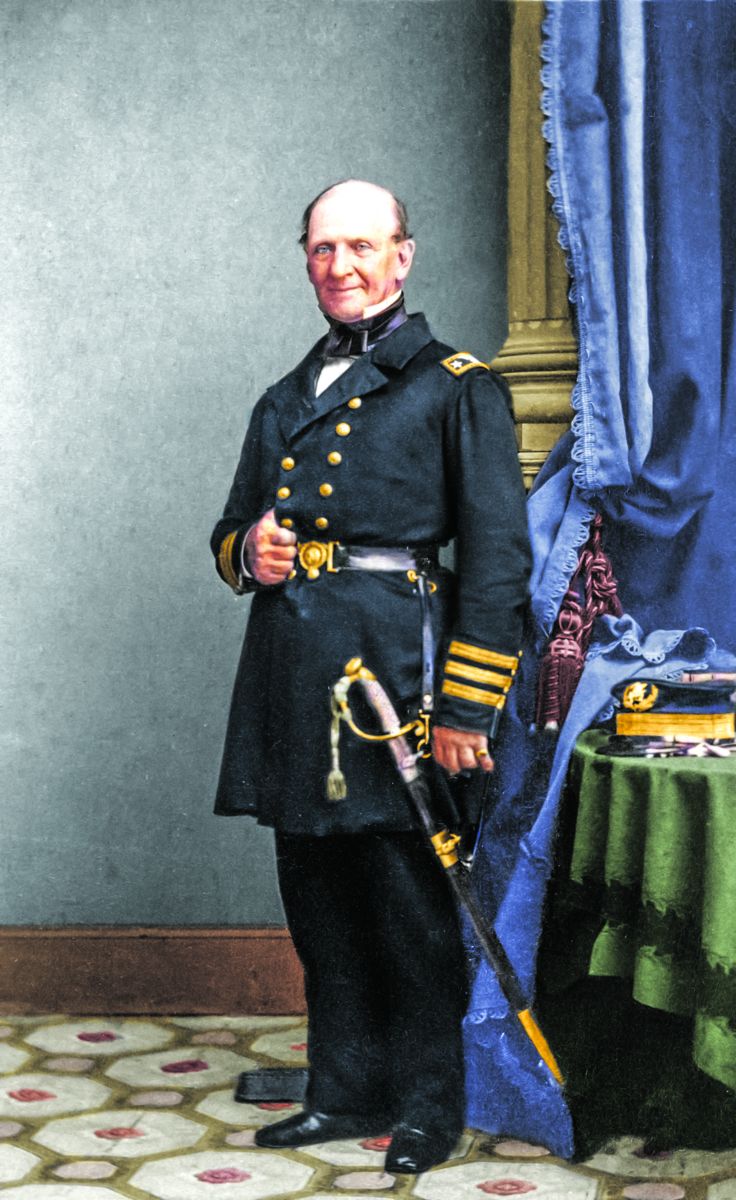
The First Unconditional Surrender “A private concern would be ruined by conducting business as it is carried on here.” – Gustavus Vasa Fox, U.S. Asst. Sec. of the Navy On April 19, 1861, President Abraham Lincoln, proclaimed a blockade of Southern ports. To enforce the blockade, Lincoln would oversee the Navy’s growth and development from 42 steam and sailing ships to hundreds of armed fast steamships. Lincoln, who would admit to Gideon Wells, Sec. of the Navy that “I know little about ships,” would build the largest naval force in size and number of ships until the start of the world wars. Welles had to energize the stagnant government office naval officers considered “the most rickety and stupid of all.” The staff of seventy-four worked a six-hour day and were sticklers for “forms and red tape.” Welles added 20 clerks, an additional work hour, barred unofficial visitors, unexcused absences, and “behindhand” clerks could not leave before normal work was completed. To counter the Union blockade, Confederate President Jefferson Davis issued letters of marque, authorizing Confederate privateers. The Winslow, a side wheel steamboat sporting one gun, was capturing prizes and taking them into Hatteras Inlet, N.C. The inlet made it possible to bring goods through the Dismal Swamp Canal to Chesapeake Bay and on to Richmond, Va. Two earthworks, Fort Hatteras mounting twelve 32-pdrs. and a 10-inch columbiad and Fort Clark with five 32-pdrs. and two 8-inch howitzers, were built to protect the narrow channel inlet, which had a shoal across the entrance and a water depth of about seven and a half feet. Defended by about 350 men, the chief engineer of the coastal defenses, “… consider[ed] this inlet secure against any attempt of the enemy to enter it.” U.S. Gen. Benjamin Butler conceived a plan to seize the Hatteras Inlet forts. Butler would lead 860 men from the 20th N.Y.,
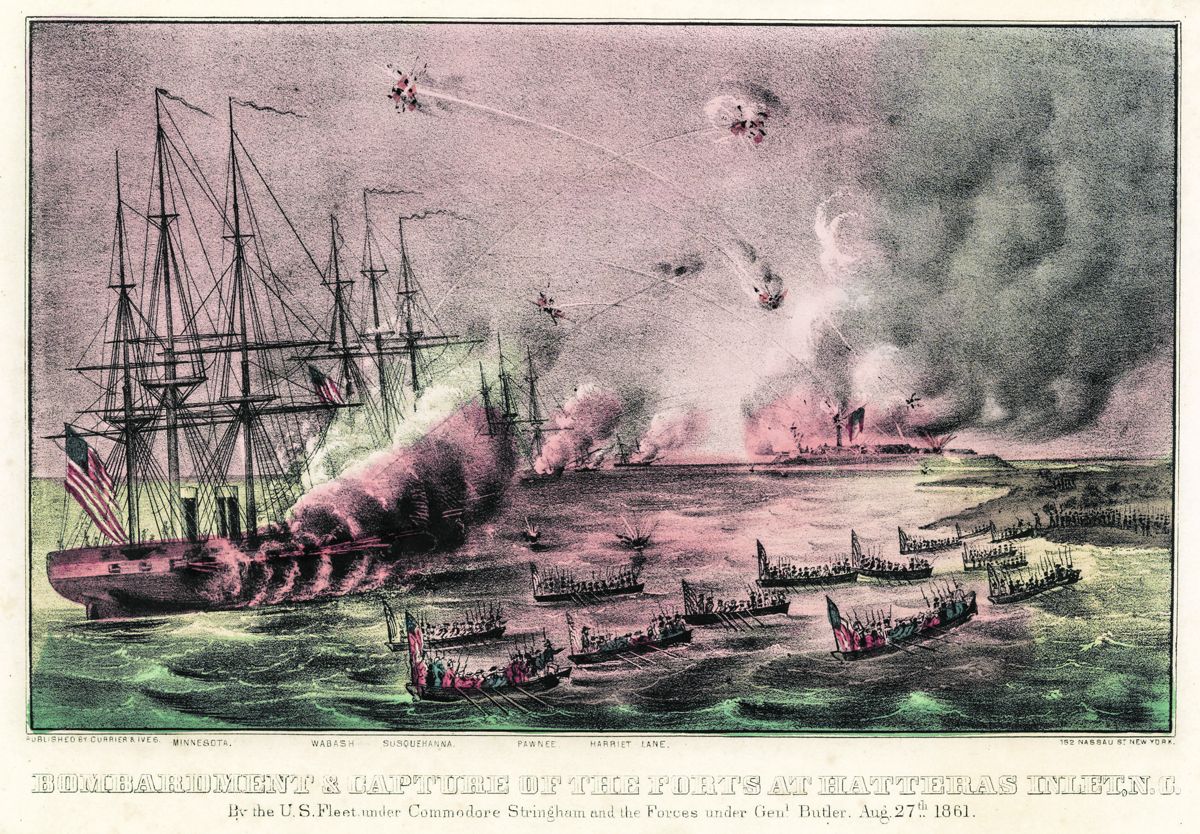
9th N.Y. Zouaves, U. S. Coast Guard, and 2nd U.S. Artillery. Silas H. Stringham, Cmdr. of the Atlantic Blockading Squadron, would command warships carrying 141 guns and two troop transports. The plan was swiftly put together and approved. The adage that one gun in a shore fortification was worth four on shipboard was about to be tested. On August 25, the troops were ordered to get ready to depart with ten days of rations and 140 rounds of ammunition. On the 26th, the ships arrived off Hatteras. On the 28th, three warships were assigned to cover and assist men going ashore about three miles north of the inlet. When landing boats sent through the turbulent waves broke up in the surf, two hulks filled with troops, were allowed to drift through the breakers to reach the shore by using a windlass and cable. About 318 men landed soaked to the shoulders, with wet ammunition, without food and, with the addition of high winds in the late afternoon, serious concerns whether they could be rescued off the beach. The Battle of Hatteras Inlet began at 10 a.m., with Stringham’s bombardment of Fort Clark. He used the innovative tactic of steaming in a circle to generate moving targets. The Minnesota (42 guns) and Wabash (23 guns) fired their Dahlgren cannon with shot and shells weighing from 68 to 120 lbs. The sailing frigate Cumberland, undertow by the Wabash, fired its 22 9-inch Dahlgrens and was later joined by the Susquehana with 15 more guns. It was a one-sided bombardment. Fort Clark’s seven guns were outranged but continued to return fire until out of powder. The guns were then spiked and the fort evacuated. At 12:25 p.m. the flags of both forts’ were lowered. Men could be seen running from Fort Clark to Hatteras. About 4 p.m., Stringham ordered the shallow hulled Monticello to reconnoiter past the inlet. Seizing the opportunity, C.S. Col. Wm. F. Martin, 7th N.C. Volunteers, ordered cannon to open fire, hitting the Monticello repeatedly. Stringham’s guns returned fire; after two hours, the ships ceased firing, and except for the ships covering men ashore, hauled off for the night. Overnight, C.S. Capt. Samuel Barron arrived with reinforcements. William Seward, U.S. Sec. of State had hoped that Barron would help keep Virginia in the Union. Instead, he resigned and in July, had been appointed Cmdr. of coastal defenses of Virginia and North Carolina. Barron took over the defense of the inlet’s forts. On August 29, Stringham resumed the bombardment of the Hatteras forts. “It was terrible to watch the large shells as they came down on the fort bursting almost as they struck, scatter sand and tents, dismounting guns and tearing everything but the bombproof covers to pieces,” wrote Lt. Roswell H. Lamson, commanding the 10-inch forward pivot gun on the Wabash. “For a long time we fired a shell every three minutes from the forward gun, and it was nothing but a continual bursting of shells around, over, and among them.”
Again, the Confederates were outranged and ordered to protect themselves until reinforcements came. One officer counted 28 shells falling per minute. The magazine was set on fire, four men had been killed and about 30 men were seriously wounded. About noon the white flag was raised. Stringham and Butler rushed back with news of their victory. After the July 21, 1861, defeat at the Battle of First Manassas, Va., Hatteras Inlet was a huge morale booster. Gustavus Vasa Fox, described it as “… of national importance besides useful for our naval credit.” During the summer, Congress enacted legislation that authorized the army and navy to disregard the principal of seniority if it was “for the good for the service.” Welles had been critical of Stringham so swiftly returning without attacking other forts in the Hatteras area. He later acknowledged that Stringham’s return was appropriate as he lacked rations for the men and shallow draft ships, had taken some 700 Confederate POWS, and left the 9th and 20th N.Y. at Hatteras to maintain a Federal presence. In September, 64-year-old Stringham submitted his resignation. In acknowledgment of his past service, he was proOperations In North Carolina,” moted to rear Admiral, retired. Battles And Leader Of The As he suspected, the position of Civil War Vol. 1: The Century Cmdr. of the Atlantic Blockading Company, 1884 Squadron would be given to two subsequently younger men. Stephanie Hagiwara is the editor Welles was succeeding in pro- for Civil War in Color.com and Civil moting more lively officers. Still, six months before U.S. Gen. Ulysses Grant demanded “unconditional surrender” at Fort Donelson, Tenn.; it was required at Hatteras Inlet. Barron refused to surrender to Butler, whose men had basically done nothing. He
Sources: •
•
McPherson, James M., War on the Waters, The Union & Confederate Navies, As 1861–
Carolina Press, 2012
Symonds, Craig L., Lincoln And
His Admirals: Oxford University
Press Inc., 2008
Anderson, Ben., The Naval
History of the Civil War: Alfred
A. Knopf, Inc. 1962

Hoogenboom, Ari, Gustavus
Vasa Fox of the Union Navy:
A Biography: John Hopkins
University Press, 2008
Hawkins, Rush C., “Early Coast
War in 3D.com. She also writes a column for History in Full Color. com that covers stories of photographs of historical interest from the 1850’s to the present. Her articles can be found on Facebook, Tumblr and Pinterest.