
The 2021 Gettysburg Civil War Show: Collecting and Displaying the 15th New York Cavalry Regiment
By James Crane III · Originally published August 2021 · p. 6
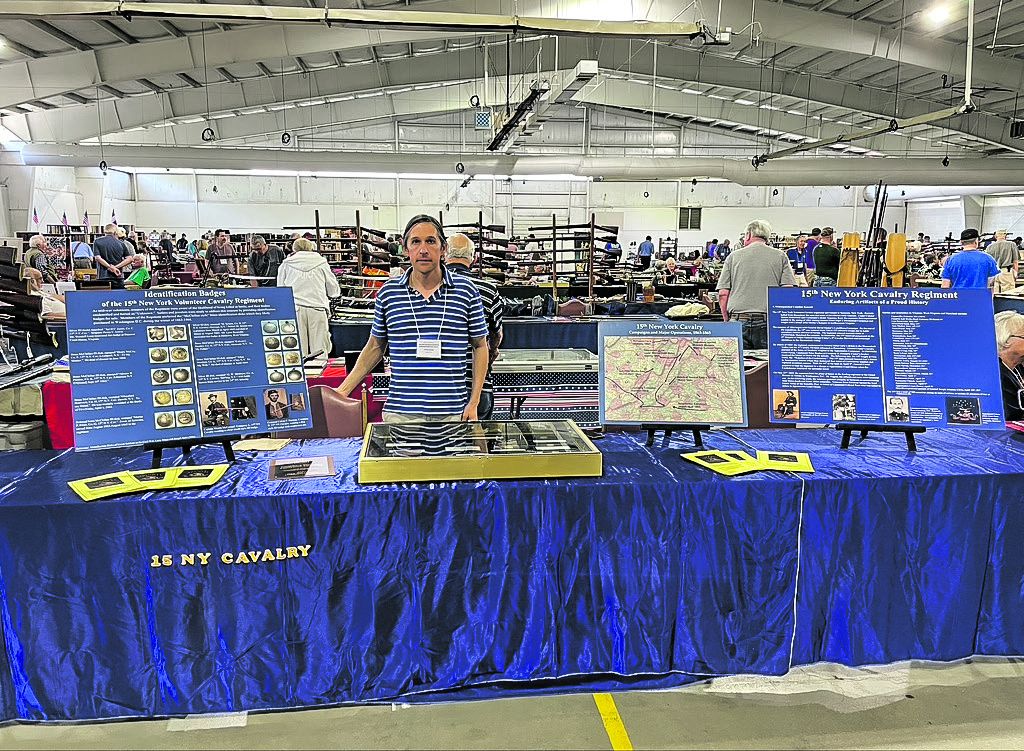
The 15th New York Volunteer Cavalry Regiment was a late addition to the Civil War, but nonetheless experienced an intense sixteen months of service. Beginning in northern Virginia with the 1864 Shenandoah Valley campaigns, followed by assignment to Major General George Custer’s 3rd Cavalry Division, the regiment had a distinguished record, and ultimately served in the forefront of the Union Army from Five Forks to Appomattox. With a majority of its officer corps consisting of veterans, and veteran noncommissioned officers and junior enlisted troopers in the ranks, the men of the 15th NY Cavalry were aware of the risks of their military service. Whether from first hand combat experience, recollections of family members, tent mates and superiors, their knowledge of the likelihood of death or grievous wounds was sobering. Additionally, newspapers reported battle casualties and burials of the dead, to include the legions of “Unknown” burials. As the November 20th, 1863, Philadelphia Inquirer reported regarding the dedication of the National Cemetery at Gettysburg, “… the number of [dead] whom no clue could be obtained as to name, regiment, etc., being greater than any State, two lots have appropriated to their reception, and classed as ‘Unknown.’” A Christian burial and a properly marked grave were of high importance to the troops. Dying for one’s country, only to be buried in a mass grave, was repugnant. To provide some degree of insurance that their graves would be properly marked, troopers understood that there must be a means of identifying their bodies. While service members in World War I and afterward received a government issued identification
McClellan ID disk of Corporal Glassford Bostwick, mortally wounded at the battle of Five Forks, Va.
tags, Civil War era identification devices were privately purchased items. Supplying a measure of assurance to allay the concerns of the troopers, sutlers and jewelers were prepared to capitalize on the demand, offering a variety of identification badges and disks. The book Identification Disks of Union Soldiers in the Civil War by Larry Maier and Joseph Stahl is a superb reference on the subject. A pre-manufactured brass disk was stamped on request with the trooper’s choice of inscription. Its cost, based on research by Maier and Stahl, was around $2. This service could be performed in austere conditions with minimal skill by a sutler, compared to the more expensive engraving performed by a professional jeweler in his shop. The information typically included on the disk included the trooper’s name, company, regiment, and hometown. Disks had holes punched through them, and could be worn on a chain around the neck, with a suspension pin on the uniform, or sent home as a gift. Ten identification devices of 15th NY troopers were on display at the June Gettysburg Civil War Show. One was a jeweler-engraved silver shield style badge. One was a pair of silver cufflinks fashioned from U.S. silver dimes. Eight were disks, two plain silver, the other six were Major General George McClellan “War of 1861” pre-manufactured brass. Of the six McClellan disks, all were stamped with presentation inscriptions such as “To My Mother,” or “To My Wife.” Perhaps they were intended to be offered as gifts, or given to the recipient posthumously. Apparently, McClellan remained a popular figure in the regiment as he campaigned for the 1864 presidential election. The excavated items each have interesting stories. Famed relic hunter Wendall Lang recovered
ID shield of Sergeant Henry W. Lewis, excavated at Hanover Court House, Va.
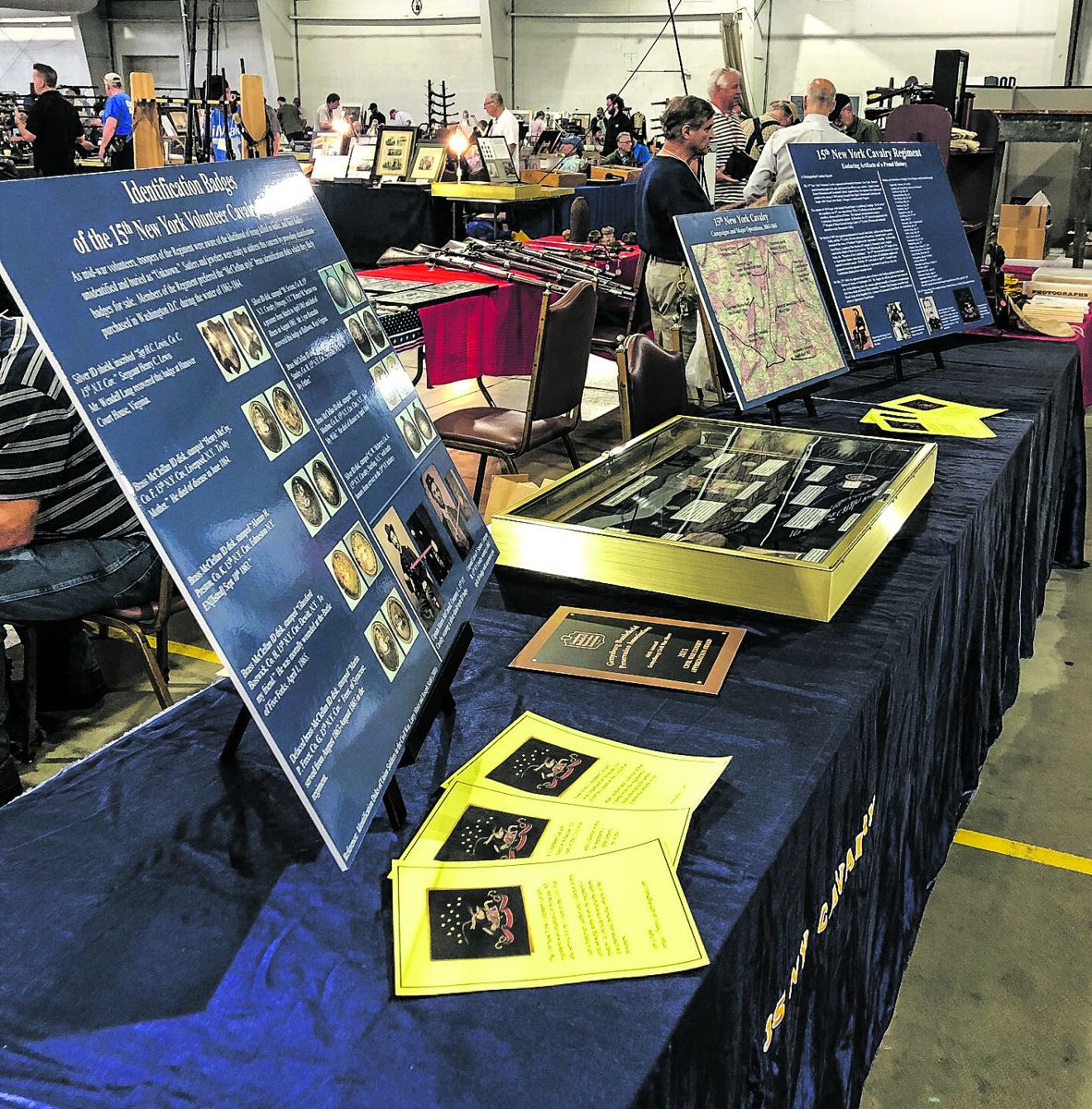
the silver ID shield of Sergeant Henry C. Lewis of Company C, 15th NY Cavalry at Hanover Court House, Va. It is likely that Lewis lost his badge when the pinback broke. This was a rather common occurrence, as a trooper’s brush with vegetation, swinging a sabre, or adjusting accoutrements could easily result in breaking the pin. Based on the regimental history “Red Neck Ties” by Chauncey Norton, Sergeant Lewis almost certainly lost it sometime between March 15 and 25, 1865, as the regiment participated in skirmishes near Ashland and Cold Harbor, Va. Lynn Routzahn, another accomplished relic hunter, found the silver ID badge of Private Robert M. Sexton, Company B, in Halltown, W.Va. Serving honorably with the regiment throughout its term of service, Private Sexton was briefly captured by Confederates on March 16, 1865, at Hanover Court House and paroled on March 26. Ironically, this is the same battlefield where Sergeant Lewis lost his silver ID shield. Private Sexton was a late war casualty and died at the military hospital in Grafton, W.Va., in August 1865. Halltown, three miles west of Harper’s Ferry, was in the area of the regiment’s mounted patrols during its bivouacs in Sandy Hook, Md., and Harper’s Ferry; he likely lost it in camp or on picket duty. Private George McIntyre of Company A carried a silver disk that is identical in style to Private Sexton’s. Private McIntyre previously served in the 24th NY Infantry Regiment and his battle honors are stamped on the disk: “2nd Bull Run, So. Mountain, Antietam, Fredericksburg, Chancellorsville.” Two other interesting identification devices are the brass McClellan disk of Corporal Glassford Bostwick and the silver cufflinks of Private Dewitt C. Tarkett. Corporal Bostwick, Company H, was tall for a cavalryman, standing at six feet, and hailed from Syracuse. He died
ID disk of Private George McIntyre, with battle honors from his prior service with the 24th NY Infantry.
of a gunshot wound to the bowels received in the April 1, 1865, battle of Five Forks. He was one of the regiment’s 27 casualties in the engagement known as the “Waterloo of the Confederacy.” Dewitt Tarkett’s cufflinks, professionally engraved with his initials “DCT,” are made from U.S. silver dimes, one dated 1854 and the other 1857. Tarkett was a tentmate of the author’s great great grandfather, who also served in Company K. James Crane III is a collector and historian of the 15th NY Volunteer Cavalry. He is a retired Army officer and currently a law student at Fordham University in New York City. He can be contacted at [email protected].