
Lawrence County, Missouri, Grist Mills and Distilleries
By J. Dale West, P.E. · Originally published August 2021 · pp. 28–29
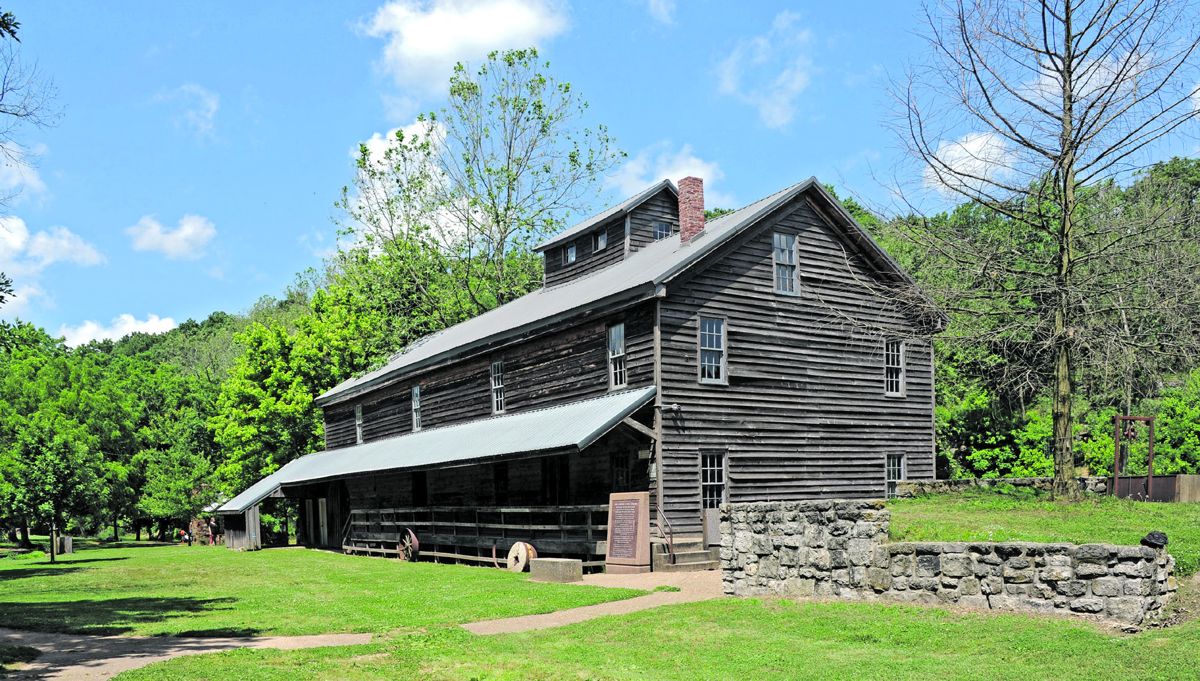
Lawrence County, Missouri, Grist Mills and Distilleries by J. Dale West, P.E. Grist mills provided flour and cornmeal, essential commodities to households, prior to the modern era. As Lawrence County was settled beginning in the 1830’s grist mills soon followed along the continuously flowing streams as the growing population could support these commercial enterprises. The flowing water provided the power to turn the mill buhrstones prior to the general availability of steam or internal combustion engines or water turbines.1 Dams were normally constructed to form a pond that released water through a millrace, or canal, thereby increasing the kinetic energy, or head, available to turn the water wheel beyond that of the natural, free-flowing stream. Water-powered mills proliferated along Spring River, Turnback, and their tributaries. The production of whiskey was a natural, value-added extension of milling grains, and many grist mills included this complementary process. To make whiskey, milled grain is treated and fermented to produce a “beer” that is distilled in multiple steps to purify and concentrate the ethyl alcohol (hereinafter termed alcohol).2 In Missouri and other midwest states including Kentucky and Tennessee, corn meal was the primary feed material to the fermentation process. Corn and other grains, however, are primarily starches that do not ferment. They must be converted to sugars to produce alcohol by fermentation. Extensive research has not uncovered a detailed description of the fermentation and distillation steps employed to produce whiskey in the Lawrence County or other distilleries. The author has pieced together the most likely process employed considering the fermentation chemistry and distillation techniques of the mid19th Century period. Information on the reconstruction of George Washington’s distillery at his Mount Vernon, Va., plantation that began operation in 1798 was helpful.3 Illegal moonshine still operations in Appalachia and other locations in more recent years probably crudely approximate the commercial fermentation and distillation steps of 150 years ago. Conversion of corn starch begins by adding cornmeal to very hot water in a copper cooker vessel that is maintained at an elevated temperature. The high temperature causes the starches to break down into sugars allowing the fermentation reaction to begin.4 With initiation of fermentation by natural yeasts in the environment to produce ethyl alcohol, a co-product, carbon dioxide, is released. Some of the carbon dioxide is dissolved in the mash water as carbonic acid. This acid further promotes the starch conversion. The sour mash fermentation process normally continues for ten or more days until the reaction ceases due to the alcohol killing the yeast or consumption of the sugar.5 Direct firing of the mash kettle is required to maintain the elevated mash temperature throughout the fermentation period. This fermentation product, called beer, contains alcohol in the seven to ten percent by volume range. Cessation of carbon dioxide bubbles from the mash indicates completion of the fermentation process. After fermentation has ended, the beer is transferred to the bottom of a specially designed distillation vessel, also constructed of copper. This single stage still is heated by direct firing to recover the alcohol. Since the alcohol volatility is greater than that of water the overhead distillate vapor is of significantly higher alcohol concentration than in the beer. The vapor exits the still by an overhead pipe to the condenser coil that is cooled by water from the mill pond or stream. The initial condensed distillate is over 40% by volume alcohol but diminishes as the alcohol concentration is depleted in the beer. This initial distillate contains a small amount of highly poisonous methyl alcohol (methanol) and other undesirable components formed in the fermentation reaction.6 This initial whiskey cut is discarded. Distillation continues until the overhead distillate contains only about 10% alcohol by volume indicated by it no longer being flammable. The still is then cleaned by removing the mash solids and remaining dilute alcohol liquid. Mash solids are fed to cattle and hogs, and the liquid residue is transferred to the mash cooker vessel for the next fermentation cycle to conserve the residual alcohol. After cleaning, the retained whiskey distillate is charged to the still base and a second batch distillation performed. This removes the mash solids carried over in the first distillation and further concentrates the alcohol. The blended alcohol concentration is about 40% (80 proof) for the final whiskey product. This was the normal product from distilleries of that period. Additional distillation of this whiskey raises the alcohol concentration and the product cost and was not often done. Site storage of cornmeal, flour, and whiskey products was in oak barrels of varying sizes produced by a local or regional cooper. For whiskey the most common barrel size was about 31 gallons. Whiskey of that era was not aged and treated by storage in charred barrels. The products were sold or bartered at the mill and distillery or were shipped to general mercantile stores and saloons in the local area or beyond. Cashless bartering at the mill and distillery was common. My grandfather Frank West once related how, as a young boy of eight or nine, his father sent him on horseback to a nearby grist mill and distillery in Breckinridge County, Ky., with shelled corn in two gunny sacks tied together and hung over the horse’s withers. Sometimes he also carried an empty stoneware jug. He returned home with a measure of cornmeal and a gallon or so of whiskey in the jug.
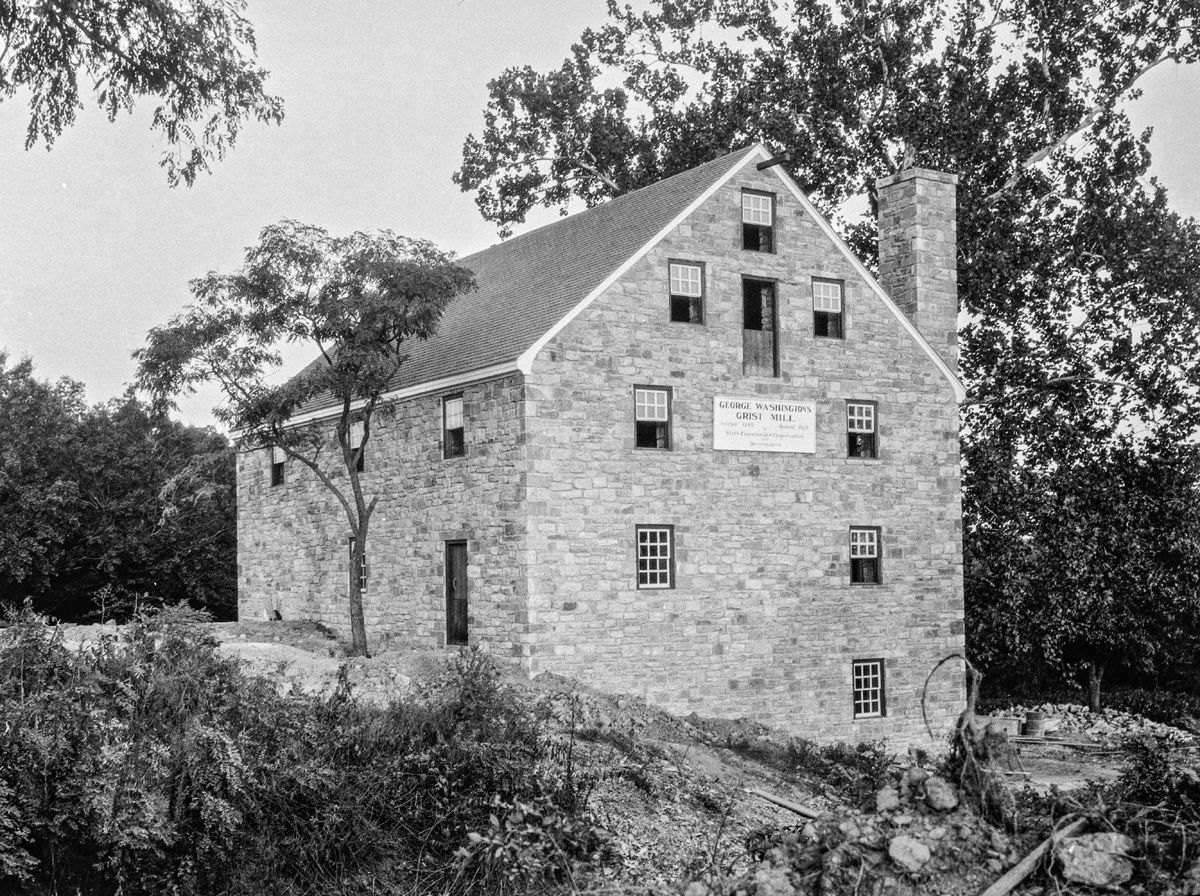
Built in 1771, George Washington’s gristmill (not his distillery) was 32 feet by 46 feet, according to an 1803 insurance document. In 1783, Washington described the mill in one of his letters, “two pair of Stones, one pair of which are French-burr, employed in the merchant business. The Mill house is of Stone, large and commodious, the dwelling house, which is convenient, is within 30 yards of it; and has a garden enclosed adjoining. A Cooper’s Shop is also near, and the whole convenient to tide water.” Library of Congress.
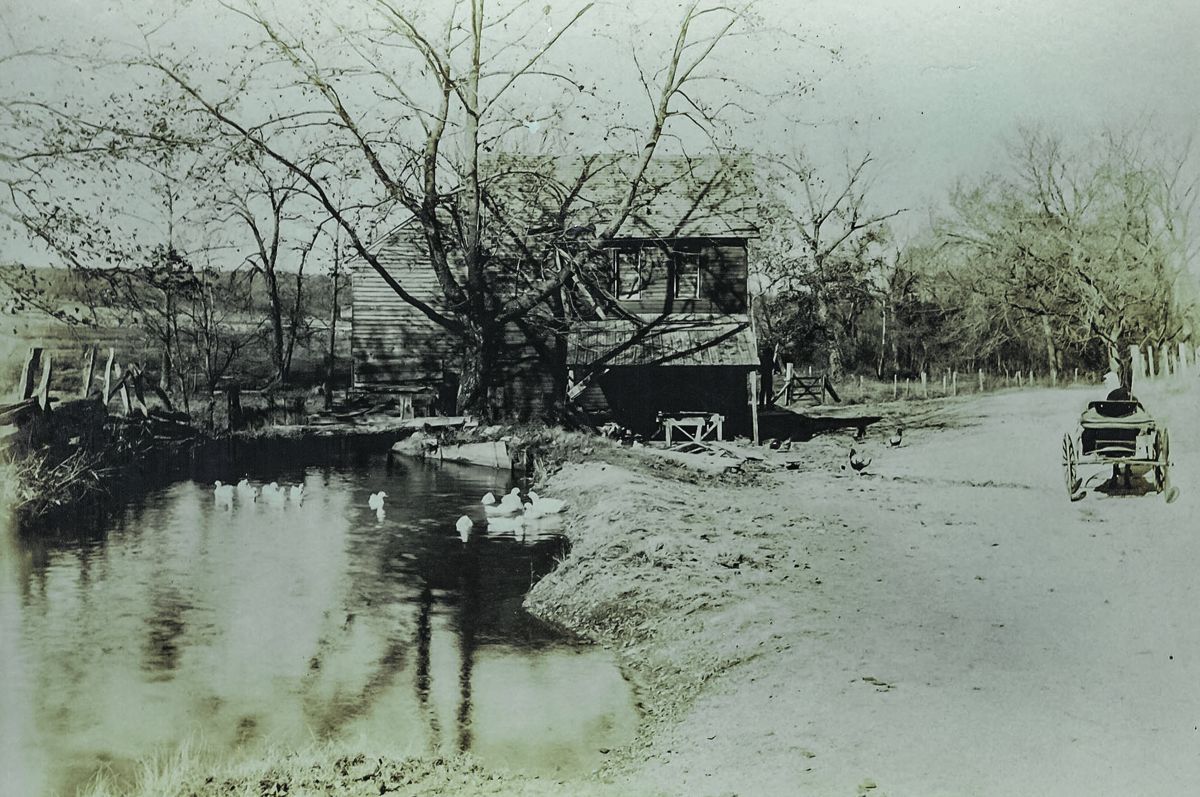
Red Mill photographed in 1905. Photo by J.G. Hillhouse. Part of Lawrence County Historical Society’s Hazel Hillhouse Estate Collection.
Several Lawrence County mills and distilleries were burned during the Civil War. Some were rebuilt after the war; some were not. Additional mills were constructed as the population increased and the economy recovered from the wartime devastation. Beginning about the turn of the new century, improved mechanical milling technology and steam and internal combustion engines made the water-power mills obsolete and increasingly uneconomical. The few remaining water-power mills closed by 1930.
Endnotes: 1.
Buhrstone is a siliceous rock used for mill grinding stones. It was commonly quarried in France and imported. Ethyl alcohol is the primary product of natural fermentation reactions. It is also termed ethanol and sometimes methyl carbinol by a less-common nomenclature system. George Washington’s Distillery FAQs (https://www.mountvernon.org/the-estate-gardens/distillery/ten-facts-about-the-distillery/). The Commonwealth of Virginia purchased the Washington
gristmill and distillery site property in 1932 and reconstructed the gristmill sometime before 1961. Based on extensive archaeological research the distillery reconstruction was completed in 2007 and is currently a working distillery. This is termed a “sour mash” process due to the acidity. Starches comprised of connected six-carbon/oxygen rings split into multiple molecules of six-carbon/oxygen ring sugars. With added yeast, fermentation requires about 3 days. Mostly bitter tasting aldehydes and ketones.
J. Dale West is a fifth-generation native of southwest Missouri and a student of Civil War history of that region. He is the author of Murder And Mayhem: The Civil War In Lawrence County Missouri (2011) and several related articles published by the Lawrence County [Missouri] Historical Society. West holds degrees in Chemical Engineering from Missouri University of Science and Technology and Texas A&M University, served in the U.S. Army Corps of Engineers and was employed by Eastman Chemical Company at Longview, Texas, in development and operations management. Following retirement from Eastman he was an adjunct Professor of Engineering at LeTourneau University, Longview. He is a licensed professional engineer in Texas.