The Unfinished Fight
Confederate Currency
By Craig L. Barry · Originally published April 2021 · pp. 8–9
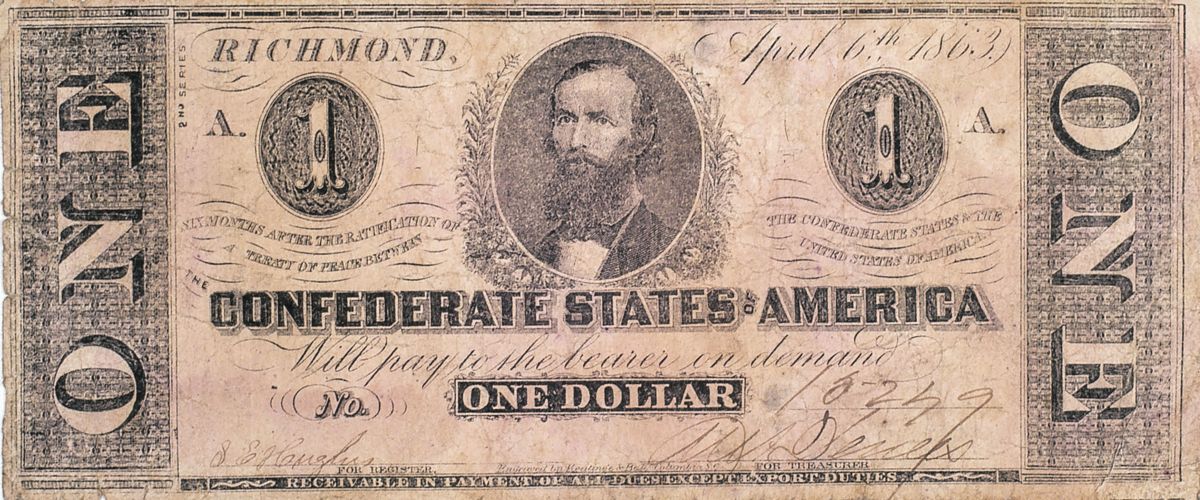
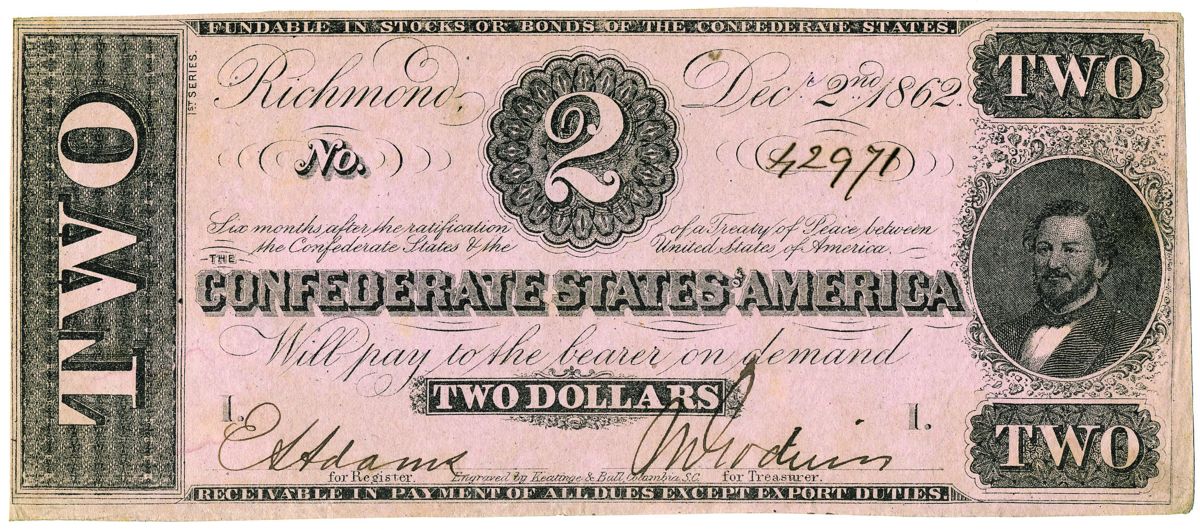
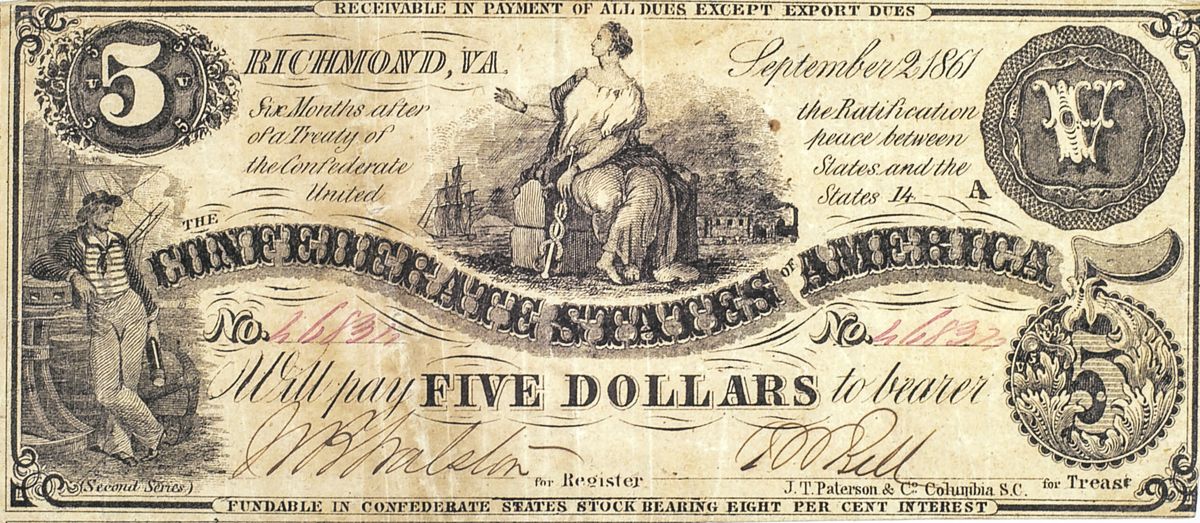
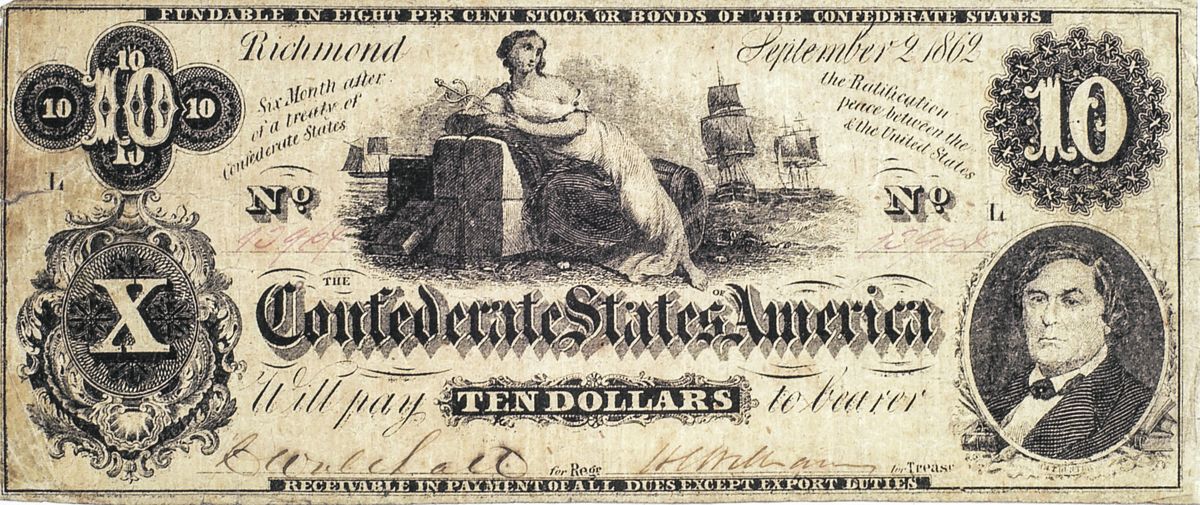
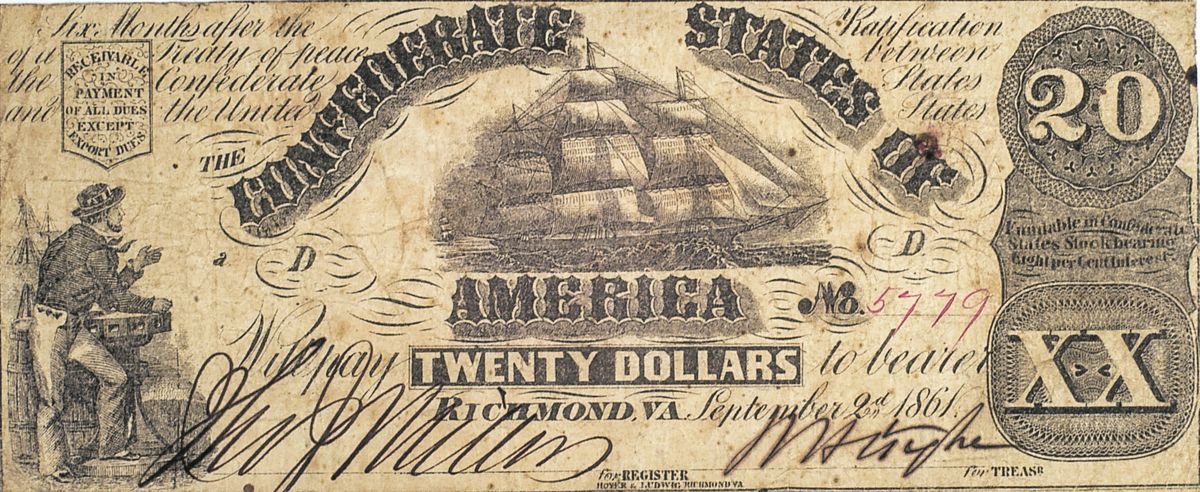
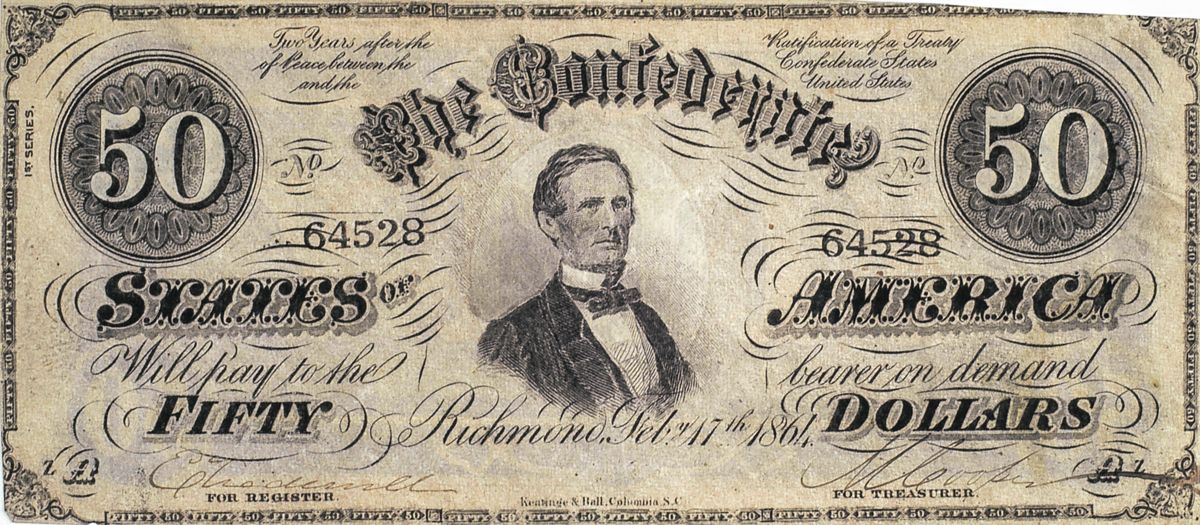
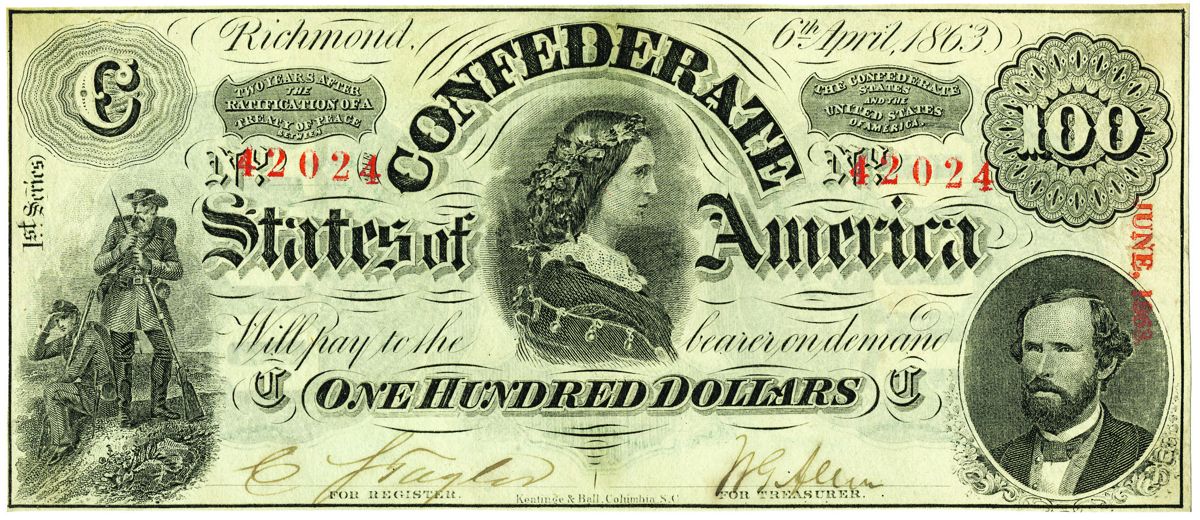
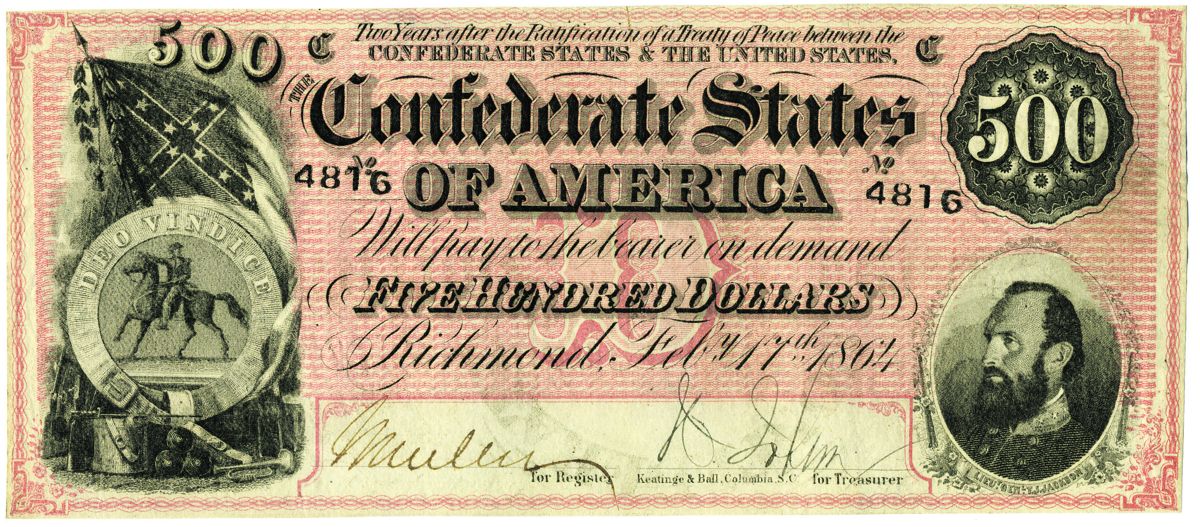
Confederate Currency “In Richmond when the cash was low and promises were all the go. Then rapid, constant was the flow of the paper currency:” – Richmond Daily Examiner, March 9, 1864 When the Civil War began in April 1861, one dollar of Confederate currency or “paper money” was worth ninety cents in gold. While the Confederacy never adopted any standard of value to back the currency, people in the 19th century instinctively measured the value of money in terms of gold, this being, historically-speaking, the soundest commodity. British banks in 1861 were willing to offer an exchange rate of $5 (Confederate) to one £ sterling, roughly the same exchange rate given the U.S. dollar at that time; the U.S. government exchange rate was $4.86 to one £ sterling in early 1861.
The financial situation quickly degenerated as the Confederate government simply printed more and more paper currency to pay down its growing war debt while they devised new forms of revenue measures. The results proved disastrous. The rates offered in 1861 on Confederate paper currency would never be that generous again. Within a year the British exchange rate was $9 (Confederate) to one £ sterling. In the absence of a substantial gold reserve, the most sensible economic method used to control the value of paper currency was to back it with some other commodity. Goods such as cotton or tobacco represented tangible value for the South. The situation seemed straightforward enough; the Confederacy had commodities that were in demand and needed money. Backing paper money with commodities is not as strange as it sounds. The Confederacy used cotton as collateral for a major bond issue in 1863. These Confederate bonds were considered as a practically fail-safe investment due to the value of the commodity (cotton) used to back the securities. Cotton was always in demand world-wide. The Confederate cotton bonds were brokered by the House of Erlanger & Company of Frankfurt, Germany, and marketed throughout England and Continental Europe. Baron Emile Erlanger was one of the wealthiest men in the world and his “House” also had branches in Paris and Amsterdam. The cotton bonds came to Erlanger after the Confederacy failed to find a British bank willing to float them. After several weeks of negotiations, Erlanger dispatched three agents to Richmond to propose a much larger bond issuance than the Confederate government had requested. In early March 1863, the parties agreed on three million £ sterling or $15,000,000 (C.S.), which amounted to a roll-back of the original exchange rate offered on Confederate paper money back in 1861. Such is the value of backing commercial “paper” with something of tangible value. The “Erlanger bonds” sold at 90% face value and were redeemable for Confederate government owned cotton but the cotton was still in the Confederate States. The clause had a critical effect in stimulating blockade running because “Erlanger bonds” holders had to run the Union blockade to convert their bonds into cotton. Of course, most European investors lost their investment post-bellum when one key assumption about redeeming the cotton bonds turned out to be false. The Federal Consul in London, F.H. Morse, wrote U.S. Secretary of State William Seward somewhat incredulously: “…as strange as it might seem these people (European investors) who are aiding the Rebels believe if worse comes, and the Union is restored, the United States Government will assume payment of their bonds.” Why the Confederate government in Richmond did not back its domestic supply of paper currency with cotton (or tobacco) as it did the Erlanger bonds is not known. Doing so may have saved them financially, or at least lessened the misery on the home front. The amounts of paper currency in circulation were not solely responsible for their decline in value, but rather, it was that there was a growing suspicion (as early as 1863) that, if the Confederacy survived, it would repudiate all its debts and begin anew with respect to financing. This was not entirely baseless as laws had been passed stipulating that certain denominations of paper currency must be converted into low interest Confederate bearer bonds by a fixed date, or else they could not be used as legal tender at all. In mid-February 1864, a very complicated law was enacted as a last desperate measure to reduce the amount of currency in circulation and stabilize its value. All non-interest bearing notes larger than $5 (C.S.) had to be exchanged for 4% bonds before April 1; if this was not done the currency would be de-valued by 10% monthly until the notes were valueless. For some odd reason any $5 (C.S.) notes in circulation would retain their full value until July 1, at which point they would be reduced by 33% in value. This act effectively took away the right of the Treasury to issue additional paper currency, except in exchange for old notes at 2/3 of the face value. The results were predictable…loss of confidence in the government, financial panic, and confusion. The record keeping of the Treasury was so incomplete that little certain knowledge of monetary supply was to be had. “Bill Arp” (a/k/a Charles H. Smith), a humorist of the times reported on the situation as follows: Secretary Memminger was asked to say about how much paper (money) he thought was in circulation…and he said he to the best of his recollection it was either six hundred millions or six thousand millions, but he wasn’t sure which… Meanwhile in March 1864, the Confederate Congress ignored the new initiatives and passed legislation to issue another $80,000,000 in currency to pay the back wages due to the Confederate troops in the field. President Jefferson Davis vetoed the measure. Vice President Alexander H. Stephens lamented privately that, “Our finances are now a wreck…past all hope in my judgment.” The old paper money was eventually collected and mutilated by cutting a hole through the center then burned. The newly issued Confederate paper currency was very much like the old, and the Richmond Daily Examiner (February 16, 1864) could not resist lampooning it. To see the faces on the notes with that unchanging expression of ineffable melancholy which the engraver has given to all of them…Davis is doleful and Stephens saturnine, Hunter is heavy and Clay clouded with care, Memminger is mournful and (Judah) Benjamin the buoyant is bien trist, having had in sight evidence of the country’s impecuniosity. It was enough to drive a well-regulated mind to lunacy.” The term “bien trist” means “a sad fate.” Craig L. Barry was born in Charlottesville, Va. He holds his BA and Masters degrees from the University of North Carolina (Charlotte). Craig served The Watchdog Civil War Quarterly as Associate Editor and Editor from 2003–2017. The Watchdog published books and columns on 19th-century material and donated all funds from publications to battlefield preservation. He is the author of several books including The Civil War Musket: A Handbook for Historical Accuracy (2006, 2011), The Unfinished Fight: Essays on Confederate Material Culture Vol. I and II (2012, 2013). He has also published four books in the Suppliers to the Confederacy series on English Arms & Accoutrements, Quartermaster stores and other European imports.