
The Graphic War
An Unknown Artist
By Salvatore Cilella · Originally published April 2021 · pp. 22–23
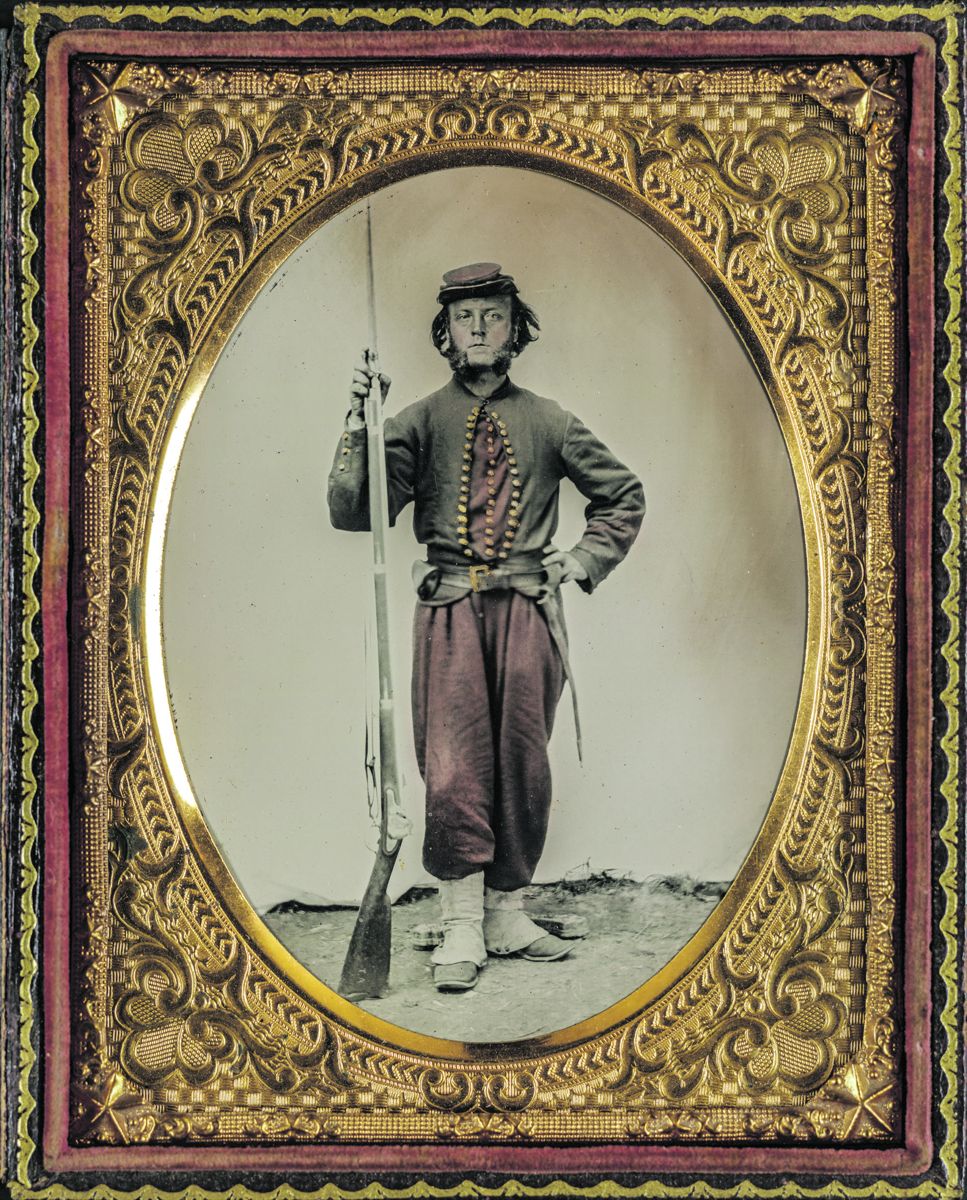
An Unknown Artist The Graphic War highlights prints and printmakers from the Civil War discussing their meaning and the print maker or artist’s goals. Throughout the Civil War countless artists, professional and amateur alike, tried to capture the reality of the war’s horrors. Most professionals, like Winslow Homer, produced quality single sheet and, in Homer’s case, Harper’s Weekly, timely vignettes from the front. Currier and Ives output during the war varied greatly in quality. Competing with the periodicals of the day, their production of Civil War art was inconsistent. Their attempts to meet “news” deadlines and be relevant and timely often found them sacrificing quality. We have already covered in this column some so-called “soldier artists”
who captured battle scenes or their own unit’s (usually their regiment’s) camp scenes. Intriguing are the “unknown’s.” Within the collections of the Library of Congress are two crude and probably only known examples of a battle’s aftermath by an unknown artist who signed his work only as “M. Henochsberg.” Both are dated and both are titled. Both are remarkably large, 19 by 24 inches. The first work is titled simply “Recovered.” Below the image in script is “M. Henochsberg Pub. Pro. Filed January 30, 1869 Mountain creek[?].” The print shows a wounded and possibly dead soldier lying on ground at the edge of a pond with two soldiers kneeling alongside him. The dead soldier has a bullet hole in his head. His left arm and right hand are submerged in the water.
Both the dead soldier and one of the other two soldiers are dressed as Zouaves, wearing bright red pantaloons. Center, looking over the scene with one paw on the deceased soldier’s body, is a dog. To the right, completing the tableau, is another soldier kneeling at the wounded soldier’s arm. He appears to be pulling the soldier’s arm and therefore his body from slipping further into the pond. He is not a zouave. In the background, mounted soldiers moving from right to left are depicted against a mountain range. It is entirely possible that the “Mountain Creek” referred to under the title is located in the Shenandoah Valley prominent in the Valley Campaigns of 1862 and 1864. On the other hand, it just may be referring to the obvious, the depiction of a creek in the foreground. Henochsberg’s second work is entitled “Found.” It is a black and white lithograph with the title within the image. Below the image in script is “M. Henochsberg” in the lower left. On the lower right corner of the margin is the date “May 8, 68.” Similar to the first print, it shows a young soldier lying at the edge of a pond, as he is found by other soldiers and a dog. The deceased soldier is wearing zouave pantaloons as is the soldier standing above him.
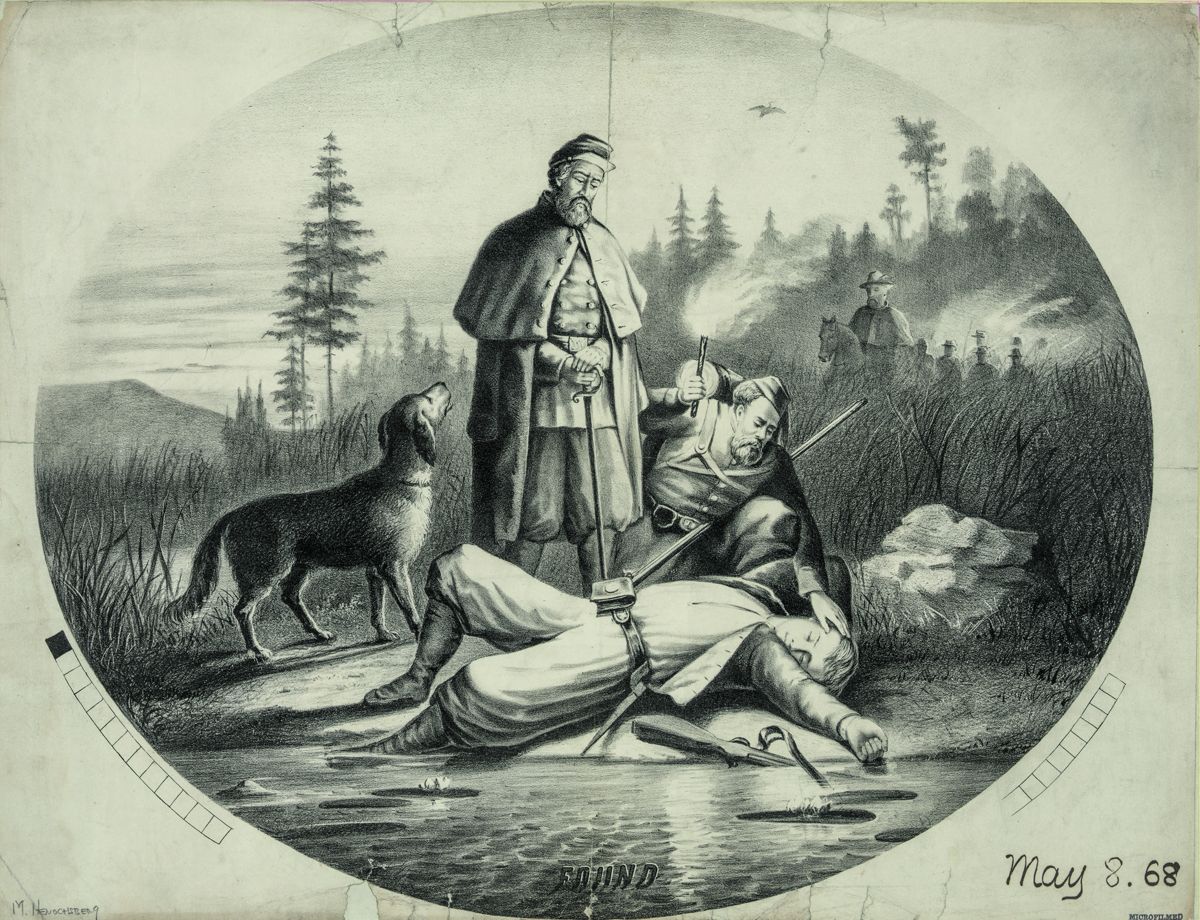
He wears a typical kepi, holds a sword, and is probably an officer. The soldier kneeling before the young soldier’s body with his left hand on the recumbent’s head, is wearing a zouave fez. Adding to the melodrama is a dog to the left, with his head cocked toward the officer in a quizzical pose. In the background upper right, a column of soldiers marches toward the scene. Both prints present several mini-mysteries. Who was Henochsberg? Was he a member of a zouave regiment/company? These depictions were completed after the war, judging from their dating. Were they meant to be actual representations of the loss of a comrade during the war? Or are they merely amateurish depictions of a scene that “might have been?” Both prints appear to be artist’s proofs with little evidence that they were eventually published. A thorough survey of known of Civil War-era prints and print makers produced nothing. There were more than 70 Federal zouave and 25 Confederate zouave units during the war. If anyone has information on our mysterious artist, we would like to know. After 43 years in the museum field, Salvatore Cilella devotes his time collecting American prints and maps and writing. His last professional position was President and CEO of the Atlanta History Center. His most recent books are Upton’s Regulars: A History of the 121st New York Volunteers in the Civil War (U. Press Kansas, 2009). His two-volume Correspondence of Major General Emory Upton, (U. of Tennessee Press, 2017), received the 2017–2018 American Civil War Museum’s Founders Award for outstanding editing of primary source materials. His latest book “Till Death Do Us Part,” an edit of Upton’s letters to his wife 1868– 70, was published in 2020 by the Oklahoma University Press.
Print shows a young soldier lying at the edge of a pond, as he is found by other soldiers and a dog in the Civil War. Library of Congress.
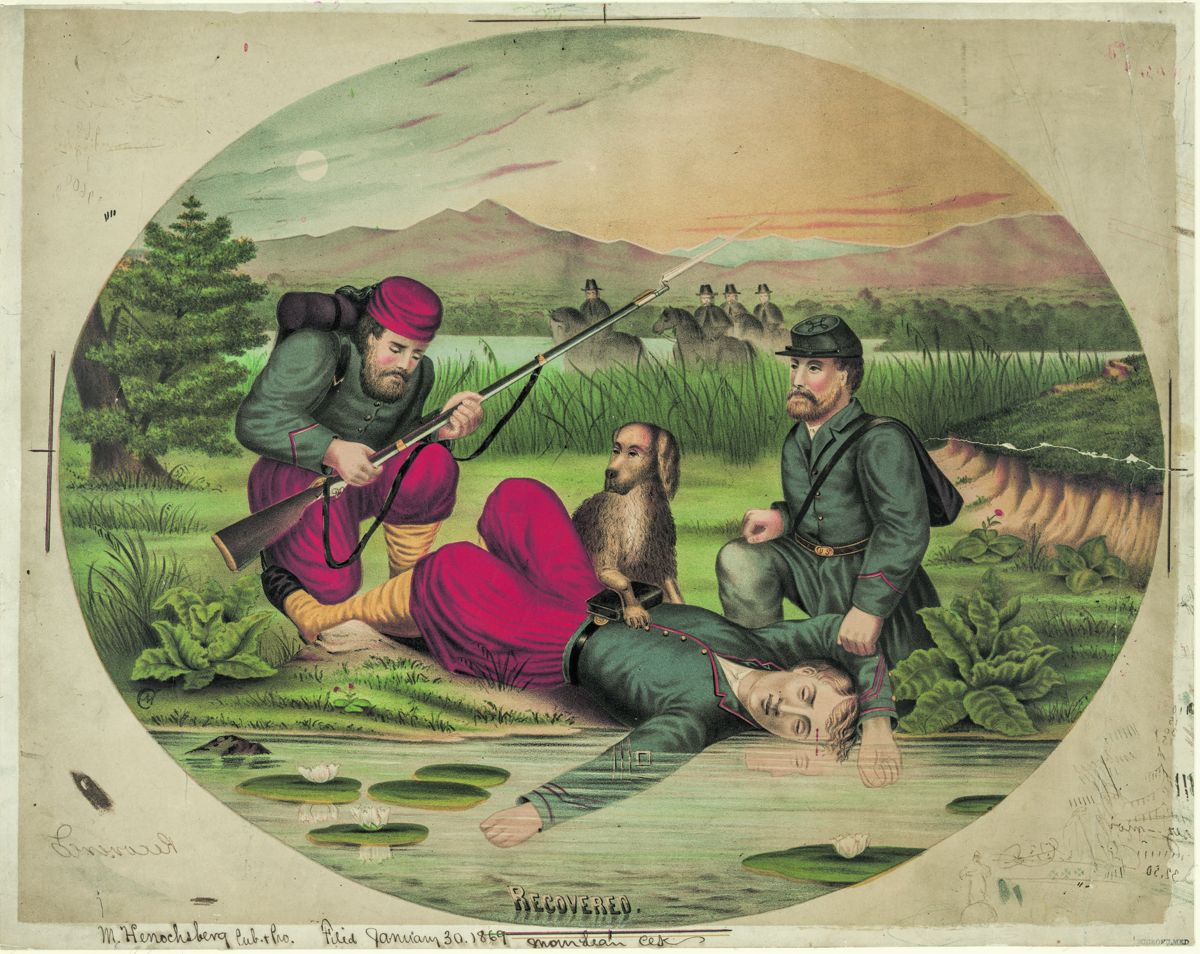
Print shows a wounded or dead soldier lying on ground at the edge of a pond with two soldiers kneeling, and dog sitting alongside him. Library of Congress.