Inspection, ARMS!
A Confederate Fighting Knife by M.L. Ferguson
By Tim Prince · Originally published April 2021 · pp. 24–25
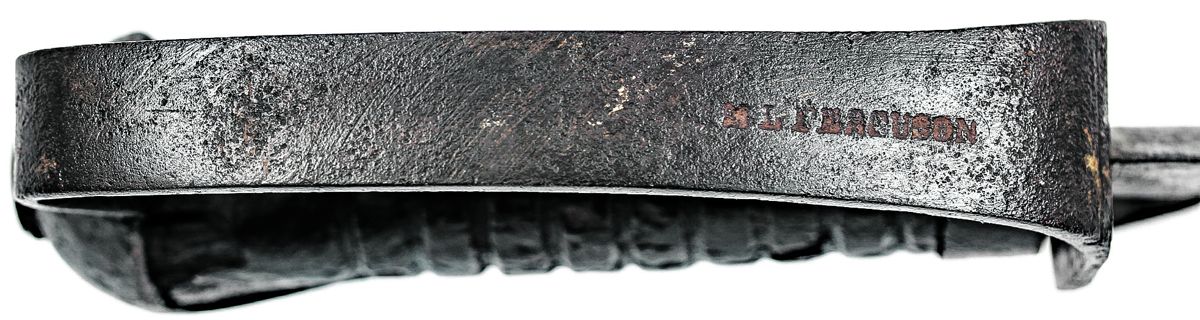
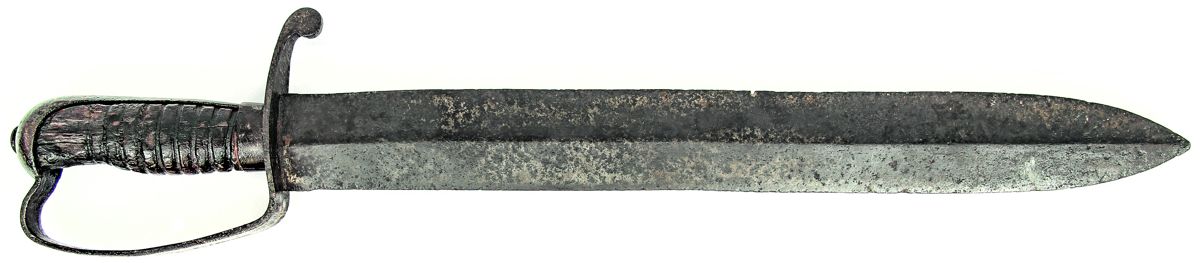
A Confederate Fighting Knife by M.L. Ferguson There is probably no more iconic Civil War image than the young Confederate soldier, heading off to war with an absurdly large fighting knife in his hand or on his belt. Early war Southern ambrotypes and tintypes provide us with a dizzying array of large, wicked, and sometimes comical fighting knives of all descriptions, often made by local blacksmiths for the Southern boys of ’61 to take to war. The classic Southern fighting knife was usually overly large and robust. Overall lengths were typically between 12 and 24 inches, with blade lengths that varied from about 8 to over 18 inches! Over the years, the majority of these local knife makers have remained anonymous, although sometimes certain traits and characteristics of surviving knives can help us to make general statements about the likely region or state where an unmarked knife may have originated. More recent scholarship has allowed us to identify some knives as to their maker, even though they bear no markings. The knife pictured here is one of those rarely encountered examples of a locally made, and yet maker marked, Confederate fighting knife. The bottom of the knuckle bow of this massive D-guard knife is clearly marked with a single die stamp M.L. FERGUSON. The use of an actual gang stamp suggests that Ferguson was a blacksmith or metalworker in business prior to the Civil War, who produced metal items that he would find necessary to mark. Research into the 1860 Census, the Confederate
Citizen Files, and Confederate Service Records reveals that the most likely identity for M.L. Ferguson was a Mississippi blacksmith. Listed only as “M. L. Ferguson” in the 1860 Census, Mr. Ferguson was a blacksmith, working in Richland Beat (now simply Richland), Holmes County, Miss. Richland is just a few miles south of Jackson, Miss. Mr. Ferguson was listed as having been born around 1826 in Maryland, and was 34 years old when the 1860 Census was taken. He owned real estate valued at $700, and had a personal estate valued at $15,575. He is listed as living with A.J. Knapp, a 27 year old carriage maker, born in New York, who held real estate valued at $600 and a personal estate valued at $3,425. As they lived in the same household, it is reasonable to assume that Ferguson & Knapp operated a carriage making and blacksmithing business together, or at the very least shared shop and manufacturing space. Mr. Ferguson was apparently well thought of in his community. According to a report in the May 2, 1860, Vicksburg Whig newspaper, Ferguson was one of two representatives from Holmes County, Miss., at the Constitutional-Union State Convention held in Jackson on April 23, 1860. Normally locally made “blacksmith” D-guard knives cannot be identified, but this is one of the exceptions to that rule. Extant examples of Confederate made arms typically survive at the rate of about 1 percent of production, suggesting that Ferguson may have manufactured as many as a couple of hundred knives. One other M.L. Ferguson marked fighting knife is known to exist, and it bears similar features. Both known examples utilize grooved wood grips with iron hilts, guards, and backstraps. The hilt design is very similar to the Starr Model 1818 contract NCO saber, and noted Confederate knife researcher, historian, and author Josh Phillips feels that both extant examples use modified Starr hilts with shortened guards, rather than newly made copies of the hilts. M.L. Ferguson was apparently a patriotic Southerner, and although he was middle aged at 35 when the war broke out, he joined a local Holmes County cavalry battalion. The battalion was never mustered into Confederate service and is listed in Confederate service records as a “Rebel Troop of Independent Cavalry.” The cavalry troop was variously known as the Holmes County Independent Battalion, Capt. Davis’ Company of Independent Cavalry and later Red’s Company of Independent Cavalry. Ferguson served in Company C of this organization. The reality is that Ferguson served in a Partisan Ranger cavalry battalion of irregulars. Like many similar organizations, they were probably just as ruthless as some more famous partisan ranger companies that were commanded by William Quantrill and “Bloody Bill” Anderson in Missouri, and Champ Ferguson in Tennessee. It is possible that the knives he made were for use by that partisan ranger organization, and the use of old Starr saber hilts may have been a way to re-use old, obsolete arms already in possession of, or damaged in use by, the rangers. Very little is known of Ferguson’s service, as records for partisan ranger battalions were rarely maintained. Only two pages of service records for Ferguson are available and provide almost no additional information beyond the fact that he served with the organization.
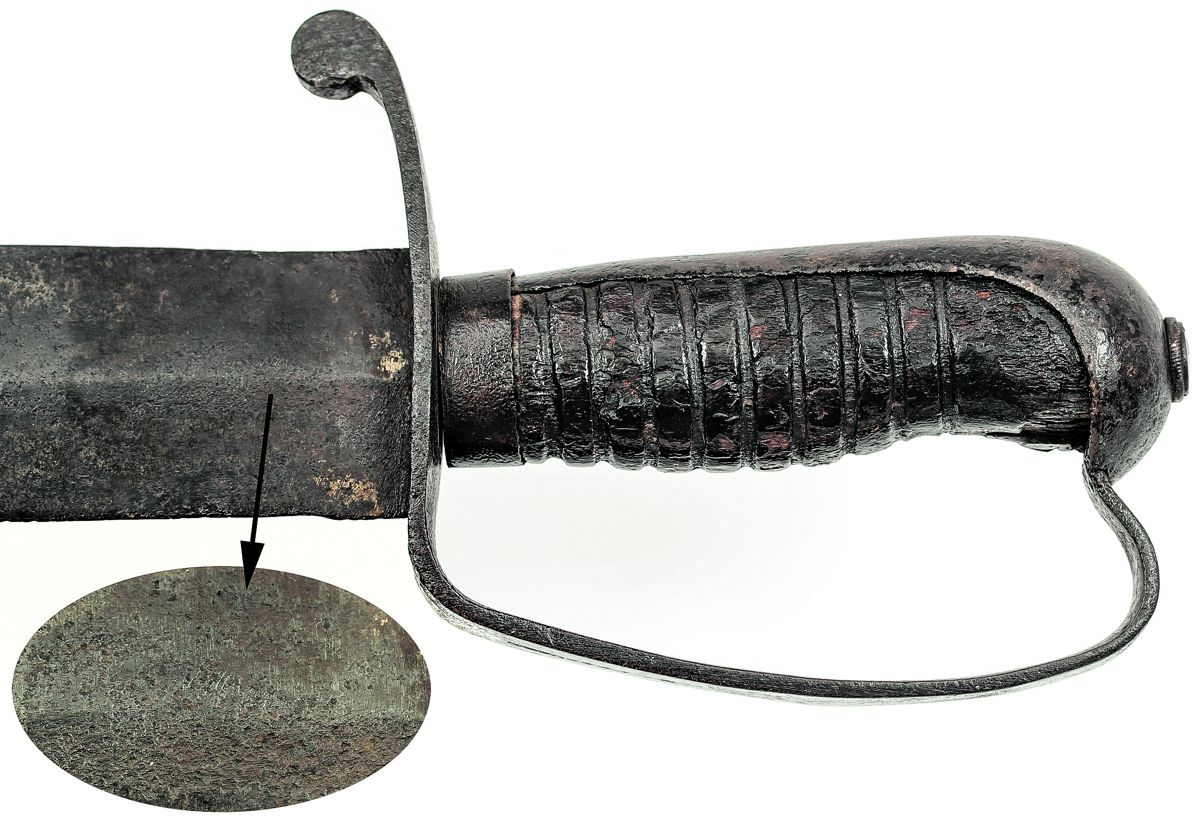
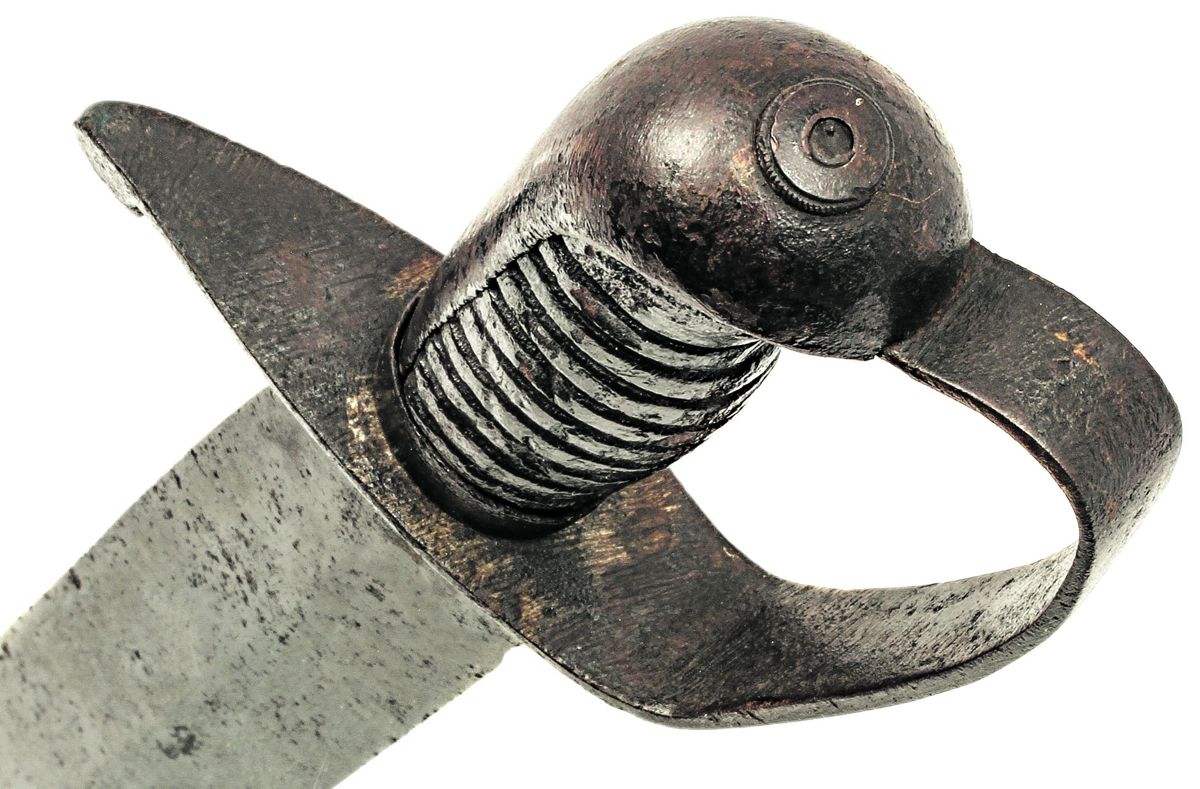
The M.L. Ferguson Confederate fighting knife pictured here is truly massive and could almost be called a short sword as much as a knife. The knife is somewhat crudely made and assembled, suggesting that the Ferguson was truly a blacksmith and no cutler. The knife is 21 3/8 inches in overall length. It has a heavy 16 3/8-inch long spear point blade with a median reinforcement ridge running the length of the blade. The ridge makes the center of the blade rather thick, measuring a l m o s t 3/8-inches in thickness. The blade has a very subtly tapered profile and is slightly narrower at the ricasso, widening towards the tip and then narrowing rapidly to a spear point. The blade width is about 1 13/16-inches at its widest point. It is secured to the hilt via its iron tang, which terminates at a round, knurled, capstan nut at the pommel cap. The reverse of the blade is stamped M.L. FERGUSON below the medial ridge, near the ricasso. The mark is well worn and barely legible but it is present and can be seen in good light if viewed from the correct angle. Unfortunately the mark proved very difficult to photograph well. As previously noted, the hilt appears to be a reworked Starr NCO saber hilt. It consists of a rudimentary onepiece, iron D-shaped guard that runs from a forward swept quillon at the front and terminates under the iron backstrap at the pommel cap. The outer face of the knuckle guard is crisply stamped M. L. Ferguson as well, with the same die used to mark the blade. The backstrap is also a single piece of iron that runs from the upper rear of the guard to the pommel cap. The backstrap is retained by a ½-inch wide iron ferrule behind the guard and the capstan nut at the pommel cap. This massive knife weighs in at slightly more than 2 pounds, 1 ounce, and, despite the large, thick blade and significant weight, the knife is relatively well balanced. The wooden grip has a moderate palm swell with nine grooves that may have had wire wrapping at some point in time to enhance the gripping surface. This knife is in untouched, attic condition, and the blade and iron hilt mountings all have a thick, chocolate brown patina. Tim Prince is a full-time dealer in fine & collectible military arms from the Colonial Period through WWII. He operates College Hill Arsenal, a web-based antique arms retail site. A long time collector & researcher, Tim has been a contributing author to two major book projects about Civil War era arms including The English Connection and a new book on southern retailer marked and Confederate used shotguns. Tim is also a featured Arms & Militaria appraiser on the PBS Series Antiques Roadshow. M L FERGUSON Left: The M.L. Ferguson D-guard fighting knife is large enough to be considered a short sword or possibly even a “cutlass.” Overall obverse view of the ML Ferguson fighting knife.