This And That
Perspectives on Sharpsburg, Phase Two
By Gould Hagler · Originally published September 2020 · pp. 32–33
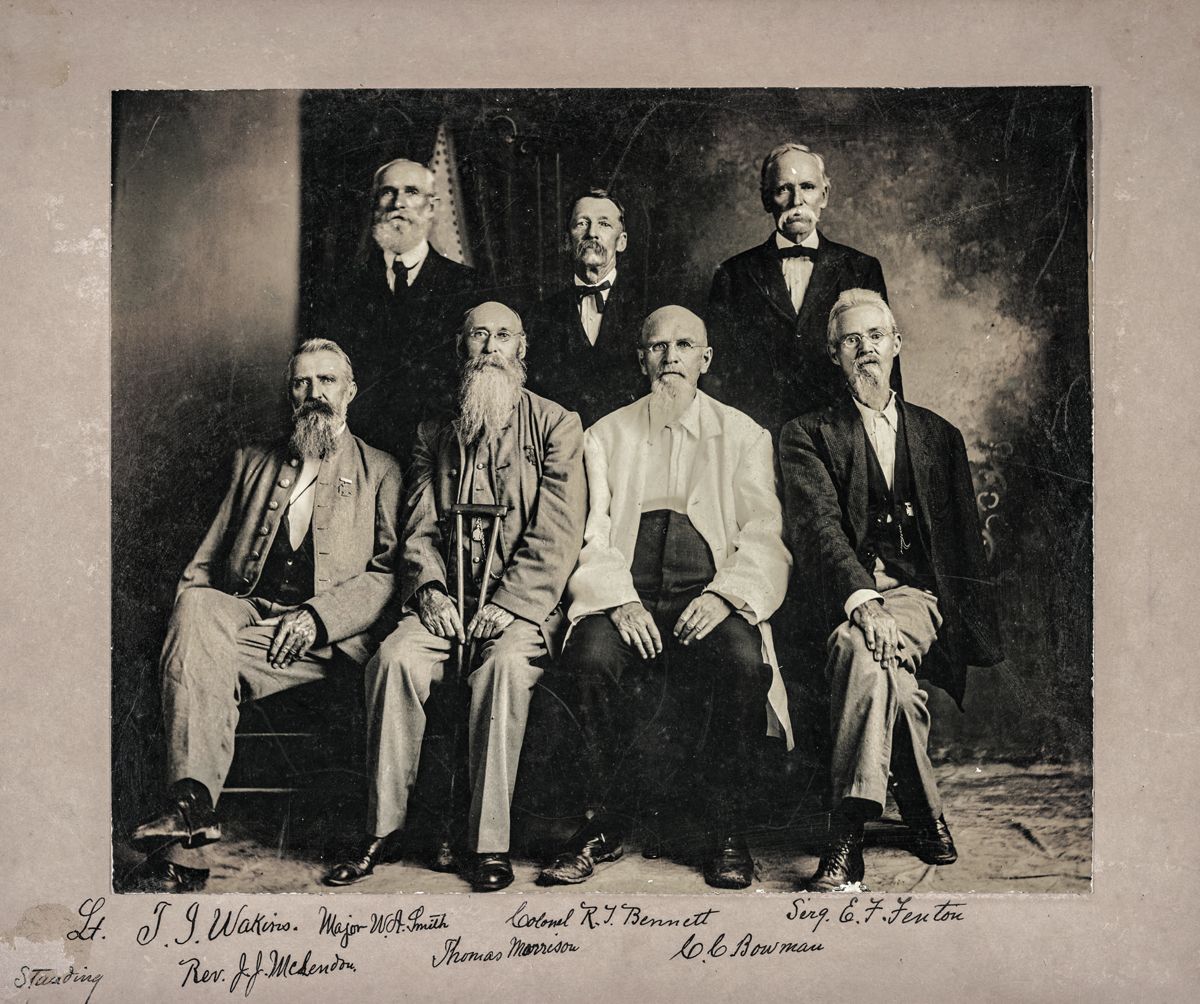
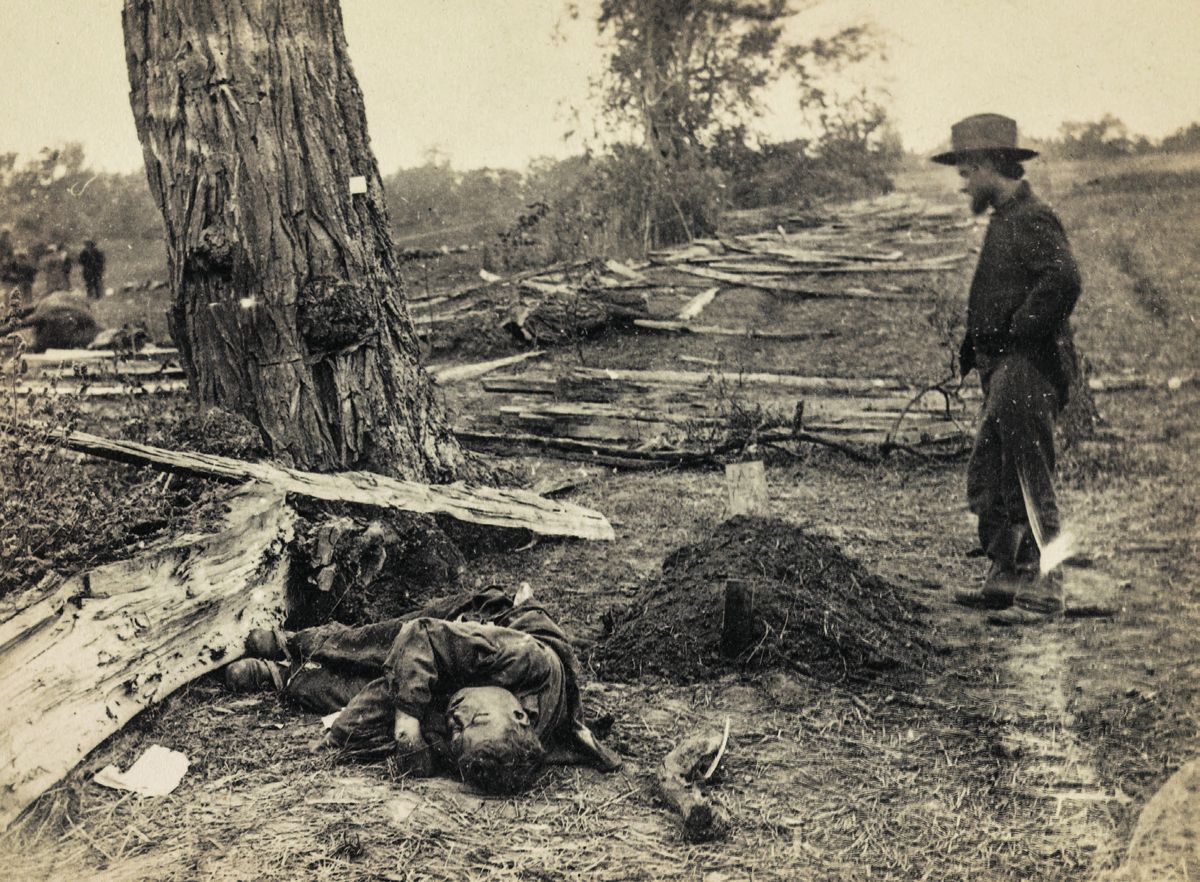
Stern necessity bade us be satisfied with simply holding our ground. – Col. Risden Bennett At the end of last month’s column we left the Confederates at the north end of the “ensanguined field of Sharpsburg,” as the fighting in the early phase of the battle petered out. We move to the center, where more American blood soaked the land. We now listen to the words of several Confederate officers leading the men who traded blows with their Federal enemies along the famous Sunken Road. The division commanded by Maj. Gen. Daniel Harvey Hill had shifted early in the day to support units fighting desperately on the Confederate left. Hill’s troops were pushed back with heavy losses. He reported that “efforts were made to rally them, in the bed of an old road…which had been their position previous to the advance.” One of his brigades, Hill stated, got back to the road but took little part in the fighting there: its leadership had been annihilated, with four of its 10 field officers dead, five badly wounded, and the tenth stunned by a shell.
Another brigade, commanded by Col. Duncan McRae, “advanced with alacrity” from the road to meet the enemy. The men “secured a good position and were fighting bravely when a panicky North Carolina captain cried out ‘They are flanking us.’” Hill wrote that with this cry “in a moment they broke and fell to the rear.” Hill’s candid report further stated that “We had now lost all the ground wrested from the enemy, and were occupying the position held in the morning. But three of my brigades had been broken and much demoralized. [The brigades of Brig. Gen. Robert] Rodes and [Col. George B.] Anderson were in the old road, and some stragglers had been gathered up and placed upon their left.” Hill sent “several urgent messages to General Lee” to alert the commander that the Federals were about to strike these depleted brigades. No help arrived before “a heavy force advanced in three parallel lines, with all the precision of a parade day,” but, even worn down as they were, Rodes’s and Anderson’s men poured “a galling fire” into the ranks of the attackers. The Federals “recoiled, and fell back; again advanced, and again fell back, and finally lay down behind the crest of the hill and kept up an irregular fire.” Hill was soon reinforced by the division of Maj. Gen. Richard H. Anderson, whose 3,000 to 4,000 men brought sufficient weight to the Confederate side, or so it seemed, when the order to charge was given. General Rodes reported that “The charge failed, mainly because the Sixth Alabama Regiment, not hearing the command, did not move with the others, and because Colquitt’s brigade did not advance far enough. That part of the brigade which did move forward found themselves in an exposed position, and, being outnumbered, fell back before I could get…the Sixth Alabama to move. Hastening back to the left, I arrived just in time to prevent the men from falling back to the rear of the road…. It became evident to me that an attack by us must, to be successful, be made by the whole of Anderson’s brigade, mine, Colquitt’s, and any troops that had arrived on Anderson’s right. My whole force at this moment did not amount to over 700 men….” Rodes noticed that troops, one regiment and part of another, that were “going to the support of Anderson…instead of passing to the front, stopped in a hollow immediately in my rear….” Rodes learned that these troops belonged to Pryor’s brigade and was told by their officers that “they had been ordered to halt there, by somebody, not General Pryor. Finding General Pryor in a few moments, and informing him of their conduct, he immediately ordered them forward.” Rodes’s account is matter-of-fact, but the reader gets the impression of a certain level of disgust at the “conduct” of these unnamed officers and their men, holed up in a hollow, with a battle swirling around them, sheltering there because “somebody,” not their commander, had ordered them to do so. Having handled this situation, Rodes returned to get an urgent message from the officer in command of the Sixth Alabama, Lt. Col. James Lightfoot, who had taken over from the seriously wounded Col. John B. Gordon. Lightfoot said his regiment’s right “was being subjected to a terrible enfilading fire…and…had but few men left in that wing….” Rodes told the colonel to “throw his right wing back out of the old road….” However, instead of following these instructions Lightfoot “moved briskly to the rear of the regiment and gave the command, ‘Sixth Alabama, about face, forward march.’ Major Hobson, of the Fifth, seeing this, asked him if the order was intended for the entire brigade; he replied ‘Yes,’ and thereupon the Fifth, and immediately the troops on their left, retreated.” Rodes did not immediately see this “retrograde movement” because he stopped to help a wounded officer and was himself then downed by a wound that he first thought to be serious. By the time he realized what had happened it was too late to prevent the retreat. “I hastened to intercept it at the Hagerstown road. I found, though, that, with the exception of a few… men…, not more than 40 in all, the brigade had completely disappeared from this part of the battlefield.” So, we have Rodes finding men sitting in a hollow because “somebody” told them to halt there. He corrects this problem. Then he orders Lightfoot to make an adjustment to his line. Lightfoot instead orders his entire regiment to retreat, and informs another regimental commander that the whole brigade is to do so. Rodes, slowed by a wound, is unable to stop his brigade—except for 40 souls—from melting away. Leadership of Colonel Anderson’s Brigade ultimately devolved to Col. Risden Bennett after its commander and other senior officers were disabled or killed. In his report for the brigade, Bennett wrote that Hill himself led the unit to its position in the Sunken Road. Soon the enemy “came into the field in front of us….” Bennett’s report describes the Federal assault. “Their advance was beautiful in the extreme, and great regularity marked their column.” The Yankees closed to within 50 yards, but “a well-directed fire sent them in disorder some 50 paces rearward.” The attackers charged again, “with same result as aforesaid, with the addendum of wild confusion.” Bennett continued: “The bravery of a field officer apparently checked the spreading symptoms of panic, and once more their courage was brought to the test. Poor return, indeed, they made for the gallantry of their leader. Confusion that seemed remediless followed.” With the assault on their line faltering, Bennett wrote, “the colonel commanding [i.e., George Anderson] gave orders for bayonets to be fixed, preparatory to an advance of the line. However, two fresh columns of the enemy were seen double-quicking to the relief of the shattered ranks of the foe, and stern necessity bade us be satisfied with simply holding our ground.” As we have seen, the division of
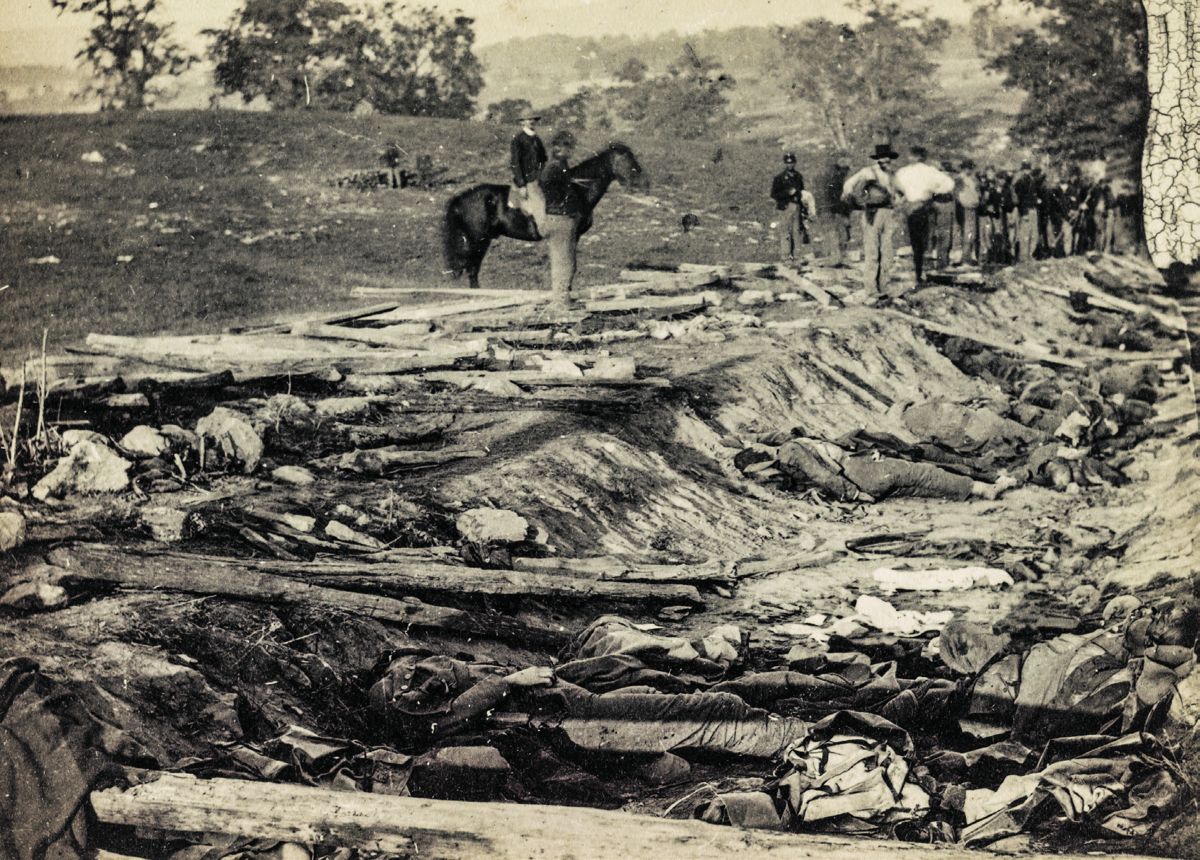
Maj. Gen. Richard Anderson had sent reinforcements to stiffen the position in the Sunken Road and enable the Confederates to counterattack. Bennett’s report contains a very negative assessment of these troops’ performance. His brigade was warned to keep a lookout on the extreme right. “While directing ourselves to that point, masses of Confederate troops in great confusion were seen…, the Sixteenth Mississippi and Second Florida [of Richard Anderson’s division], coming to our succor, broke beyond the power of rallying after five minutes’ stay.” The panic spread, Bennett wrote, as two regiments of his brigade were swept up in “the stampede, if we may so term it.” “The hour of 1 p.m. had arrived. [Richard] Anderson’s division had gone to the rear. Two regiments…of our own brigade were missing. The dark lines of the enemy had swept around our right, and were gradually closing upon Rodes’ brigade.” Bennett’s assessment was that “to contend against front and rear attacks we were totally inadequate, and the bare alternative of retreat was presented. The command was ordered to make the retreat….” Bennett concluded his report by saying that “About sunset the colonel commanding was taken from the field, disabled.” The brigade suffered 302 casualties, with 57 killed and 245 wounded. However, Bennett reported that “The command was reformed at the road leading to Sharpsburg, and participated in all the skirmishes of the afternoon.” The Confederates had been forced back but there was no Federal breakthrough. Heavy fighting in the center ended in the early afternoon. The next threat came from the south end of the line. Federals had crossed the creek in force; the Confederate right had been largely denuded of troops, as the morning and midday crises required Lee to shift men to his left. Where were the men to be found to stop this final Federal push? Would the Army of Northern Virginia be saved, or would it be cut off from the Potomac crossing and trapped in Maryland? Next month we will read about one of the war’s most famous episodes, the arrival of the division of Maj. Gen. A.P. Hill. Sources: The reports of the officers quoted are in O.R., Ser. 1, Vol. 29, Part 1. Maps of the Sharpsburg battlefield can easily be found online. The American Battlefield Trust shows excellent maps at its site, www.battlefields.org. Gould Hagler is a retired lobbyist living in Dunwoody, Ga. He is a past president of the Atlanta Civil War Round Table and the author of Georgia’s Confederate Monuments: In Honor of a Fallen Nation, published by Mercer University Press in 2014. Hagler speaks frequently on this topic and others related to different aspects of the Civil War and has been a regular contributor to CWN since 2016. He can be reached at [email protected].