
Through The Lens
Give Them Cold Steel Armstrong’s Raid – Part I
By Stephanie Hagiwara · Originally published September 2020 · pp. 22–23
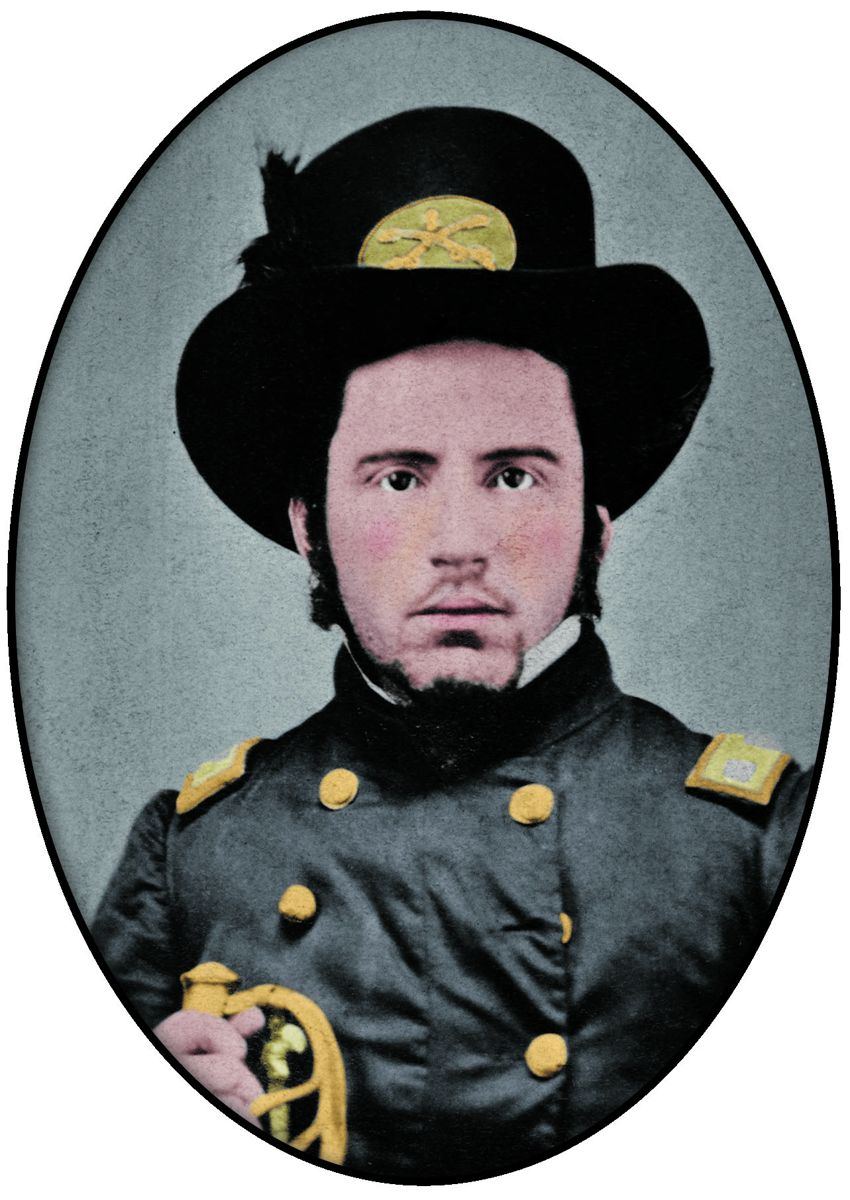
“It is reported that a rebel force of 6,000 cavalry have been sent to attack our lines. Keep a sharp lookout.” – U.S. Gen. Ulysses S. Grant On Aug. 14, 1862, C.S. Gen Braxton Bragg launched his Kentucky Campaign to drive U.S. Gen. Don Carlos Buell out of Kentucky and Tennessee. To prevent Gen. Ulysses S. Grant from sending Buell troops, Grant had to be kept occupied. C.S. Col. Francis “Frank” C. Armstrong was promoted to general for the job. Armstrong was ordered to gather the scattered Army of the West cavalry units and disrupt Federal supply and communication lines and gather intelligence in west Tennessee. At daybreak on Aug. 22, Armstrong’s cavalry rode out of Guntown, Miss., traveled over 60 miles, and linked up with Col. William “Red” Jackson’s horsemen in Holly Springs, Miss. Four days later, Armstrong “now had perhaps thirty-five hundred, rank and file. We had never moved with as large a body of cavalry before. Generally speaking, they were well mounted and a fine-looking body of men,” wrote Sgt. R.R. Hancock, 2nd Tenn. Cavalry. Armstrong may not have realized it, but as early as Aug. 28, his raid was already accomplishing one objective. The Federal telegraph wire had been spreading news of his approach. Grant had to deny Gen. Henry Halleck’s request to send reinforcements for Buell due to the large numbers of Confederate cavalry in the area. On Aug. 30, the Confederate advance rode in column formation and the horses were kicking up dust clouds. The Federals stationed at Bolivar, Tenn., were sent out to investigate a report that “a small rebel force was menacing our pickets.” Armstrong’s men had been busy cutting up the Mobile and Ohio railroad. Two companies of the 11th Cavalry, one section of the 9th Indiana Battery, 20th Ohio Infantry, and three companies of the 78th Ohio Infantry were sent out. The remaining 78th companies were ordered to be ready for movement. Col. Mortimer D. Leggett led the advance with 45 20th Ohio infantrymen mounted on mules. Around 1 p.m. the two forces met “in a piece of woodland,” on the Van Buren Road, about 5 ½ miles from Bolivar. It was Armstrong’s 7th Tenn. Cavalry vs. the lead companies of the 20th Ohio. Leggett observed that, “the nature of the ground being such that cavalry could not be used, some 12 or 14 of those who had [Sharps] carbines dismounted and formed with the infantry. After driving the enemy steadily but slowly for three-fourths of a mile I gained a position where I had a distinct view of the foe and found that I was contending with a force of over 6,000 instead of 300 or 400.” Leggett sent for reinforcements. Due to the terrain, he realized that “… my force must have been annihilated had I attempted to escape from such overwhelming numbers. I had not men enough to retreat, and consequently had no choice left but to fight until support could reach us.” Two hours later, six more companies of the 20th Ohio joined the fight with two guns of the 9th Indiana Battery. The battery was sent back a mile to avoid capture. Dust clouds had masked the true number of the Rebels. Now the dust clouds signaled the enemy’s intention to get around the Union’s flank. Leggett led the action to block Armstrong’s flanking move. Leading the Rebel charge was Capt. John R. “Rock” Champion, 2nd Mo. Cavalry. He was shot dead before reaching his foe. As fighting escalated, Col. Harvey Hogg with four companies of the 2nd Ill. Cavalry arrived. Hogg, an anti-slavery lawyer, politician, and eloquent orator, was raised in a slave owning family. He moved to Bloomington, Ill., and may have become acquainted with Abraham Lincoln while practicing law on the Eight Circuit. In 1857, both men were part of the losing team prosecuting Isaac Wyant for murder. Richard Yates, Governor of Illinois, offered the highly regarded Hogg the position of Lt. Col in the 2nd Ill. Cavalry. Hogg would reached out to the president through fellow 8th Circuit attorney and Lincoln family lawyer, Leonard Swett, requesting guns and other supplies for his men. As for meeting the enemy, Hogg would instruct his men with his “oft-quoted order: ‘If we do … don’t use your pistols but give them the cold steel. The saber is the weapon for the cavalry to rely on.’” Armstrong’s men began tearing down fences along the road and entering the field to fire on Hogg’s men. Leggett spotted Col. Robert “Black Bob” McCulloch, 2nd Mo. Cavalry, preparing to charge behind them. Leggett told
Hogg, “If he had any doubt about holding his position he had better fall back and not receive their charge. He promptly replied, ‘Colonel Leggett, for God’s sake don’t order me back.’ I replied, ‘Meet them with a charge, colonel, and may Heaven bless you.’ He immediately ordered his men to draw their sabers, and after giving the order ‘Forward’ he exclaimed, ‘Give them cold steel, boys,’ and darting ahead of his men he fell pierced with nine balls.” “McCulloch waved his saber and cheered the men on, and in we went with the rebel yell, cutting and slashing as we again drove them from the field,” recalled C.Y. Ford, 2nd Mo. The fighting intensified as the men fought hand-to-hand. The 78th Ohio arrived, shoring up the Federal line. Leggett wanted to engage his guns. The Federals retreated to their waiting artillery. Lt. Wallace Hight’s 9th Ind. Battery “opened upon them with shot and shell and caused them to break and disperse in great disorder.” After more than seven hours of fighting the Federals retreated to Bolivar. The Confederates made camp on Clearwater Creek with 71 Federal POWs. Pvt. John Hubbard, 7th Tenn. Cavalry, who had enlisted in Bolivar over a year earlier, wrote of Champion, “his body was borne from the field by two of his troopers. I saw for the first time a dead Confederate who had been slain in battle.” Hogg’s body was retrieved by his friends and shipped back to Bloomington. On his 29th birthday, Hogg was buried in what was the largest funeral in Bloomington up to that time. Both sides thought they had won the Battle of Bolivar. Leggett reported, “900 of our brave soldiers met and drove from the field over 6,000 well-officered and well-armed rebels.” Leggett would return the next day to finish the job, but the Confederates were moving on to a different target. Armstrong also sent a report. “Just finished whipping the enemy in front of Bolivar; ran in town. I believe they will leave the country. West Tennessee is almost free of the invaders. All needed is advance of the infantry. … You will hear of us again in a day or so.”
CWN
Sources: • •
•
•
•
•
•
OR Series I, Volume XVII, Part I, Chap. XXIX, pp. 44-51. Alexander, H. (1962). The Armstrong Raid Including the Battles of Bolivar, Medon Station and Britton Lane. Tennessee Historical Quarterly 21(1), pp. 31-46. Black, Robert W. Cavalry Raids of the Civil War. Stackpole Books, 2004. Owens, Ryan, “Harvey Hogg,” McLean County Museum of History, 2018. Eckley, Robert S. Lincoln’s Forgotten Friend, Leonard Swett. Southern Illinois University Press, 2012. Wyllie, Arthur. Hancock’s Diary: Or A History of the Second Tennessee Confederate Cavalry. Brandon Printing Company, 1887. Ford, C. Y., “Fighting With Sabers.” Confederate Veteran 30, 1922.
Stephanie Hagiwara is the editor for CivilWarinColor.com and Civil Warin3D.com. She also writes a column for HistoryinFullColor. com that covers stories of photographs of historical interest from the 1850’s to the present. Her articles can be found on Facebook, Tumblr and Pinterest.