
The Graphic War
Fort Sanders
By Salvatore Cilella · Originally published September 2020 · pp. 26–27
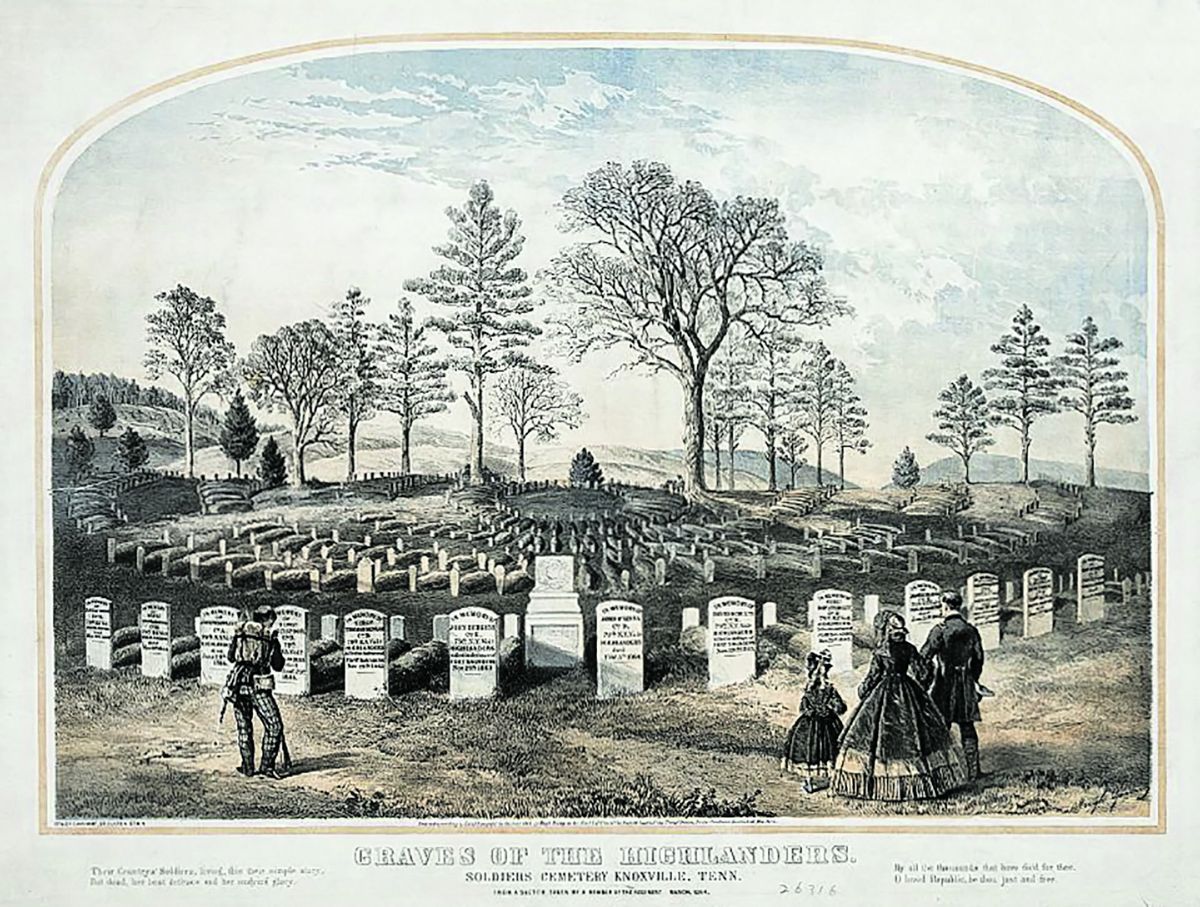
Fort Sanders The Graphic War highlights prints and printmakers from the Civil War discussing their meaning and most importantly, the print maker or artist’s goals.
The long summer of 1863 was marked in the eastern theater by Meade’s inability to crush Lee after Gettysburg. All summer long and into the fall, the two armies punched and counter punched to no avail. In a major skirmish/ minor battle at Bristoe Station on October 14, Union General Gouverneur Warren surprised Confederate General A.P. Hill, decisively driving him from the field. Three weeks later, this time with Federal General John Sedgwick facing Confederate
General Jubal Early, the Yankees roundly drubbed the Rebel force causing nearly 1,700 casualties at Rappahannock Station, November 7. The so-called Mine Run Campaign from November 27 to December 2, with many feints and useless movements, effectively ended in a draw with both armies going into winter camp without significant contact. In the meantime, substantial action occurred in the West. The last half of 1864 witnessed three major engagements between the two armies at Tullahoma, Tenn. (June 24-July 3); Chickamauga, Ga. (September 19-20); and Chattanooga, Tenn. (November 24). Both the Army of Tennessee and the Union forces had been reinforced from the east: General James Longstreet from the Army of Northern Virginia and General Ambrose Burnside from the Army of the Potomac. The two reinforcements finally fought at Knoxville Nov. 29, 1863, and a small fort protecting the town became the center of interest. Longstreet chose to attack Fort Sanders, the main defensive position at Knoxville. Longstreet believed the fort was Knoxville’s, and therefore Burnside’s, weakest link. Confederate forces surrounded the town. Burnside reacted by fortifying the entire town and by Nov. 29, it had been under siege a week. Longstreet planned on a nighttime storming party assembled below the fort to assault its daunting slopes at dawn. During the night, in a freezing rain, nearly 3,000 Confederates in three brigades noisily assembled. Defenders inside the fort were thus alerted to the impending attack. Manning the fort were some 250 to 500 men, depending on sources. One of the defenders was the 79th New York, “The Highlanders.” The ensuing attack, coming at dawn, lasted only some twenty short minutes. Federal forces had stretched telegraph wire between tree stumps in an outer ditch. An inner ditch, twelve feet wide and ten feet deep in some places, featured a steep vertical wall up to the fort. Early intelligence noted that Federal troops were seen walking across the ditch, not knowing the Yankees were walking on planks. The attacking Confederates were easy targets for Federal soldiers firing from the ramparts. Attempts to scale the wall without ladders were futile. The attack quickly became an unmitigated disaster. The Highlanders suffered only nine casualties in a total Federal loss of 100. Confederate losses were substantial: 800 killed, wounded, or missing. Longstreet withdrew and eastern Tennessee remained in friendly northern hands. Years later, the Chicago lithographic firm of Kurz and Allison portrayed the ill-fated attack by Longstreet’s brigades. In its usual dramatic fashion, the artists pictured an orderly, organized assault, seemingly in bright sunlight, not at dawn. However, it realistically portrayed the tangled wires strung between tree stumps as the record showed. Also depicted are those Rebels who managed to scale the slippery wall where they engaged in hand to hand combat. Clouds of exploding shells document the presence of 12-pdr. cannon inside the fort. More realistically portrayed is a moving image of the Soldier’s Cemetery outside Knoxville. This lithograph shows the graves of the 79th N.Y. Volunteers, the “Highlanders” in the forefront. It is an excellent example of a lithograph as primary source. It was based on a “Sketch Taken by A Member of the Regiment March, 1864.” A member of the regiment stands in front of thirteen Highlander graves, each with a name and details of death, while an officer and family stand at the right. Upon closer examination, it is possible to identify a few graves from the attack on Fort Sanders. The regiment suffered four enlisted deaths and 16 wounded, all of whom recovered, during their tour in the fort.1 The Knoxville National Cemetery was founded by General Burnside after the siege. This large folio print shows the cemetery high on a hill framed by the surrounding hills and river. The artist, Hugh Young, was an officer in the 79th, who enlisted at age 31 to serve three years. He rose from private to Captain by war’s end.2 Less than a year later, Young deposited his print with the Library of Congress in October, 1864. 1.
Endnotes:
The four dead were Sergeant Thomas Denham, Co. B; John Burgess, Co. K; David Schultz, Co. K; and Sergeant Robert Atherlly. Frederick Phisterer, New York in the War of the Rebellion: 1861 to 1865. 3d. ed. 5 vols. Albany: J. B. Lyon Company, State Printers, 1912, IV, 2859.
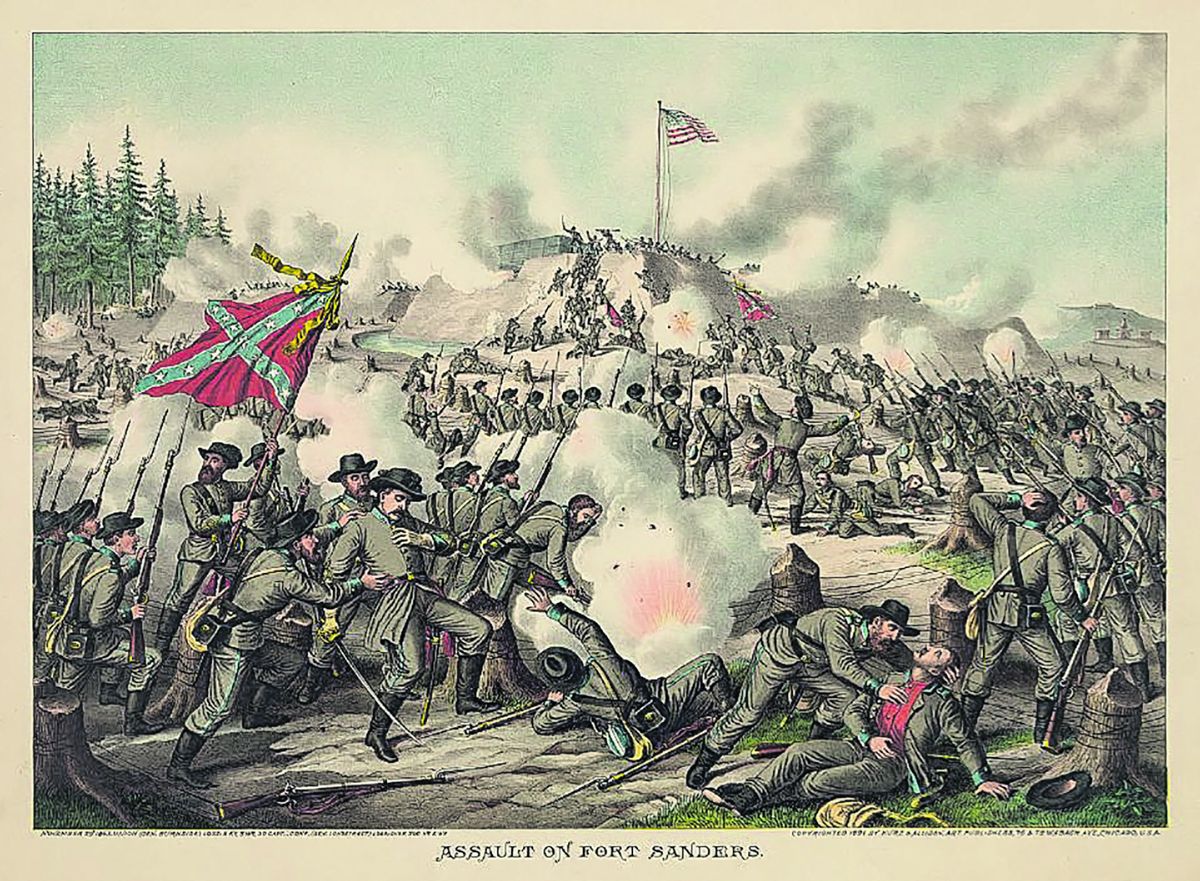
Kurz & Allison Fort Sanders. Library of Congress.
Salvatore Cilella devotes his time collecting American prints and maps and writing. His last professional position was President and CEO of the Atlanta History Center. His most recent books are Upton’s Regulars: A History of the 121st
New York Volunteers in the Civil War (U. Press Kansas, 2009). His two-volume Correspondence of Major General Emory Upton, (U. of Tennessee Press, 2017), received the 2017–2018 American Civil War Museum’s Founders Award for outstanding editing of primary source materials. His latest book “Till Death Do Us Part,” an edit of Upton’s letters to his wife 1868– 70, was published in May by the Oklahoma University Press.