
Emerging Civil War
Emerging Civil War — September 2020
Originally published September 2020 · pp. 34–35
Chris Mackowski
From the Editor
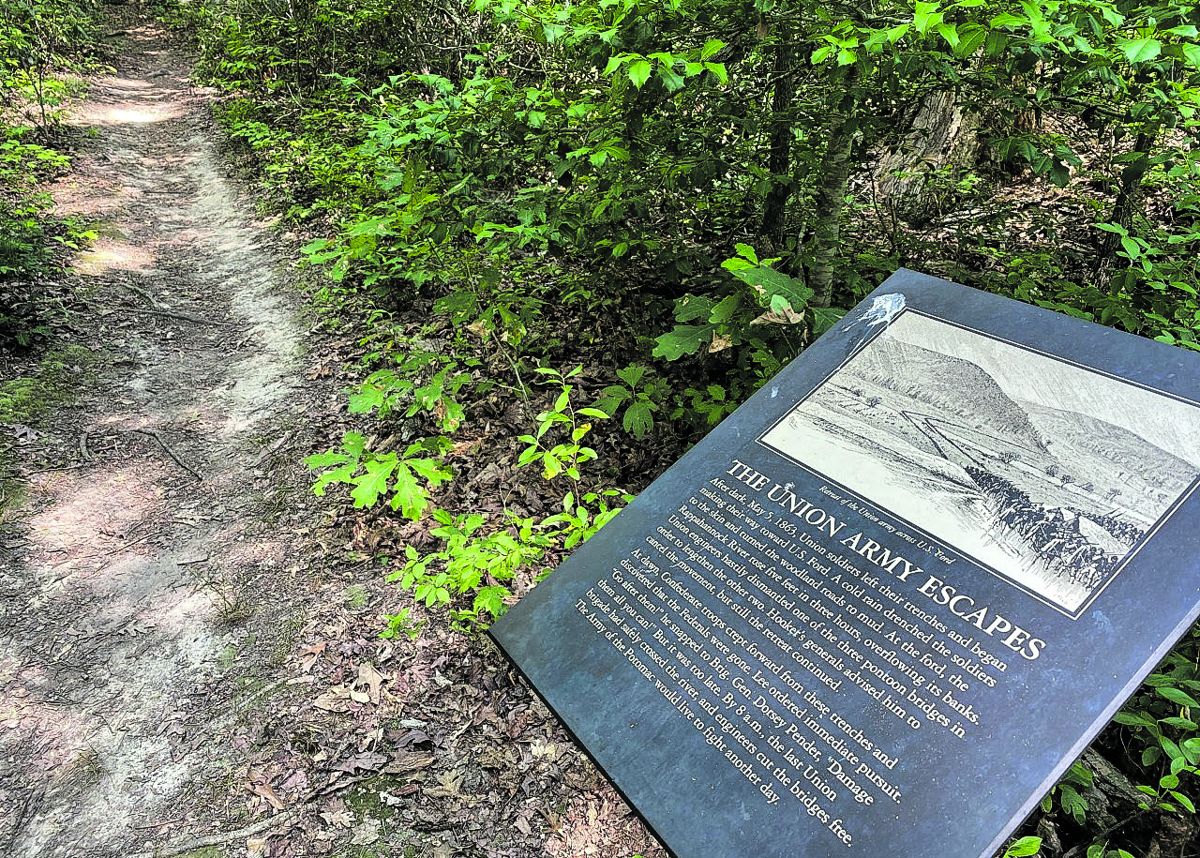
My car’s thermometer reads 76 degrees when I set off into the woods. The Chancellorsville History Trail leaves the parking lot across from the visitor center and loops 3.2 miles through the forest north of modern Route 3. In this area, Confederate attacks and Federal counterattacks seesawed through the woods on May 3, 1863. In the thick of the fight and without orders, Brig. Gen. Joseph Revere, grandson of the Revolutionary War hero, pulled his men out of line through here and marched them to the rear to reform. I pass an aluminum sign that tells the story, one of several such signs posted along the path. The ground rolls with small hills, crisscrossed by dry streambeds that, in the spring, flowed with shallow trickles of water. When the path descends toward the low ground, the foliage thickens; along the high ground, the groundcover thins out. In places, ample sunlight pours down into what was once described as “the dark, close wood” of the Virginia Wilderness. I’ve been exercising along the trail since mid-June, circling the loop twice each day, doing an on-off speed-walk/run combo that keeps my heartrate within a specific range. The heat has been especially oppressive this third week of July and my car thermometer will read “92” by the time I get back. Fortunately, the trail is beautiful, which helps distract me from the labor of the workout. It’s all a matter of mental toughness, even if the heat compounds the physical fatigue. It’s been a hot summer all the way around. In fact, out here in the woods, away from the news, the internet, the protests, and the pandemic, it’s almost cool. I might offer that as a prescription to everyone: talk a walk in the woods, slow or fast. Get away from things. Cool off. I often see deer, and last week I surprised a small skunk hardly bigger than a kitten. Once or twice a week, there’s a box turtle. I sometimes think they’re moving at the exact right speed, with the exact right deliberateness. — Chris Mackowski, Ph.D. Editor-in-Chief
The Seventh Annual Emerging Civil War Symposium at Stevenson Ridge Well, we ended up having to postpone this year’s symposium, bumping everything back. Our theme, Gordon Rhea’s keynote address, Greg Mertz’s tour, and all our speakers, to next year. Darn COVID-19! Mark your calendars for August 6-9, 2021. If you had a ticket and haven’t yet indicated your refund preference, you can find out more information here: https://emergingcivilwar.com/2020/07/06/2020-symposium-postponed. On the bright side, as a way to say thank you to our ticket-holders, we’re going to do a virtual symposium in August. We’ll record a series of presentations on Saturday, August 8, and make them available on YouTube later in the month, first as exclusive content to our ticket-holders, and, later, to our general audience. C-SPAN is also coming to record the programs, so you’ll see them there later this fall.
ECW News & Notes Sarah Kay Bierle made a social-distanced trip to New Market, Va., in July. It was great to be back in the Shenandoah Valley for a warm day of hiking on the battlefield. Sean Michael Chick has done a series of discussions about the Civil War, U.S. Presidents, and Napoleon’s commanders on the youtube channel Thersites the Historian: https:// www.youtube.com/channel/ UClHybiqQOzR8kUpg5BbnjdQ Bert Dunkerly wanted to take a moment to call attention to some people who have been a big help to him recently. Gordy Morgan has finished editing Bert’s ERW book about New Jersey in the Revolution. Gordy is a great editor and ERW is fortunate to have his help. Edward Alexander is producing some maps for me and I’m amazed at his attention to detail. Jon-Erik Gilot and Kevin Pawlak finished the manuscript for their John Brown’s Raid book for the ECWS. Look for it on bookstore shelves in the coming year. Chris Kolakowski, in his new position at the Wisconsin Veterans Museum, recently participated in a panel discussion that examined the role of Wisconsin soldiers at the Battle of Gettysburg. Chris was joined by the museum’s curator of history, Kevin Hampton. https://www.facebook.com/
WisconsinVeteransMuseum. Chris Mackowski reviewed Adam Petty’s The Battle of the Wilderness in Myth and Memory: Reconsidering Virginia’s Most Notorious Civil War Battlefield for LSU’s Civil War Book Review: https://digitalcommons.lsu.edu/cwbr/vol22/iss2/9. Derek Maxfield has an event in West Sparta, N.Y., at 2 p.m. Aug. 9, to promote his new ECWS book, Hellmira. Ryan Quint is returning to the Fredericksburg & Spotsylvania National Military Park, with August 2 being his first day back. Ryan started there years ago as an intern. “I am very much looking forward to returning to my roots as a Civil War historian,” he says.
10 Questions…with Phill Greenwalt Phill Greenwalt is one of ECW’s longest-serving contributors. He’s also co-founder of Emerging Revolutionary War and the Emerging Revolutionary War Series. We first profiled him in the November 2017 newsletter (http://conta.cc/2zau8iL). You can read his full ECW bio here: https://emergingcivilwar.com/author-biographies/editors/phill-greenwalt. You’ve been helping to steer the ship over at our sister site, Emerging Revolutionary War, these days. How’s life in the 18th Century?
Phill Greenwalt loves to talk about his home state of Maryland and his adopted state of Florida in the Civil War. The 18th century is still there. Emerging Revolutionary War is going strong, though, and we thank our readership and followers for that. With the limits placed on travel, and with historic sites, parks, and hallowed ground all facing challenges, the historians at Emerging Revolutionary War came up with the idea of a Zoom history happy hour-type program for Sunday evenings. When we’re able to jaunt out to a battlefield or attend a conference, we always congregate afterwards at a restaurant, bar, or brewery, have a drink and discuss history. So, we figured we’d make the best of the situation and do it virtually! The idea took off in mid-April and is still going strong on Sunday evenings, so join us at 7 p.m. on our Facebook page. Otherwise, the historians continue to crank out content, work on future publications, and, speaking personally here, trying to knock out books on that ever growing “to-read” list! Do you have any Civil War projects in the works at the moment? I currently completed an essay for an Engaging Civil War Series future publication and am jointly working on a publication about Floridians at Gettysburg that has a historical memory aspect, too. With some archives being closed, that project is taking longer than expected, but I’m cranking away at it and excited to see how it is coming along. Also, I’m working on a few essays for various historical organizations/initiatives. And maybe a future Emerging Civil War Series publication, too—who knows? What else are you working on? I’m brainstorming and setting the foundation for the next volume I’ll write in the Emerging Revolutionary War Series. I cannot give the details away yet and, besides, it is a few years from seeing the light of day. There are other great books in that series just published, about to be published (including one of mine on Valley Forge), and a few in various stages of production. Check Savas Beatie and Emerging Revolutionary War to stay up-to-date. Being in Florida, you’ve had the chance to explore the state’s often-overlooked Civil War history. Why don’t you think the state gets more credit for that history? I think the main reason is location/geography. Florida was still relatively uninhabited at the time, with less than 300 people living in South Florida and large swaths of the state still unchartered. It had minimal railroad mileage, and a large part was still untamed Everglades. The state’s population, at the time of secession, ranked it 11th out of 11 Confederate states. To put it in perspective, Florida had 30% fewer people than the 10th most-populated state in the Confederacy, Arkansas. By 1862, the Confederacy had largely given up defending the state, with its many miles of coastline and the strength of the U.S. Navy, so the state was largely forgotten until Confederate authorities realized they needed Florida’s economic factors: cattle and salt. Or when those former authorities needed to leave the country! When people come to Florida, they tend to be drawn to other tourist attractions, Disney World, South Beach, and the Space Coast for some reason. If a visitor to the Sunshine State could visit just one Civil War site, what would you recommend? If you want to visit a battlefield, Olustee, in a still largely undeveloped area, has a great reenactment on the anniversary in February, great time to be in Florida. It was a very savage but important engagement in 1864. I think someone gave a talk on it at an ECW Symposium about how it was one of the forgotten battles. Aside from a battlefield, Fort Jefferson in Dry Tortugas is a unique experience. It’s the largest brick fort in the western hemisphere. Dr. Mudd, from the John Wilkes Booth conspiracy, was held there. It’s located 67 miles off the coast of Key West. Lightning Round (short answers with a one-sentence explanation) Favorite primary source? Can it be a tie? E.P. Alexander and W.W. Goldsborough’s The Maryland Line in the Confederate Army 1861–1865. Favorite Civil War-related monument? 2nd Maryland (CSA) at Gettysburg. It misspells the brigade commander and has two unit designations, I’ll let those interested go see it and do the research. Favorite unsung hero of the Civil War era? Is John C. Breckenridge unsung? If not, J.J. Dickison (CSA) and Nathan Kimball (USA) What’s a bucket-list Civil War site you’ve not yet visited? Fort Donelson National Battlefield. Favorite ECWS book that’s
CWN not one of your own? Let Us Die Like Men: The Battle of Franklin by Lee White.
ECW Bookshelf We have two new audiobooks now available as part of the Emerging Civil War Series. • Strike Them a Blow: Battle Along the North Anna River by Chris Mackowski, narrated by the author. • A Long and Bloody Task: The Atlanta Campaign from Dalton to Kennesaw Mountain to the Chattahoochee River by Stephen Davis, narrated by Gary Williams.
The two latest audiobook releases from the Emerging Civil War Series. Both are available from Amazon.com, Audible.com, and our publisher, Savas Beatie (https://www.savasbeatie.com/).
July in American Revolutionary War history is a month to celebrate. On July 2, the Continental Congress agreed on independence, and on July 4 John Hancock affixed his grandiose signature to the bottom of the document declaring it so. There is also reason to celebrate for ERW. This month, the latest volume of the Emerging Revolutionary War Series book was released: A Handsome Flogging: The Battle of Monmouth, Jun. 28, 1778. The book is available for purchase through Savas Beatie (https:// www.savasbeatie.com/a-handsome-flogging-the-battle-ofmonmouth-june-28-1778/) and soon on Amazon. To hear more about the book, click over to our Facebook page and listen to the Rev War Revelry with the author Billy Griffith: https://www.facebook.com/emergingrevwar/videos/1586386451520562. Each Sunday, at 7 p.m. EST, remember to click over to the Facebook page for the next installment of “Rev War Revelry,” an hour-long historian happy hour on topics related to the era. And, as always, continue to check out at blog at www.emergingrevolutionarywar.org.