
American Battlefield Trust — September 2020
Originally published September 2020 · pp. 24–25
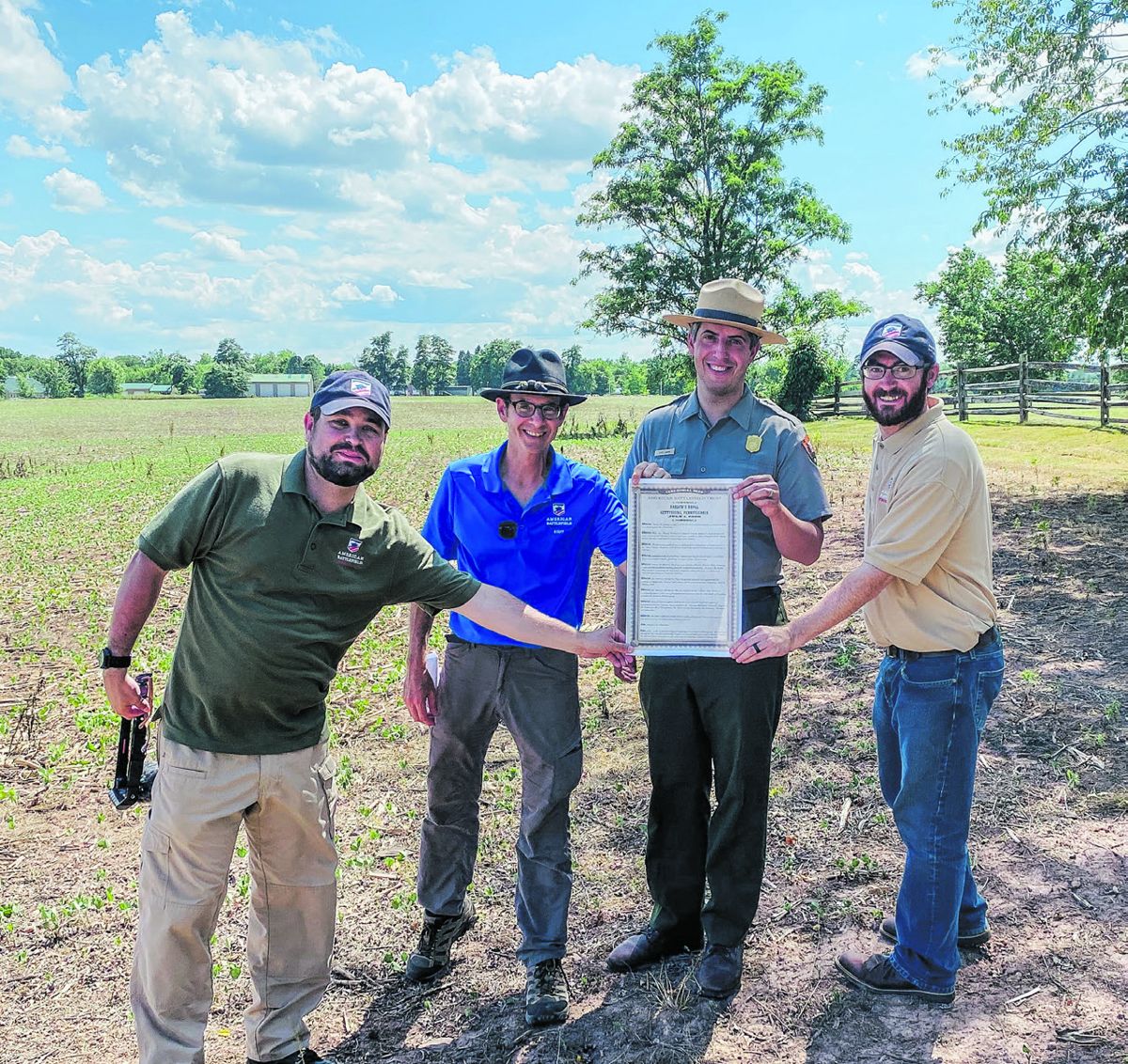
Although many events and activities that typically mark the anniversary of the Battle of Gettysburg went digital in 2020, there was at least one tangible and permanent legacy of the commemoration. On July 1, the American Battlefield Trust transferred a critical 35-acre tract at Barlow’s Knoll to the National Park Service. “Among the dozens of battlefield properties that we protect each year, a small number rise above the rest because of their iconic nature,” said Trust President Jim Lighthizer. “Barlow’s Knoll at Gettysburg is certainly in that category. For years and decades to come our members will be able to walk this land and tell their children and grandchildren that ‘I helped do something special by saving this forever.’” On July 1, 1863, the area that became known as Barlow’s Knoll was the far right of the Federal line. Brig. Gen. Francis Barlow’s two XI Corps brigades initially deployed in the fields before he made a controversial decision to advance across the land now protected by the Trust and transferred to the Park, and onto a small rise about 700 yards distant. Barlow had hoped that the elevation would provide an advantage to his artillery, but he overextended his force and was dislodged from the position. Retreating toward the Adams County Almshouse, again crossing the Trust-purchased property, Barlow attempted to rally his men, but was badly wounded. “Gettysburg National Military Park and the American Battlefield Trust have a long and successful history of partnership,” said Park Superintendent Steven Sims. “They are a constant ally and aid in our work; this land transfer at Barlow’s Knoll is just the latest example. I look forward to many more instances of cooperative preservation.” Protection of this land had been a top park priority for decades until the Trust had the opportunity to acquire it from Adams County in 2016. Because the tract was entirely within the National Park’s boundary, it was ineligible for Federal matching grants designed to create public-private partnerships for battlefield preservation. This meant that the Trust had to raise the full $400,0000 price in private donations. Today, Gettysburg National Military Park protects more than 6,000 acres of that battlefield and welcomes 1 million visitors annually. The American Battlefield Trust has preserved a total of 1,183 acres at Gettysburg, much of it subsequently transferred into the national park for permanent stewardship and interpretation. The Trust’s highest profile effort at Gettysburg has been the purchase and restoration of the site that served as Lee’s Headquarters, a multi-million dollar project that included removing a hotel complex and subsequently returning the landscape to its wartime appearance.
Achievement Unlocked! Major Awards for Trust Video Productions As digital education and interpretation tools become increasingly important, the American Battlefield Trust is keeping pace with trends and earning an ever-growing list of accolades for its groundbreaking video storytelling. In recent weeks Trust video productions earned Silver Medal honors in major international competitions from the Society of Publication Designers and the Telly Awards, showcasing the innovative means available to bring the past alive through this medium. “In terms of its reach, accessibility, and immersive qualities, video is the most versatile tool in our interpretation arsenal,” said
Trust President James Lighthizer. “We are proud of the ways these productions can bring the past alive for so many different audiences.” All the honored videos were created in collaboration with Wide Awake Films, a longtime Trust partner based in Kansas City, Mo. Wide Awake specializes in crafting quality pieces that bring the past to life, a skill they contribute to other historic sites and organizations, including George Washington’s Mount Vernon. Late in 2019, the Trust released its first truly immersive video production, Civil War 1864: A Virtual Reality Experience, that swiftly became the most popular video the Trust has ever created. Last month, it was included as an official selection at the Pixii Festival, an international gathering showcasing immersive. The production also won a Silver Telly Award in the Virtual and Mixed Reality division of the 41st annual Telly Awards, the world’s largest honor in video and television content. Separately, a Trust fundraising video featuring actor and historic preservationist Steve Zahn exploring an endangered part of Kentucky’s Perryville Battlefield, also earned a Silver Telly Award in the Promotional Video: Not for Profit category. In conjunction with a special edition of its award-winning membership magazine, Hallowed Ground, that focused on the history of the Medal of Honor, the Trust released a suite of supporting video content to enrich the reader experience. On-site interviews were combined with archival images and historically
MOH recipient Britt Slabinski at the Slaughter Pen Farm. Ron Maxwell. accurate reenactment footage to showcase the enduring ties that exist between the historic and modern military. Dubbed “Brothers in Valor,” this package has recently been named the Silver Medalist in the 55th annual Society of Publication Designers competition in the Video of the Year category, finishing just behind a film produced by The New Yorker to support its issue on human trafficking. The entire multimedia “Brothers in Valor” package also won a Grand Award in the APEX Awards for Publication Excellence.
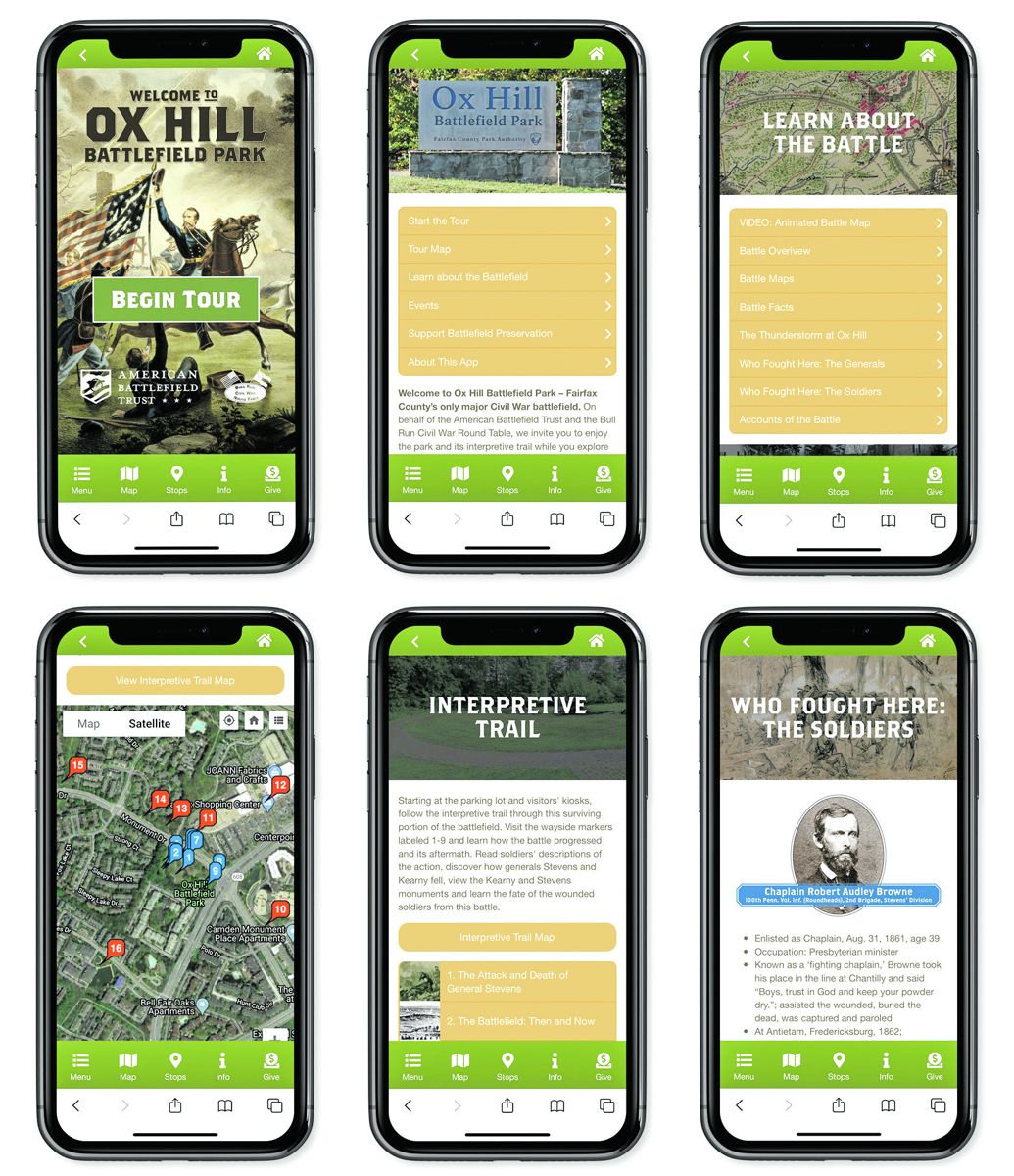
Explore Battle History and Preservation History with Ox Hill (Chantilly) Battlefield Tour Guide Any discussion of the modern battlefield preservation movement begins in the same place: Chantilly, Va. After watching development pressures spreading across Northern Virginia consume much of this battlefield, a group of historians formed the Association for the Preservation of Civil War Sites in 1987. The need for action was real, and that small group has now grown to become the American Battlefield Trust, the nation’s top historic land preservation organization, having protected 52,000 acres in 24 states, at sites associated with the Revolutionary War, the War of 1812, and the Civil War. The Trust also leads the way in bringing digital technology to historic interpretation, recently launching its 21st mobile app to help visitors explore Fairfax County’s Ox Hill Battlefield Park. The Ox Hill (Chantilly) Battlefield Tour Guide app helps users explore the fighting that took place on Sept. 1, 1862. More than just telling the story of that battle, the app shares the controversies involved in the loss of 99 percent of the battlefield to development and how preservationists rallied to secure, save, and commemorate the 4.9 acres that remained. “A digital product is the ideal way to tell the story of the Battle of Chantilly,” said Trust President Jim Lighthizer. “Technology lets you peel away the years and visualize what this landscape looked like when mighty armies clashed amid a late-summer thunderstorm.” This project was produced in partnership with the Bull Run Civil War Round Table (BRCWRT), one of the leading such organizations in the nation, and with the support of local historian and BRCWRT member Ed Wenzel, one of the initial activists who launched the modern battlefield preservation movement. Significant assistance was also provided by the Fairfax County Park Authority. The Ox Hill Battlefield Tour Guide app includes 16 stops along Ox Hill Battlefield Park’s existing trail, adding multimedia depth to the static interpretation. An interactive tour map allows users to seamlessly navigate between stops, and brings the user to nearby off-park battlefield locations that were lost to development. The Trust’s renowned battle maps, completely updated for this app, reflect the multiple phases of the fighting and immerse the user in the battle. Annotated period photographs of the Park and surrounding area add layers of knowledge.