
A Week in 1862 with Stuart’s Cavalry Covering Lee’s Flank
By Daniel Carroll Toomey · Originally published September 2020 · pp. 38–44
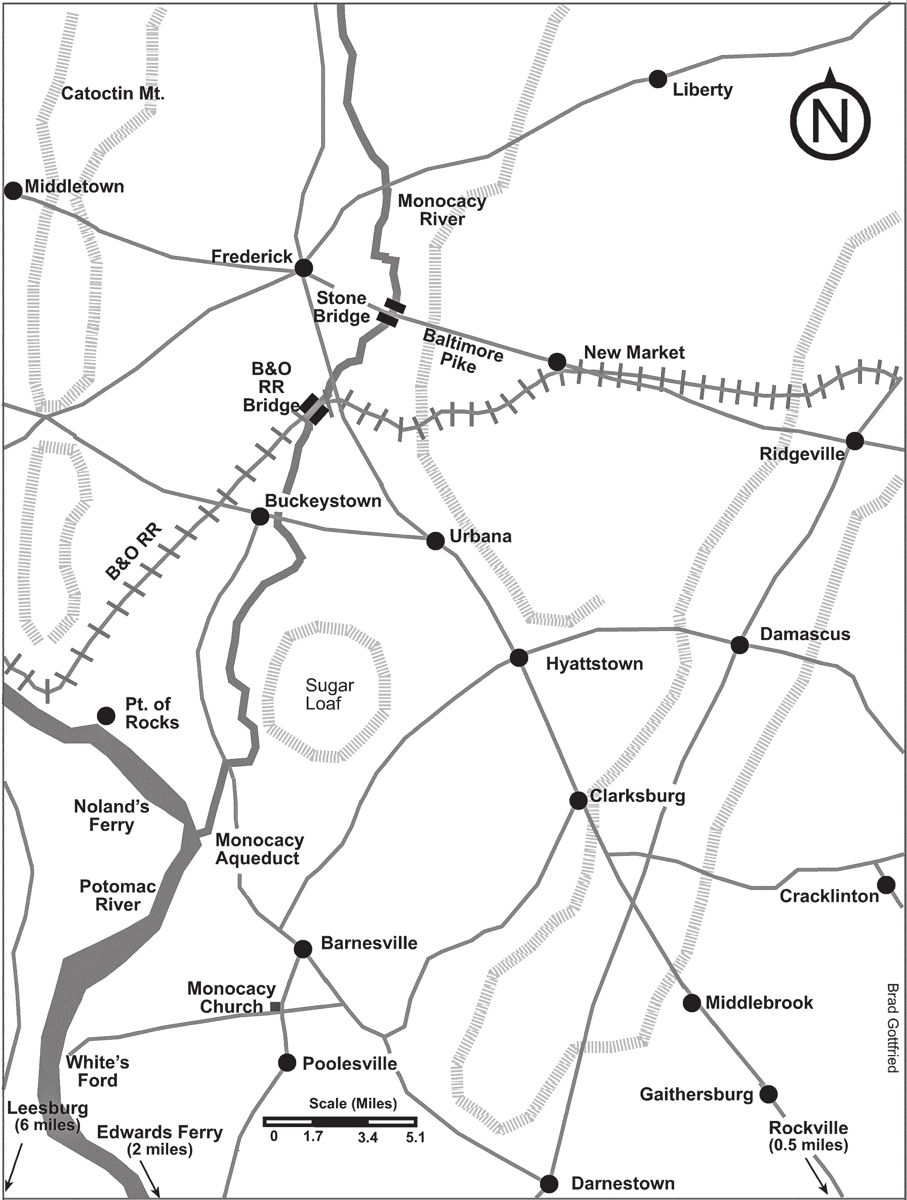
On Sept. 5, 1862, Lee’s Army of Northern Virginia began crossing the Potomac River at White’s Ford, Edward’s and Noland’s Ferries. Frederick native Colonel Bradley T. Johnson was given the honor of leading Jackson’s Corps into Maryland at White’s Ford as the bands played “Maryland My Maryland.” General J.E.B. Stuart’s assignment was to protect Lee’s right flank until his entire army had crossed the river. In order to cover all the roads leading to Frederick City from Baltimore and Washington he established a defensive arc from the mouth of the Monocacy River to New Market. Between Sept. 5 and 12, Union and Confederate cavalry were constantly engaged. The numerous skirmishes and small battles fought during that time represent a classic example of Confederate cavalry covering the Army of Northern Virginia’s flanks. While this type of operation undoubtedly occurred numerous times in Virginia, it only happened once in Maryland on this grand a scale. Stuart left Leesburg, Va., with two brigades, at 2 p.m. on Sept. 5. Hampton’s Brigade crossed at White’s Ford. Fitzhugh Lee’s Brigade crossed lower down the river at Edward’s Ferry. Colonel Thomas Munford covered the army’s rear with less than 300 hundred cavalrymen. Stuart ordered Fitz Lee to occupy Poolesville, Md., before making camp for the night.1 Stuart’s adversary was General Alfred Pleasonton, commander of the Cavalry Division of the Army of the Potomac and a native of Washington, D.C. Pleasonton sent out three regiments to reconnoiter between Seneca Creek and Poolesville.
At 4 p.m. 100 men from the First Massachusetts Cavalry passed through Poolesville under Captain Samuel E. Chamberlain. The town’s citizens showed their Southern leanings by erecting a barricade in the street after they left. The Yankees soon encountered the Fifth Virginia Cavalry and were driven back into the town where a collision with the newly erected impedimenta brought about a great number of unhorsed riders; in all 48 men and 40 horses were captured. Confederate losses were three killed and four wounded. That night both Lee’s and Hampton’s brigades made camp at Poolesville.2 The next day Fitz Lee’s Brigade moved to New Market on the National Road and sent patrols out as far east as Ridgeville. Hampton’s Brigade occupied Hyattstown with outposts at
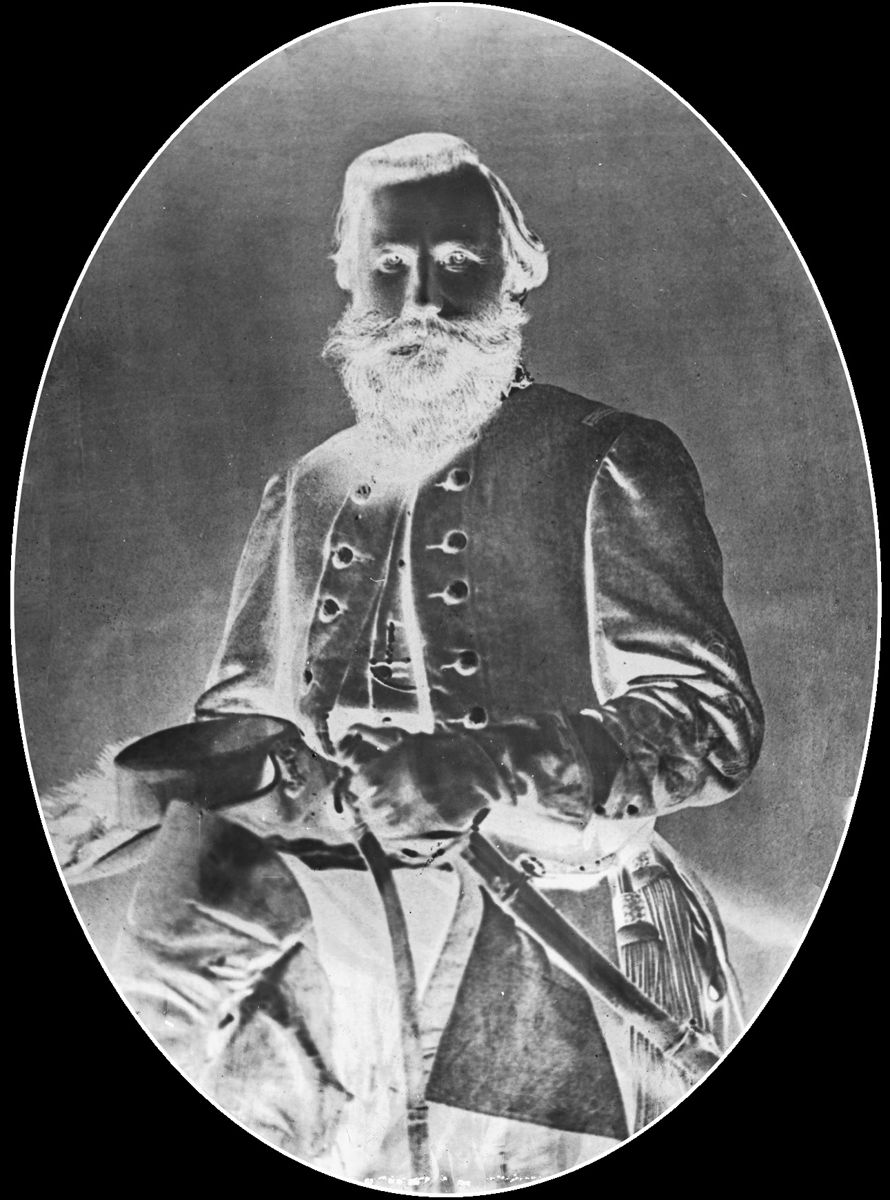
General J.E.B. Stuart. Library of Congress.
Stuart’s Cavalry map. Brad Gottfried.
Damascus and Clarksburg. Colonel Munford’s Brigade was now up and anchored the right of Stuart’s line at Sugar Loaf Mountain with pickets extending all the way to Poolesville.3 In Frederick City Surgeon Robert E. Weir commanded the Federal army hospital at the old Hessian Barracks. When he received word from Colonel Dixon Miles, the post commander at Harpers Ferry, that the Confederate Army was only a day’s march from Frederick, Surgeon Weir and Lieutenant G. Castle, with the help of Captain William T. Faithful and Company C, First Potomac Home Brigade worked together to prevent as many sick soldiers as possible from being captured. In Captain Faithful’s official report he stated that he secured all available horses and wagons in the city, loaded two wagons with the most valuable medical supplies, put 275 convalescent soldiers in the rest, and sent them off to Pennsylvania under the command of assistant surgeon C.P. Harrington. They then set fire to what could not be removed. Captain Faithful also managed to send an entire train load of military supplies to Baltimore before the Baltimore & Ohio Railroad line was cut. Just south of Frederick City, the B&O’s main line crossed the Monocacy River on an iron suspension bridge consisting of three spans each 115 feet long. On Sept. 8 the Confederates set about destroying the bridge. Earlier attempts had failed due to a lack of tools and explosives. This time gun power was poured into the cores of the iron castings. The resulting explosion knocked the three spans off their piers and into the water below. The bridge was not replaced until after the battle of Antietam.4 On the morning of Sept. 6, Fitzhugh Lee moved from Barnesville to New Market. He positioned his brigade to cover both the Baltimore Pike and the Baltimore & Ohio Railroad. His mission was to thwart any Union force moving west from Baltimore City and at the same time appear to be the army’s lead element advancing on Baltimore to disguise the direction Lee’s army was actually moving. He left behind a squadron of the Ninth Virginia under Captain Thomas C. Waller. When Union cavalry advancing toward Sugar Loaf Mountain overran Waller’s picket post and captured ten men, Waller quickly abandoned the town and retreated to New Market losing one man killed and six wounded in the process.5 Prior to this engagement Stuart led Hampton’s Brigade through Barnesville and skirted the base of Sugar Loaf Mountain. Before the Confederate invasion began Lieutenant Brinkerhoff N. Miner operated a signal station on the mountain’s summit. Part of a chain of posts that ran from Darnstown to Emmetsburg, it provided the Federal capitol with an early warning system. Chief Signal Officer of the U.S. Army, Major Albert J. Myer, stated, “The range of vision from this point is unequaled by that of any other in Maryland.” Given its name from its shape, the mountain rises 750 feet above the Monocacy Valley. Troop movements could be observed as far south as Leesburg, Va., as well as several crossings on the Potomac River. To both the east and the west it provided a sweeping view of the Maryland countryside. Lieutenant Miner had established the signal station there on Sept. 3 and it sent the first report of Confederate forces moving into Maryland. Fearing the approach of Confederate patrols, Miner abandoned the post the night of Sept. 5. The next day Captain Miner and his flagman, A.H. Cook, were in route to reopen the station when they happened upon two Rebel cavalrymen. One, a courier who unbeknown to them was carrying dispatches from President Jefferson Davis to General Robert E. Lee, was captured. His companion managed to escape and informed Stuart of the captured courier. A detachment of the First North Carolina took off in pursuit followed by Stuart with Hampton’s Brigade. The galloping Confederates overtook the two Yankees and their prisoner before they got far. Neither Union soldier had taken the time to search their prisoner so no vital information was lost. With the two Yankees, Stuart also captured a complete set of signaling equipment that he used to open his own signal station on Sugar Loaf Mountain.6 He also presumably captured the Federal signal codes. After recapturing the courier, Stuart, with Hampton’s Brigade, proceeded to Urbana. Meanwhile in Frederick City, a member of Elijah V. White’s 35th Battalion of Virginia Cavalry rode up to the hospital at the Hessian Barracks and informed Surgeon Weir that he was a prisoner of war. Colonel Miles’ prediction was right on the money. At the same time the Union cavalry continued to search for Lee’s army. Elements of the Third Indiana, First New York, and First U.S. Regiments nosed their way towards Hyattstown while the Eighth Illinois moved toward Poolesville. Two companies of the First New York skirmished with the Ninth Virginia at
Sugar Loaf Mountain and were forced to return to Clarksburg. Hampton’s Brigade spread out around Urbana and Stuart made his headquarters there at the home of Mr. Cockey.7 On Sept. 6, Munford’s Brigade, the Second, Seventh, Twelfth Virginia, and Chew’s Battery of horse artillery, crossed the Potomac at White’s Ford. While Munford crossed and deployed, the newly reconstituted Army of the Potomac began moving west from Washington. General McClellan established his headquarters at Rockville where he was joined by the VI Corps.8 On Sept. 7 a detachment of Union cavalry charged into Poolesville and captured two Rebel videttes stationed there. Early the next morning, Munford’s Brigade was sent to Poolesville to chase off Union cavalry threatening to discover the Confederate infantry camped west of the Monocacy River. In effect, General Pleasanton was running a mirror image of Stuart’s operation, attempting to find the enemy and provide a protective screen for the slowly advancing Army of the Potomac. When Colonel John F. Farnsworth, commander of the Second Brigade of cavalry led the Eighth Illinois and Third Indiana into Poolesville supported by two guns of the Second U.S. Artillery, Munford opened fire with two guns from Chew’s Battery, a Blakely, probably a 3.5-inch rifle, and a 12-pounder howitzer. The Union cavalry was forced to fall back until their own guns could go into action. Chew nearly lost both his pieces when the Union cavalry came on again at full gallop. Two rounds of canister and a counter charge by the Seventh Virginia saved the howitzer, while the Twelfth Virginia lost eight men defending the Blakely rifle. By the end of the day Poolesville was in Federal hands. Farnsworth lost one man killed and twelve wounded; the Confederate losses were five killed, nine wounded, and six captured.9 When Stuart took up residence in Urbana he discovered a two story building that had previously been used as a female academy. He deemed it an excellent place for a ball and ordered the necessary arrangements made for September 8. Major Heros von Borcke of Stuart’s staff was master of ceremonies. He proclaimed Miss Anne Cockey, AKA the New York Yankee, the queen of the ball. Just as things were going in great style, Major Alonzo Adams led five companies of the First New York Regiment against Hyattstown, an outpost four miles away. A quick-thinking line officer sent a courier to warn Stuart just before his position was overrun. Directed to the academy, the dust covered trooper’s announcement that a battle was in progress was authenticated by distant gun fire. Officers quickly bid adieu to the ladies as they buckled on sabers and rode out of sight. Stuart pushed the impertinent Yankees out of Hyattstown with Hampton’s Brigade and Pelham’s horse artillery. Once the situation was stabilized, he turned the operation over to his subordinates and returned to Urbana where the ball was resumed around midnight.10 Pressure began to mount as the Army of the Potomac crept closer to Frederick City. Union cavalry occupied Damascus and Lisbon with an eye to advancing on New Market. Farnsworth, with the Eighth Illinois and Third Indiana supported by the Fourth Maine Artillery, advanced from Poolesville and pushed the Rebels out of Monocacy Church and Barnesville on Sept. 9. When Farnsworth’s regiment attacked two companies of the Twelfth Virginia on picket at Monocacy Church, several of the Rebel’s horses were killed and others stumbled over them throwing their riders. The Virginias lost one man killed and eight captured along with their battle flag. The Eighth Illinois pursued the Twelfth Virginia to Barnesville where the Virginians were driven further west with the loss of one killed, eight captured, and several wounded. On a different road to the north, another detachment of the Eighth Illinois under Captain George M. Kelly engaged a separate group of Rebels and drove them through Barnesville and two miles beyond. The Confederates lost five men wounded and fifteen captured.11 The same day, a squadron of the First New York Cavalry led by Major A.W. Adams charged into Hyattstown and drove out a detachment of Wade Hampton’s Brigade. Hampton’s men returned the next day with artillery support to reclaim the town but were driven off by the New Yorkers reinforced by the First U.S. Cavalry under Captain Marcus A. Reno.12 On Sept. 10, Captain William P. Sanders, Sixth U.S. Cavalry, supported by two guns from the horse artillery, attempted to reoccupy Sugar loaf Mountain and capture the Confederate signal station operating on its summit. Their advance struck an advanced position commanded by Captain Waller of the Ninth Virginia Cavalry and captured a ten man picket post. The Virginians fell back to the base of the mountain.13 General Fitzhugh Lee and the balance of the Ninth Virginia joined Captain Waller’s men and succeeded in turning back the Yankees. Captain Sanders then dismounted his troopers and renewed the battle on foot. Only one squadron of the Ninth Virginia was armed with carbines while the entire Union force was equipped with both carbines and side arms. Lee ordered the men with carbines to take positions on the wooded slope of the mountain while the remainder remained mounted and covered their flanks. Firing from behind rocks and trees, the Southerners were able to hold on until darkness put an end to the fighting. That night Lee led the Ninth Virginia west towards Frederick.14 The morning of Sept. 10, Captain William P. Sanders attempted to drive Colonel Munford off Sugar Loaf Mountain but was repulsed with one man killed and four wounded. The next day Colonel Farnsworth led his brigade against Munford supported by Winfield Scott Hancock’s Brigade of infantry. This was the largest force thrown against Stuart’s line to date. McClellan’s advance was closing in on Lee’s army. The I Corps was at Triadelphia. The II and XII Corps were far as Clarksburg. To defend his position Munford had only two depleted regiments, the Second and Twelfth Virginia and four guns from Chew’s battery, in all about 500 men. After skirmishing for several hours, Munford was forced to let the Yankees have their signal station back and withdrew to Urbana.15 The same morning, Daniel Harvey Hill’s Division left Monocacy Junction and marched through Frederick City following the rest of Lee’s army, who had departed the day before. By noon only Confederate cavalry remained south and east of the city. As the bulk of Stuart’s command shifted north and west, Hampton’s Brigade headed for Frederick City and Munford took up outpost duties at Hyattstown. At 1:30 p.m. Major Adams with the First New York Cavalry and a squadron of regulars from the First US Cavalry commanded by Captain Marcus A. Reno charged into Hyattstown but were repulsed by Lieutenant Dan Shunk’s section of horse artillery and Munford’s undersized brigade. When the Union cavalry withdrew to Clarksburg, Munford fell back to the Monocacy where the wooden bridge for wagon and pedestrian traffic was still standing. Chew’s Battery covered the bridge supported by the cavalry on either side of the road. Munford remained there until ordered to take up a new position in the village of Jefferson in the nearby Catoctin Mountains on Sept. 12.16 Union infantry would soon be on the field in great numbers. The Kanawha Division formed the van of the IX Corps. It marched through Damascus and camped at Ridgeville. The rest of the corps could be found between there and Hyattstown. The II Corps was at Clarksburg; the Twelfth had stopped at Damascus. Fitzhugh Lee was forced to give up New Market on Sept. 11. As the day came to a close, Captain James Abraham’s Independent Company of West Virginia Cavalry entered the east side of New Market as the last Confederate videttes exited the western side. When Fitzhugh Lee abandoned New Market, he retreated to Liberty and crossed the Monocacy River north of Frederick the next morning only to have Stuart order him back over the river to scout the Union Army’s right flank. He led his brigade as far north as Westminster where he charged into the town and captured the Provost Marshal. After damaging a bridge on the Western Maryland Railroad and throwing a first class scare into the mostly pro-Union residents, Lee retired across the Monocacy. His actions forced General Pleasanton to send one brigade as far north as Gettysburg to make sure the Confederates were not trying to make an end run around the Union right flank.17 The last action before the Confederates evacuated Frederick City occurred on Sept. 12. Wade Hampton formed the rear guard of the Cavalry Division and the Army of Northern Virginia. He wisely gave up New Market to the advancing IX Corps and fell back to the Monocacy. Here he made a stand with two guns covering the bridge with cavalry on both sides of the road. At this time Hampton had two squadrons south of the city guarding the pedestrian bridge where Munford’s Brigade was now in danger of being cut off. To help slow down the Union advance, he added one rifled gun supported by a squadron from the Second South Carolina to the force at the stone bridge. Kegs of power were placed on the bridge in hopes of blowing it up. When Captain Abraham’s Company of West Virginia cavalry approached the bridge, the Confederate pickets retreated to the west side and set off the powder which made a great deal of smoke and noise but failed to damage the bridge. Two companies of Union cavalry then charged the bridge but were forced back by the Rebel artillery. At this point Simmonds’
Kentucky Battery arrived with two 20-pounder Parrott rifles and a 12-pounder Napoleon smoothbore. Lieutenant Abraham led his cavalry downstream and crossed so he could outflank the Confederate artillery. At the same time the two 20-pounders opened fire. With one gun out of action the Confederates retreated into the city. By 2 p.m. Cox’s Division was on the scene.18 A squadron of the Second South Carolina under Lieut. John Meighan skirmished with the advancing infantry losing two men before being ordered to fall back. Hampton withdrew his artillery and posted it to cover the road from Frederick to the Catoctin Mountains. Colonel August Moor’s Brigade, crossed the bridge and followed the Rebels into the city with a detachment from the Chicago Dragoons and one gun. Hampton ordered Meighan’s Squadron to charge the Yankees and sent them flying down East Patrick Street. Colonel Moor and seven men were captured. In attempting to escape, one trooper ran over an artilleryman who failed to release the lanyard and fired a round of canister at point blank range into his own men. Eight Yankee cavalrymen hit the ground in a heap. The gunners limbered up to avoid being captured only to overturn their gun. Unable to bring off the cannon, Stuart’s men shot the horses and retreated back into Frederick. On the Union left, Farnsworth led his brigade supported by two batteries of horse artillery from Sugar Loaf Mountain toward Frederick City via Urbana. As Hampton and the last remnants of the Confederate Army exited Frederick, Colonel Augustus H. Coleman led his Eleventh Ohio Infantry into the city. The Rebels were gone, but they would be back in 1864.19 1.
Endnotes:
D. Scott Hartwig, To Antietam Creek: The Maryland Campaign of September 1862, (Baltimore: 2012), p. 104 R.L.T. Beal, History of the Ninth Virginia Cavalry, (Richmond: 1899), p. 37; Ezra J. Warner, Generals in Blue, (Baton Rouge: 1972), p. 373. OR’s, Vol. 19, Part 1, pp. 814815; Ezra Carman, The Maryland Campaign of September 1862, Edited by Thomas G. Clemens, (New York), Vol. 1, p. 92. Paul & Rita Gordon, A Playground of the Civil War: Frederick Country, Maryland, (Frederick, MD: 1994), pp. 4548: OR’s, Vol. 19, Part 2, p. 568; Carmen, p. 132; Daniel Carroll Toomey, The War Came By Train: The Baltimore and Ohio
Railroad During the Civil War, ( Baltimore: 2013), p. 123. 5. OR’s, Vol. 19, Part 1, p. 815. 6. OR’s, pp. 117-118; J. Willard Brown, The Signal Corps, USA in the War of the Rebellion, (Boston: 1896), Butternut and Blue reprint, 1996, pp. 241, 242, 325; Carman, pp. 176-177. 7. OR’s, Vol. 19, Part 1, pp. 208209; Vol. 51, Part 1, pp. 136137; Carman, p. 165. 8. Carman, p. 169. 9. Abner Howard, M.D., History of the Eighth Cavalry Regiment Illinois Volunteers…, Morningside Bookshop reprint (Dayton: 1984), pp. 171-172; OR’s, Vol. 19, Part 1, pp. 208, 825. 10. Beal, p. 37; Hartwig, p. 174175; James A. Davis, “JEB Stuart’s Sabers & Roses Ball,” Catoctin History #10, p. 24. 11. OR’s, Vol. 19, Part 1, pp. 208209; Daniel Carroll Toomey, The Civil War in Maryland, (Baltimore: 1983), p. 49; Howard, p. 172 12. Carman, pp. 167-168. 13. OR’s, Vol. 19, Part 1, p. 209; Carman, pp. 176-177. 14. Beal, pp. 37-38, Carman, p. 176 15. Carman, pp. 177, 179; Harsh, p. 188; OR’s, Vol. I, p. 815. 16. Carman, 179; Harsh, p. 206. 17. Carman, pp. 187-188; OR’s, Vol. 19, pp. 815-816; Harsh, pp. 188, 205. 18. Carman, p. 186; OR’s, Vol. 19, Part 1, pp. 822-823. 19. Bradley T. Johnson, “address on the First Maryland Campaign” Southern Historical Society Papers, (Kraus Reprint Co.: 1977), Vol. 12, pp. 516-517; Carman, p. 187; OR’s, Vol. 19, Part 1, pp. 822-823. Daniel Carroll Toomey, is a University of Maryland graduate. Mr. Toomey has authored several books on the Civil War including, The Civil War in Maryland, Marylanders at Gettysburg, and The Maryland Line Confederate Soldiers’ Home. He is also co-author of Baltimore During the Civil War, and Marylanders in Blue, all of which were published by Toomey Press. He has lectured for a number of historical organizations, as well as for the National Park Service and the Smithsonian Institution. He has also contributed to radio and television programs, and on two Civil War battle videos. Mr. Toomey is a member of the Surratt Society, the Maryland Arms Collectors Association and the Company of Military Historians, and was project historian for the Maryland Memorial erected at Gettysburg in 1994 and wrote the inscription for that monument.